No products in the cart.


Can a peptide help researchers study how the brain protects itself, adapts under stress, and recovers after injury without acting like a classic stimulant or hormone?
That question sits at the center of interest in the semax peptide. Semax stands out because it isn’t just another research compound with a thin evidence trail. It has unusual historical depth, a defined peptide structure, and a body of mechanistic work that makes it relevant to modern neuroprotection and cognition research.
For US-based researchers, Semax raises a practical challenge. The best-known clinical history comes from Russia, while most US demand centers on research procurement, formulation quality, and experimental reproducibility. That gap creates confusion. People often know Semax is “promising,” but they don’t always know what it is, why its structure matters, or how to evaluate material quality before building a study around it.
This article takes a research-first view. It explains what Semax is, why its Russian clinical history matters, how its neuroprotective mechanisms are being mapped at the molecular level, and what to look for when sourcing research-grade material. The aim isn’t to make treatment claims. It’s to give you a clean, evidence-based framework for understanding Semax as a laboratory and preclinical research tool.
The brain doesn’t recover through one switch. It repairs, adapts, and reorganizes through overlapping systems that involve trophic signaling, inflammatory control, oxidative balance, and synaptic remodeling. That complexity is exactly why researchers pay attention to compounds that appear to influence multiple pathways at once.
Semax peptide is one of those compounds. It has a long research history, a specific engineered structure, and a reputation for acting more like a signaling coordinator than a single-receptor hammer. If you think of many CNS compounds as one-key tools, Semax looks more like a control panel that adjusts several settings together.
That matters in preclinical work. Models of stroke, neurodegeneration, and cognitive impairment rarely fail because only one pathway is involved. They fail because injury cascades spread across immune signaling, cell survival, oxidative damage, and plasticity. A peptide that can be studied across all those domains is scientifically useful even before anyone agrees on every mechanism.
Practical rule: With Semax, the first question shouldn’t be “What effect should I expect?” It should be “Which biological system am I trying to interrogate?”
US-based researchers also face a second problem. Semax has richer historical context than many peptides, but material quality still determines whether a study is interpretable. Poor identity confirmation, weak purity control, or unstable formulation can blur any signal you’re trying to measure.
So the right way to approach Semax is disciplined and boring in the best scientific sense. Start with the molecule. Then move to mechanism. Then ask whether the lot in your freezer is good enough to deserve a place in your protocol.
Semax is a synthetic heptapeptide with the sequence Met-Glu-His-Phe-Pro-Gly-Pro. It was designed as an analog derived from an ACTH fragment, but engineered to retain neurological interest while eliminating the steroidogenic activity associated with the parent hormone. That design choice is one reason Semax has remained scientifically interesting. It separates peptide signaling effects from classical adrenal hormone effects.
Semax isn’t notable only because of its chemistry. It was approved as a prescription medication in Russia during the 1990s for stroke recovery and cognitive disorders, and that three-decade track record gives researchers a longer practical history than most synthetic peptides can offer, as summarized in the Semax peptide profile at Peptpedia.
That history matters because many research peptides enter discussion with little beyond in vitro enthusiasm. Semax arrived through a different path. It gained attention in a healthcare system where it was used, observed, and revisited over time.
For graduate students, this is the simplest way to frame it: Semax sits in the middle ground between a classic pharmaceutical and a modern research peptide. It isn’t a blank slate. It also isn’t fully integrated into US clinical frameworks. That tension is why so many researchers want a clearer, translation-focused explanation.
If you’re comparing the wider field of cognitive support compounds and trying to sharpen focus with brain supplements, Semax is useful as a contrast case. Most supplements are discussed in terms of ingredients and general effects. Semax is discussed in terms of peptide engineering, neurobiology, and research design.
The molecule’s small size is part of its appeal. Verified references describe it as a 7-amino acid synthetic analog with a molecular weight of 813.93 Da, built to preserve cognitive relevance while avoiding the steroid-producing activity of its precursor.
That may sound abstract, but here’s the practical takeaway. Structure determines behavior. The sequence isn’t just a label on a vial. It affects how the peptide resists enzymatic breakdown, how it interacts with targets, and how reliably researchers can test it across models.
A short comparison helps:
| Feature | Why researchers care |
|---|---|
| Synthetic heptapeptide design | Easier to define chemically than a complex biologic mixture |
| Derived from ACTH fragment logic | Suggests a rational design lineage rather than random screening |
| No steroidogenic activity | Reduces confusion with adrenal hormone-driven effects |
| Clinical history in Russia | Adds real-world context that many newer peptides lack |
Semax matters less as a buzzword and more as a well-defined peptide scaffold with an unusually long record of scientific attention.
When researchers discuss Semax, the most useful mental model is not “one peptide, one target.” A better model is one peptide, several coordinated adjustments. Semax appears to influence signaling networks tied to survival, repair, and adaptation.
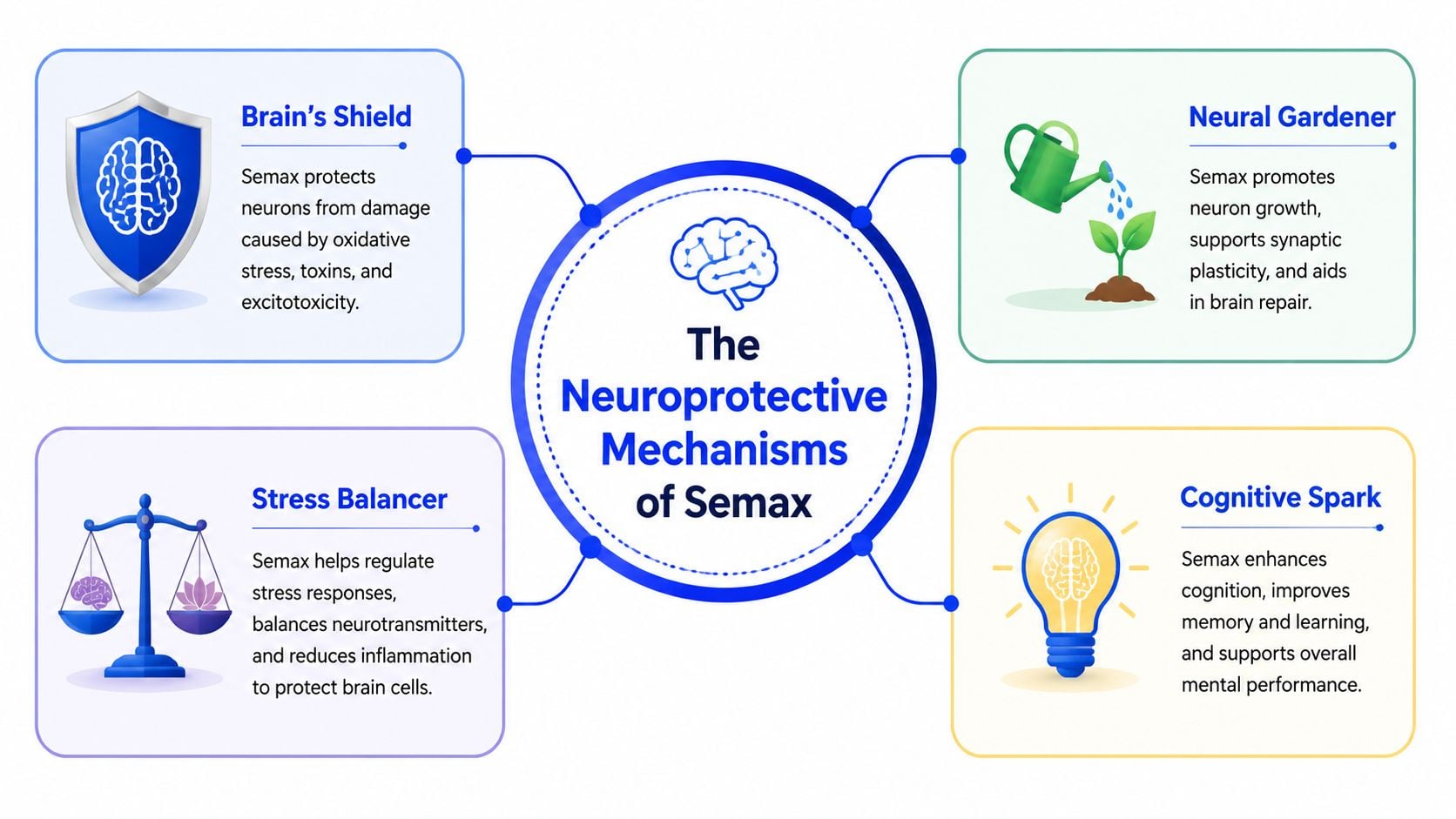
One validated thread in the literature is its relationship to BDNF and TrkB-associated signaling. In practical terms, BDNF acts like a growth-support and maintenance signal for neurons. If neurons are the hardware, BDNF helps preserve the wiring, support repair, and improve the conditions for plasticity.
That doesn’t mean Semax “raises BDNF and solves everything.” Biology is messier than that. What makes the compound interesting is that BDNF-related activity seems to sit alongside broader effects on gene expression and protein networks tied to immune signaling and recovery.
The analogy I use with students is this: Semax looks less like a replacement part and more like a lab supervisor adjusting multiple stations at once. It doesn’t build the neuron directly. It changes the instructions, priorities, and local environment that shape what cells do next.
Mechanistic confidence improves when separate experimental layers start pointing in the same direction. In animal models of Alzheimer’s disease, Semax reduced amyloid plaque burden by 2.8-fold in cortical regions compared with untreated controls, and genome-wide analysis showed it dynamically altered expression of genes involved in immune response and post-ischemic recovery.
Those two findings belong together. The plaque result gives you a visible disease-relevant endpoint. The gene-expression result suggests the peptide isn’t acting as a narrow blocker. It’s reshaping a broader biological response.
Researchers should care about that for three reasons:
Research takeaway: Semax is most interesting when your hypothesis involves systems biology, not just acute symptom analogs.
There’s also a conceptual caution here. Multi-pathway compounds are powerful research tools, but they can be harder to interpret if your protocol is sloppy. If the design doesn’t separate timing, tissue selection, and endpoint hierarchy, a “network effect” can quickly become a vague story instead of a testable result.
The easiest way to understand Semax’s research value is to follow the problems scientists keep throwing at it. Each model asks a different question. Can it help after ischemic injury? Can it alter toxic protein behavior? Can it support functions linked to learning, resilience, or recovery?

Semax has long attracted attention in ischemia research. That’s partly due to its Russian clinical history, but the preclinical logic is just as important. Stroke models let researchers measure structural injury, neurological outcomes, inflammatory signaling, and recovery dynamics within the same framework.
In that setting, Semax is attractive because it doesn’t fit neatly into a single category like “anti-inflammatory” or “growth factor mimetic.” It appears to intersect with both injury limitation and recovery support. For a lab studying ischemia, that makes it useful as either a primary intervention candidate or a comparative signaling tool.
A simple way to think about this is that stroke research needs compounds that can operate in the chaos after injury. Semax is often discussed because that post-injury period isn’t one problem. It’s a stack of problems happening at once.
Semax also appears in neurodegeneration research because some data move beyond general neuroprotection and into molecular interaction with disease-relevant protein systems. In Alzheimer’s-related models, it has been shown to interfere with toxic Aβ:Cu complex formation, reducing fibril mass by up to 25% and cutting membrane leakage by 48%.
That matters because it gives researchers more than a vague “brain support” narrative. It points to a measurable effect on aggregation-related pathology. If amyloid toxicity is partly driven by metal-associated conformational behavior, then a peptide that interferes with that process becomes relevant at the mechanistic level, not just the behavioral one.
Outside classic disease models, Semax gets discussed in experiments related to attention, memory, adaptation, and stress resilience. Here, the attraction is its broad neurobiological profile. Researchers interested in synaptic plasticity, cognitive flexibility, or stress-linked performance often look for compounds that don’t behave like standard stimulant templates.
That doesn’t make Semax simple. It makes study design more demanding.
Consider the kinds of questions researchers may ask:
A promising peptide becomes a useful peptide only when the model asks a question the peptide is structurally and biologically suited to answer.
A surprising amount of peptide research fails before the experiment starts. The protocol can look polished, the endpoints can be advanced, and the analysis plan can be rigorous. If the material itself is inconsistent, degraded, or poorly documented, none of that rescues the study.
Verified production data matter here. Research-grade Semax is produced via solid-phase peptide synthesis, and this process can yield greater than 98% purity after HPLC purification. Its C-terminal Pro-Gly-Pro motif contributes exceptional proteolytic stability, which is one reason the molecule is valued for consistent activity in experimental settings, according to this overview of Semax synthesis and stability considerations.
That isn’t just manufacturing trivia. Purity changes interpretation. If a peptide lot contains unwanted fragments, salts, or degradation products, researchers can’t be sure which component influenced the result. A clean behavioral effect built on a dirty sample isn’t sound science.
The Pro-Gly-Pro tail is especially important because it helps explain why Semax attracts attention as a practical research tool. A more stable peptide is easier to work with, easier to formulate, and less likely to produce artifacts caused by rapid degradation before the compound even reaches the tissue of interest.
When sourcing Semax for lab use, treat procurement as part of the experiment. You aren’t buying convenience. You’re buying confidence in identity and batch consistency.
Here’s a practical checklist:
A short decision table helps clarify what matters:
| Verification point | Why it matters |
|---|---|
| COA | Confirms the lot has been documented and tested |
| HPLC chromatogram | Shows whether the claimed purity is credible |
| MS data | Supports correct peptide identity |
| Microbial report | Reduces contamination-related confounding |
| Endotoxin report | Important in inflammation-sensitive assays |
Poor peptide quality doesn’t just weaken results. It can push a lab toward false mechanistic conclusions.
For Semax, quality control is tied directly to the science. If you’re studying subtle effects on plasticity, inflammation, or protein aggregation, material inconsistency can easily mask the signal you’re trying to detect.
Good Semax experiments are built around handling discipline and timing logic. The peptide may be interesting biologically, but at the bench level it still behaves like a material that can be mishandled, mismeasured, or poorly scheduled.
Start with the basics. Keep lyophilized peptide protected from heat, moisture, and light. Reconstitute using a sterile workflow, label the vial clearly, and avoid repeated casual handling that increases contamination risk or measurement error.
Many mistakes in peptide work are boring mistakes. Wrong solvent assumptions, unclear labeling, repeated warm-up cycles, and inconsistent pipetting create noise that later gets mistaken for biology.
A simple lab habit helps more than people expect:
Timing matters with Semax because its kinetics are fast enough to shape the design of behavioral and neurobiology experiments. Verified data indicate that Semax has a plasma half-life of approximately 1 to 2 hours and achieves rapid CNS penetration in under 10 minutes via intranasal delivery. For assay planning, that means your endpoint windows need to match the compound’s timing rather than your convenience schedule.
Many early designs go wrong. A researcher administers a peptide with rapid CNS access, then measures too late, too infrequently, or with no rationale for the collection window. The result isn’t necessarily a failed peptide. It may be a failed clock.
Practical questions to answer before starting:
If Semax reaches the CNS quickly, your experiment should move quickly too.
Use a pilot phase if needed. With a peptide that acts on coordinated signaling systems, small improvements in timing can make a major difference in interpretability.
Semax is the core peptide discussed throughout this article. N-Acetyl Semax Amidate is a modified variant that researchers often describe as having greater resistance to enzymatic breakdown. In plain terms, it’s a related molecule designed to stay active longer. If you’re comparing them in research, treat them as distinct test articles, not interchangeable labels.
Not in the classic sense. Researchers usually discuss Semax in terms of neurotrophic signaling, neuroprotection, and cognitive support rather than the direct push-pull profile associated with conventional stimulants. That said, it would be too simplistic to call it “just calming” or “just activating.” Its profile is better understood as neuromodulatory.
In the US, Semax isn’t generally positioned as an approved mainstream drug product. That’s why suppliers typically sell it for research, laboratory, or analytical use only. For researchers, the practical implication is straightforward: documentation, labeling, and sourcing standards matter a great deal.
Because Semax studies often examine subtle CNS endpoints. If the peptide is impure, degraded, or inconsistently formulated, it’s easy to confuse batch noise with biology. With neuroplasticity, inflammation, and aggregation-related assays, clean input material is part of the experimental design.
Its combination of rational design, long-standing Russian clinical history, and modern mechanistic research makes it unusual. Many peptides have one of those. Semax has all three, which is why it keeps showing up in conversations about translational neuropeptide research.
The semax peptide matters because it combines a defined engineered structure, long Russian clinical history, and mechanistic relevance across neuroprotection, plasticity, and recovery research. For US-based labs, the biggest lesson is practical. Strong science with Semax starts with verified quality, careful timing, and a protocol built around the biology.
Researchers who need transparent, US-made peptide sourcing can explore Peptide Warehouse USA for research-use-only compounds backed by batch documentation, COAs, and lab-focused support. Learn more and explore options for high-purity peptides that fit analytical and preclinical workflows.