No products in the cart.



One result has reset expectations in obesity pharmacology: peptide-based incretin drugs can now produce weight loss once associated mainly with bariatric procedures. That shift explains why interest in the best peptides for weight loss has expanded so quickly, but it also explains why the category is often described imprecisely.
The central problem is classification. FDA-approved peptide or peptide-related drugs such as semaglutide and tirzepatide belong to a very different evidence tier than research-use-only compounds sold for laboratory investigation. The first group has human dose-finding, phase 3 efficacy data, safety monitoring, manufacturing controls, and formal regulatory review. The second may have receptor-level rationale, animal data, or early exploratory findings, but it does not carry the same clinical meaning and should not be discussed as though it does.
That distinction matters because peptides are a biochemical class, not a guarantee of therapeutic validity. A peptide may function as a validated medicine, a useful experimental tool for probing appetite or energy balance, or an inadequately characterized product with uncertain identity and purity.
A sound way to evaluate this field is to start with mechanism, then ask what level of evidence supports that mechanism, then examine how the material is sourced and characterized. For readers who want a broader primer on peptides as amino acid chains for cellular health, that background is useful before narrowing the discussion to weight-focused compounds.
The phrase best peptides for weight loss often hides a category error. Some peptides have large, randomized clinical datasets and FDA approval. Others are research chemicals studied for pathway discovery, not patient care. If you collapse those into one list, you lose the most important distinction in the field.
That distinction matters because weight regulation isn’t one process. It involves appetite signaling, gastric emptying, hedonic feeding, insulin sensitivity, substrate partitioning, mitochondrial function, and in some contexts growth hormone signaling. Different peptides touch different nodes in that network.
The useful question isn’t “Which peptide is strongest?” It’s “Strongest for what mechanism, in what evidence tier, and under what regulatory status?”
For graduate-level analysis, three categories deserve separate treatment:
A second point is less obvious, but more important. The highest-performing clinical agents have shifted the standard by which every other peptide should be judged. That means many older “fat-loss peptide” claims now look mechanistically interesting but translationally weak. A compound can still be valuable in a lab if it isolates a pathway cleanly, even if it’s nowhere near the clinical benchmark for total body weight reduction.
Peptides act like short biochemical instructions. They don’t “burn fat” in a generic sense. They bind receptors, alter signaling cascades, and shift how tissues regulate hunger, insulin response, gastric motility, substrate use, and sometimes growth-related pathways.
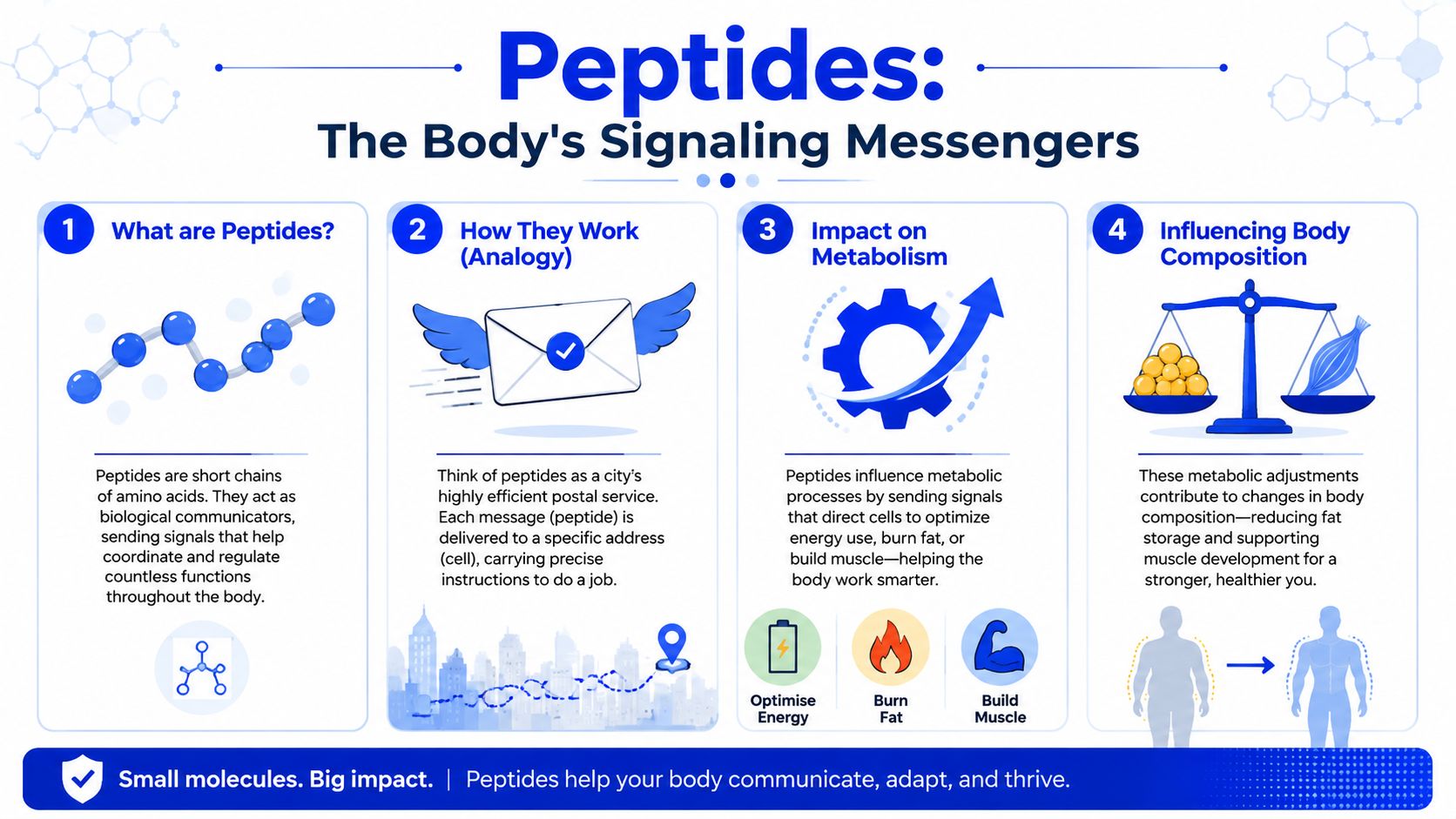
A useful analogy is a postal system. Each peptide carries a message, but only cells with the correct receptor “address” receive it. That’s why two peptides can both be discussed in weight management research while producing very different physiological effects.
GLP-1 receptor agonists influence satiety and caloric intake. In the semaglutide data summarized by Medical News Today, the mechanism includes prolonged satiety, reduced caloric intake, and slowed gastric emptying. The same source describes semaglutide as producing dose-dependent weight loss through GLP-1 receptor activity on pancreatic beta cells and hypothalamic neurons.
Other peptide classes work through very different logic:
That’s why “metabolism booster” language is often too blunt for serious analysis. Mechanism matters. If you want a consumer-facing comparison of broader support strategies beyond peptides, this roundup of top metabolism boosters for 2026 is useful context, but receptor-level specificity is what determines research value.
| Peptide Class | Example(s) | Primary Mechanism | Evidence Level |
|---|---|---|---|
| GLP-1 receptor agonist | Semaglutide | Satiety signaling, reduced energy intake, slower gastric emptying | Clinical |
| Dual GLP-1 and GIP agonist | Tirzepatide | Combined incretin signaling affecting satiety and insulin sensitivity | Clinical |
| GLP-1 and glucagon dual agonist | Survodutide | Appetite effects plus increased energy expenditure pathway interest | Emerging clinical |
| Growth hormone secretagogue related peptides | CJC-1295, Ipamorelin | GH and IGF-1 axis modulation | Preclinical or limited human research |
| HGH fragment related peptide | AOD-9604 | Lipolysis-focused research pathway | Preclinical or limited human research |
| Mitochondrial peptide | MOTS-c | Insulin sensitivity and metabolic flexibility research | Preclinical or emerging |
Practical rule: Don’t compare peptides by marketing category. Compare them by receptor target, downstream biology, and the level of evidence supporting the claim.
In the modern obesity-drug literature, mean weight reduction approaching 15% with semaglutide and exceeding 20% with tirzepatide changed the benchmark for what peptide-based pharmacology can achieve in humans. That matters because this section is about a category with randomized clinical trial data, regulatory review, standardized manufacturing controls, and defined prescribing frameworks. That is a very different evidentiary position from research-use-only peptides discussed elsewhere in this article.

Semaglutide became the reference point because it showed, in large human trials, that a peptide acting through the GLP-1 receptor could drive clinically meaningful and sustained weight loss rather than producing only modest short-term changes. In the STEP 1 study summarized by Medical News Today, adults receiving once-weekly semaglutide achieved 14.9% mean weight loss over 68 weeks versus 2.4% with placebo. The same summary reports that 86.4% of participants lost at least 5% of body weight and 50.5% lost at least 15%.
The mechanism is well characterized. Semaglutide is a GLP-1 receptor agonist that lowers energy intake through central satiety signaling and slows gastric emptying, while also improving glycemic control in appropriate metabolic contexts. Those effects are specific and testable. They should not be confused with broad consumer language about “boosting metabolism,” which obscures the actual receptor pharmacology.
Its benchmark status rests on three points.
That last distinction is often blurred in online peptide discussions. It should not be. Approved pharmaceutical peptides can serve as clinical comparators because their effects, adverse-event patterns, and dose-response relationships have been characterized in humans. Research-use-only compounds are hypothesis-generating tools unless and until comparable human data exist.
Tirzepatide changed the discussion because it combines GLP-1 receptor agonism with GIP receptor agonism. That dual-incretin design appears to improve weight-loss efficacy beyond what had been established with single-pathway GLP-1 agonism alone.
The practical conclusion is straightforward. Tirzepatide currently defines the upper end of clinically validated peptide-based weight-loss efficacy among approved or late-stage incretin therapies. For readers comparing the two in plain language, this review of the efficacy of tirzepatide versus semaglutide summarizes the outcome differences in accessible terms.
Mechanistically, the interesting point is not that tirzepatide produces larger average reductions in body weight. The more informative observation is that dual agonism may coordinate appetite regulation, gastric motility, insulin dynamics, and food-reward signaling more effectively than GLP-1 receptor activation alone. That does not mean every patient will respond better to tirzepatide, and it does not erase tolerability constraints. It does explain why tirzepatide is treated as a higher benchmark in current comparative discussions.
A second point deserves precision. Superiority in trial outcomes should not be overstated into claims of permanent metabolic resetting. The established finding is that these agents can produce large reductions in body weight while treatment is maintained. Weight regain after discontinuation, observed in incretin withdrawal studies, suggests that ongoing receptor engagement remains an important part of the effect.
The hierarchy in current evidence is clear:
For readers who want a brief overview before returning to the text, this video gives a practical orientation:
Once you move past approved incretin drugs, the field becomes more fragmented and much more interesting mechanistically. The question shifts from “What has the strongest clinical proof?” to “Which pathways are worth interrogating in models of adiposity, energy use, and metabolic resilience?”

AOD-9604 remains notable because it has long been discussed as a fat-metabolism research peptide rather than an appetite-regulating one. The appeal is conceptual. If a compound influences lipolysis without centering glucose effects, it may help isolate adipose-specific questions in preclinical work.
CJC-1295 and Ipamorelin occupy a different niche. Researchers use them to probe growth hormone pulse dynamics and downstream IGF-1 biology. That makes them relevant for body-composition studies, but their logic differs from GLP-1 drugs. They don’t represent the same appetite-first pharmacology, and they shouldn’t be judged by the same endpoint expectations.
MOTS-c is interesting for the opposite reason. It shifts attention away from classic endocrine appetite control and toward mitochondrial signaling, insulin sensitivity, and exercise-mimetic biology. That makes it attractive for models where metabolic flexibility, not just scale weight, is the primary outcome.
The most clinically relevant investigational peptide in this broader group is probably survodutide. According to GoodRx, survodutide achieved 19% weight loss over 46 weeks in a phase 3 trial, while MOTS-c is being studied as an “exercise mimetic” with potential effects on insulin sensitivity and fat loss through distinct pathways.
That pairing is useful because it shows two very different directions in the field:
In preclinical design, a peptide can be valuable even if it’s not the strongest weight-loss agent. Clean pathway interrogation is often more useful than maximal effect size.
This is also where many “top peptide” lists become analytically weak. They often rank compounds together that answer different scientific questions. AOD-9604, CJC-1295, Ipamorelin, and MOTS-c shouldn’t be treated as substitutes for tirzepatide. They belong to different experimental conversations.
Approved anti-obesity drugs and research-use-only peptides operate under different evidence and manufacturing standards. Treating them as interchangeable collapses a distinction that matters for both scientific interpretation and legal use.

Semaglutide and tirzepatide exist within a regulated pharmaceutical system. Their composition, dose strength, labeling, adverse event reporting, and clinical claims are tied to formal review. That does not guarantee perfect outcomes, but it does mean the product and the evidence base are linked through a defined regulatory process.
Research-use-only peptides sit in a different category. Some may be scientifically informative in cell systems or animal models, yet that research value does not establish safety, efficacy, or lawful use in humans. The distinction is explicit in the cited source material. CJC-1295 and AOD-9604 lack FDA approval for human use and are classified as research chemicals, and the FDA has warned about unapproved peptides from compounding pharmacies because of contamination risks and dosing inaccuracies (Dr. Axe).
That difference has a practical consequence many peptide roundups miss. For an approved drug, the primary question is how to interpret clinical evidence. For a research peptide, the first question is whether the material itself is adequately characterized before any biological inference is made.
Poor material quality can produce false mechanistic conclusions. If the vial contains the wrong sequence, substantial impurities, degradation products, or inconsistent lot-to-lot composition, an observed effect may reflect contamination or formulation noise rather than the peptide named on the label.
The decision rule should be simple:
Regulatory reality: “Research use only” defines the permitted context for the material. It is not a substitute for human safety data.
Transparent suppliers become important at this stage. A factual example is Peptide Warehouse USA, which presents its catalog as laboratory, analytical, and preclinical material rather than as compounded medication. That framing aligns with appropriate research procurement and avoids implying approved therapeutic use.
A peptide’s label is not evidence of its identity. For reproducible work, you need documents that connect a specific batch to analytical testing.
The most basic document is the Certificate of Analysis. According to the product documentation cited in the verified material, reputable suppliers provide COAs showing purity levels up to 99.5%, supported by third-party HPLC and mass spectrometry testing, and that documentation is critical for consistency and traceability in preclinical research (batch-tested COAs with HPLC and MS verification).
That matters because HPLC and MS answer different questions. HPLC helps characterize purity within the sample. Mass spectrometry helps confirm molecular identity. One without the other leaves uncertainty.
When reviewing a batch record or COA, check for the following:
A useful habit in graduate research is to treat procurement records as part of the methods section. If you couldn’t defend the sourcing trail in front of a committee, the material shouldn’t enter the experiment.
Good peptide work starts before the assay. It starts with verifying what’s actually in the vial.
The field of peptides is no longer a loose collection of speculative fat-loss compounds. It now has a clear evidence hierarchy.
At the top sit the clinically established incretin-based agents. Semaglutide created the modern benchmark, and tirzepatide pushed it higher through dual agonism. Below that tier sits a diverse research ecosystem that includes AOD-9604, CJC-1295, Ipamorelin, MOTS-c, and emerging candidates such as survodutide. These compounds remain scientifically useful, but they answer different questions and carry different evidentiary weight.
That distinction is the main analytical takeaway. If you’re evaluating the best peptides for weight loss, don’t ask only which compound seems most powerful. Ask which mechanism is being tested, how strong the human data are, and whether the material is an approved pharmaceutical or a research-use-only input. That framework prevents category errors and improves experimental judgment.
For labs and analytical buyers, quality documentation is not an extra. It is the condition that makes the data interpretable. Learn more, explore options, and choose materials only when identity, purity, and traceability are clearly documented.
Researchers who need laboratory-use peptide materials can explore Peptide Warehouse USA for batch-documented products, COA-backed sourcing, and compounds positioned for analytical and preclinical work rather than human use.