No products in the cart.

Searching for underground supply peptides often starts the same way. A researcher needs BPC-157, TB-500, GHK-Cu, Semax, or PT-141 for a lab workflow, opens a browser, and lands in a maze of polished storefronts, forum recommendations, discount offers, and vague “research use only” claims. Some vendors look legitimate. Some look anonymous. Many sit somewhere in between.
That’s where buyers get into trouble. In peptide sourcing, a clean website is not quality control. A low price is not proof of efficiency. And a PDF labeled “COA” is not automatically meaningful.
Interest in peptides for research tied to repair, metabolism, longevity, and related applications has grown fast. At the same time, the underground market has expanded right alongside legitimate suppliers. The result is a buyer environment where the burden of verification often falls on the person placing the order.
The practical question isn’t whether underground supply peptides exist. They clearly do. The paramount concern is how to separate traceable, high-purity material from batches that could undermine a study or contaminate a workflow.
This guide focuses on verification. If you buy, receive, store, or qualify research peptides, the job is not passive shopping. It’s procurement discipline.
A buyer looking for research peptides online usually sees two markets blended together. One side includes suppliers that act like real laboratory vendors, with lot-level documentation, clear handling information, and support that can answer technical questions. The other side includes underground supply peptides sold in a haze of marketing language, vague sourcing, and unverifiable purity claims.
That overlap creates false confidence. A product page can list BPC-157, TB-500, GHK-Cu, Selank, or Semax with tidy labeling and still tell you almost nothing about what’s in the vial. If the supplier can’t prove identity, purity, and batch traceability, the rest is decoration.
In practice, serious procurement starts with one assumption. Every claim must be checked. That means asking for the batch-specific COA, confirming whether the purity result is tied to HPLC/MS, checking whether microbial or endotoxin documentation exists, and making sure the lot number on the paperwork matches the lot number on the product.
Practical rule: If a vendor makes buying easy but verification hard, treat that as a sourcing problem.
Researchers often focus on peptide benefits, sequence selection, and handling protocol. Those matter. But supply quality comes first, because a mislabeled or impure input can distort every result that follows.
Underground supply peptides are peptides sold outside normal regulated channels, in what industry observers describe as a significant regulatory gray area. Experts quoted by NutraIngredients on unapproved research peptides say these products have “come on the scene really strong in the last five years or so” and sit outside FDA categories for food, dietary supplements, and drugs.
That matters because the gray area affects manufacturing expectations. The same reporting notes there is no expectation for Good Manufacturing Practices to apply to underground peptide production, creating what experts describe as a “choose-your-own-adventure” approach to manufacturing quality. In procurement terms, that means two vials with the same label may come from very different processes.
Underground sellers often present products as research chemicals, not approved drugs. That labeling can make the storefront look compliant on the surface while avoiding the standards buyers usually associate with validated manufacturing, release testing, and documented batch control.
A legitimate peptide source looks different. It provides:
The issue isn’t only legal classification. It’s whether the supplier can demonstrate what was made, how it was tested, and whether the same standard will apply to the next order.
The underground market didn’t appear in a vacuum. Demand for peptides has risen sharply in the legitimate manufacturing sector too. According to Straits Research on the peptide synthesis market, the global peptide synthesis market was valued at USD 667.26 million in 2024 and is projected to reach USD 1.926 billion by 2033, with a 12.5% CAGR. The same source notes that solid-phase peptide synthesis services are estimated at USD 201 million in 2025 and expected to reach USD 282 million by 2030.
Those numbers matter because supply is not frictionless. The same market analysis points to demand pressure from GLP-1 manufacturing, major investment from branded manufacturers, and production limits where each 5,000-liter reactor delivers only 5-8 kg per batch. It also notes 15–20% pricing premiums from regulated North American suppliers compared with Asian alternatives.
Here’s the trade-off buyers face:
| Channel | What usually improves | What often gets worse |
|---|---|---|
| Legitimate documented supply | Traceability, consistency, release documentation | Price and lead time |
| Underground supply peptides | Accessibility and apparent savings | Verification, consistency, confidence |
When demand rises and regulated supply stays expensive or constrained, buyers go looking elsewhere. That’s exactly where shortcuts start to look attractive.
A cheap vial doesn’t stay cheap if it ruins a study, forces a repeat order, or introduces contamination into a workflow. The main mistake buyers make is treating underground peptide risk as a vague caution instead of an operational problem.
The first risk is simple. You may not receive what the label claims.
Reporting cited by ABC7 Chicago on unregulated peptide risks notes that studies on unregulated imports have shown up to 30% mislabeling. That single fact should reset how any lab evaluates a low-cost supplier. If identity is uncertain, every downstream decision becomes less reliable.
The practical consequences include:
A lot of procurement problems start with documentation that looks official but doesn’t stand up to scrutiny. Forums are full of users asking how to spot fake paperwork because the market trains buyers to trust appearance first.
Treat unverifiable documentation the same way you’d treat a missing label in a sample freezer. It’s not a minor issue. It breaks chain-of-confidence.
The second risk is less dramatic but often more expensive. Low-grade material produces noisy data.
If a peptide lot contains impurities, degradation products, or the wrong sequence, you may still get a signal. The problem is that you can’t trust what generated it. That uncertainty can distort comparisons, repeatability, and internal decision-making.
Common failure patterns look like this:
This is why procurement and research integrity belong in the same conversation. A supplier that can’t prove lot identity and purity doesn’t just create safety concerns. It creates interpretive noise.
A useful internal check is to ask one question before purchase: if this lot performs strangely, what evidence will I have to rule the material in or out? If the answer is “almost none,” the supplier has already failed qualification.
The fastest way to reduce sourcing risk is to reject bad suppliers early. Most illicit or low-discipline vendors reveal themselves before the order is placed.
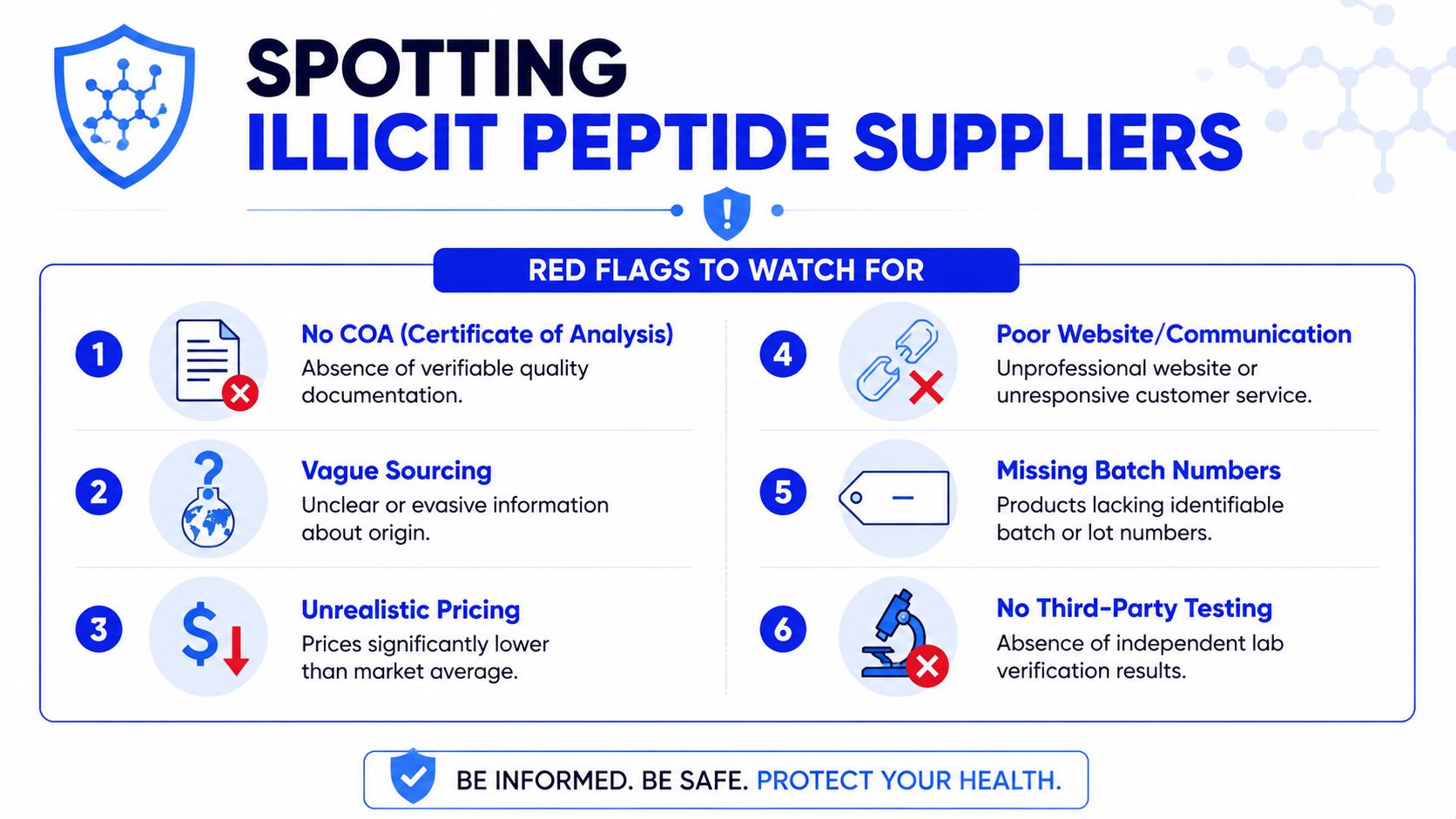
Some warning signs are visible within minutes.
A vendor selling lab materials should look and act like a lab supplier. If the site reads more like a hype-driven storefront than a technical business, take the hint.
The more important red flags appear in the paperwork, or in the refusal to provide it.
A short decision table helps when screening unfamiliar sellers:
| Red flag | What it usually means |
|---|---|
| Generic COA only | Documentation may be reused or non-specific |
| No lot number match | You can’t confirm the test applies to your vial |
| Purity claim with no method | The claim isn’t independently useful |
| Support avoids technical questions | The supplier may lack real QC depth |
Buyers’ filter: If you have to argue with a vendor just to get basic verification, move on.
When buyers ask what separates a usable peptide vendor from a risky one, the answer isn’t branding. It’s verifiable process control.
High-purity manufacturing depends on analytical discipline. According to Advanced ChemTech on peptide synthesis quality benchmarks, automated systems can produce peptide purity up to 99.5%, and researchers should demand third-party COAs verifying greater than 99% purity via HPLC/MS. That’s the benchmark that separates documented supply from underground variability.
A COA is useful only if it answers specific questions.
Start with the identifiers:
Then look at the analytical claims. A meaningful peptide COA should point to HPLC/MS or equivalent identity and purity testing, not just a headline purity number floating on its own.
What to verify on the COA:
A fake-looking COA often tells on itself. Generic templates, repeated values across unrelated lots, and no direct lot tie-in are common failures.
Internal testing has value. Independent testing is what turns it into confidence.
A third-party report is useful because it reduces the supplier’s ability to grade its own homework. When a vendor provides external purity verification and can align it to the batch record, the buyer gets a clearer picture of whether the material is suitable for serious laboratory use.
This short video offers a useful visual reference point for evaluating peptide quality expectations:
Ask for the supporting records before payment, not after delivery. Serious suppliers expect that request.
Most buyers think about quality as a single-order issue. In real lab operations, consistency across orders matters just as much.
Traceability means the supplier can connect:
Without that chain, reorder confidence disappears. A peptide that performs well once is not enough. The next lot has to be comparable, and the vendor should be able to show why.
Ask simple procurement questions:
If the answers are vague, treat that as a process-control gap.
The best peptide suppliers don’t rely on slogans about quality. They show evidence of disciplined synthesis, purification, and release review.
Automated systems with real-time quality control create a different baseline from hand-waved, low-visibility production. That doesn’t guarantee perfection, but it does improve repeatability and reduce the odds that buyers are gambling on poorly characterized material.
A practical supplier scorecard looks like this:
| Verification point | Acceptable standard |
|---|---|
| Identity confirmation | Supported by HPLC/MS documentation |
| Purity claim | Batch-specific and clearly stated |
| Third-party evidence | Available on request or attached to the lot |
| Traceability | Lot number tied across product and paperwork |
| Technical support | Can answer direct QC questions clearly |
If a supplier clears those checks, you’re no longer guessing. You’re qualifying.
Even strong material can be compromised by weak receiving and storage practices. Labs that buy peptides regularly need a basic internal routine, not improvised decisions made order by order.
A simple procurement SOP prevents repeated mistakes.
Include these checks before approving a supplier:
This doesn’t need to be bureaucratic. It needs to be consistent.
Storage is not an afterthought with peptides. According to NovoPro Labs , lyophilized peptides should be stored at -20°C to extend stability to several years. The same guidance notes that reconstituted solutions should be aliquoted into single-use volumes because freeze-thaw cycles can cause 10-30% loss of activity per cycle.
Use that guidance operationally:
Good procurement gets you a clean starting point. Good handling keeps it that way.
If a lab spends heavily on sourcing and then treats storage casually, it gives away the benefit of careful qualification.
The answer depends on jurisdiction, use case, and how the material is marketed and handled. What matters operationally is that research peptides can exist in a regulatory gray area, and that doesn’t make every seller equivalent. Buyers should evaluate intended use, documentation, labeling, and internal compliance requirements before procurement.
For labs, the safer approach is straightforward. Buy only from suppliers that clearly position products for research, laboratory, or analytical use and that support those products with transparent documentation.
Treat receiving like a quality checkpoint. Confirm the lot number on the vial matches the paperwork, review the attached or requested analytical records, inspect packaging condition, and move the material to appropriate storage without delay.
If the peptide is lyophilized, cold storage matters right away. If you plan to reconstitute it, pre-plan aliquots so the material won’t be exposed to repeated freeze-thaw cycles later.
A research chemical supplier provides materials for laboratory, analytical, or preclinical work. A compounding pharmacy operates in a different regulatory environment and serves a different function. Those categories should not be blurred.
For procurement teams, that distinction matters because the documentation, intended use, and compliance expectations are not the same. If your workflow involves research materials, choose vendors that are explicit about research-only positioning and equally explicit about their lot-level quality records.
Underground supply peptides create one consistent problem. They shift the burden of trust onto the buyer while offering too little evidence to justify that trust.
Serious sourcing works differently. You verify the COA, confirm the lot match, look for third-party testing, ask about traceability, and reject suppliers that make basic quality questions difficult. That approach protects more than a budget. It protects the integrity of the work.
In peptide procurement, verification is not optional. It’s the minimum standard for any lab that wants repeatable inputs and defensible results.
Choose suppliers that make documentation easy to review, not hard to obtain. Explore options that support every lot with clear analytical records and consistent handling standards.
If you’re looking for a research-focused supplier with USA manufacturing, batch testing, transparent COAs, microbial and endotoxin documentation, and stated purity levels up to 99.5%, learn more at Peptide Warehouse USA.