No products in the cart.



You open a fresh peptide shipment, set the box on the bench, and think the hard part is over. It isn’t. The first storage decision often determines whether that vial stays close to its stated purity or slowly drifts into a less reliable research material.
That’s why knowing how to store peptides matters as much as choosing a clean batch in the first place. Good storage protects signal quality, preserves consistency between runs, and keeps you from blaming assay variability on biology when the actual problem started in the freezer.
A peptide vial isn’t just a product. It’s a chemical system that starts changing the moment storage conditions stop protecting it. If you treat every peptide the same, you’ll eventually lose material to oxidation, moisture uptake, aggregation, or avoidable handling damage.
Lyophilized peptide is the stable form most researchers want for storage. With water removed, many degradation pathways slow down sharply. That’s why dry material usually tolerates handling and transport far better than the same peptide after reconstitution.
Once you add solvent, stability drops. Water enables hydrolysis, supports pH-driven side reactions, and makes freeze-thaw damage possible. A peptide that sits as a dry powder can become fragile as a liquid stock.
Storage failures usually come from four sources:
Temperature swings
Repeated warming and cooling accelerate degradation and create condensation risk when cold vials are opened.
Moisture exposure
Hygroscopic sequences can pull water from air. That invites hydrolysis and can change how the powder behaves during later reconstitution.
Light exposure
Some sequences are more light-sensitive than others, especially once dissolved.
Oxidation
Peptides containing methionine, cysteine, or tryptophan are especially vulnerable. These residues may lose 15-30% potency within weeks at standard temperatures without anaerobic storage, and expert protocols place long-term storage above 4 weeks at -80°C or below, intermediate storage at -20°C, and short-term storage under 4 weeks at 4°C.
Practical rule: Storage isn’t about finding the coldest shelf and hoping for the best. It’s about matching peptide form, sequence risk, and use timeline.
If you remember one principle, use this one. Dry peptides are forgiving. Reconstituted peptides are not. That single distinction shapes nearly every best practice that follows.
A lyophilized peptide can arrive at high purity and still lose research value before the first experiment. I see that happen less from dramatic failures than from routine handling errors. A vial gets opened straight from the freezer, picks up moisture, goes back on the shelf, and the material no longer behaves like the certificate suggests it should.
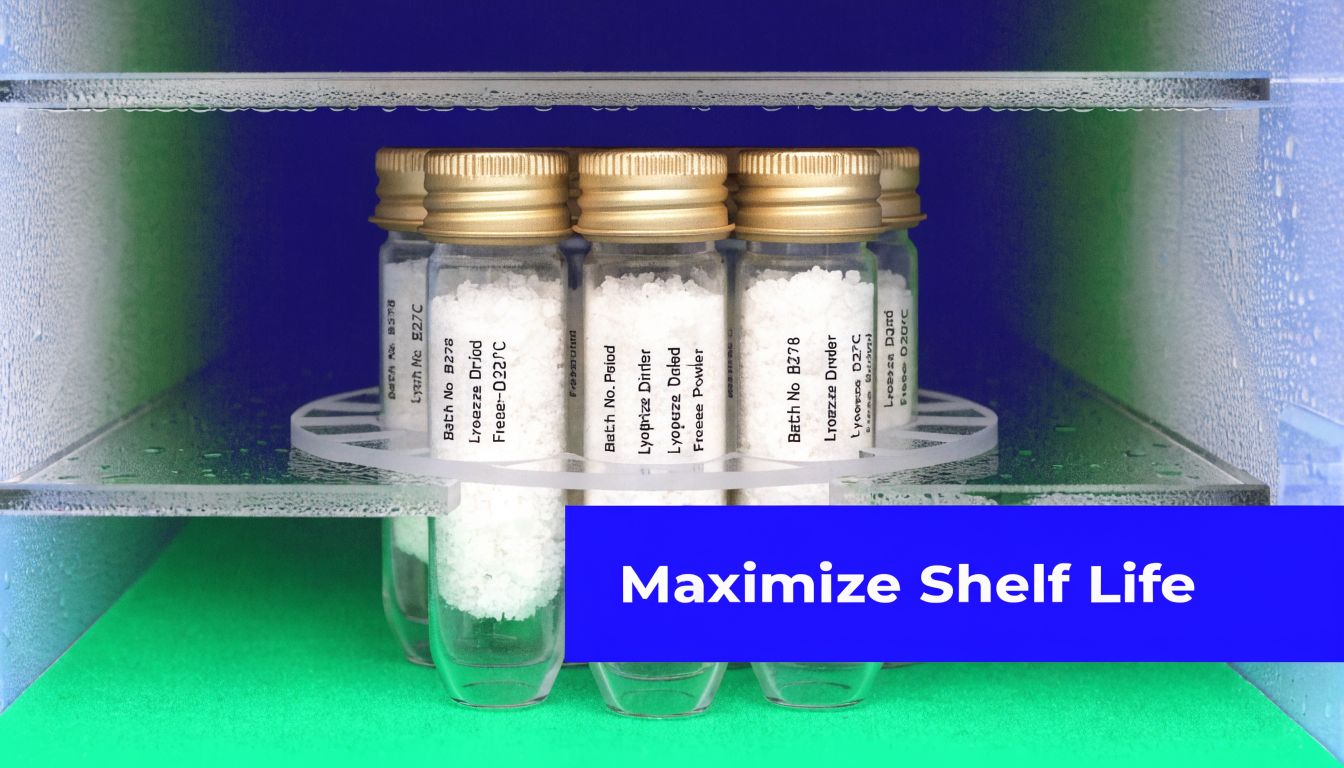
Lyophilized peptides tolerate storage better than peptide solutions, but shelf life still depends on how long the material must remain unchanged and how often the vial will be handled.
As noted earlier, guidance from Peptide.com recommends storing dry peptides at low temperature for long retention, typically in the freezer range used for research stocks. The same guidance distinguishes brief room-temperature holding from true storage. Bench or drawer conditions may be acceptable during short handling windows, but they are a poor choice for archived material or reference lots.
The scientific reason is straightforward. Lower temperature slows the reactions that still occur in a dry solid, including oxidation and trace moisture-driven degradation. Freezing does not make a peptide immortal. It reduces the rate at which small chemical changes accumulate and later show up as lower purity, altered solubility, or inconsistent assay performance.
Match storage to use:
That last point matters more than many labs expect. A stable freezer is useful. A stable freezer plus fewer openings is what preserves the powder you paid for.
For lyophilized peptides, water is often the first avoidable insult. Dry powder can absorb moisture from room air fast enough to change how it weighs, dissolves, and ages in storage.
Store vials tightly sealed. Use secondary containment with desiccant if your lab environment is humid or if vials will be stored for extended periods. Keep the cap and stopper area clean, because residue at the seal can compromise closure over time.
Cold vials need one extra step. Let them come to room temperature before opening. That prevents condensation from forming inside the vial or around the closure, where a small amount of water can create a large stability problem over repeated handling cycles.
Good peptide storage is really a handling discipline. The goal is to keep the powder dry, cold, and undisturbed until the moment it is needed.
A short visual refresher can help if you’re training new staff or standardizing a bench protocol.
Storage practice determines whether peptide purity remains a real asset or just a number on a datasheet. With lyophilized material, the job is simple in principle and unforgiving in execution. Keep it sealed, keep it dry, and avoid handling patterns that erode experimental reliability.
As soon as a peptide is reconstituted, storage becomes more exacting. Most of the expensive mistakes happen here. Researchers often start with a high-purity material, then erase that advantage with repeated thawing, the wrong container, or poor solution handling.
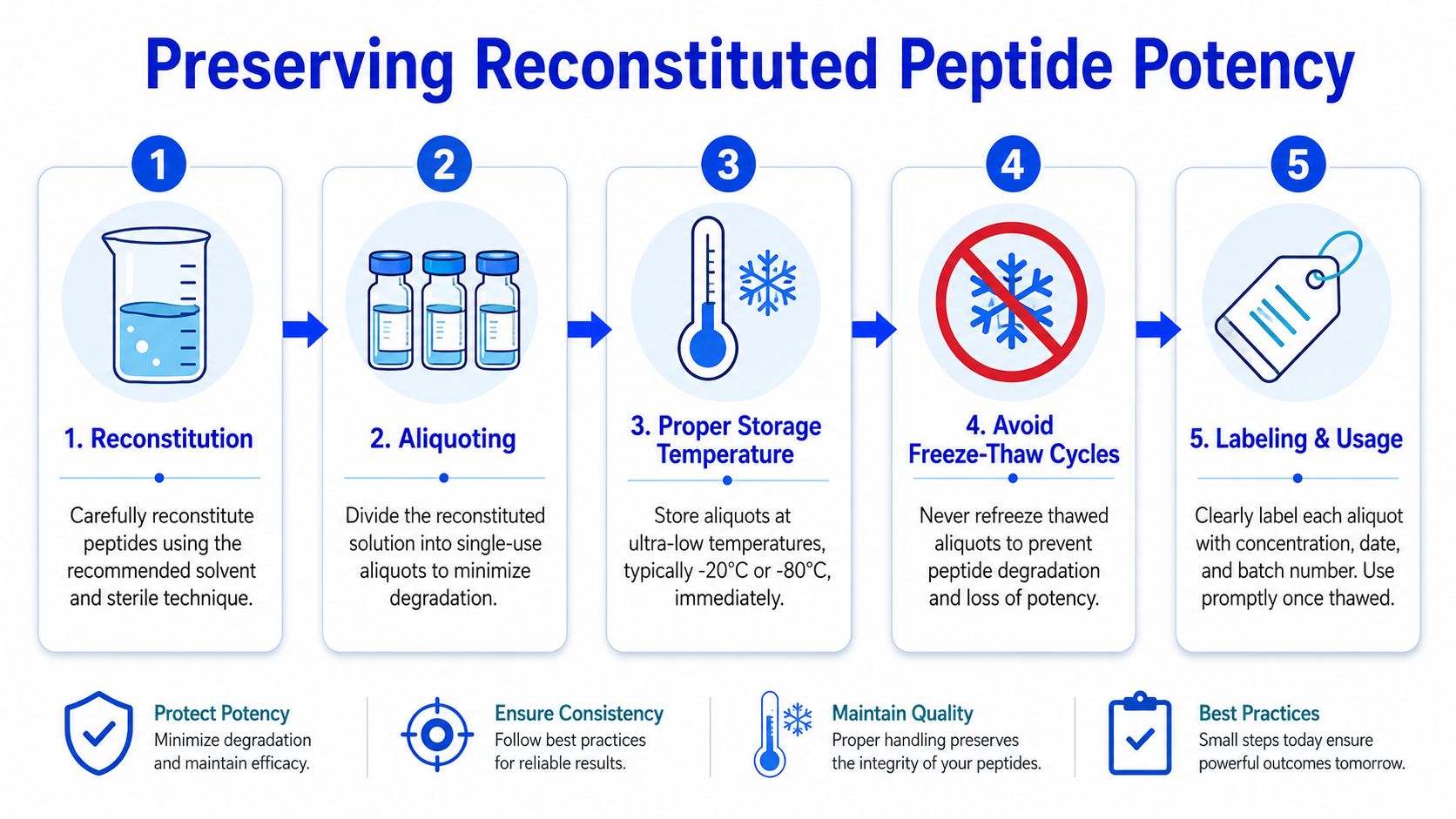
If you only adopt one liquid-storage habit, make it single-use aliquoting.
According to NIBSC peptide storage guidance, reconstituted peptides should be stored at -20°C or -80°C in aliquots to limit freeze-thaw cycles, which can cause 50-70% potency loss per cycle. The same guidance cites a 2009 study in the Journal of Proteome Research showing that standard polypropylene vials can adsorb 20-40% of hydrophobic peptides during freeze-thaw cycles.
That’s two losses happening at once. You can lose peptide from molecular damage and from the container wall.
A reconstituted stock should be prepared for how it will be used, not for how convenient it is to pipette once on day one.
Liquid peptide stocks need more than low temperature.
Choose conditions that reduce the known failure points:
Use aliquots sized for one experiment or one run
This avoids refreezing a partially used vial.
Prefer low-binding or appropriate glass storage when adsorption is a concern
Hydrophobic sequences are more likely to stick to standard plastics during handling.
Avoid frost-free freezers for critical liquid stocks
Defrost cycling creates temperature fluctuation, which works against stability.
Control pH during reconstitution
Don’t assume any aqueous solution is acceptable. Peptide behavior changes quickly when the solution environment is wrong.
A clean workflow prevents most downstream problems:
Experienced labs separate convenience from control. A large shared stock seems efficient. In practice, it introduces variability every time someone pulls it out, warms it, and returns it to the freezer.
Good storage protects material. Good quality control protects interpretation. If you can’t trace what was stored, how it was handled, and whether the solution conditions were appropriate, you’re guessing about sample integrity.
Every aliquot should tell you what it is without opening your notebook.
A practical label should include:
That level of labeling matters when multiple compounds such as BPC-157, TB-500, Semax, Selank, PT-141, or GHK-Cu are moving through the same cold storage system. Peptides can look identical on sight. Mix-ups happen when labeling is treated as admin work instead of sample control.
A Certificate of Analysis isn’t just paperwork for procurement. It’s part of your storage plan.
Use the COA to confirm:
If your supplier provides third-party testing documents, microbial reporting, endotoxin data, and a clear batch trail, that makes storage decisions more defensible. You know what entered the lab, and you can preserve that standard more consistently.
The value of a high-purity peptide isn’t the number on the COA by itself. The value is keeping the sample close to that starting condition until the day you use it.
Bench time matters. So does how a sample moves between locations.
According to Bachem handling and storage guidance, pH 5-6 is optimal once peptides are reconstituted, helping suppress aggregation and bacterial growth. The same guidance states that freeze-thaw cycling can reduce peptide efficacy by 20-40% per cycle, and bacterial contamination during handling can reduce measured peptide concentration by 15-25% within weeks.
That has direct workflow implications:
When teams struggle with reproducibility, storage is often treated as background detail. In reality, it’s one of the first places to audit.
Not every problem means the sample is unusable, but every visible change deserves a reasoned check. Don’t force a questionable peptide into an assay just because the vial was expensive.
Cloudiness usually points to one of a few issues: incompatible solvent conditions, pH problems, contamination, or aggregation. Start with the simplest question. Did the peptide fully dissolve under the intended conditions in the first place?
If the solution changed after storage, review the handling record:
If contamination is possible, treat the sample as compromised. If precipitation appears linked to solubility rather than contamination, the material may need reassessment under the original reconstitution conditions rather than blind reheating or aggressive mixing.
A warm shipment is not automatically ruined, especially if the peptide was shipped in lyophilized form and remained sealed. The right response is to check the form, packaging condition, and supporting batch documents, then move the material into proper storage promptly.
For reconstituted material, be stricter. Liquid peptides are less forgiving, and unexplained temperature exposure should be treated as a quality event that needs documentation.
Here’s a quick reference for routine decisions:
| Peptide Form | Long-Term Storage (>1 Month) | Short-Term Storage (1-4 Weeks) | Brief Use (<1 Week) |
|---|---|---|---|
| Lyophilized peptide | -80°C or below is preferred for archival storage | -20°C is standard for intermediate storage | 4°C can work for brief handling windows |
| Reconstituted peptide | Frozen aliquots, typically at -20°C or -80°C | Refrigerated only for limited short-term use if appropriate to the protocol | Use promptly after thawing and avoid room-temperature holding |
For critical reconstituted stocks, it’s a poor choice. Frost-free systems cycle through temperature changes as part of defrosting, and that instability works against peptide preservation. Use a freezer with stable temperature control when solution integrity matters.
Sometimes you can’t tell by eye alone. Visible clues such as cloudiness, unexpected precipitate, color change, or signs of contamination can justify rejecting a sample, but some degradation is only obvious through analytical testing. If the experiment is sensitive, confirm integrity with your normal QC workflow rather than relying on appearance.
They can share the same freezer, but they should not share the same vial or mixed storage solution unless your protocol specifically validates that combination. Mixed storage complicates traceability, solubility behavior, and troubleshooting. Keep each compound in its own labeled aliquot set.
Not necessarily. Sealed lyophilized peptides often tolerate short transit exposure far better than liquid material. Document the condition on arrival, review the lot paperwork, and transfer the vial into correct storage without delay.
If you’re sourcing research-grade material and want batch-tested peptides supported by clear COAs, microbial and endotoxin documentation, and stated purity up to 99.5%, learn more about Peptide Warehouse USA and explore options that make storage, traceability, and consistent lab handling easier from day one.