No products in the cart.

When a supplier says they sell usa made peptides, what exactly is American about the product?
That question gets skipped too often. In practice, buyers see a domestic label and assume it covers synthesis, purification, testing, packaging, and shipping. Sometimes it does. Sometimes it only means the peptide ships from a U.S. address.
For researchers, that difference matters. A peptide can look acceptable on a product page and still create avoidable variability in assay work, analytical development, or preclinical screening if the supplier can’t show clear lot-level documentation. The procurement job isn’t just to find a domestic vendor. It’s to confirm that a “USA made” claim maps to real process control, traceability, and repeatable quality.
A domestic label can be useful, but it isn’t proof.
The peptide market in the United States is large enough that sourcing decisions shouldn’t be treated like a niche purchasing issue. The U.S. peptide therapeutics market was valued at USD 17.8 billion in 2022. That scale tells you something important. U.S. peptide manufacturing sits inside a mature, highly regulated pharmaceutical and research ecosystem.
For a lab manager or procurement lead, the primary question isn’t “Is domestic always better?” The fundamental question is whether domestic sourcing gives you better control over the variables that affect your results.
Practical rule: Treat “usa made peptides” as a starting signal for due diligence, not the finish line.
The strongest suppliers make it easy to verify what they do. The weak ones rely on broad claims, generic purity percentages, and polished product pages that stop short of showing lot-specific evidence.
That difference shows up later in the work:
A serious peptide supplier should be able to answer basic chain-of-custody questions without hesitation.
| Procurement question | Why it matters |
|---|---|
| Where was the peptide synthesized? | Establishes origin of the core manufacturing step |
| Where was it purified and lyophilized? | Affects handling, stability, and accountability |
| Where was QC performed? | Determines who generated the release data |
| Is the COA batch-specific? | Confirms the document matches the material shipped |
| Are HPLC/UPLC and MS data available? | Supports identity and impurity review |
Researchers don’t need marketing language. They need evidence that the supplied lot is the same material described in the paperwork.
The phrase usa made peptides sounds precise. It usually isn’t.
In peptide procurement, “USA made” can refer to very different operating models. A vendor may synthesize the sequence in the United States and also run purification, lyophilization, release testing, and shipping domestically. Another vendor may import bulk peptide, complete finishing steps in the U.S., and market the product with nearly identical language.
That distinction isn’t academic. It changes who controlled the batch, who generated the analytical record, and who can answer questions if something looks off. As noted by Peptide’s discussion of U.S.-made peptide sourcing, a peptide may be synthesized abroad, then finished, tested, and shipped domestically. Buyers need to know which steps are domestic.
Think about the phrase the same way you’d think about a car labeled “assembled in the USA.” Assembly and full manufacturing aren’t the same thing. Peptides work the same way.
Break the chain into parts:
A supplier that only talks about shipping location is telling you about logistics, not manufacturing.
Domestic fulfillment can still have value. It may shorten delivery times and simplify communication. But it doesn’t automatically mean the analytical package is stronger or the chain of custody is cleaner.
Ask vendors a direct question: “Which steps for this lot were performed in the United States, and which were performed elsewhere?”
That one question often separates transparent manufacturers from storefront resellers.
When the answer is vague, assume you’ll have limited visibility if you need to investigate a lot discrepancy, compare repeat orders, or support internal documentation. When the answer is specific and backed by records, the “USA made” claim becomes operationally useful.
Domestic manufacturing matters when it reduces risk in the work itself.

U.S.-based peptide facilities often operate under Current Good Manufacturing Practice expectations and related quality systems. Those controls focus on methods, facilities, and production oversight. In practical terms, USA-made peptide manufacturing standards ties domestic production to reduced dependence on international suppliers, lower disruption risk, stronger traceability, and faster delivery.
For research teams, those advantages only matter if they show up as better material control. The strongest domestic suppliers don’t sell geography. They sell documented process discipline.
A peptide molecule doesn’t become better solely because it was made in the United States. What changes is the surrounding system.
Here are the biggest research advantages:
That last point gets underestimated. Labs often focus on purity first, which makes sense, but delayed resupply can damage timelines just as easily as weak analytics.
Peptides are chemically fragile materials. Transit isn’t neutral.
Longer shipping paths create more chances for handling mistakes, storage inconsistency, and temperature exposure that may contribute to oxidation or aggregation in more sensitive sequences. Domestic sourcing can shorten that path, which is one reason many research buyers prefer vendors with tighter control over fulfillment and batch turnover.
This video gives useful manufacturing context for how peptide workflows and controls affect research suitability:
A good supplier also understands that research integrity depends on consistency, not just headline purity. If one lot behaves differently from the prior order, your team needs enough analytical detail to decide whether the problem sits in the material, the assay, or the handling.
Domestic sourcing is most valuable when it shortens the distance between the batch record and the person who can explain it.
That is why serious buyers look for process transparency first and patriotic branding second.
How do you confirm that a “USA made” claim reflects actual process control instead of a marketing label?
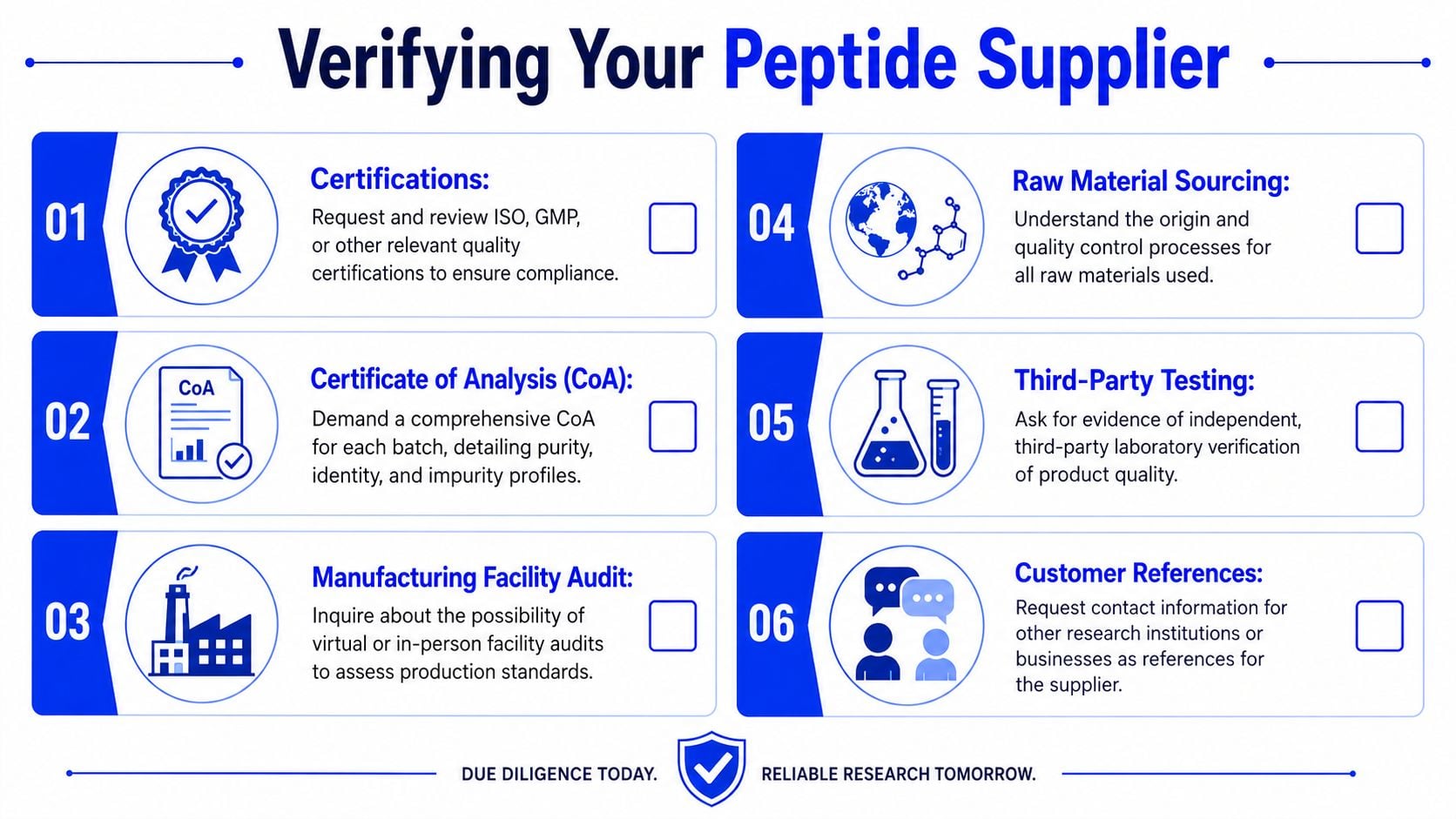
Start with the paperwork tied to the specific lot you plan to buy. If a supplier cannot produce batch-specific records before purchase, the country-of-origin claim has limited value from a research and procurement standpoint.
For research peptides, the useful differentiator is lot-level analytical qualification. Identity and purity should be supported by more than one method, commonly mass spectrometry plus HPLC or UPLC, as shown in this peptide COA and analytical verification discussion. A single purity percentage on a product page does not tell you how the result was generated, what impurities were present, or whether the data belongs to the lot in front of you.
I treat the COA as the first traceability check, not the last.
When I review peptide documentation, I look for a clean chain from synthesis to release. The document should let your team answer three practical questions quickly: Is this the correct sequence, how was purity measured, and can the record be matched to the vial label without guesswork?
A usable COA should include:
Each item serves a different purpose. MS supports identity. Chromatography shows peak distribution and helps you judge whether the reported purity is credible in context. Release details show whether the supplier can maintain traceable records.
The fastest supplier screen is a short set of questions that requires specific answers.
Use this checklist:
The answers matter as much as the documents. Clear, direct replies usually indicate the supplier can retrieve batch records quickly and understands what researchers need to review. Vague responses often signal that sales language is ahead of quality documentation.
One more check helps separate real domestic control from partial domestic handling. Ask which steps were completed in the United States: synthesis, cleavage, purification, analytical testing, filling, labeling, and release. Some vendors use “USA made” for material that was only finished or shipped domestically. That may still fit a budget purchase, but it is not the same risk profile as a batch manufactured and released under one accountable quality system.
If a supplier will not provide the analytical record before purchase, treat that as a documentation gap, not a minor inconvenience.
Most peptide buying mistakes are visible early. Teams just ignore the signals because the price looks attractive or the website looks polished.

A credible American peptide producer typically uses solid-phase peptide synthesis, often with standard downstream verification by RP-HPLC and MS. From a buyer’s perspective, this peptide manufacturing workflow makes the practical benchmark clear: the vendor should disclose analytical methods and provide lot-specific data. Country of origin alone doesn’t determine research suitability.
Some warning signs matter more than others. These are the ones I treat as procurement problems, not minor inconveniences.
Cheap peptides often become expensive when a lab burns time validating questionable material.
The best procurement systems are boring. They rely on repeatable checks, not gut feel.
A simple workflow looks like this:
| Step | What to do | Why it reduces risk |
|---|---|---|
| Pre-screen | Request COA, method details, and manufacturing location info | Filters out opaque vendors early |
| Test order | Buy a small quantity first | Confirms documentation matches delivered material |
| Internal review | Compare lot data against application needs | Prevents overbuying before qualification |
| Reorder standardization | Save approved vendor responses and lot criteria | Makes repeat procurement faster and cleaner |
If your team is refining that process, broader logistics thinking helps too. Offering a useful framework for evaluating supplier reliability, delivery flow, and operational accountability. Those ideas transfer well to peptide sourcing, especially when timing and chain-of-custody matter.
For labs with multiple buyers, formalize the checklist. Don’t let one person approve vendors based on pricing while another person handles quality review after problems appear. Procurement and QC need the same gate.
The phrase usa made peptides should mean more than a shipping origin. For a serious research buyer, it should point to traceable manufacturing, clear analytical release criteria, and consistent lot documentation.
The strongest suppliers understand that modern procurement is evidence-based. They don’t ask buyers to trust broad claims about quality. They provide records that let a lab verify identity, review purity, compare lots, and document sourcing decisions with confidence.
That shift matters because peptide purchasing is no longer just a vendor selection task. It’s part of research quality management. If your team relies on peptides for analytical work, assay development, or preclinical studies, weak sourcing creates downstream noise that no amount of post hoc troubleshooting fully fixes.
A reliable supply chain usually comes from a few disciplined habits:
Buyers who follow that process make fewer reactive decisions. They spend less time chasing missing paperwork, explaining inconsistent results, or replacing material that should never have passed intake review.
If you’re evaluating suppliers now, use a simple standard: ask what was done domestically, ask how the lot was qualified, and ask for proof before purchase. That’s the practical path to lower-risk sourcing and better experimental consistency.
If you’re looking for a documented domestic option, Peptide Warehouse USA offers USA-made research peptides for laboratory, analytical, and preclinical use with batch-specific COAs and additional lot documentation where available. Learn more, review the available product lines, and explore options that fit a tighter procurement process.