No products in the cart.


A molecule first isolated in 1973 still shapes modern peptide research because it sits at the intersection of endogenous biology, copper transport, and tissue signaling. GHK-Cu copper peptide also carries an unusually practical twist for lab researchers: it’s not enough to know what it may do biologically. You also need to understand how its chemistry, purity, and formulation context affect the result you see.
That matters because blood levels reported for GHK-Cu are about 200 ng/mL at age 20 and around 80 ng/mL by age 60, a decline of about 60% . That age-linked drop is one reason researchers keep returning to this peptide in skin, repair, and regenerative models.
Interest in GHK-Cu also spills into broader aesthetic and wellness conversations, including resources on anti-aging peptide therapy, but serious research demands a stricter lens. The useful questions aren’t just “what are the benefits of peptides?” They’re “what is this complex at the molecular level,” “how does it move copper,” and “what handling errors could distort the study?”
GHK-Cu copper peptide is one of those molecules that looks simple on paper and becomes much more interesting the closer you examine it. It’s a naturally occurring copper tripeptide, not a trendy synthetic invention, and that changes how many researchers think about its relevance. Endogenous molecules often tell us something important about the body’s own repair logic.
Researchers usually encounter GHK-Cu through skin-aging discussions, wound-healing literature, or hair-focused peptide conversations. But that surface-level framing misses the deeper story. True interest comes from three converging facts: it exists naturally in humans, it changes with age, and its chemistry gives it a specific way to move copper into biologically useful settings.
GHK-Cu is worth studying not because it sounds advanced, but because its structure gives researchers a direct way to ask how copper signaling and tissue repair may intersect.
That’s where practical research judgment becomes essential. If the complex is poorly sourced, degraded, or placed into a formulation that disrupts its activity, your assay may say more about your preparation than about the peptide itself.
Copper is indispensable to biology, yet poorly controlled copper chemistry can distort an experiment. That tension explains much of the interest in GHK-Cu. Researchers are not studying a generic trace mineral supplement. They are studying a defined tripeptide complex that changes how copper is held, presented, and exchanged in biological systems.
GHK stands for glycyl-L-histidyl-L-lysine. Cu refers to copper in the Cu2+ oxidation state within the complex. The peptide is short, but short does not mean biologically trivial. Small peptides often function less like structural material and more like compact molecular instructions that alter what nearby cells do.
GHK by itself is a specific amino acid sequence. Once copper binds, the result is a coordination complex with its own chemical behavior. For research use, that distinction matters. Assay design, solvent choice, storage conditions, and even the way a supplier reports identity on a COA all depend on whether you are working with the free peptide or the copper-bound form.
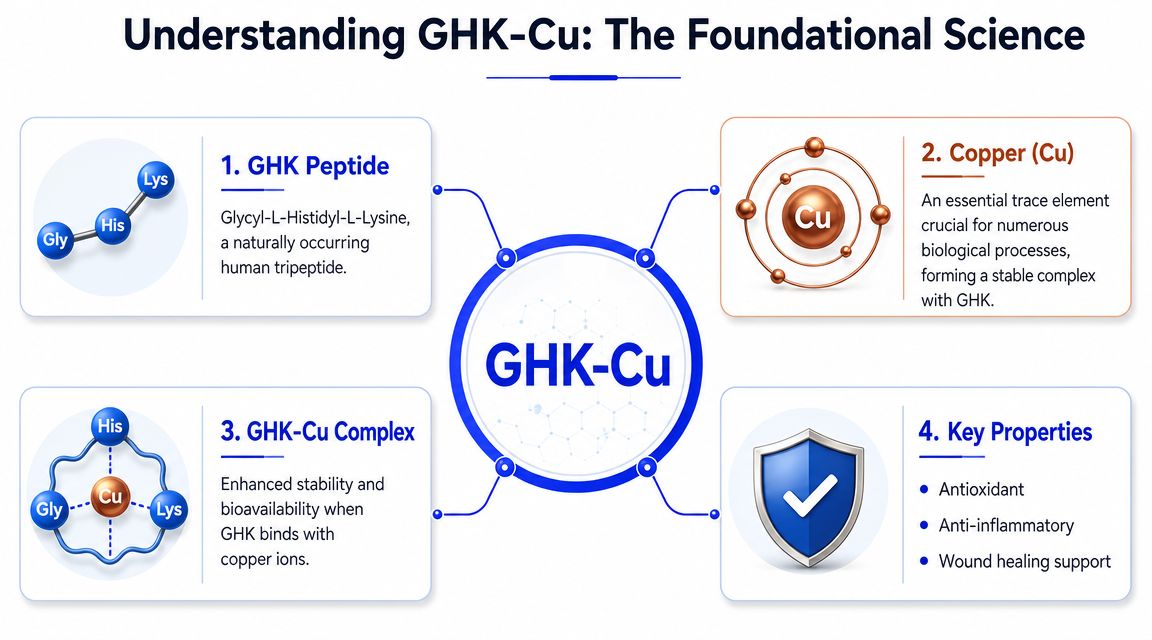
GHK-Cu behaves more like a controlled copper-handling system than a simple copper salt. Free copper ions can enter redox reactions that create experimental noise or unwanted oxidative stress. In GHK-Cu, the peptide constrains copper through defined coordination chemistry, which changes its reactivity and biological presentation.
Studies discussing the complex describe copper(II) coordination through the N-terminal amino group, the deprotonated peptide nitrogen, and the histidine imidazole nitrogen, giving the molecule a square-planar Cu(II) geometry with high binding affinity, as outlined in this review of GHK structure and biological activity. For a lab researcher, the practical point is straightforward. GHK-Cu should not be treated as interchangeable with copper chloride, copper sulfate, or the peptide alone.
A useful comparison is a reagent delivered in a chelated, buffered form rather than as a bare reactive ion. The elemental component is the same. The experimental behavior is not. That difference influences uptake, stability in formulation, and the kinds of cellular responses you are measuring.
Researchers who work with topical systems run into this quickly. Vehicle composition, pH, competing ligands, and exfoliating acids can all affect complex stability. If a formulation also includes strong acids, the chemistry deserves a closer look before any biological conclusion is taken seriously. For teams evaluating compatibility in skin-focused models.
Three practical ideas usually clarify the science:
That last point is where sourcing and analytical paperwork start to matter. A COA that lists purity without clear identity testing, counterion information, or lot-specific analytical data leaves too much unanswered. With GHK-Cu, foundational science and practical lab judgment are tightly linked.
Research on GHK-Cu tends to cluster around visible, measurable biological systems. Skin is the most familiar. Repair models are close behind. Hair research remains a frequent point of interest because follicle biology depends on signaling, matrix support, and local tissue environment.

Skin research is where many people first hear about GHK-Cu copper peptide. In that setting, the interest usually centers on extracellular matrix support and the signaling environment around fibroblasts. Researchers often discuss collagen, elastin, and glycosaminoglycan-related pathways because those components influence firmness, resilience, and structural integrity.
That doesn’t mean GHK-Cu should be treated like a simple cosmetic additive. The molecule’s broad gene effects and copper-binding behavior make it more interesting than a standard “anti-aging ingredient” label suggests. For labs studying barrier function, matrix remodeling, or skin recovery, the better question is how the complex shifts cellular behavior under defined conditions.
A related practical issue is compatibility with exfoliating acids and other actives. Teams working on multi-active topical systems often benefit from broader background on acids and skin turnover.
Repair-oriented research gives GHK-Cu a second major home. Here, the focus broadens beyond appearance and into tissue quality, signaling coordination, and local recovery dynamics. Researchers have explored it in contexts tied to wound closure, matrix organization, and tissue remodeling.
What makes GHK-Cu interesting in repair models isn’t a single pathway. It’s the combination of copper delivery, signaling influence, and gene-level effects. In tissue systems, those layers rarely operate in isolation.
Practical rule: If your model depends on orderly matrix formation and oxidative balance, treat GHK-Cu as a context-sensitive signaling complex, not a one-variable input.
Hair-focused research usually asks whether GHK-Cu can influence follicle environment rather than “grow hair” in a simplistic sense. Follicles are small organs with demanding microenvironments. They depend on local signaling, connective support, and surrounding tissue health.
That’s why GHK-Cu keeps appearing in discussions around scalp biology and follicle support. For researchers, the more rigorous framing is to evaluate effects on follicular structure, local matrix behavior, and signaling patterns in models that can separate direct action from formulation noise.
A small tripeptide can influence a surprisingly wide range of cellular behavior because GHK-Cu does two jobs at once. It carries copper in a coordinated form, and it appears to shift how cells prioritize repair-related signaling.
Gene modulation often gets described in a way that sounds more dramatic than the biology. GHK-Cu does not alter the DNA sequence. The practical meaning is narrower and more useful. Cells may increase or decrease transcription of certain genes after exposure to the peptide-copper complex, depending on the model, dose, and local tissue state.
A useful comparison is a recording console with many channels already wired in place. The system does not create a new song. It adjusts which signals are louder, quieter, or better balanced. That is why GHK-Cu attracts interest across skin, repair, and follicle models. Researchers are often observing different downstream readouts that may trace back to the same upstream shift in expression control.
For bench work, that broad signaling profile has a direct consequence. Experimental outcomes can drift if material quality drifts. If one lot contains impurities, residual salts, or inconsistent copper loading, a result that looks like “gene activity” may partly reflect sample quality instead of true biology. This is one reason experienced groups read the COA closely rather than treating peptide identity and peptide performance as the same thing.
Copper is necessary in biology, but poorly controlled copper is a problem. Free metal ions can participate in unwanted redox reactions, which makes delivery chemistry matter almost as much as dose. GHK binds copper and presents it in a form cells can interact with more selectively.
At the cellular level, this is less like dumping a reactive metal salt into a system and more like handing over a tagged reagent in the correct container. The peptide coordinates the metal, helps limit indiscriminate reactivity, and may improve how copper enters pathways tied to repair and extracellular matrix biology. Researchers care about that distinction because the same nominal copper concentration can behave very differently depending on whether it is free in solution or held in a defined complex.
This is also where practical handling starts to matter. Copper-peptide complexes are sensitive to formulation context, storage conditions, and contamination from competing ligands. In real lab settings, the mechanistic question is never just “what does GHK-Cu do?” It is also “what exactly is in this vial, how stable is the complex, and does the COA support the claimed purity and composition?” Those questions sit much closer to experimental reliability than most summary articles admit.
A short visual explainer can help if you’re mapping this mechanism for a team discussion:
Research on GHK-Cu began with a useful fact for experimental design: this is not an arbitrary synthetic sequence chosen after the fact. It was identified as a naturally occurring human peptide complex in early biochemical work, which immediately gave investigators a different kind of question to ask. Instead of asking whether cells can tolerate an unfamiliar reagent, they could ask how a native signal behaves when its concentration, copper-loading state, or local environment changes.
That distinction shaped the field. Endogenous molecules often serve as physiologic clues. They are less like foreign test compounds and more like notes already written in the system’s own margin. For GHK-Cu, the early plasma finding suggested relevance to repair biology, aging, and extracellular matrix regulation, and it helped explain why later studies treated the complex as a regulatory probe rather than only a copper donor.
The next major step involved structural and coordination work. Researchers needed to determine whether GHK associated with copper in a loose, reversible way or formed a defined complex with reproducible biochemical behavior. The literature supported the second view. That matters in practice because a defined complex is easier to study, compare across batches, and relate to biological effects than a poorly characterized mixture of peptide, free copper, and partially bound species.
Gene-expression studies then widened the scope of interest. Once investigators reported broad changes in transcriptional programs linked to repair, inflammation, and matrix remodeling, GHK-Cu stopped being framed only as a narrow skin-active compound. A better analogy is a lab reagent that changes the settings panel rather than pressing a single button. It does not appear to act through one isolated output. It may shift multiple cellular programs at once, which makes experimental context, cell type, and exposure conditions much more important.
That also explains why landmark papers can be exciting and frustrating at the same time.
Many studies point toward meaningful biological activity, but far fewer give the kind of batch-level detail a careful lab needs. For a researcher trying to reproduce an effect, the practical questions are immediate. Was the material fully copper-loaded. What counterions were present. How was purity established. Did the authors confirm identity by mass spectrometry or HPLC, or did they rely on supplier documentation alone. A published effect size means much less if the underlying material was not characterized clearly.
The strongest GHK-Cu papers connect structure, biological response, and experimental conditions. The weakest ones leave the reagent itself partly undefined.
That is why the landmark literature should be read in two layers. The first layer is biological interpretation: repair signaling, extracellular matrix effects, and gene modulation. The second is reagent quality: composition, complex integrity, and documentation. In real research settings, those layers cannot be separated cleanly. A COA is not administrative paperwork. It is part of the mechanism, because an impure or incompletely complexed sample may behave like a different chemical system altogether.
A surprising share of failed peptide experiments trace back to handling, not hypothesis. GHK-Cu makes that especially clear because you are not working with a generic powder. You are working with a defined peptide-metal complex whose behavior can shift if preparation conditions are poorly controlled.
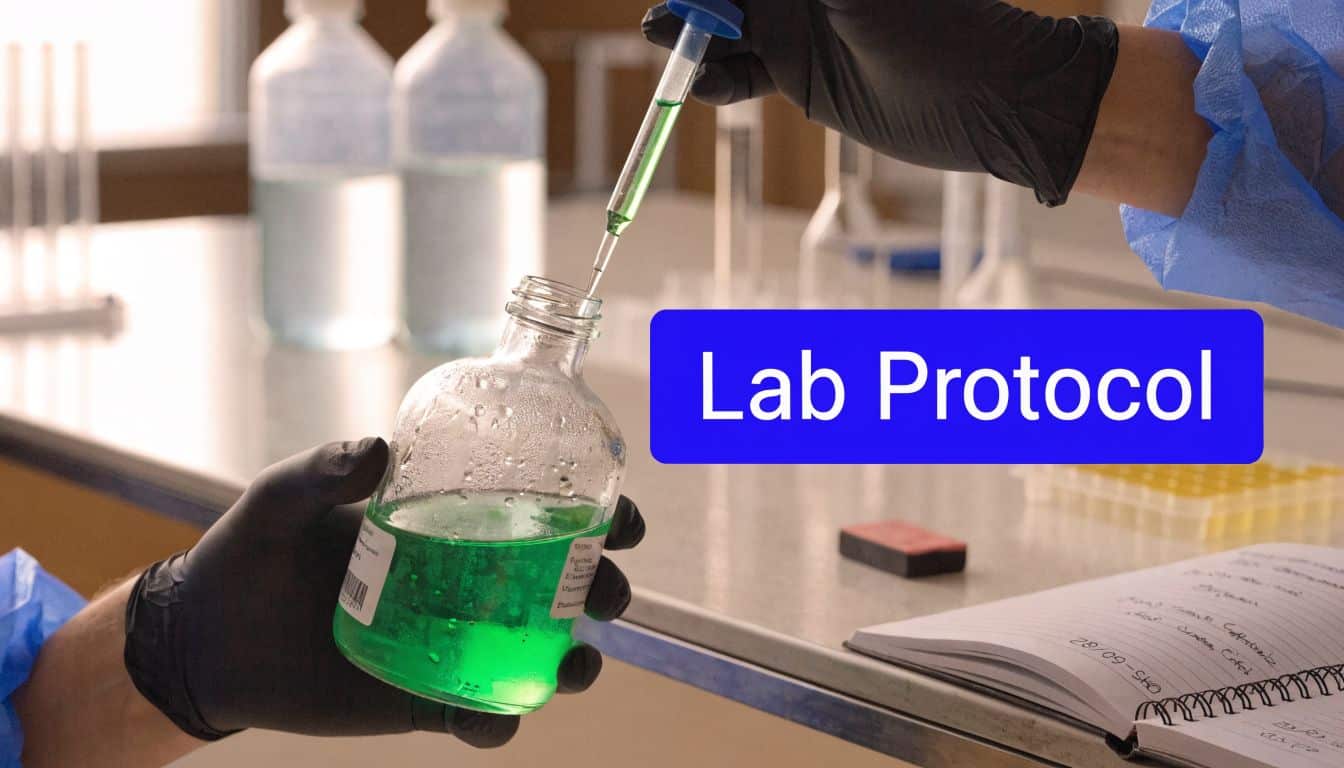
GHK-Cu should be treated less like a passive ingredient and more like a small coordination system. The peptide is carrying copper, and that copper can be influenced by pH, solvent composition, and competing binders. In practical terms, a preparation error does not just dilute your sample. It can change the chemical state you thought you were studying.
That is why preparation notes matter as much as assay notes.
A careful workflow usually includes these steps:
This approach helps close the gap between mechanistic literature and bench reality. If one lab studies intact GHK-Cu and another unknowingly studies a partially altered preparation, the biological readout may diverge even if both groups believe they used the same reagent.
Scientists seeking COA-backed material may evaluate suppliers that publish identity and purity documentation. For example, Peptide Warehouse USA states that its GHK-Cu research product is sold for laboratory and analytical use with supporting batch documents.
A Certificate of Analysis is part of the reagent record. It helps establish what was tested, which lot was tested, and how confidently you can connect the vial in your hand to the compound named on the label.
Use this quick review table:
| COA item | Why it matters |
|---|---|
| Lot number | Confirms traceability between the vial and the document |
| Identity result | Shows that the tested material matches the stated compound |
| Purity listing | Indicates how much of the sample is target material rather than impurities or byproducts |
| Test date | Provides context for inventory age and document relevance |
| Supporting reports | Endotoxin, microbial, or related reports may matter depending on the assay system |
One point often causes confusion. Purity is not the same as suitability. A high-purity material can still create problems if the identity data are thin, the lot record is incomplete, or the reconstitution history is poorly documented. The COA works like the chain-of-custody sheet for a critical sample. It does not replace good experimental design, but it prevents avoidable ambiguity at the very start.
Bench note: A clean-looking vial does not confirm identity, purity, or complex integrity. The documentation carries most of that burden.
“Research use only” is not casual label language. It defines intended use and sets the compliance boundary. High-purity peptide materials sold under that designation are meant for laboratory, analytical, or preclinical work. They are not presented as products for human consumption.
That distinction protects both the supplier and the researcher. It also encourages a healthier purchasing mindset. Instead of shopping by hype, serious buyers look for manufacturing transparency, lot traceability, and testing documentation.
A responsible supplier should make it easy to answer practical questions such as:
Purity alone doesn’t solve the whole problem. GHK-Cu is a bioactive copper complex, and its activity can be affected by pH, chelators, retinoids, and certain forms of vitamin C, while public literature still offers limited standardized guidance on these interactions, as discussed in this review of GHK-Cu formulation considerations.
That single point changes how researchers should think about sourcing. A good batch can still perform poorly if it’s dropped into the wrong matrix. In other words, quality has two parts: the material you buy and the environment you place it into.
Researchers who ignore compatibility often misread the result. They may think the peptide failed, when the formulation architecture disrupted the complex.
Few small biomolecules keep generating serious research interest across wound biology, dermal remodeling, peptide chemistry, and metal homeostasis. GHK-Cu does, and that persistence matters. Molecules fade when early promise cannot survive replication, formulation constraints, or sourcing variability. GHK-Cu has stayed relevant because the core scientific question remains productive.
Its future in research will depend less on broad claims and more on experimental discipline. GHK-Cu is a tripeptide-copper complex with signaling effects that appear to extend beyond simple copper replacement. In practical terms, that means researchers are not studying a single linear output. They are studying a system in which ligand integrity, copper binding state, concentration, solvent environment, and assay design can all change the readout.
That is why the next phase of GHK-Cu work is likely to be more technical and more useful. The field needs cleaner comparisons across batches, better reporting on reconstitution and storage conditions, and more explicit treatment of matrix effects. Gene modulation is often discussed as if it were a switch. In reality, it behaves more like a control panel with many dials, and small experimental differences can shift the pattern.
For bench researchers, the practical lesson is clear. Treat GHK-Cu like a coordination complex that requires context, not like a generic peptide reagent. A strong project starts before the first assay, with COA review, identity and purity checks, traceable lot records, and a sourcing process that reduces avoidable uncertainty.
Researchers who want to explore GHK-Cu with stronger batch traceability and documentation can review Peptide Warehouse USA as one option for COA-supported research materials.