No products in the cart.



Most articles on gh releasing peptides skip the question that matters most in research. Are you trying to force growth hormone biology, or are you trying to observe it under controlled stimulation?
That distinction changes everything. GH releasing peptides are valuable because they stimulate the body’s own growth hormone secretory machinery rather than supplying growth hormone directly. For a researcher, that makes them tools for studying endocrine signaling, pulse timing, receptor biology, and assay design, not just compounds on a product list.
A lot of confusion starts when people lump every “GH peptide” into one category. They aren’t the same. Some compounds act through the GHRH pathway, while others act through the ghrelin receptor pathway. Those pathways intersect, but they aren’t interchangeable. If you don’t separate them conceptually, it becomes hard to interpret data, compare compounds, or design a meaningful experiment.
This guide takes the middle ground between marketing copy and dense endocrinology papers. You’ll get the mechanism, the major compound classes, the evidence that matters, and the laboratory details that often decide whether a study produces interpretable results.
How do you stimulate the growth hormone axis without replacing the hormone itself and, in the process, preserve more of the system you are trying to study?
That question explains why GH releasing peptides remain useful research tools. These compounds are used to provoke endogenous GH secretion, so the response still passes through the organism’s own receptors, feedback controls, and pulse-generating circuitry. For experimental design, that distinction matters. Direct GH administration answers a different question because it starts at the endpoint rather than at the signaling steps that produce the endpoint.
The historical literature established this class through studies showing that synthetic peptides could trigger GH release in pituitary and whole-animal models. Early work from the Bowers group helped define GH secretagogues as more than modified versions of GHRH signaling. They revealed a separate entry point into the GH axis, later tied to the ghrelin receptor pathway. That separation gave researchers something unusually useful: a way to perturb one hormonal output through different upstream controls and compare the consequences.
A practical analogy helps here. If GH is the measured output of an instrument, secretagogues let you test the control panel rather than inject a premade reading onto the display. That is why these compounds appear so often in physiology studies. They are not just “GH boosters” in the consumer sense. They are probes for receptor biology, neuroendocrine timing, and feedback regulation.
This research framing is easy to miss.
Consumer summaries usually compress the topic into benefit lists, while review articles often assume familiarity with hypothalamic-pituitary endocrinology. The more useful middle ground is to ask what each peptide class allows a researcher to test. Some compounds are better for examining pulsatile release. Others help isolate receptor-specific effects or compare how metabolic state changes responsiveness. Teams integrating endocrine experiments with systems-level analysis may also draw on adjacent methods such as bioinformatics applications for federal health, especially when peptide studies are interpreted alongside transcriptomic, receptor-expression, or longitudinal physiology datasets.
Researchers usually return to GH releasing peptides for four reasons:
A good rule for study planning follows from this. If the aim is to understand how the axis behaves, responds, or fails under different conditions, a secretagogue often provides more mechanistic information than exogenous GH.
The field’s history also matters for interpretation. Initial enthusiasm extended beyond laboratory endocrinology, but the lasting scientific value of these compounds has been in research on GH physiology, receptor pharmacology, and translational study design. That is the right starting frame for reading the evidence: not as a generic performance category, but as a set of experimental tools for asking more precise questions about GH biology.
The easiest way to understand the mechanism is to think of GH release as a locked output with more than one control input. Different ligands can push the pituitary toward the same endpoint, but they do it through different receptors and intracellular programs.

When you administer GH directly, you bypass part of the regulatory architecture. When you use a secretagogue, you’re asking the axis to respond through its own machinery. That makes receptor location, feedback state, and timing much more important.
This is one reason computational modeling and translational analysis have become useful companions to wet-lab endocrine work. Teams working across molecular datasets, receptor biology, and systems interpretation may find value in broader resources on bioinformatics applications for federal health, especially when peptide studies feed into larger physiology programs.
Here’s the part that usually creates confusion. GHRH analogs and GHRPs can both increase GH release, but they are not doing the same thing.
A useful analogy is two keys opening the same building through different doors. The final outcome is entry, but the access route changes the timing, signaling cascade, and interaction with other controls.
For GHRPs, the key receptor is the ghrelin receptor. According to the NCATS drug record describing GHRP pharmacology, ghrelin-like growth hormone-releasing peptides are synthetic, non-natural peptides that stimulate endogenous GH secretion primarily through the GHS-R1a receptor, which is a Gq-coupled GPCR expressed in the pituitary and hypothalamus. Activation drives downstream PLC/PKC signaling.
That receptor-level detail matters because it explains several practical observations:
Many readers assume “stimulates GH” means “works like GH.” It doesn’t. A secretagogue doesn’t replace the hormone. It stimulates the body to release it.
That distinction becomes important in study design. If the hypothalamic-pituitary axis is part of the question, then receptor pathway selection isn’t a minor detail. It’s the experiment.
Two compounds can raise the same measured hormone and still represent very different biology.
Why does one GH-releasing compound produce a clean answer in one experiment, while another creates a harder-to-interpret endocrine signal? The short answer is class. Before comparing named compounds, it helps to sort them by the signaling route they engage.
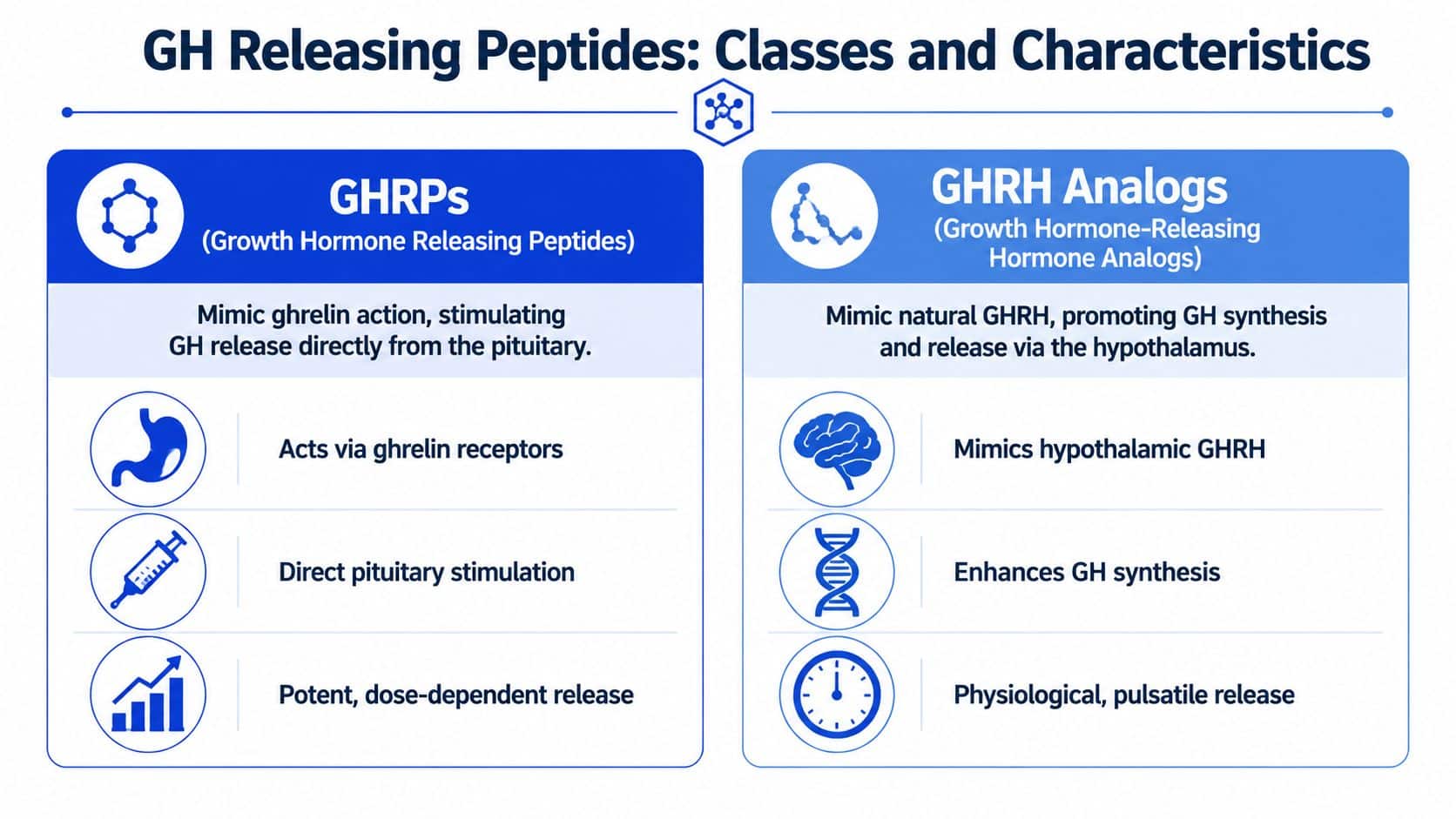
For research purposes, the most useful split is between GHRH analogs and ghrelin mimetics, often grouped under GHRPs. Both can increase endogenous GH release, but they are not interchangeable tools. They probe different control points in the somatotropic axis, and that difference shapes experimental design, timing, and interpretation.
GHRH analogs work through the native GHRH signaling route. In practical terms, they are often chosen when a study is trying to stay close to the physiology of pituitary stimulation by hypothalamic GHRH input.
Common examples include Sermorelin and CJC-1295. These compounds are often discussed together, but their formulation features, pharmacokinetic behavior, and intended research use are not identical. That matters because a prolonged signal and a short signal do not test the same biological question, even if both sit in the same class.
This class is useful when researchers want to examine questions such as:
A helpful comparison is that GHRH analogs act through the axis’s established command pathway. If the experiment asks how closely a model preserves normal hypothalamic-pituitary communication, this class often provides the cleaner probe.
GHRPs serve a different experimental purpose. They stimulate GH release through the ghrelin receptor pathway rather than the GHRH receptor pathway. In the history of the field, this distinction was a major turning point because it showed that more than one receptor system could drive GH secretion.
Researchers commonly encounter compounds such as:
Grouping them under one label is convenient, but it can hide meaningful pharmacologic differences. Individual analogs may differ in receptor selectivity, off-target endocrine effects, and how straightforward the resulting signal is to interpret in a given model system.
That is why compound choice should follow the research question. A study focused on ghrelin-linked secretagogue activity asks a different mechanistic question than a study focused on GHRH-like pituitary stimulation. The readout may be the same hormone, but the upstream biology is different.
The most useful comparison is not “which one raises GH more.” It is “which signaling input does this experiment need?”
| Class | Main pathway emphasis | Research use case |
|---|---|---|
| GHRH analogs | GHRH-linked stimulation | Useful when studying GH regulation closer to the native GHRH axis |
| GHRPs | Ghrelin receptor activation | Useful when isolating ghrelin-linked GH secretagogue effects |
| Combined studies | Complementary signaling inputs | Useful when testing interaction between two distinct control pathways |
The article’s research angle matters for this reason. Consumer-oriented summaries often treat these compounds as variants of the same outcome. Mechanistically, they are better understood as separate probes for different nodes in GH biology. One class helps test GHRH-axis function. The other helps test ghrelin-receptor driven secretory control. Combining them tests pathway interaction rather than simple additive exposure.
A useful analogy is a building with two separate control panels connected to the same output system. Both panels can activate the lights, but they do so through different wiring. If the lights turn on, the result looks similar. If you are studying the wiring, the difference is the entire experiment.
For researchers sourcing actual materials, product labels are only the start. Identity testing, purity data, storage conditions, and lot-level documentation all affect whether a peptide can support reproducible laboratory work. Peptide Warehouse USA is one example of a supplier in this category. The research question should determine whether a given supplier’s documentation and handling specifications are adequate for the assay.
The most useful evidence on gh releasing peptides doesn’t come from generic “benefits” lists. It comes from studies that ask whether these compounds produce distinct, measurable endocrine behavior under defined physiological conditions.

One of the strongest recurring themes is synergy. Researchers have long observed that GHRH-pathway stimulation and GHRP-pathway stimulation can interact in a way that produces a stronger GH response than either signal alone.
That finding matters because it confirms these pathways are distinct but complementary. It also means that a combined protocol is not just “more compound.” It is a different physiological experiment.
A clinical model published in the American Journal of Physiology found that abdominal visceral fat, IGF-I, and IGF-binding protein-3 together explained 60% of the variability in the synergistic GH response to GHRH-GHRP administration (P < 0.001), as reported in this human physiology study on GHRH-GHRP synergy. For researchers, that is a major design clue. Subject characteristics aren’t just background noise. They are part of the mechanism that shapes response.
Many simplified articles fail on this exact point. They treat the peptide as the main variable and the subject as secondary. Endocrinology rarely works that way.
If abdominal visceral fat and endocrine markers strongly shape synergy, then two models exposed to the same protocol may produce different GH outputs for reasons that have nothing to do with peptide quality alone. That affects:
For a visual overview of the broader topic, this explainer may help orient newer readers before they return to the primary literature.
A second interpretation issue is that a larger acute GH pulse doesn’t automatically answer the biological question you care about. If your endpoint is downstream adaptation, tissue response, or axis behavior over time, then pulse timing and baseline physiology may matter more than a single high post-dose value.
Good endocrine data comes from matching the sampling plan to the biology, not from chasing the biggest visible spike.
Why do two labs studying the same GH-releasing peptide sometimes report different signal strength, variability, or assay behavior? One common answer is not receptor biology at all. It is reagent quality and handling history.

For GH peptide research, sourcing is part of experimental design. A peptide vial is not just the starting material. It is also a possible source of hidden variance. If the material contains synthesis byproducts, residual salts, or inflammatory contaminants, the study may end up measuring those variables along with the intended GH-axis effect.
A useful Certificate of Analysis should answer a mechanistic question: what, exactly, is in the vial you plan to test? Label agreement alone is too weak for that purpose. Researchers need identity confirmation, chromatographic purity, peptide content, and contamination data that are relevant to the assay system.
A technical sheet for GHRP-2 lists identity testing along with HPLC purity ≥98.0%, peptide content ≥95%, and endotoxin <1.0 EU/mg in this GHRP-2 analytical profile. Those details matter for a simple reason. In cell work, impurities can create off-target effects. In animal work, endotoxin can shift inflammatory tone and distort endocrine readouts. Even the salt form can change solubility and reconstitution behavior.
A practical intake screen should cover:
This is the research angle that often gets lost in consumer summaries. Different peptide classes are used as tools to probe GH biology, so the material has to be characterized well enough to support the biological question. A poor-quality agonist does not just weaken the signal. It blurs the interpretation of receptor selectivity, timing, and dose response.
Handling errors often masquerade as biological noise.
Peptides are chemically smaller than proteins, but they still have practical weak points. Repeated freeze-thaw cycles can change apparent activity. Incomplete dissolution can produce concentration errors. Light exposure, adsorption to plastics, and inconsistent aliquoting can all widen variance between runs.
The logic is similar to enzyme kinetics. If substrate concentration drifts from tube to tube, the apparent biology starts to reflect preparation error. Peptide experiments behave the same way. Researchers may attribute a weak GH response to model physiology when the actual problem was reconstitution inconsistency or storage history.
One source of confusion is that GH-releasing peptides can act on short time scales, so preanalytical sloppiness has outsized effects. Earlier cited technical information on GHRP-2 notes a rapid post-dose activity window. That matters less as a marketing point than as a sampling problem. If specimen collection is not aligned to the expected pharmacodynamic window, the study can miss the peak and make an active compound look inactive.
Treat every vial as both reagent and variable. Write the intake, storage, reconstitution, aliquoting, labeling, and sampling plan before the first experiment starts, then keep those steps fixed across lots and study days.
Lab note: When peptide data look noisy, review lot records, reconstitution logs, and sample-timing accuracy before revising the biological hypothesis.
GH releasing peptides need to be handled within a clear legal and ethical frame. For laboratory suppliers, these compounds are sold for research, analytical, or in vitro use, not as approved therapeutic products for patient care.
That distinction matters because a research chemical supplier is not the same thing as a compounding pharmacy. Research products are not prepared, dispensed, or represented as patient-specific sterile medications. If a buyer confuses those categories, both the compliance picture and the scientific expectations become distorted.
For institutional work, the safest approach is to document intended use, keep procurement records aligned with protocol scope, and ensure that everyone handling the material understands the boundary between laboratory investigation and clinical administration.
Researchers sometimes talk about compliance as if it sits outside the experiment. It doesn’t. Clear use restrictions, traceable documentation, and appropriate handling standards support cleaner procurement decisions and more defensible work.
That’s especially important in peptide research, where the same compound names often circulate in both scientific and consumer spaces. The responsible standard is straightforward. Use these materials only in legitimate research settings, keep claims proportional to the evidence, and avoid treating experimental secretagogues as if they were approved drugs.
A serious lab doesn’t need hype. It needs documented materials, disciplined methods, and a study design that respects regulatory boundaries.
They stimulate GH release through different receptor pathways. GHRH analogs work through the GHRH side of the axis, while GHRPs act through the ghrelin receptor pathway. In research terms, they are complementary tools, not interchangeable versions of the same tool.
Because combined pathway activation can reveal interaction effects that single-pathway studies can miss. This is useful when the question involves synergy, pituitary responsiveness, or how endocrine context changes the integrated GH signal.
Growth hormone is not secreted as a flat, continuous output. Timing matters. A human study summary indexed in PubMed notes that GH responses to secretagogues can start by 15 minutes, peak at 60 minutes, and return to baseline by 180 minutes, which is why sampling windows are critical in this PubMed summary on secretagogue pulse timing.
If you sample too early, too late, or too infrequently, you may miss the response pattern entirely. That can lead to a bad conclusion, even when the peptide was active.
No. A stronger acute signal doesn’t automatically translate into a more meaningful biological outcome. Pulse dynamics, receptor pathway, and baseline physiology all shape what that GH rise means in context.
Start with fit-for-purpose documentation. Identity testing, purity data, endotoxin review, and lot traceability usually matter more than broad claims about peptide “benefits.” The best purchasing decision is the one that supports reproducible interpretation in your specific assay.
If you’re sourcing compounds for endocrine, analytical, or preclinical work, Peptide Warehouse USA offers research-use peptide products with batch documentation designed for laboratory workflows. Learn more, review available options, and choose materials that match the level of control your study requires.