No products in the cart.



If you search for glow blend peptide, are you looking at a real formula, or just a marketing label that different sellers use for different mixtures?
That question matters more than most buyers realize. In research settings, vague naming creates practical problems. Two products can share the same “glow” label while containing different peptide combinations, different ratios, and different handling requirements. If you’re comparing results across experiments, that ambiguity can undermine the entire study design.
A careful way to think about glow blend peptide is this: it usually refers to a commercially branded peptide stack, not a single standardized compound. For researchers, that means the first job isn’t asking what “glow” promises. It’s asking what is in the vial, what evidence supports each component, and whether the supplier documents purity, ratio, and stability clearly.
A glow blend peptide usually isn’t one defined molecule with a universally accepted formula. In current market use, it’s better understood as a label applied to a peptide combination that is marketed around skin support, repair, recovery, or cosmetic “glow” outcomes.
That sounds simple, but the naming problem is real. One source notes that a major unanswered question is whether Glow Blend is a distinct standardized formula or just a marketing umbrella for different peptide mixes, and it highlights that some descriptions use GHK-Cu + BPC-157 + TB-500 while others add different components, creating a genuine procurement and interpretation problem for labs in this discussion of glow and KLOW ratios.
For a new graduate student, I’d frame it this way. “Glow” is the box label. The actual scientific object is the ingredient list inside the box.
Consumer-facing content often uses the same phrase for at least two different ideas:
That distinction changes how you interpret claims, compare data, and assess fit for a study.
Practical rule: Never treat “glow blend peptide” as a complete description. Treat it as a prompt to request the exact formulation, ratio, and lot-specific documentation.
The broader peptide category also includes blends aimed at recovery, immune support, and cosmetic applications. If you want a more general primer on how clinics and wellness providers talk about peptide categories, this guide on how to enhance your immunity using peptides is useful context because it shows how broad peptide language can become once branding enters the conversation.
For laboratory purposes, a reasonable working definition is narrower. Glow blend peptide often refers to a multi-peptide research stack built around skin- and repair-related mechanisms, most commonly with GHK-Cu as the skin-focused anchor and BPC-157 and TB-500 included for broader tissue-repair and inflammatory pathway interest.
That doesn’t mean every product sold under the name is equivalent. It means the term is only useful once the supplier has translated branding into chemistry.
Most research-oriented versions of glow blend peptide center on three names: GHK-Cu, BPC-157, and TB-500. A research supplier overview describes glow as a three-peptide formulation used to examine extracellular matrix repair, cellular motility, and anti-inflammatory tissue stabilization together in experimental models in this explanation of the GHK-Cu, TB-500, and BPC-157 blend.
That framing is far more useful than cosmetic marketing because it tells you what the blend is trying to test. Each component covers a different biological lane.
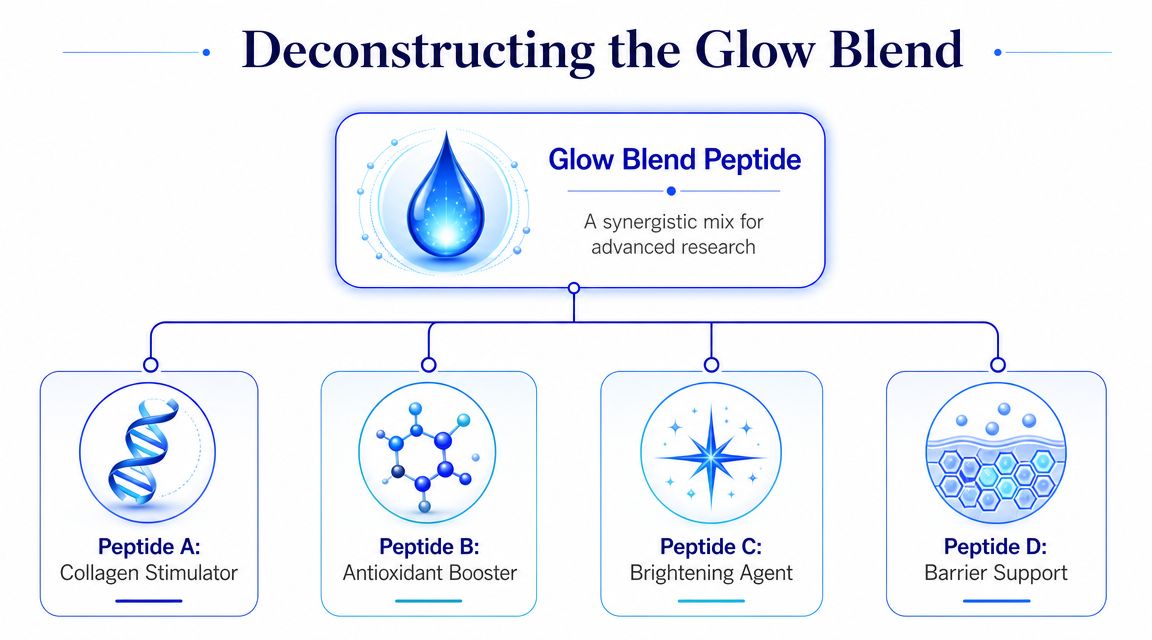
Start with GHK-Cu. This is the component most often associated with skin, collagen-related interest, and tissue remodeling discussions.
Then add TB-500, which researchers often discuss in relation to cell migration and cytoskeletal dynamics. That makes it relevant when you need to observe movement and structural reorganization rather than only matrix signaling.
Finally, BPC-157 enters as the tissue-stabilization and anti-inflammatory interest point. In blend logic, it fills a gap that neither GHK-Cu nor TB-500 covers on its own.
The appeal of the stack isn’t that one peptide does everything. It’s that each one addresses a different part of a broader repair model.
| Peptide Component | Primary Research Focus | Hypothesized Role in Blend |
|---|---|---|
| GHK-Cu | Tissue remodeling, collagen-related signaling, skin-focused pathways | Acts as the matrix and remodeling anchor |
| BPC-157 | Tissue stabilization and anti-inflammatory pathways | Supports local repair conditions in experimental models |
| TB-500 | Cellular motility and cytoskeletal remodeling | Helps model migration and structural reorganization |
A few points usually trip up newer researchers:
If one supplier sells glow blend as GHK-Cu, BPC-157, and TB-500, while another adds different ingredients, the products are not functionally identical. They may share a keyword, but they don’t share a clean experimental identity.
That’s why experienced labs start with composition, not promise language. A peptide blend should be procured like a reagent panel, not like a skincare concept.
The mechanistic case for glow blend peptide usually starts with GHK-Cu, not with the blend as a whole. A peer-reviewed review hosted on PubMed Central describes GHK-Cu as having regenerative and protective actions and notes its ability to modulate gene expression, including suppression of RNA production in 70% of 54 human genes overexpressed in cancer patients in this PubMed Central review of GHK-Cu.
That doesn’t prove a branded glow blend works as a finished product. What it does provide is a serious scientific rationale for why GHK-Cu often serves as the central peptide in these stacks.
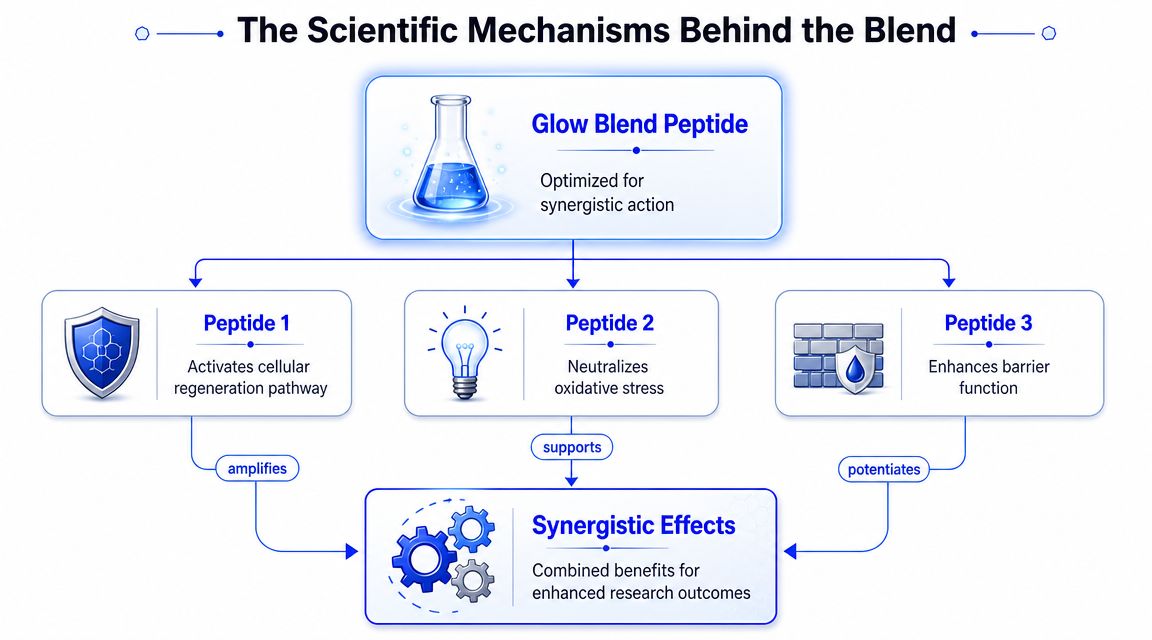
Think of GHK-Cu as the signal peptide in the group. It’s the component most closely tied to remodeling, copper-dependent signaling, and the kind of skin-focused biology that made “glow” branding commercially attractive in the first place.
For a lab team, that matters because it tells you where the strongest evidence base sits. If you removed GHK-Cu from many glow-style blends, the product would lose much of the rationale behind its skin and matrix positioning.
If you’re interested in the practical, non-technical side of collagen-oriented care, these collagen boosting treatments give useful context for why collagen signaling keeps appearing in aesthetic discussions, even though research peptide blends should be evaluated separately from clinical beauty services.
A simple analogy helps. Imagine wound or repair biology as a job site:
The point of the blend is not magical synergy. The point is multi-axis observation.
A single-molecule study can be clean, but it may also be too narrow for questions that involve matrix deposition, migration, and inflammatory tone at the same time. A blend gives researchers a way to test those axes together, provided the study design is disciplined enough to separate signal from noise.
Lab mindset: A blend should answer a multi-variable question. If your experiment only needs one pathway, a single peptide may be the cleaner tool.
That’s where many commercial descriptions go off track. They jump from plausible mechanistic complementarity to implied product-level outcomes. Good research practice stops short of that leap unless the blend itself has been directly evaluated under defined conditions.
In peptide work, the vial matters almost as much as the sequence. A blend can look attractive on paper and still fail in practice if the ratio is unclear, purity isn’t documented, or post-reconstitution handling is sloppy.
Supplier specifications show that GLOW blends are often sold as lyophilized powders with defined component ratios, including one example of a 10 mg vial containing 5 mg GHK-Cu, 2.5 mg BPC-157, and 2.5 mg TB-500, along with HPLC-verified purity and a cited 72 hours of post-reconstitution stability at 4°C in these glow blend peptide product specifications.

A proper review starts with the documents, not the product copy.
Check for:
Reconstitution isn’t just a technical footnote. It affects degradation, adsorption loss, and the comparability of one run to the next.
Keep the practical rules simple:
A peptide blend can fail an experiment without being chemically “bad.” It may simply have been handled inconsistently.
For buyers comparing vendors, one factual option in this category is Peptide Warehouse USA, which states that it supplies lot-supported research peptides with COAs, microbial and endotoxin reports, and stated purity data for laboratory, analytical, and preclinical use.
The right way to view glow blend peptide in a lab is as an experimental tool, not a ready-made answer. Its value appears when the research question requires several repair-related dimensions to be observed together.

A fibroblast study is a straightforward example. A researcher may want to compare a single-agent condition against a blended condition to see whether matrix-related signaling, migration behavior, and local inflammatory markers shift differently when the peptides are combined.
Another useful setting is comparative formulation work. If a lab is trying to understand whether a blended system behaves differently from isolated GHK-Cu, BPC-157, or TB-500 samples, the blend becomes a test object for side-by-side analytical and preclinical screening.
You can also imagine an ex vivo tissue model where the aim isn’t treatment but observation. In that kind of setup, the blend may help generate a more complex repair-like signal environment than one peptide alone.
Glow blend peptide is most defensible in studies that need to ask compound questions such as:
By contrast, it’s less attractive when your question is narrow. If you only need to study one defined pathway, a single peptide usually gives cleaner interpretation.
That’s the basic tradeoff. Blends can model complexity better, but they also create more variables. Good researchers only accept that trade when the study question requires it.
Glow blend peptide sits in a category where branding often moves faster than standardization. That makes ethics and compliance especially important.
A major consumer-facing overview describes glow peptide blend as a commercially branded concept rather than a standardized drug, notes examples of compounded injectable mixtures, and explicitly states that such formulations are not FDA-approved for any indication in this overview of what to know about glow peptide blend.
Words like “glow,” “rejuvenation,” and “recovery” sound harmless, but they can blur categories. A product may be discussed online as if it were a cosmetic enhancer, a wellness injection, and a research reagent all at once.
That’s a problem because those categories don’t share the same evidentiary or regulatory standards.
For labs, the correct posture is conservative:
Compliance point: “Not FDA-approved” is not a slogan. It’s a boundary condition for how the material can be positioned and used.
A research chemical supplier is not the same thing as a compounding pharmacy. The labels, intended use, and legal framework are different.
That means the buyer has responsibilities too. You need to make sure the material is being used strictly for laboratory, analytical, or preclinical purposes, and that personnel understand its status before it ever enters a workflow.
The cleanest labs do one thing well here. They document intended use in plain language and train staff not to drift into consumer or clinical interpretations.
Most problems with glow blend peptide don’t start at the bench. They start at procurement.
The term itself is ambiguous. The science behind one component may be stronger than the science behind the finished blend. And a good-looking product page still doesn’t replace lot documentation. Once you accept those points, buying becomes much easier.
Use this list before approving any vendor:
One useful outside reference for thinking about verification culture is this explainer on NSF certification for supplements. It covers a different product category, but the broader lesson still applies: independent documentation matters more than front-label claims.
A strong procurement process doesn’t just reduce risk. It improves interpretation. When the formula is defined, the purity is documented, and the handling conditions are controlled, your results say more about the biology and less about the supply chain.
If you’re sourcing research-grade peptide materials and want clearer batch documentation, transparent COAs, and products positioned strictly for laboratory use, you can learn more from Peptide Warehouse USA.