No products in the cart.


If you’re trying to buy BPC-157 online, you’ve probably already run into the problem. One site presents it like a wellness product. Another hides behind vague purity claims. A third says “research use only” but then drifts into language that sounds like a treatment pitch.
That mix of signals is exactly why procurement matters more than marketing.
When I evaluate a sensitive compound for lab purchasing, I don’t start with claims about benefits of peptides. I start with status, documentation, traceability, handling, and whether the seller understands the line between a research supply and a consumer health product. With BPC-157, that line matters.
This guide focuses on how to buy BPC-157 online as a research supply, not how to use it clinically. The practical question isn’t just whether a listing looks professional. It’s whether the supplier gives you enough evidence to justify putting that material into a real research workflow.
The online peptide market rewards appearance. Clean product pages, technical jargon, and a posted purity number can make weak suppliers look credible. BPC-157 is where that problem becomes obvious, because many listings are built to attract broad consumer interest even though the compound is better approached as a research procurement decision.
A careful buyer treats the purchase like a vendor qualification exercise. That means checking whether the seller behaves like a research supplier, whether the documentation matches the lot, and whether the product language stays inside compliant boundaries. If a vendor can’t do those things, the rest of the page doesn’t matter.
For this category, the first filter is simple:
Practical rule: If a BPC-157 page spends more space on outcomes than on testing, identity, and batch records, treat it as a risk signal.
That approach saves time. It also prevents a common mistake. Buyers often compare product forms, convenience, and branding before they’ve established whether the seller is even operating in a way that supports valid research procurement.
What works is boring. Current third-party documentation. Clear non-human-use language. A consistent batch record. Contact information that leads to a real support team. Shipping policies that show the seller has thought through product integrity.
What doesn’t work is equally predictable. Vague “high purity” language without supporting reports. Missing lot references. Pages that blur research supply with medical positioning. Sellers who publish dosing suggestions or imply therapeutic outcomes.
A solid procurement process is less about finding the most attractive listing and more about eliminating weak candidates quickly. That’s how experienced buyers protect both research quality and organizational risk.
The regulatory status is the first thing to understand before you buy. Without that context, buyers tend to read the market incorrectly and assume they’re shopping for a normal supplement or medication channel. They aren’t.
BPC-157 sits in a regulatory gray zone. It is not approved for human use, and the FDA has confirmed there is no legal basis for compounding pharmacies to use BPC-157 in compounded medications. It is also on the WADA Prohibited List under S0 “Unapproved Substances,” which reinforces its status as an investigational compound rather than an approved therapeutic product, as noted in this regulatory overview of BPC-157 status.

When a supplier labels BPC-157 as “for research use only”, that isn’t cosmetic language. It defines the transaction. It tells you the product is being sold through research-chemical channels rather than through an approved drug pathway.
That distinction matters because buyers often misread disclaimers as a formality while paying attention to wellness-style messaging. In procurement terms, the disclaimer is the more important signal. It tells you how the supplier categorizes the material and what claims they should not be making.
A compliant listing should stay inside that frame. It should avoid presenting BPC-157 as a consumer treatment product. It also shouldn’t give the impression that the research label is just a legal shield covering what is really a therapeutic sale.
The practical impact is straightforward. You should assess online offers as research-supply purchases, not as therapeutic products. That changes what questions matter.
Instead of asking whether a page sounds convincing, ask:
| Procurement question | Why it matters |
|---|---|
| Is the product clearly marked for research use only? | It shows whether the seller understands the regulatory boundary. |
| Are non-human-use disclaimers visible and consistent? | Mixed messaging is a warning sign. |
| Does the seller avoid therapeutic language? | Medical-style claims create unnecessary risk. |
| Is the documentation built around lot control? | Research supply quality depends on verifiable traceability. |
A supplier who respects the research-only boundary is easier to qualify than one trying to market around it.
There’s also a buyer segment that needs to be even more cautious. Athletes and tested populations face an additional compliance issue because BPC-157 appears on the prohibited list referenced above. For those buyers, regulatory awareness isn’t secondary. It’s part of the procurement decision from the start.
The broader point is that BPC-157 doesn’t fit a normal retail health-product model. Buyers who understand that early make better decisions later, because they stop judging vendors by marketing polish and start judging them by compliance behavior.
A common failure point appears before payment. A supplier shows polished branding, clean product photos, and fast checkout, but cannot produce matching batch records when asked. For a compound like BPC-157, that is not a minor gap. It is a procurement risk.
Qualification should work like a file review, not a marketing review. The question is whether the seller can support the transaction with consistent records, controlled communication, and a process that holds up if a shipment arrives with a discrepancy.
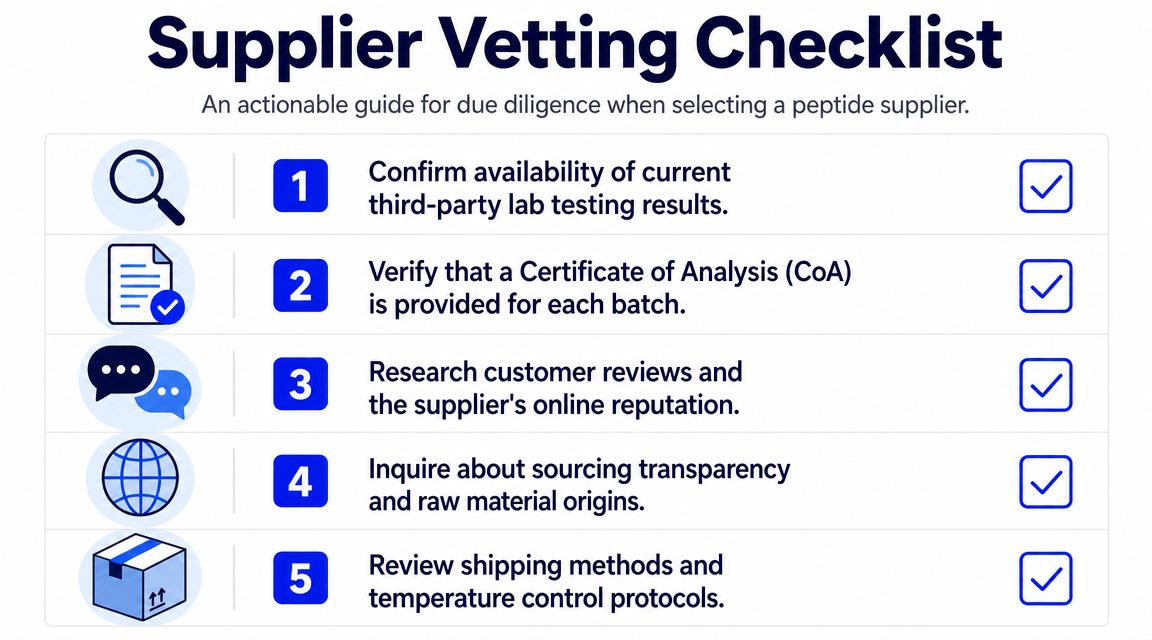
The first screen is simple. Read the site as if you were auditing a vendor file.
Look for a supplier that describes the product in research and analytical terms, keeps non-human-use disclaimers visible, and publishes basic operating information such as contact channels, shipping terms, and return procedures. Clear operating language does not prove quality, but vague or conflicting language often predicts problems later.
The warning signs are usually easy to spot:
Tested athletes and other high-scrutiny buyers need a stricter screen. In that setting, documentation quality matters more than persuasive copy, as discussed in this buyer-focused review of BPC-157 compliance concerns.
Serious suppliers expect pre-purchase questions. They answer them clearly and send records that match the product being offered. Weak suppliers delay, send generic PDFs, or avoid direct confirmation of the lot.
Use a short qualification set:
A supplier does not need a perfect website to pass this stage. It needs controlled paperwork and staff who can answer straightforward questions without changing the story.
Peptide Warehouse USA is one example of a supplier presented in a research-supply format, with stated support for COAs, microbial and endotoxin reports, and batch documentation. Treat that as a starting point for review, not a substitute for your own qualification process.
After you’ve reviewed the paperwork criteria, this overview is worth watching because it reinforces the same boundary between research supply and therapeutic marketing:
Paperwork comes first, but operations still matter. I pay attention to how a supplier handles small process questions, because that usually reflects how they handle packing errors, lot substitutions, and delivery problems.
Check for these signs:
A seller that avoids lot-traceability questions is showing you how it operates. That matters more than polished design.
Good vendor qualification is disciplined and a little repetitive by design. The goal is to reduce avoidable risk before the order is placed, not after the shipment is in hand.
A Certificate of Analysis is the core document in peptide procurement. If you’re going to buy BPC-157 online, the COA is what turns a product page into a verifiable batch purchase.
Many buyers stop at seeing that a COA exists. That isn’t enough. The key question is whether the report is batch-specific, current, readable, and supported by the rest of the file set.
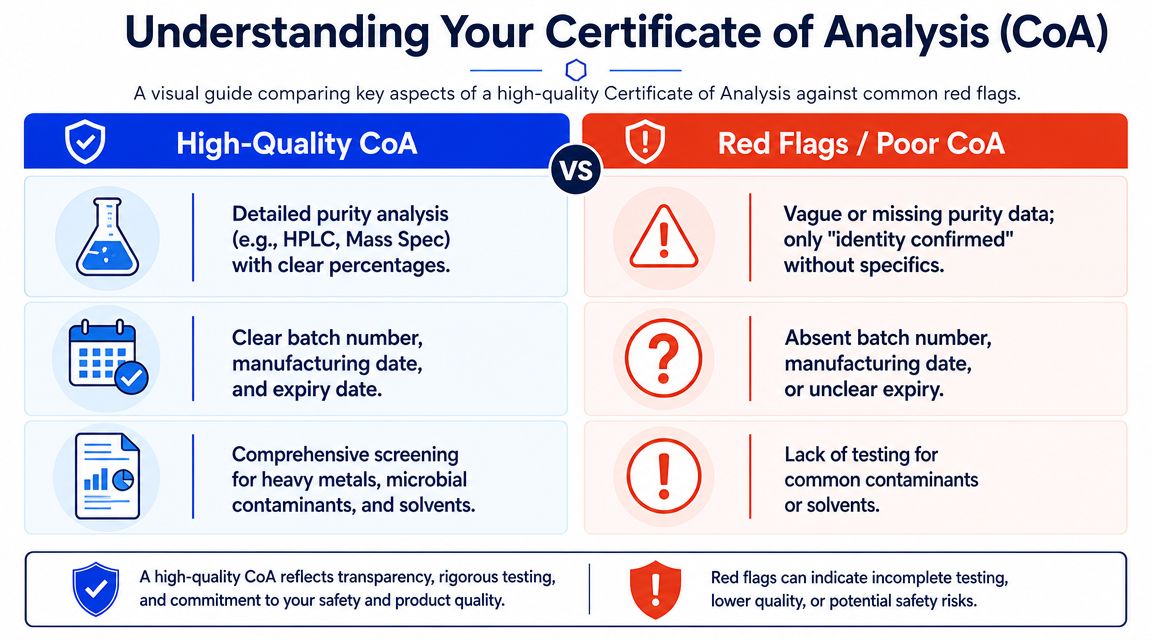
The strongest quality signals for BPC-157 procurement are third-party COAs, stated purity levels, microbial and endotoxin reports, and transparent batch documentation. Those signals matter more than debates about product format, especially where human data is limited, as outlined in this discussion of documentation-focused peptide procurement.
A useful COA should help you answer four basic questions:
| COA element | What you want to confirm |
|---|---|
| Identity | The material tested is actually the peptide named on the label. |
| Purity | The report states a purity result, not just a vague pass statement. |
| Batch details | The lot number on the report matches the vial or packaging. |
| Test timing | The report is recent enough to support the batch being sold. |
Then look beyond the main COA. A strong document package often includes related testing such as microbial or endotoxin reporting, plus clear batch references that tie the reports together.
That’s the difference between documentation that informs a purchase and documentation that exists only to reassure casual shoppers.
A weak COA usually gives itself away fast.
Watch for problems like these:
Buy the batch, not the brand story.
A good procurement habit is to compare three things side by side before approving the order: the product page, the COA, and the expected label information. If the naming, lot references, or test details drift across those records, ask the vendor to reconcile them in writing.
This is also where buyers often overvalue format and undervalue verification. Injectable, capsule, or another presentation can dominate the sales copy, but procurement should stay centered on documented quality. The material’s analytical support matters more than convenience language.
The simplest rule is the one purchasing teams use every day. If the file set can’t survive a basic audit, the order shouldn’t move forward.
Once a supplier is qualified, the next risk point is the transaction itself. Plenty of avoidable problems happen after checkout. Wrong lot, weak packing, poor receipt handling, and sloppy storage can all undermine an otherwise acceptable purchase.
The safest approach is to keep treating the order like a controlled research procurement.
Start by confirming the seller is presenting the item as a research supply purchase, not a therapeutic one. Buyers should check for research-only language, verify non-human-use disclaimers, and avoid vendors that imply medical efficacy or provide dosing advice, as emphasized in this discussion of how buyers should assess BPC-157 listings.
Then tighten the transaction process:
Receiving is a quality step, not just an unpacking step.
Inspect these items right away:
If your team manages temperature-sensitive materials regularly, this guide to pharmaceutical cold chain compliance is a useful operational reference because it frames transport as a chain of custody issue rather than just a shipping detail.
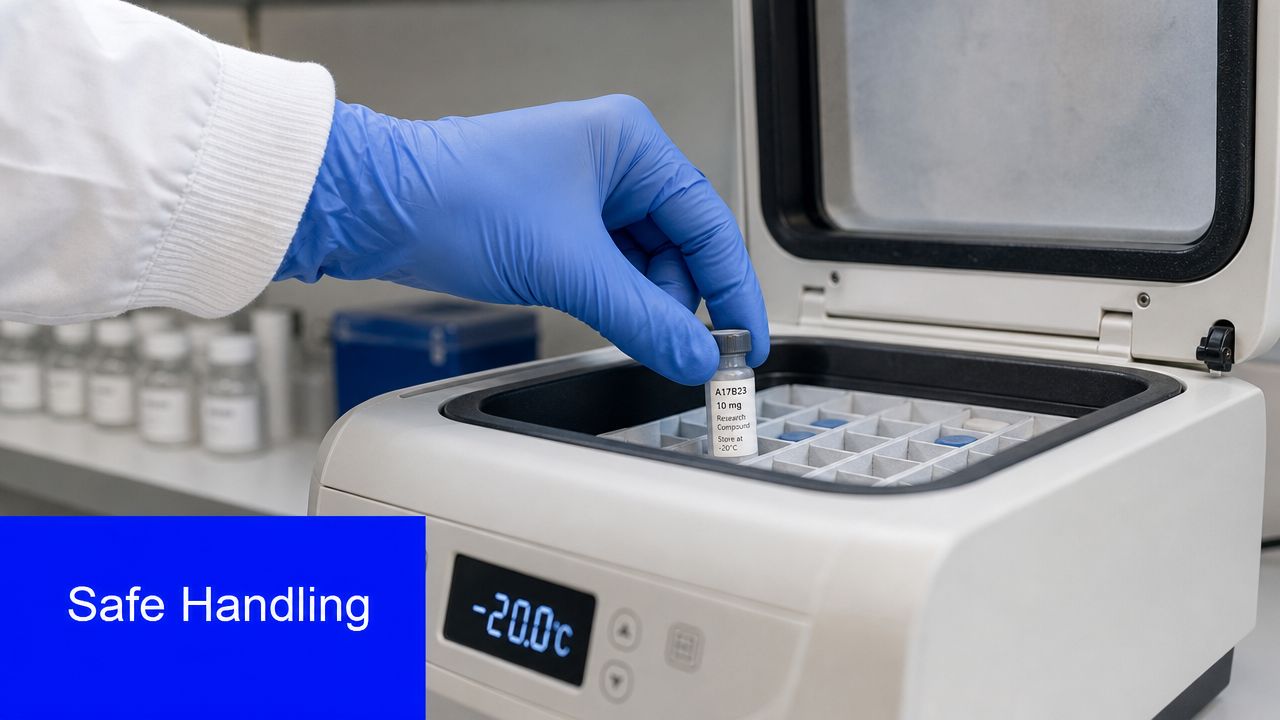
Storage should follow the supplier’s handling guidance and your internal lab controls. The key point is consistency. Heat, light exposure, poor labeling, and casual handling create preventable risk.
Set a basic receiving and storage routine:
Storage errors are procurement errors that happen late.
Many small buyers often lose discipline at this stage. They spend time choosing a vendor, then treat receipt and storage like an afterthought. For a research compound, those final steps are part of the same quality system.
Buying BPC-157 online is easiest when you stop treating it like a general retail purchase. It’s a research procurement decision. That means the primary work happens before checkout and continues after delivery.
The strongest buying framework is simple. Start with regulatory awareness. Then qualify the supplier. Then verify the documentation. Then protect the batch through careful receiving and storage. If any one of those steps breaks down, the purchase becomes harder to defend.
That process also helps cut through noise. You don’t need to chase every product claim or compare every marketing angle. You need a seller that respects research-only boundaries, provides real batch support, and handles fulfillment like a controlled supply chain rather than a hype-driven storefront.
For buyers doing legitimate laboratory, analytical, or preclinical work, quality and traceability are not optional. They’re the baseline. A COA alone isn’t enough if it isn’t current, batch-linked, and supported by the rest of the record. A polished website isn’t enough if the language drifts into implied therapeutic use. And fast checkout isn’t helpful if the receiving process can’t preserve documentation continuity.
The upside is that careful procurement is repeatable. Once you know how to screen language, evaluate records, and check the handoff from vendor to lab, it becomes much easier to identify which suppliers are worth your time.
If you’re ready to explore options, look for vendors that publish transparent testing standards, clear research-use positioning, and lot-specific documentation. That’s the foundation for confident purchasing and cleaner downstream research.
If you want a documentation-first option for research procurement, Peptide Warehouse USA offers US-made research peptides for laboratory and analytical use with lot-supported records such as COAs, microbial and endotoxin reports, and batch documentation. Learn more about its quality and compliance approach before placing your next order.