No products in the cart.


Discussions of BPC-157 for weight loss often miss the central scientific point. BPC-157 is studied primarily as a research peptide with possible effects on tissue repair, angiogenesis, and gastrointestinal healing, not as a direct fat-loss agent.
That distinction changes how the evidence should be read. Claims about weight reduction usually move faster than the data, especially in online marketing language that treats improved recovery or training tolerance as if they were proof of a specific metabolic effect.
Current support for direct fat loss in humans is weak. The more plausible hypothesis is indirect: if a compound improved recovery, reduced discomfort, or supported gut function in a research setting, it could affect exercise consistency or diet adherence. That is different from demonstrating a direct effect on adiposity, energy expenditure, or appetite regulation in controlled human trials.
For researchers, BPC-157 is better understood as an investigational compound with speculative relevance to body composition than as an evidence-based obesity intervention.
The current weight-loss narrative around BPC-157 runs ahead of the evidence.
Search trends and promotional copy often place BPC-157 beside fat loss, body recomposition, and GLP-1 drugs. That association developed far later than the original research interest in the compound. The earlier literature focused on healing, recovery, and tissue-related questions, while the weight-loss framing emerged largely from extrapolation, anecdote, and product positioning. As noted earlier, the published record remains weighted toward preclinical work rather than controlled human studies on obesity or fat mass reduction.
The popular claim is straightforward. BPC-157 reduces body fat.
A careful reading of the evidence leads to a narrower conclusion. There is no established body of controlled human research showing that BPC-157 directly changes appetite, energy expenditure, or fat oxidation in a predictable way. That gap matters because weight loss can follow many indirect pathways, including better training tolerance, less interruption from discomfort, or improved adherence to diet and activity routines. Those outcomes can change body composition without showing that the compound itself acts as a fat-loss agent.
BPC-157 is more accurately framed as a recovery-focused research compound with speculative indirect relevance to body composition, not as a validated intervention for fat loss.
The strongest way to evaluate claims is to separate three categories that are often blended together online:
That distinction changes the interpretation of nearly every bold claim in this area. If a researcher, athlete, or self-experimenter loses weight while using BPC-157, the observation may reflect behavior change, recovery status, concurrent interventions, or expectation effects. It does not establish direct efficacy against adiposity.
For research purposes, that is the central reality. The hype focuses on fat loss. The evidence base supports a much narrower and more cautious discussion.
BPC-157 is a synthetic pentadecapeptide, a short chain of fifteen amino acids that is marketed far more broadly than it has been studied. In the literature, the compound appears mainly in preclinical work focused on repair biology, tissue integrity, and healing-related mechanisms. That matters because a compound associated with recovery research is not the same thing as a compound shown to reduce fat mass in humans.
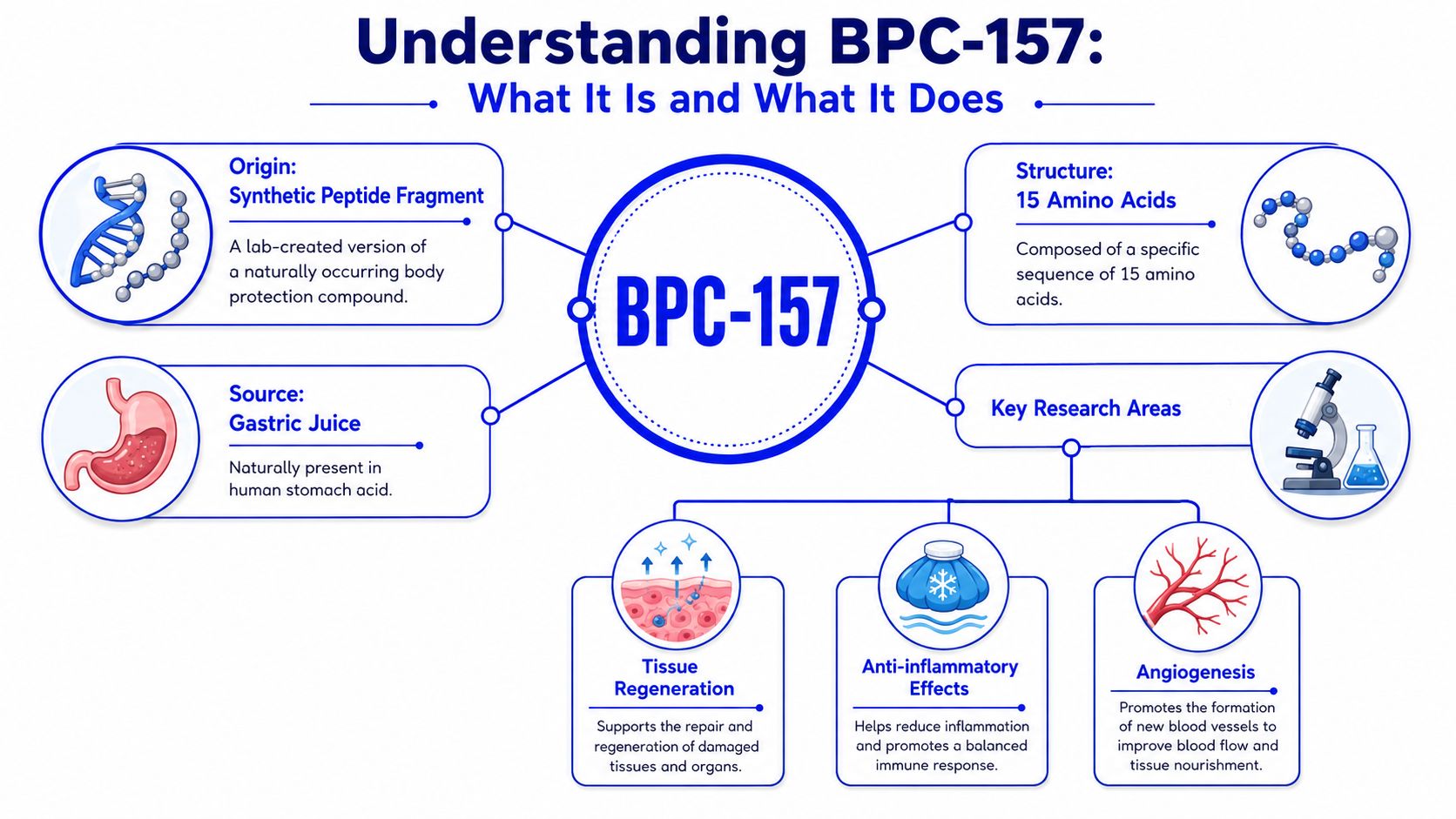
The name stands for Body Protection Compound, which has encouraged expansive claims online. A label can shape expectations, but it does not establish clinical efficacy.
The research history is narrower. Interest in BPC-157 grew from gastric and injury-repair questions, so the recurring themes are mucosal protection, connective tissue healing, angiogenesis-related signaling, and responses to injury models. That background helps explain why discussions of BPC-157 often center on tendons, ligaments, muscle, and the gastrointestinal tract rather than appetite regulation, energy expenditure, or validated obesity endpoints.
A careful summary of the literature looks like this:
This distinction is easy to lose in marketing copy. If a researcher asks what BPC-157 does, the most defensible answer is that it has been investigated primarily as a repair-oriented research peptide in preclinical settings.
What is absent from the literature is as informative as what is present. There is no established basis for describing BPC-157 as an evidence-based weight-loss drug, appetite suppressant, or direct modifier of human adiposity. Claims in those categories move beyond demonstrated findings.
Practical rule: Interpret BPC-157 as a research compound linked mainly to healing and recovery questions, with speculative relevance to body composition and no direct human proof of fat-loss efficacy.
That narrower framing is less exciting than the sales pitch, but it is much closer to the state of the evidence.
The most plausible case for BPC-157 affecting body composition is indirect. Not through a proven lipolytic effect, not through established appetite suppression, and not through a validated obesity mechanism.
Instead, the argument usually runs through recovery. If a researcher assumes the peptide may help with training interruptions, discomfort, or post-exertion recovery, then improved routine consistency could theoretically influence energy balance over time.
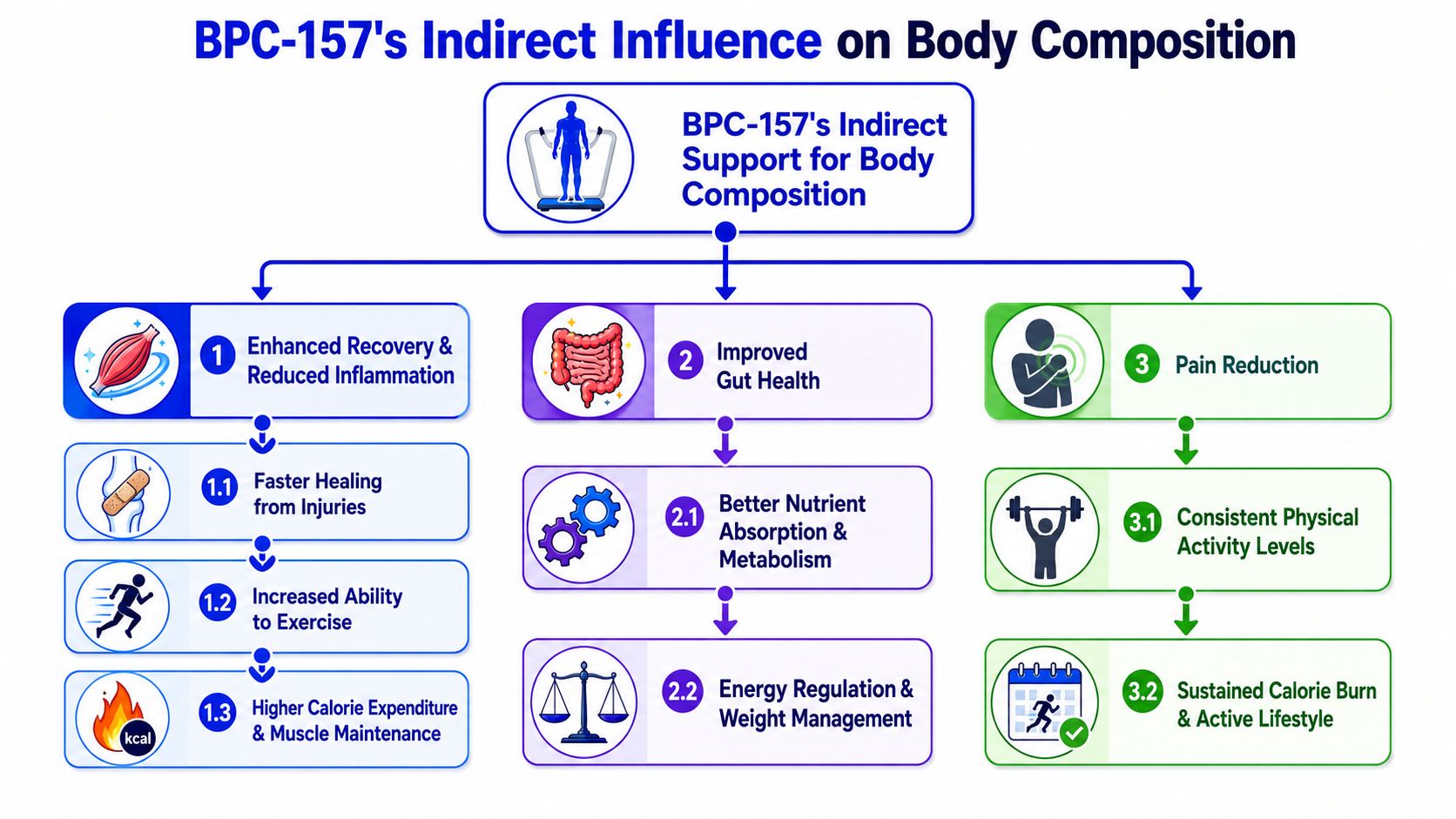
In practice, body composition changes usually come from repeated behaviors. A person trains consistently, maintains a nutrition plan, and avoids long breaks.
If BPC-157 helps preserve consistency through recovery-related effects, then the downstream consequences could include:
None of that proves direct fat loss. It only suggests a route by which a recovery-focused compound might alter the conditions that make fat loss easier.
A useful visual summary appears below.
There’s also a second indirect theory. Because BPC-157 has long been associated with gastric and gut-related research, some people infer that better gut comfort or better routine stability could improve adherence to nutrition targets.
That theory is coherent. It’s also still unproven as a body-fat intervention.
A person who feels better often follows a plan better. That can affect scale weight and body composition. But the causal driver would still be behavior and adherence, not an established “fat-burning peptide” effect.
Marketing usually overreaches at this stage. It takes a plausible chain of events and presents it as a validated outcome.
A recovery advantage is not the same thing as a metabolic effect.
That distinction also matters in current conversations pairing BPC-157 with GLP-1 drugs. Recent commentary notes that “synergy” claims with semaglutide or tirzepatide are largely speculative and not backed by strong human trials, even as anecdotal use in sports and fitness communities continues to grow.
So if BPC-157 influences body composition at all, the most defensible explanation is indirect support of the process, not direct control of fat mass.
Metabolic claims are where the gap between online enthusiasm and actual evidence becomes easiest to see.
The current literature does not establish BPC-157 as a fat-loss agent in humans. The stronger findings come from preclinical work on tissue repair, inflammation, angiogenesis, and gastrointestinal healing. Those areas can generate hypotheses about body composition, but they do not answer the practical metabolic questions researchers would need answered first: Does body fat decrease, under what conditions, compared with what control, and with what durability?
That distinction matters because body weight can change for many reasons. Better training tolerance, less pain-limited inactivity, fewer interruptions to eating patterns, or improved recovery could all alter adherence and energy expenditure without any direct effect on adipose tissue biology. A peptide that helps an animal or person maintain routine is not automatically a peptide that changes metabolic regulation.
A careful reading of the field supports a narrower conclusion. BPC-157 remains biologically interesting, but the evidence base for obesity, fat-mass reduction, or treatment of metabolic disease in humans is still thin. Researchers discussing body composition should frame it as an indirect and unconfirmed possibility, not an established outcome.
That makes BPC-157 very different from interventions supported by human clinical programs, including structured nutrition, exercise, approved pharmacology, and supervised Effective weight reduction programs.
Several gaps keep the metabolic case unsettled:
Those missing pieces are not technicalities. They determine whether a compound belongs in a mechanistic research discussion or in a clinically credible weight-management discussion.
For now, BPC-157 fits the first category. Researchers can justify interest. They cannot justify confident claims that it reduces fat mass in humans.
Safety questions around BPC-157 are often discussed too casually. The regulatory picture alone should make any serious reader more careful.
BPC-157 remains outside mainstream medical approval. It is described as not approved for human use, the U.S. FDA has not approved it, and the World Anti-Doping Agency classifies it as an S0 “Unapproved Substance”, according to this review of BPC-157 safety and regulatory status.
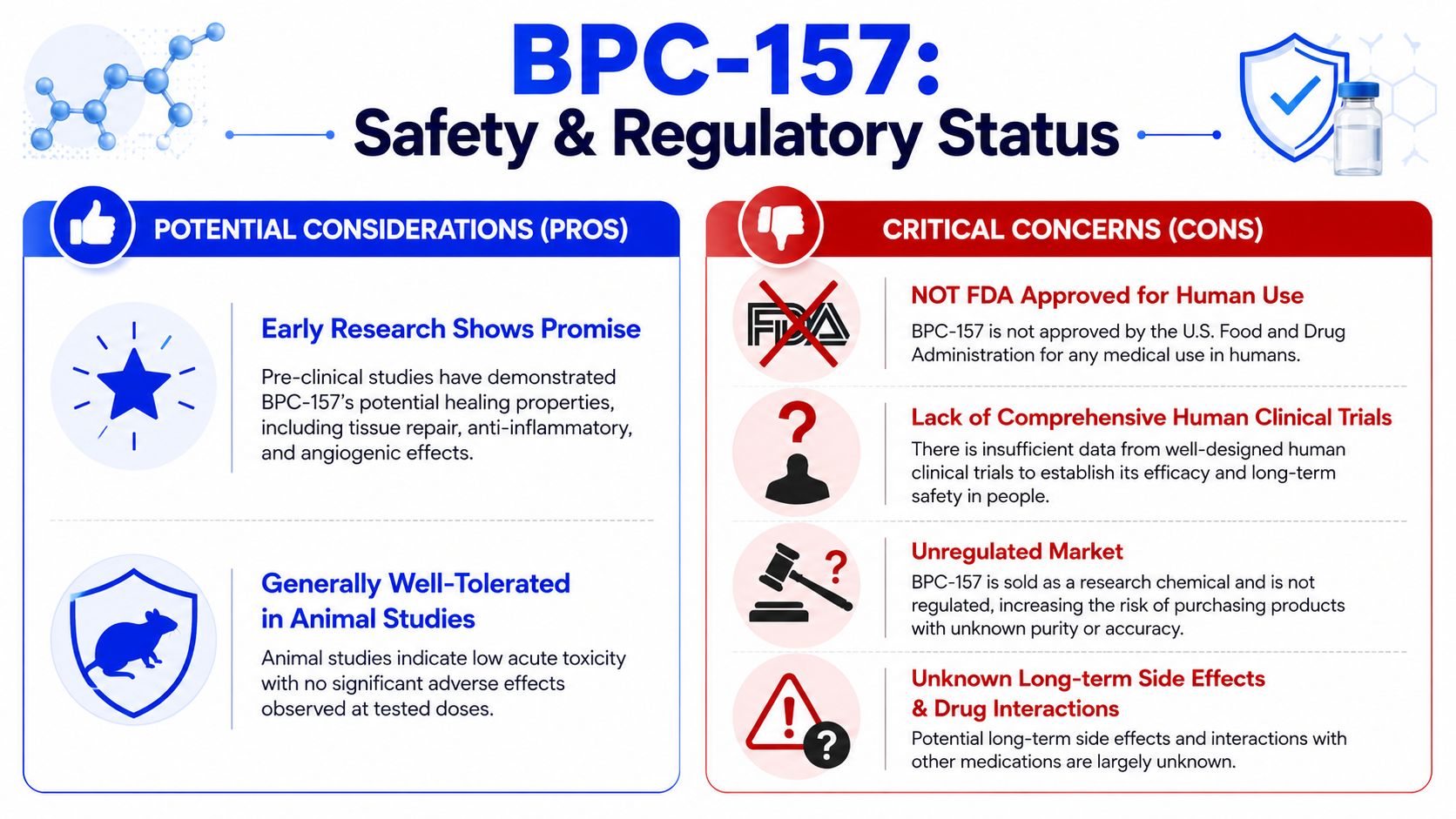
Those facts change how the compound should be framed. It is not a mainstream medical therapy. It is a research compound discussed in a setting where clinical approval has not been established.
For athletes, the anti-doping classification matters. For researchers, the lack of mainstream approval means caution in interpretation, procurement, and claims. For consumers reading online marketing, it means popularity should never be confused with accepted medical status.
The same review notes a very small human safety experience and reports that one pilot study found no clinically meaningful changes in vital signs, ECGs, or laboratory biomarkers. It also describes regenerative effects in animal studies through pathways such as VEGFR2 and Akt-eNOS.
That’s useful context, but it doesn’t close the safety question. Small pilot observations are not the same as broad long-term human safety characterization.
A realistic safety summary looks like this:
The right posture is caution. Not panic, not hype.
If someone’s primary goal is fat loss, BPC-157 is the wrong place to put confidence. The evidence-based route is less glamorous and much more reliable.
Weight management usually improves when fundamentals are handled well and, when appropriate, when proven medical therapies are considered under professional supervision. That’s what separates a speculative add-on from a validated approach.
The strongest non-speculative strategies are familiar because they work across many settings:
For people exploring structured care, resources on Effective weight reduction programs can help show what a more established treatment pathway looks like. That’s especially useful when comparing speculative peptide claims against interventions designed around recognized weight-management principles.
If fat loss is the goal, use tools with direct evidence for fat loss.
| Strategy | Level of Evidence | Primary Mechanism |
|---|---|---|
| Calorie deficit | Established | Reduces energy intake relative to expenditure |
| Resistance training | Established | Preserves lean mass and supports body composition |
| Protein-focused nutrition | Established | Improves satiety and lean-mass retention |
| Sleep and stress optimization | Established | Supports appetite regulation and routine adherence |
| FDA-approved GLP-1-based therapy | Established within approved use | Directly targets appetite and metabolic pathways |
| BPC-157 | Limited for weight management | Theoretical indirect support through recovery-related factors |
That table highlights a key issue. BPC-157 doesn’t sit in the same category as proven weight-loss strategies. It sits in the category of a research compound that may affect adjacent variables, but has not established direct efficacy for fat loss.
BPC-157 is a serious research topic, but not for the reason many weight-loss articles suggest. Its main scientific identity comes from tissue repair, recovery, and regenerative questions. The case for BPC-157 for weight loss rests mostly on indirect theories, not definitive human proof.
That distinction protects researchers from a common mistake. They see plausible mechanisms, anecdotal enthusiasm, and broad online marketing, then assume the compound has already crossed into evidence-based metabolic use. It hasn’t.
A careful reading leads to a narrower conclusion. BPC-157 may be relevant to body composition only if recovery, training consistency, or routine adherence improve. Even then, that would not make it a proven fat-loss agent. In research terms, interest is justified. Confidence is not.
For laboratories studying peptides, quality and documentation matter as much as theory. Explore the Peptide Warehouse USA catalog to learn more about third-party tested research compounds for laboratory and analytical use only.