No products in the cart.



Cartilage research matters because the clinical problem is enormous. The CDC estimates that 32.5 million adults in the United States had osteoarthritis in 2024, and the WHO reports that 528 million people globally were affected in 2019, up 113% since 1990 (cartilage-supportive research context). Against that backdrop, interest in Cartalax has grown for a simple reason: it is discussed as a cartilage-targeted peptide rather than a general joint supplement.
If you’re looking into Cartalax peptide benefits, the useful question isn’t whether the compound has been surrounded by hype. It has. The better question is which claims are directly tied to cartilage biology, and which ones drift into broad anti-aging speculation without solid human evidence.
For researchers, clinicians following the literature, and informed buyers in the research-peptide market, that distinction matters. Practical management of joint issues still relies on basics such as load management, rehab, and movement quality. For readers also interested in non-compound support strategies, this roundup of clinician-approved knee exercises is a useful companion resource.
Osteoarthritis isn’t a niche problem. It sits at the center of aging, mobility loss, chronic pain, and long-term tissue degeneration. That is why cartilage-supportive compounds continue to attract attention in translational research, even when the compounds themselves remain investigational.
Cartalax belongs to that category. In the literature and review-style summaries, it is framed as a synthetic tripeptide studied for cartilage-focused effects, particularly around extracellular matrix maintenance. That puts it in a very different bucket from broad wellness supplements or generic recovery products.
Practical rule: When evaluating Cartalax peptide benefits, start with cartilage biology. If a claim doesn’t clearly connect to chondrocytes, matrix turnover, or joint tissue maintenance, it usually moves beyond the strongest support available.
What makes the compound interesting is not that it promises a miracle. It doesn’t. What makes it worth discussing is that the research framing is unusually specific. Cartalax is investigated in relation to collagen and proteoglycan synthesis, which are the core structural components that help cartilage handle load and absorb shock.
That specificity also helps separate serious inquiry from sales language. A researcher can ask focused questions. Does the peptide alter gene expression in cartilage cells? Does it support matrix maintenance? Does it reduce degradative signaling? Those are answerable research questions. Claims about whole-body rejuvenation are much harder to defend with the evidence currently available.
Cartalax is typically described as a synthetic tripeptide with the amino-acid sequence AED. One secondary source notes that this sequence resembles a region of the alpha-1 chain of type XI collagen, a cartilage-associated structural protein, which helps explain why Cartalax is positioned as a cartilage-targeted compound rather than a general peptide of unknown relevance.
That design logic matters. In peptide research, sequence isn’t just chemistry trivia. It often determines the tissue context in which a compound is explored and the type of cellular behavior investigators monitor.
Cartalax is generally grouped with cartilage-targeted bioregulatory peptides. That label suggests a signaling role, not a nutritional one. Researchers don’t usually approach it the way they approach glucosamine, collagen powder, or broad-spectrum anti-inflammatory ingredients.
Instead, the working idea is narrower and more mechanistic:
This is why the compound gets attention in cartilage degeneration models. It isn’t marketed in the research context as a simple building block. It’s discussed as a signal-like molecule that may help steer how cartilage cells behave.
Cartalax shouldn’t be treated as a validated clinical therapy. It is also not the same thing as a conventional joint-support ingredient with a large Western consumer literature behind it.
Cartalax makes the most sense when viewed as a research-stage peptide with a cartilage-specific hypothesis, not as a proven treatment and not as a catch-all longevity tool.
That distinction keeps expectations realistic. If you’re evaluating Cartalax peptide benefits seriously, the compound is most compelling when the question is tissue-specific cartilage support under research conditions.
The central claim around Cartalax is that it may act at the level of gene expression in chondrocytes, the cells responsible for maintaining cartilage. Secondary literature describes proposed effects on collagen, proteoglycan, and aggrecan synthesis, along with suppression of matrix-degrading enzymes such as MMPs (cartilage-targeted bioregulatory peptide research summary).
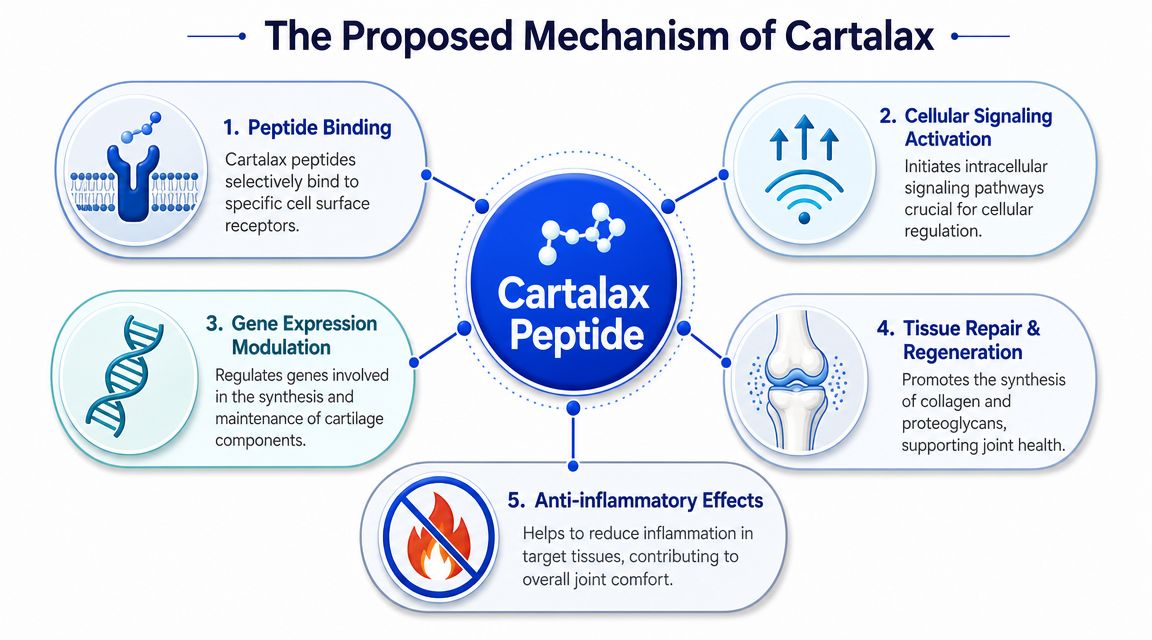
Cartilage fails slowly. Chondrocytes don’t just need to survive. They need to maintain matrix composition over time while resisting degradative pressure. In practical terms, that means preserving the balance between synthesis and breakdown.
Cartalax is interesting because the proposed mechanism points toward that balance. If a compound encourages production of structural matrix components while reducing matrix degradation, it may support tissue maintenance rather than changing symptom perception.
A useful analogy is a biochemical instruction set. The peptide isn’t conceptualized as raw material for cartilage. It’s framed more like a signal that may nudge cartilage cells toward a maintenance-oriented program.
If the hypothesis is right, the expected downstream effects are specific:
That matters because many joint-oriented interventions are judged mainly by short-term symptom change. Cartalax is different in concept. The research interest is more structural. The question is whether the peptide can influence the cellular program that maintains extracellular matrix integrity.
Lab perspective: A cartilage-targeted peptide is only as interesting as the markers it moves. In Cartalax research, matrix synthesis and matrix preservation are the key readouts, not vague claims about feeling better.
What doesn’t work in this context is inflating the mechanism beyond what the evidence supports. Some write-ups stretch Cartalax into broad mitochondrial, metabolic, or systemic anti-aging narratives. The cartilage mechanism does not automatically validate those broader interpretations. A tissue-specific gene-expression hypothesis should stay tissue-specific until separate evidence shows otherwise.
Consumers looking for Cartalax peptide benefits often seek a clear answer. The honest answer is that the strongest discussion remains centered on cartilage biology, not generalized anti-aging outcomes. In research terms, the peptide is most often considered for matrix preservation, cartilage support, and changes related to joint function.
The proposed benefits follow directly from the cartilage-focused mechanism:
The weak point in current content is scope creep. Some recent discussions push Cartalax into longevity, kidney protection, mitochondrial stress response, fibroblast aging, appetite, and metabolism. The best-supported summaries still point back to cartilage-focused biology and note that broader claims appear to rest on early cell-culture or hypothesis-level discussion rather than validated human outcomes (broader-claim caution around Cartalax).
That doesn’t mean those ideas are impossible. It means they aren’t the defensible core of the compound right now.
| Research Area | Proposed Mechanism | Studied Outcome |
|---|---|---|
| Cartilage matrix maintenance | Influence on collagen, proteoglycan, and aggrecan synthesis | Support for extracellular matrix integrity |
| Chondrocyte regulation | Gene-expression modulation in cartilage cells | Shift toward maintenance-focused cellular behavior |
| Matrix preservation | Suppression of matrix-degrading enzymes such as MMPs | Reduced cartilage breakdown pressure |
| Joint function models | Combined structural and local signaling effects | Mobility- and comfort-related changes in observational settings |
| Cartilage-focused peptide screening | Tissue-targeted bioregulation | Differentiation from general joint supplements |
For researchers building a decision framework, Cartalax makes the most sense in models where cartilage turnover is the endpoint. It makes much less sense as a catch-all peptide for every age-related complaint.
The evidence base around Cartalax is best described as preclinical plus observational, not modern large-scale randomized validation. That doesn’t make it irrelevant. It does change how much confidence you should place in outcome claims.

Historical summaries describe Cartalax in osteoarthritis-focused protocols using 10 mg daily in repeated short cycles. One summary reports treatment periods of 2 to 6 months, with outcomes such as 20% to 40% pain reduction and 15% to 30% mobility improvement in Russian observational studies, while another series reports 68.5% of participants noted reduced joint pain and better motility (historical observational summary of Cartalax protocols).
Those numbers are the reason Cartalax still gets discussed. They suggest the peptide’s early reputation came from symptom-oriented orthopedic observations paired with a plausible tissue-level mechanism.
Still, observational data can overstate confidence. Without rigorous randomization, placebo control, standardized outcome handling, and broad independent replication, it’s hard to know how much of the observed effect is attributable to the compound itself.
The most useful reading of the early evidence is cautious optimism. There is enough signal to justify continued research, but not enough to treat Cartalax as settled clinical science.
A short visual summary helps frame that balance:
What works in Cartalax discussions is specificity. The cartilage mechanism and early orthopedic observations line up reasonably well. What does not work is pretending those reports carry the same weight as contemporary randomized trials.
A careful reader should separate three layers of evidence:
That hierarchy matters. It keeps the conversation evidence-based and prevents overstating what remains an investigational compound.
Cartalax should be handled as an investigational research compound. It is not FDA-approved, and the most defensible discussions stay focused on cartilage biology rather than broad therapeutic promises. Recent content has expanded the peptide into longevity and metabolic claims, but those assertions appear to rest on early or hypothesis-level discussion rather than validated human outcomes.
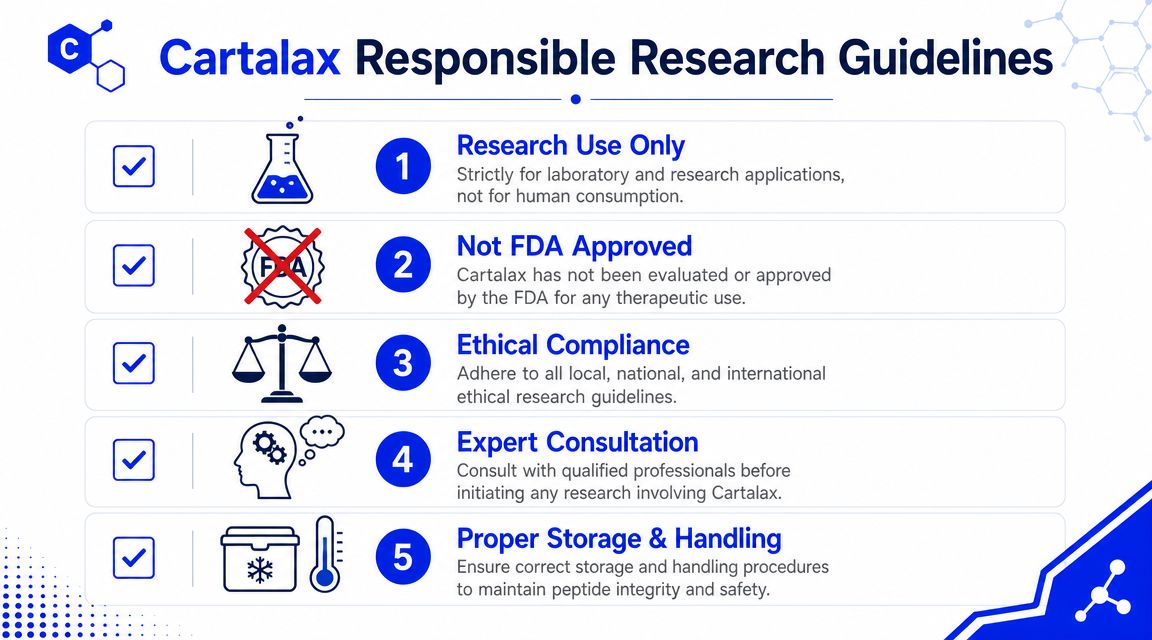
The first filter is simple. Ask whether a claim is grounded in cartilage-focused research or whether it has been layered on top of the same small evidence base.
Claims worth taking seriously usually have these features:
Claims that usually don’t hold up are the ones that stretch Cartalax into a universal anti-aging tool without separate evidence.
Research discipline matters more than marketing language. If a peptide is sold on broad promises but supported by narrow data, trust the narrow data.
For any peptide study, sourcing quality directly affects interpretability. A poor-quality sample can invalidate otherwise sound work. That’s why researchers should look for a Certificate of Analysis (COA) and related batch documentation that addresses identity, purity, and contamination checks.
For practical handling, reconstitution and storage procedures also need to be disciplined. This Herbilabs’ guide to peptide safety is a useful reference for general peptide preparation practices in a research setting.
When evaluating suppliers, look for:
In that context, Peptide Warehouse USA is one example of a research supplier that states batch testing, COA availability, and research-use-only positioning for its catalog, including Cartalax-related listings. That doesn’t replace independent verification, but it is the right type of documentation to look for.
Cartalax is most compelling when it stays in its proper lane. It is a cartilage-targeted bioregulatory peptide discussed for possible effects on chondrocyte behavior, extracellular matrix maintenance, and cartilage preservation. That is the strongest case for Cartalax peptide benefits in the current literature.
The weaker case is the inflated one. Broad anti-aging and metabolic claims go beyond what the available support can defend. For researchers and informed buyers, the practical takeaway is straightforward. Treat Cartalax as a research-stage compound with a cartilage-specific hypothesis, not as a proven systemic solution.
The next step for the field is better validation. More rigorous replication, clearer human study design, and tighter endpoint reporting would do more for Cartalax than any amount of marketing. Until then, careful sourcing and disciplined interpretation remain the right approach.
If you’re sourcing research compounds for cartilage-focused work, Peptide Warehouse USA offers Cartalax and other research peptides for laboratory, analytical, and preclinical use. Learn more, review available documentation, and explore options that fit a research-only workflow.