No products in the cart.



If you search “what is MGF peptide,” you’ll quickly run into a problem. Many pages treat MGF as if it were one simple compound, when the literature points to a more complicated identity.
That confusion matters. In research contexts, MGF refers to a stress-responsive product of the IGF-1 gene, but people often mix together the full splice variant, its E-domain, and the short C-terminal peptide fragment used in laboratory work. Those are related, but they aren’t interchangeable.
A precise way to frame it is this: mechano growth factor is best understood as a 24-amino-acid C-terminal E-peptide fragment of the IGF-1 gene produced by alternative splicing in response to mechanical stress, and preclinical work has reported measurable anabolic activity, including an osteoblast cell study showing about 67% increased proliferation at 1 nM (Superpower’s MGF research overview). That makes MGF interesting scientifically, but it does not turn it into a clinically established human-use compound.
Most of the serious discussion belongs in a research-only frame. The strongest evidence base still comes from cell models, animal work, and delivery experiments, not substantial human clinical trials. If you want to understand MGF clearly, the key is to separate its molecular identity from the marketing language built around it.
MGF peptide sits in an unusual spot in peptide science. It’s often discussed like a muscle-building product, yet its scientific identity is narrower and more specific. Researchers study it because it appears during local tissue stress responses, especially when tissue experiences mechanical loading or hypoxic conditions.
The easiest mental model is to think of the IGF-1 gene as a recipe that can be edited into different versions. One of those edited outputs is associated with MGF biology. That means MGF isn’t just “another name for IGF-1.” It comes from the same gene family, but its structure and signaling behavior differ.
A second source of confusion is form. Some papers discuss IGF-1Ec in humans or IGF-1Eb in rodents. Others focus on the MGF-Ct24E fragment, which is the short C-terminal peptide commonly synthesized for experiments. Search results often blur those together, even though the literature distinguishes the splice variant from its cleavage products and notes that MGF-related fragments can signal differently from mature IGF-1 (review of IGF-1 isoforms and MGF-related fragments).
Practical rule: When someone says “MGF,” ask which form they mean. The full splice variant and the short C-terminal peptide are related, but they aren’t the same experimental object.
That distinction is the difference between a vague label and a usable scientific concept.
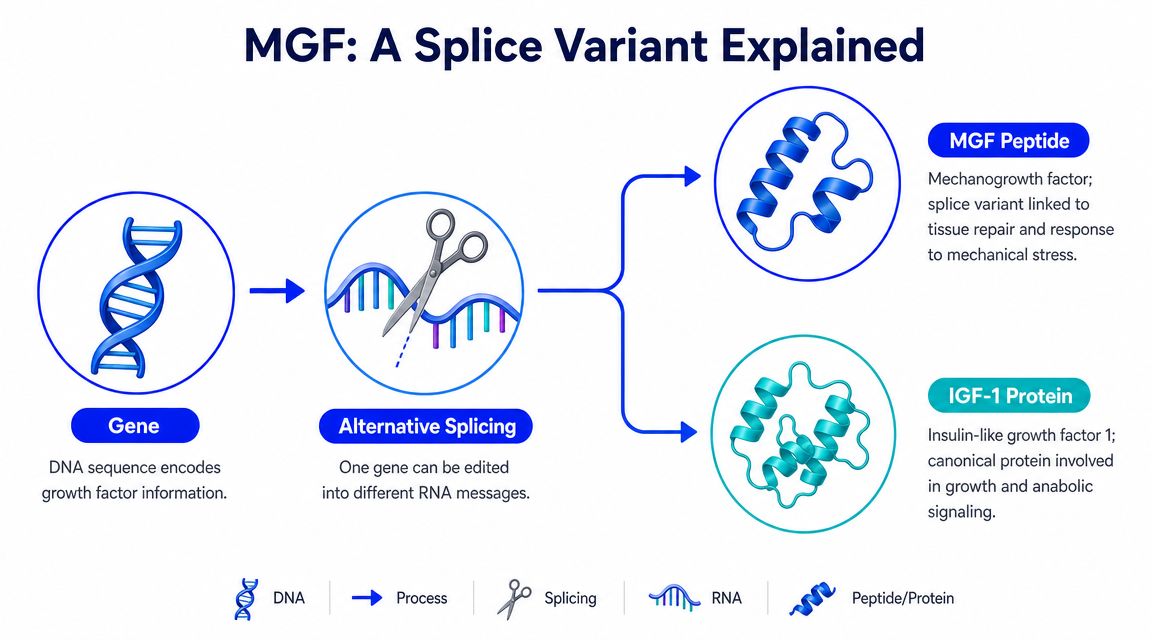
The phrase alternative splicing sounds technical, but the logic is simple. A gene can produce different RNA transcripts depending on how its segments are assembled. The underlying gene hasn’t changed. The output has.
That’s the right frame for MGF. In humans, MGF is associated with the IGF-1Ec splice variant. In rodents, the related form is commonly called IGF-1Eb. The structural feature people focus on is the unique E-domain insert generated through that splicing event.
One reported human C-terminal sequence for MGF is the 24-amino-acid peptide YQPPSTNKNTKSQRRKGSTFEERK (NovoPro’s sequence summary for MGF). That sequence matters because it gives MGF-related biology a structural identity separate from mature IGF-1.
Here, many readers get tripped up.
There are at least two layers to keep straight:
| Form | What it refers to | Why it matters |
|---|---|---|
| IGF-1Ec / IGF-1Eb | The splice variant transcript or isoform context | Describes the gene-level variant produced under specific stress conditions |
| MGF-Ct24E | The short C-terminal peptide fragment | Often the actual molecule used in peptide and cell research |
Researchers often use the short fragment because it’s a defined experimental material. But that doesn’t mean the fragment is identical to the full biological context in which the splice variant is produced inside tissue.
A good analogy is this. The splice variant is the whole paragraph. The C-terminal fragment is one sentence extracted from it because that sentence appears biologically active and experimentally tractable.
The most common mistake in MGF discussions is collapsing gene splice biology, peptide fragment chemistry, and applied claims into one bucket.
If you keep the forms separate, the science becomes much easier to follow. MGF is not a generic “growth peptide.” It’s a splice-variant-associated signaling peptide system with a specific structural origin.
MGF-related signaling is typically described as a local repair response. Mechanical loading or hypoxic stress appears to trigger production of the splice variant, and the downstream effect is less about general endocrine growth and more about signaling at the stressed tissue site.
That’s why MGF is often linked in preclinical work to satellite-cell activation, tissue repair signaling, and MAPK/Erk1/2 pathway activity, rather than being framed as a standard hormone-like growth factor with approved clinical use. In plain language, it behaves more like a local “repair alert” than a whole-body growth instruction.
If you compare it with a construction site, mature IGF-1 is closer to a broader project signal that supports growth processes. MGF acts more like the first radio call that tells nearby repair crews where damage occurred.
The interest in MGF comes from the type of cellular events it appears to influence in laboratory models:
This doesn’t mean the peptide has established clinical utility. It means researchers see a plausible mechanistic role in early repair signaling and cell response.
In MGF research, the important question usually isn’t “Does it grow tissue?” It’s “Which cells respond, through which pathway, under what local conditions?”
That shift in wording keeps the discussion grounded in experimental biology instead of hype.
A lot of online confusion disappears once you stop treating MGF and IGF-1 as synonyms. They’re connected, but they don’t do the same job in the same way.
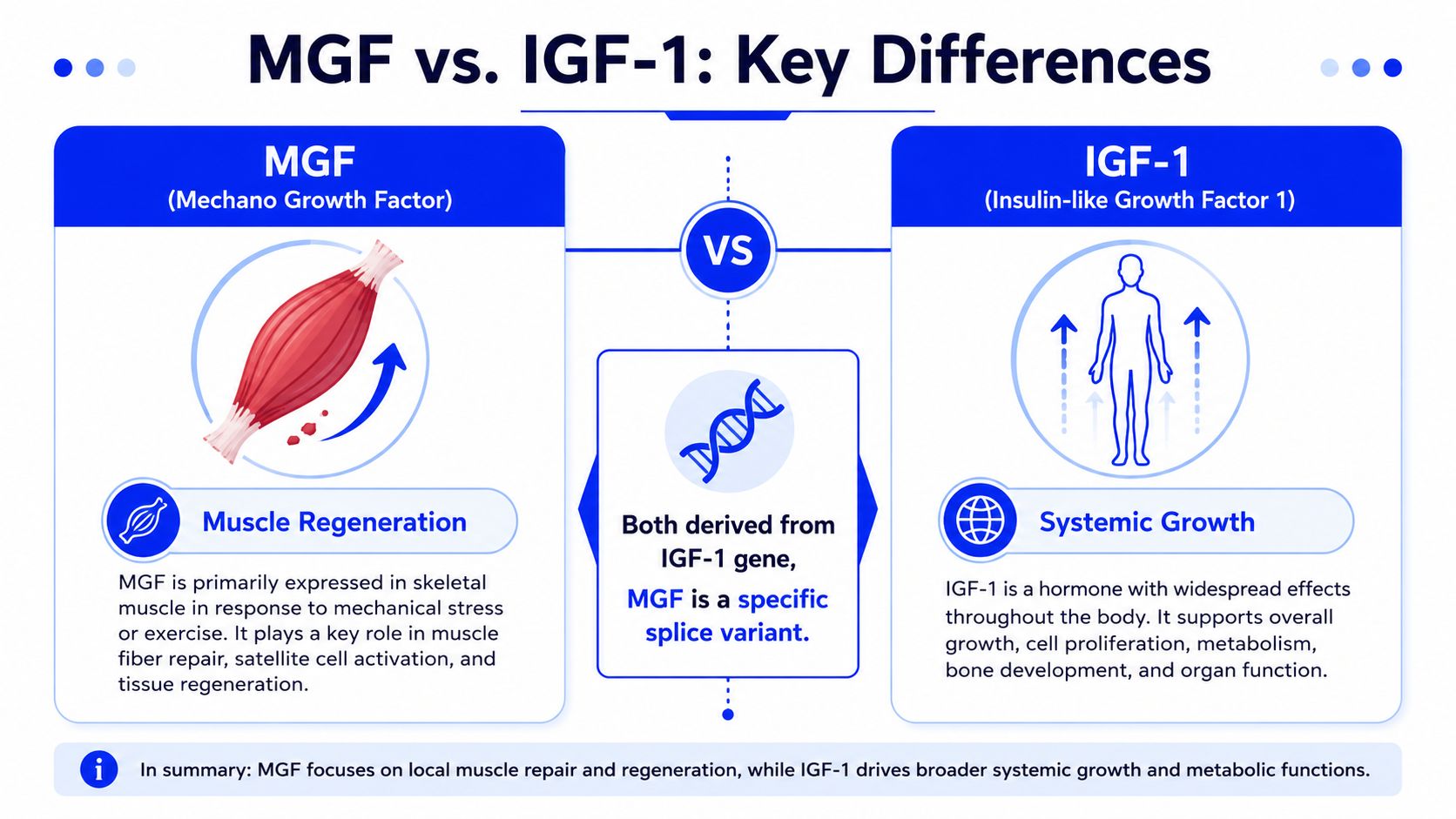
Both originate from the IGF-1 gene, but MGF is a splice variant-associated form, while mature IGF-1 is the better-known growth factor product. That shared origin is real. The downstream identity is not the same.
MGF is generally discussed as stress-induced and locally responsive. IGF-1 is more often understood in a broader growth-regulation context. So even before you get to receptors and pathways, the biological framing already differs.
For readers interested in recovery science more broadly, clinical rehabilitation fields such as expert physical therapy for wound care offer a useful contrast. Those settings deal with real-world tissue recovery under established care models, while MGF remains a research-stage molecule studied mainly in controlled laboratory systems.
A visual summary can help anchor the distinction:
| Feature | MGF | IGF-1 |
|---|---|---|
| Origin | Splice variant-associated output of the IGF-1 gene | Mature IGF-1 growth factor form |
| Common trigger | Mechanical or hypoxic stress in tissue | Broader physiological regulation |
| Typical scope | Local repair signaling | Wider growth-related signaling |
| Research interest | Satellite cells, repair initiation, stress response | Growth, metabolism, broader anabolic pathways |
Use that table as a discipline check. If a claim about MGF sounds identical to generic IGF-1 marketing, it’s probably oversimplified.
What, exactly, has MGF research shown so far. Mostly this: the signal is interesting in controlled systems, but the evidence base still sits far closer to bench science than to clinical medicine.
That distinction matters even more because “MGF” can refer to two related but different things. Some papers discuss the IGF-1Ec splice variant as a gene product. Others test the shorter C-terminal peptide fragment often called MGF-Ct24E. If those are treated as interchangeable, the literature can look more consistent than it really is. A splice variant is the full transcript context. A peptide fragment is one selected portion of that output. Those are connected ideas, but not the same experimental object.
Across preclinical models, investigators have examined MGF-related constructs in muscle biology, wound repair, cartilage studies, bone cell activity, and neural tissue questions. The clearest signal is not a finished therapy story. It is a mechanistic story. Researchers are asking whether stress-responsive IGF-1 pathway variants or derived peptide fragments can alter how cells enter repair programs, proliferate, or respond to injury.
Bone-cell work is a useful example. In osteoblast culture systems, investigators have reported that an MGF-derived C-terminal peptide can stimulate proliferation under laboratory conditions. That finding supports a narrow and important point: the peptide fragment is biologically active in vitro. It does not, by itself, show clinical benefit in people, and it does not prove that every “MGF” construct behaves the same way.
The human evidence gap remains large. A published review in Cureus describes MGF as a molecule with substantial preclinical interest but limited clinical validation, with much of the literature centered on cellular and animal models rather than controlled human outcomes (Cureus review of MGF and its research status).
A useful way to read this literature is to separate three questions that are often blurred together.
Researchers who follow translational work across difficult conditions may also find value in broader reporting on current scientific developments in rare diseases, where the same hierarchy of evidence applies. Mechanistic promise can justify more research. It cannot substitute for clinical proof.
MGF is best understood as a research-stage concept with active preclinical relevance. For now, that means laboratory interpretation first, and clinical restraint second.

For laboratory teams, MGF is less about theory and more about control. If the material is poorly handled, you can’t tell whether a result reflects biology or a preparation error.
A sensible workflow usually includes:
Some of the most useful MGF research isn’t just about the peptide itself. It’s about how delivery changes exposure.
A preclinical study using PEGDMA microrods showed measurable bioactivity with sustained release. An aliquot with a theoretical payload of roughly 4,600 ng released about 570 ng over 14 days, indicating that localized sustained delivery can be a key experimental design variable in tissue-engineering work (preclinical MGF microrod delivery study).
That finding matters for a simple reason. A short pulse and a slow local release are not biologically equivalent, even when the same peptide is involved.
For experimental planning, keep these questions front and center:
What form is being delivered
The fragment, analog, and splice-variant context may lead to different interpretations.
How long is local exposure maintained
Tissue response can depend on persistence, not just presence.
Which readout are you prioritizing
Proliferation, survival, migration, and repair signaling are related but distinct outcomes.
What controls will separate vehicle effects from peptide effects
Delivery systems can introduce confounding variables if you don’t design carefully.

For MGF research, sourcing isn’t a procurement detail. It’s part of experimental validity.
A peptide lot should come with a Certificate of Analysis, and that document should do more than repeat a product name. Researchers typically want evidence of identity, stated purity, batch traceability, and supporting analytical documentation. If microbial or endotoxin data are relevant to the planned use, those records matter too.
The fastest way to create noisy peptide data is to start with poorly documented material. If identity is uncertain or contamination isn’t ruled out, the biological readout becomes harder to interpret.
Use a simple screening checklist:
This is one area where restraint is a positive sign. A serious peptide supplier gives you documents, not drama.
MGF is easiest to understand when you separate three things that online content often mixes together. First, it’s tied to an IGF-1 splice-variant system, not to mature IGF-1 itself. Second, its biology is most compelling as a local stress and repair signal studied in preclinical models. Third, the evidence base remains research-stage, with far stronger support in cell and animal work than in human clinical data.
That makes MGF scientifically interesting and commercially easy to oversell. The right response is precision.
For researchers, the practical questions are straightforward. Which MGF form are you studying. What delivery model fits your assay. And does your sourced material have the documentation needed for reproducible work. If those answers are clear, MGF can be evaluated on its real merits as a laboratory compound.
If you’re looking for documented, research-grade peptide materials for laboratory, analytical, or preclinical work, Peptide Warehouse USA offers USA-made research compounds with transparent batch documentation, including COAs and supporting testing records. Learn more and explore options that fit a research-only workflow.