No products in the cart.


Most discussions about metabolic compounds start in the wrong place. They ask whether a compound is “for fat loss” before asking what it is. That’s exactly why so many readers get confused about what is 5 Amino 1MQ.
The short answer is simple. 5-Amino-1MQ is a small-molecule inhibitor of the enzyme NNMT, not a peptide, and current evidence places it firmly in the category of experimental metabolic research compounds rather than validated human therapeutics. Its appeal comes from a mechanistic idea that many researchers find interesting: if you alter how cells handle nicotinamide, you may also influence NAD+ availability, mitochondrial energy handling, and fat-storage signaling.
That sounds abstract at first. It becomes much clearer once you separate the chemistry, the mechanism, the preclinical findings, and the practical question of how a lab should evaluate quality and sourcing.
If metabolic science is moving toward enzyme-level control rather than blunt, system-wide stimulation, compounds like 5-Amino-1MQ make sense as a topic of interest. People searching what is 5 Amino 1MQ usually encounter a mix of hype, mislabeled products, and oversimplified claims. The useful answer is narrower and more scientific.
5-Amino-1MQ is an experimental small molecule studied for its ability to inhibit NNMT, or nicotinamide N-methyltransferase. That enzyme sits in a pathway tied to nicotinamide handling and cellular energy balance. Because of that, researchers discuss 5-Amino-1MQ in the context of metabolism, NAD+ preservation, and adipose biology.

A good way to approach it is to ignore the marketing language and ask four practical questions instead.
Working definition: Think of 5-Amino-1MQ as a research tool for probing metabolic regulation, not as a finished answer to human weight management.
That distinction matters. A compound can be scientifically interesting without being clinically established. In fact, many promising molecules stay in that early category for a long time. 5-Amino-1MQ belongs in that bucket. It’s interesting because of what it may help researchers test about NNMT and metabolic signaling, not because human efficacy has been settled.
What exactly is 5-Amino-1MQ at the chemical level? Clearing up that classification helps prevent a lot of downstream confusion.
The common error is to place 5-Amino-1MQ in the peptide category. Chemically, it is a synthetic small molecule. That is a basic point of identity, but it also shapes how researchers interpret its behavior, test its quality, and discuss its mechanism.
The confusion usually starts with marketing language rather than chemistry. In some corners of the supplement and research-chemical discussion space, compounds associated with body composition get grouped together as if they belong to the same class. 5-Amino-1MQ does not fit that shortcut.
A peptide is built from amino acids linked into a chain. A small molecule has a different architecture. The comparison is similar to a bead strand versus a single machined component. Both can interact with biological systems, but their structure, analytical testing, and formulation logic are different from the start.
That distinction is important because researchers can end up asking the wrong questions if they begin with the wrong category. With peptides, the focus often falls on sequence, chain integrity, and peptide-specific handling. With 5-Amino-1MQ, the focus shifts toward molecular identity, purity, and small-molecule analytical confirmation.
For a laboratory team, calling 5-Amino-1MQ a small molecule is more than a vocabulary preference. It sets the frame for how the compound should be evaluated.
| Feature | Peptide-oriented framing | 5-Amino-1MQ framing |
|---|---|---|
| Chemical identity | Amino acid sequence | Defined synthetic small molecule |
| Quality questions | Sequence accuracy and chain integrity | Identity, purity, and batch consistency |
| Analytical emphasis | Peptide-focused characterization | Small-molecule verification methods |
| Research lens | Often receptor or signaling interactions | Enzyme inhibition, specifically NNMT |
That difference helps explain why sloppy labeling creates real scientific problems. If a compound is described with the wrong chemical class, readers may import the wrong assumptions about storage, testing, formulation, or expected biological behavior.
Misclassification does more than distort the marketing. It distorts the research question.
Another point deserves precision. 5-Amino-1MQ is discussed in the literature and research commentary as a small molecule NNMT inhibitor, which places it in an enzyme-targeting framework rather than a broad “fat loss compound” bucket. That is a narrower and more scientifically useful description.
A clear way to state it is this. 5-Amino-1MQ is a synthetic small molecule studied for NNMT inhibition in metabolic research.
Once that definition is in place, the rest of the discussion becomes easier to follow. The compound is better understood as a laboratory tool for studying a metabolic enzyme target, with sourcing and evaluation standards that match small-molecule research rather than peptide conventions.
The reason 5-Amino-1MQ gets attention is that it targets a specific enzyme rather than trying to push the whole organism with a broad stimulant effect. The target is NNMT, short for nicotinamide N-methyltransferase.
A visual summary helps before getting into the details.
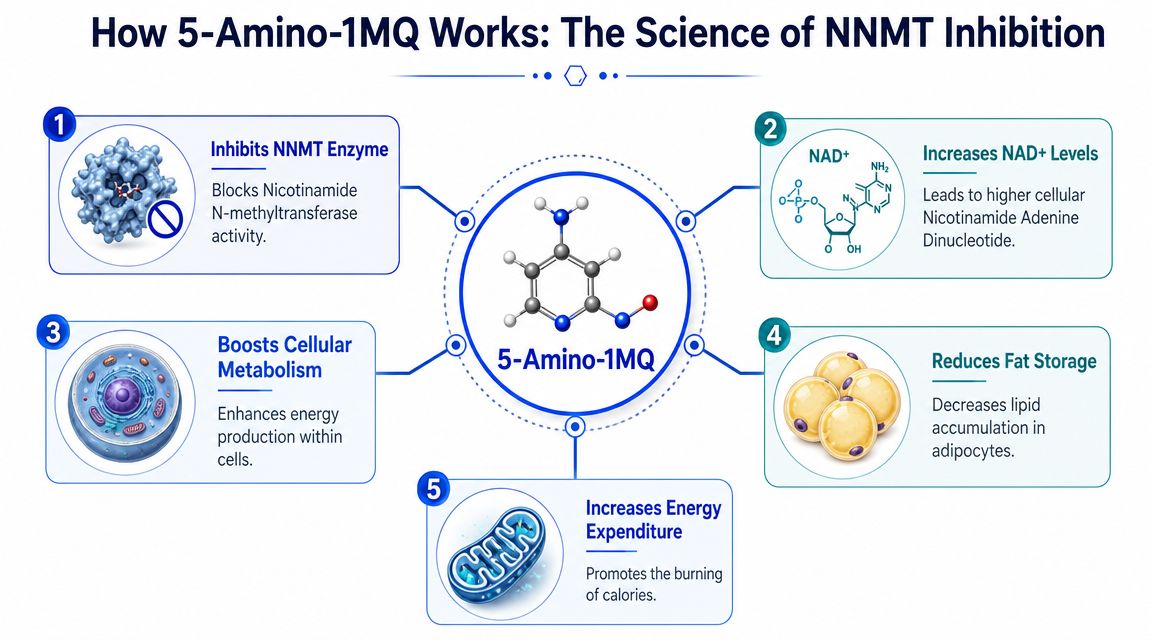
NNMT participates in nicotinamide metabolism. That’s important because nicotinamide sits close to the biology of NAD+, a coenzyme central to cellular energy handling. When researchers talk about 5-Amino-1MQ, they usually focus on the idea that inhibiting NNMT may redirect nicotinamide handling in a way that helps preserve NAD+ availability.
A useful analogy is a reservoir system. If NNMT acts like one outlet draining material away from a shared reservoir, then inhibiting NNMT may help keep more of that upstream material available for other metabolic needs. The key point isn’t that 5-Amino-1MQ “creates energy” directly. It’s that it may alter how cells allocate an important metabolic resource.
That mechanistic framing leads to the main hypothesis around 5-Amino-1MQ. By inhibiting NNMT, the compound may shift metabolism toward:
This is why the compound shows up in conversations about body composition research without fitting neatly into categories like stimulant thermogenics or appetite suppressants. It acts upstream, at the level of enzymatic regulation.
For readers who want an expert walkthrough of this mechanism in plain language, this video is useful:
Mechanistic lens: 5-Amino-1MQ is best understood as a pathway-modifying probe. It changes a regulatory step, then researchers observe the downstream effects.
The foundational data point comes from a peer-reviewed preclinical study. In that paper, 5-Amino-1MQ showed high cell membrane permeability and an IC50 of about 1 µM, which supports the view that it can inhibit NNMT effectively in vitro. In the same study, obese mice given 20 mg/kg subcutaneously three times daily for 11 days showed progressive body-weight loss versus controls [peer-reviewed preclinical study on 5-Amino-1MQ and NNMT inhibition].
Those details matter for two reasons.
First, they show that the compound isn’t just theoretically interesting. It has measurable biochemical activity. Second, they define the current boundary of evidence. The strongest concrete support is still preclinical, not human clinical.
That’s where many articles go wrong. They jump from “interesting enzyme inhibitor in a mouse study” to “established metabolic solution.” That leap isn’t justified. The appropriate conclusion is narrower. 5-Amino-1MQ has a credible mechanism and an important animal-model signal, but its human performance remains unproven.
What makes a small molecule interesting before any human efficacy data exist? In the case of 5-Amino-1MQ, the answer is not a dramatic outward effect. The interest comes from what the compound lets researchers test at the pathway level. If NNMT acts like a drain on nicotinamide-related metabolism, then inhibiting that enzyme gives investigators a way to ask how cells and tissues behave when that drain is partially restricted.
That framing matters because 5-Amino-1MQ is often misdescribed online. It is a small molecule research compound studied for NNMT inhibition, not a peptide and not a general catch-all “fat loss” category. In preclinical work, its value is as a probe. Researchers use probes to perturb one node in a network and then measure what changes downstream, much like reducing current through one branch of a circuit to see how the rest of the system redistributes flow.
The scientific appeal is tied to mechanism. Many established weight-management approaches are framed around appetite signaling, central stimulation, or hormone-mimetic effects. 5-Amino-1MQ draws attention for a different reason. It gives metabolic researchers a way to study whether changing NNMT activity alters cellular resource handling upstream, particularly around nicotinamide metabolism and related signaling state.
That changes the questions worth asking.
Instead of focusing on subjective effects such as hunger or stimulation, researchers can examine whether NNMT inhibition influences adipocyte behavior, energy balance pathways, and metabolic signaling patterns in experimental systems. The compound is therefore useful less as a category match for familiar consumer products and more as a laboratory tool for testing a specific biochemical hypothesis.
A practical way to view it is this:
“Potential effects” can mean two very different things. In rigorous writing, it should refer to observed preclinical signals and plausible mechanistic implications for further study. It should not be stretched into claims about established human outcomes.
That distinction is especially important here. The preclinical literature makes 5-Amino-1MQ scientifically interesting because it connects a defined molecular target, NNMT, with measurable changes in experimental models. As noted earlier, expert commentary places 5-Amino-1MQ in the category of metabolic modulation through NNMT inhibition and NAD+ preservation, which separates it conceptually from appetite suppressants and stimulants without treating it as a validated therapeutic class of its own.
A comparison helps clarify the point:
| Category | Primary research framing | Relevance to 5-Amino-1MQ |
|---|---|---|
| GLP-1 style approach | Appetite, satiety, feeding behavior | Different primary mechanism and research question |
| Stimulant approach | Arousal, thermogenesis, perceived energy | Different pharmacologic profile and experimental use |
| NNMT inhibition approach | Enzyme activity, metabolic pathway regulation, downstream cellular effects | The main scientific lens for 5-Amino-1MQ |
This is why expectations need to stay calibrated. A researcher studying pathway regulation may find 5-Amino-1MQ useful because it targets a defined enzymatic step with preclinical relevance. A reader looking for proof of human benefit is asking a different question, and current evidence does not answer it.
The careful conclusion is narrower and more useful. Preclinical findings support continued interest in 5-Amino-1MQ as a small molecule NNMT inhibitor for metabolic research. They do not justify turning an experimental compound into a consumer-style promise.
What does a responsible safety discussion look like for a compound that attracts attention online long before human evidence exists? For 5-Amino-1MQ, it starts with a simple boundary. The compound is studied as an experimental small molecule NNMT inhibitor, and its reported metabolic effects remain preclinical. No FDA-approved NNMT inhibitors currently provide a clinical benchmark for safety, dosing, or efficacy in humans.
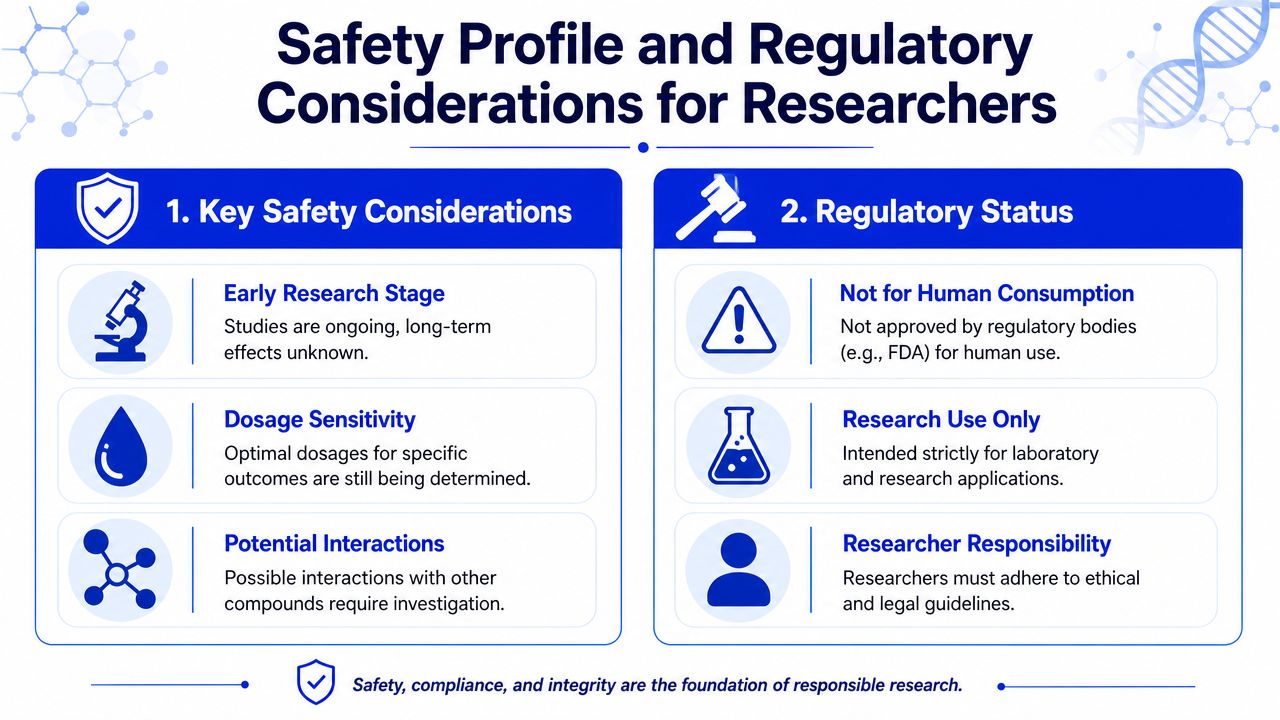
That distinction matters because mechanistic interest and human readiness are different categories. A useful analogy is the difference between a well-characterized tool in a benchtop assay and a validated intervention in medicine. A molecule can interact with a defined enzymatic target and still leave major questions unanswered about pharmacokinetics, off-target effects, tolerability, and reproducibility across species.
“Research only” should shape behavior across the entire workflow.
For a laboratory, that means procurement records, sample labeling, storage conditions, internal communications, and study interpretation should all reflect the same status. It also means avoiding a common error in public-facing descriptions. Many articles incorrectly jump from pathway-level interest to implied human benefit, even though the evidence does not support that step.
A careful lab should work from four assumptions:
The last point often causes confusion. A defined mechanism does not grant permission to make therapeutic claims. In translational research, those are separate evidentiary thresholds.
Before purchasing or designing experiments around 5-Amino-1MQ, researchers should pressure-test both the material and the language used to describe it.
Is the compound identified correctly?
The supplier should describe 5-Amino-1MQ as a small molecule NNMT inhibitor. Calling it a peptide is a basic classification error and a warning sign that the vendor may not understand the material.
Is the evidence framed at the right level?
Product descriptions should refer to preclinical or research use, not settled human outcomes.
Is there batch-level documentation?
Identity, purity, and traceability should be supported by current analytical records tied to the lot being sold.
Do your internal records match that status?
Inventory systems, vial labels, and study notes should all reflect research-use handling rather than consumer-style positioning.
Compliance rule: If a supplier’s language sounds more certain than the evidence base allows, treat that gap as a quality signal, not just a marketing problem.
Scientific caution and regulatory caution often point in the same direction. Groups that overstate what 5-Amino-1MQ can do in humans often under-document what they are selling. For a broader framework on separating evidence-led presentation from marketing language.
Even strong mechanistic science becomes useless if the test material is poor. For 5-Amino-1MQ, sourcing quality is part of experimental design, not an afterthought.
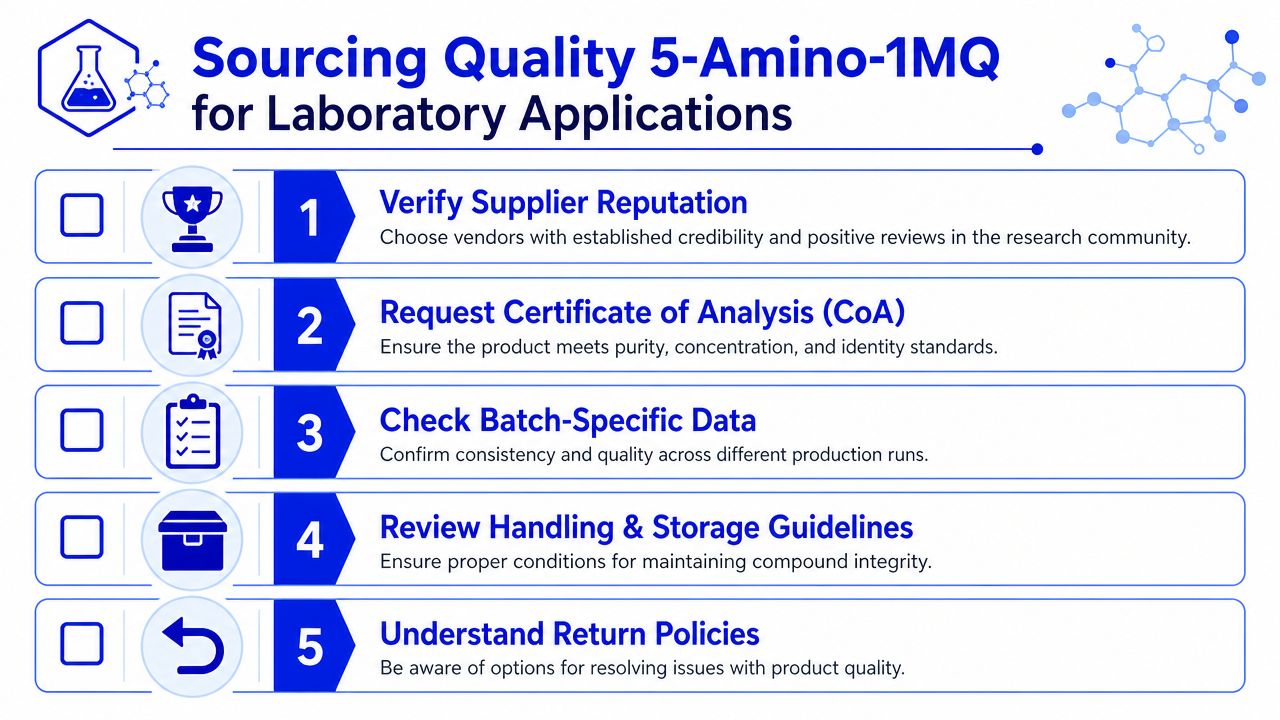
A good supplier review starts with documentation, not branding.
Certificate of Analysis
Ask for a batch-specific COA. It should identify the compound and report analytical findings clearly.
Purity and identity testing
Look for transparent reporting of purity and the method used to evaluate it, such as HPLC when applicable.
Batch traceability
The lot should be tied to records that let your lab connect the sample you receive to the data provided.
Storage and handling instructions
Even a correctly synthesized compound can become a poor research material if it’s stored or shipped carelessly.
Researchers sometimes focus only on nominal purity. That’s too narrow. A reliable sourcing decision also depends on whether the vendor communicates clearly, labels accurately, and supplies usable records.
Consider two scenarios. One supplier offers a “premium” product page with vague promises but little batch data. Another provides a clear COA, identifies the compound correctly as a small molecule, and states research-use boundaries plainly. The second supplier is usually the better scientific choice even before you compare anything else.
Good sourcing protects the validity of the experiment. It also protects the researcher from wasting time interpreting results produced by a questionable material.
The clearest answer to what is 5 Amino 1MQ is this. It’s a small-molecule NNMT inhibitor being studied for its role in metabolic research, especially around nicotinamide handling, NAD+ preservation, and adipose-related signaling. It is not a peptide, not a stimulant, and not an established human therapeutic.
That combination makes it interesting and limited at the same time. Interesting, because the mechanism is specific and biologically meaningful. Limited, because the evidence base remains preclinical and doesn’t establish human safety or efficacy.
If you’re comparing metabolic strategies at a broader educational level, this overview of science-backed choices for metabolism can help place enzyme-targeting research compounds in context alongside more familiar categories.
The right next step is careful evaluation. Learn more, explore options, and keep the standard high for evidence, compliance, and batch-level quality.
If you’re looking to explore high-purity compounds for laboratory and analytical work, Peptide Warehouse USA offers a catalog built for research use, with transparent documentation and batch-level support. Learn more about their available compounds and explore options that fit a responsible, evidence-driven workflow.