No products in the cart.


Most advice about the best peptides for muscle growth starts with a ranked list and ends with a sales pitch. That’s the wrong way to think about this category. The divide isn’t between “strong” and “weak” peptides. It’s between compounds with actual human outcome data and compounds that are mostly discussed through mechanism, theory, or bodybuilding folklore.
That distinction matters for anyone doing serious literature review, product evaluation, or preclinical planning. In practice, many muscle-growth peptides are interesting because they influence the growth hormone and IGF-1 axis, not because they’ve already shown broad, long-term hypertrophy effects in healthy trained people. If you want a reminder of how dominant fundamentals still are, it helps to learn about progressive overload strategies before attributing too much to any compound.
For research purposes only, this guide separates mechanistic plausibility from human evidence. That makes the field less exciting than social media suggests, but much more useful.
Interest in muscle-growth peptides didn’t become mainstream because researchers proved a universal shortcut to hypertrophy. It grew because growth-hormone-secretagogue peptides offered a different story from anabolic steroids. They stimulate the body’s own hormonal pathways instead of acting as direct anabolic agents, which gave them a scientific aura and a strong narrative in fitness culture.
That history also created confusion. A review of peptide use in bodybuilding notes that compounds such as ipamorelin, CJC-1295, sermorelin, and IGF-1-related agents became central to the discussion, while the same literature also emphasizes that human evidence for direct muscle-building remains limited, mixed, and often short-term. The review further notes that reported gains in muscle strength and mass were seen over 8 to 12 weeks when peptides were paired with resistance training, and that growth-hormone-secretagogue peptides are banned as doping agents in professional sports, which has shaped their visibility as much as performance claims have (Healthline’s review of peptides for bodybuilding).
Core insight: The “best peptides” narrative has been driven more by endocrine mechanism and anti-doping attention than by broad clinical proof in healthy athletes.
For a research audience, that changes the framing. The useful question isn’t “Which peptide builds the most muscle?” It’s “Which peptide class has a plausible mechanism, what outcomes have been measured, and how far does that evidence travel outside the study conditions?”
That’s why a rigorous guide won’t treat all compounds equally. Some are best understood as GH-axis modulators, some as recovery-oriented candidates, and some as popular ideas in search of human data.
Peptides are short chains of amino acids, but in signaling biology they function more like instructions than building blocks. A simple way to think about them is a key and lock model. The peptide is the key, the receptor is the lock, and the downstream cellular response is what happens when the right key turns.
In muscle-related research, the peptide itself usually isn’t “muscle” in a bottle. It binds to a receptor, triggers a cascade, and influences processes that may affect recovery, protein synthesis, endocrine signaling, or tissue remodeling. That’s a much narrower and more realistic description than the claims often made in online muscle-building lists.
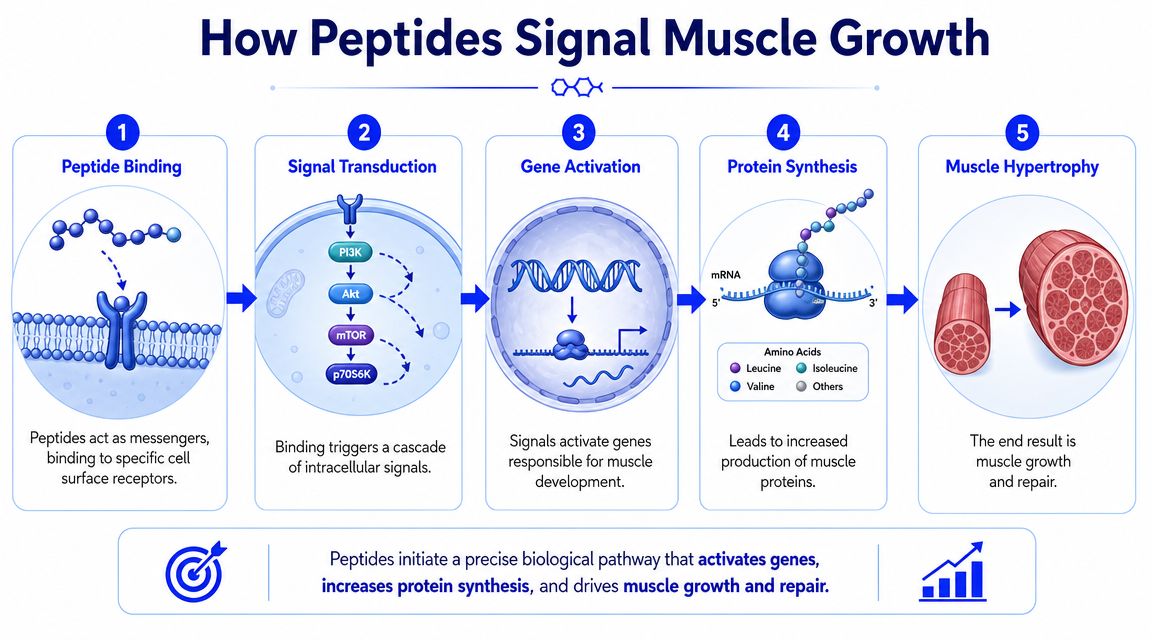
Several steps matter in sequence:
For the best peptides for muscle growth, the pathway that matters most is the growth hormone and IGF-1 axis. In this model, peptides such as GHRH analogs or growth-hormone secretagogues act upstream. They stimulate pituitary release of growth hormone, which can then increase IGF-1 signaling and support conditions associated with protein synthesis and recovery.
The important scientific point is that this is an indirect pathway. These compounds are discussed because they may shape the hormonal environment in which adaptation happens. They don’t directly behave like classic anabolic drugs.
Peptide signaling can be biologically persuasive long before it is clinically decisive.
That’s why mechanism alone can mislead smart readers. A peptide can make sense on paper, fit known endocrine biology, and still have weak evidence for actual hypertrophy outcomes in trained humans. Researchers should treat receptor logic as a starting point, not a verdict.
A practical reading of the literature keeps three layers separate:
Mechanism
What receptor or pathway the peptide influences.
Translational relevance
Whether that pathway is likely to matter in the studied population.
Measured outcome
Whether the study showed changes in lean mass, strength, soreness, recovery, or body composition.
When searching for the best peptides for muscle growth, the category often considered is growth hormone secretagogues, often grouped with GHRH analogs. This is the part of the peptide market built around the idea that upstream hormonal modulation can create a more favorable environment for muscle protein synthesis, recovery, and body recomposition.
This group includes compounds such as CJC-1295, ipamorelin, and sermorelin. Their appeal is straightforward. They stimulate the pituitary’s own growth hormone release, which can increase IGF-1 and potentially support recovery capacity and protein synthesis. But the critical limitation is equally straightforward. The evidence base in well-trained humans is limited and mixed, and many bodybuilding claims rest on relatively few studies rather than broad, durable clinical confirmation (Innerbody’s review of muscle-growth peptides).
That makes these compounds more defensible as research candidates for recovery and body-composition support than as proven primary muscle-builders.
| Peptide | Primary Mechanism | Half-Life | Primary Research Focus |
|---|---|---|---|
| CJC-1295 | GHRH analog that supports pituitary GH release | Varies by form | GH-axis modulation, recovery support, body-composition research |
| CJC-1295 without DAC | Shorter-acting GHRH analog approach | Shorter than DAC forms | Pulsatile GH-release modeling in research settings |
| CJC-1295 with DAC | Longer-acting GHRH analog approach | Longer than non-DAC forms | Extended GH-axis exposure in experimental designs |
| Ipamorelin | Growth-hormone secretagogue that stimulates pituitary GH release | Not established here with citable quantitative detail | GH-axis modulation with emphasis on selective secretagogue behavior |
| Sermorelin | GHRH analog that stimulates endogenous GH release | Not established here with citable quantitative detail | Endogenous GH signaling research |
A few distinctions matter when comparing them qualitatively:
The most useful contrarian example in this field is IGF-1 LR3. It’s routinely named in “top peptide” rankings for hypertrophy, largely because its mechanism sounds ideal for muscle growth. Theoretical discussions point to satellite-cell activity and reduced protein breakdown as reasons it should matter.
The problem is evidence. Expert review material notes that there are currently no human studies specifically focused on IGF-1 LR3 efficacy for muscle growth, which makes its reputation much more speculative than most rankings admit (Hone Health’s expert roundup on muscle-growth peptides).
The more a peptide is recommended online, the more important it becomes to ask whether anyone has actually measured the outcome in humans.
That doesn’t make IGF-1 LR3 irrelevant for research discussion. It makes it a case study in how mechanistic plausibility can outrun human data. For an analyst, that’s the main lesson of this entire category.
Some peptides enter muscle-growth discussions without being direct GH secretagogues. They’re studied because recovery limits adaptation. A compound that supports tissue repair or reduces recovery friction can influence training continuity, even if it doesn’t directly stimulate hypertrophy signaling.

Among the compounds often discussed are BPC-157 and TB-500. In muscle-focused discussions, they’re not typically framed as primary anabolic agents. They’re discussed as recovery-oriented peptides whose proposed value lies in tissue repair, training tolerance, and the ability to maintain workload.
That distinction matters because it changes what a study should try to measure. If the hypothesis is recovery support, then outcomes like soreness, force restoration, training continuity, or connective tissue tolerance may be more defensible than a broad “muscle gain” claim.
A useful research mindset is to separate these two questions:
Those are not the same claim, and they shouldn’t be tested as if they are.
The strongest peer-reviewed signal in peptide-related muscle outcomes may not come from the most aggressively marketed injectables. A 2021 review in Nutrients reported that collagen peptides combined with 12 weeks of resistance training were associated with increased fat-free mass in multiple non-athletic populations, including young men, elderly sarcopenic men, and premenopausal women. The same review also noted benefits in hand strength and isokinetic quadriceps strength in older adults, as well as faster restoration of explosive force production and reduced muscle soreness after strenuous exercise in a collagen peptide group (2021 Nutrients review on bioactive peptides and skeletal muscle health).
That’s important for two reasons.
First, it shows that some of the clearest peptide-related outcome data sits in the nutritional peptide category rather than the bodybuilding-injectable category.
Second, the review links peptide biology to PI3K/Akt/mTOR signaling in preclinical work, which gives a plausible mechanistic bridge without overstating direct hypertrophy effects in every population.
Researchers looking for signal over hype should pay attention to recovery markers and study-specific functional outcomes, not just to compounds with the loudest marketing.
A short explainer can help anchor that distinction:
If the phrase “best peptide” is going to mean anything scientifically, it has to be tied to a specific endpoint. For some endpoints, especially recovery-related ones, collagen peptides currently look better documented than many headline compounds.
A peptide study fails long before the data analysis if the design confuses theory with outcomes. That’s especially true in muscle research, where the intervention often sits on top of large background variables such as resistance training quality, protein intake, sleep, and baseline adaptation status.
A clean design starts by deciding what kind of effect you’re testing. If the peptide is a GH secretagogue, the most relevant outcomes may include body composition, recovery indicators, functional strength, and endocrine biomarkers. If the peptide is being studied for tissue support, hypertrophy should probably be a secondary endpoint rather than the first claim.
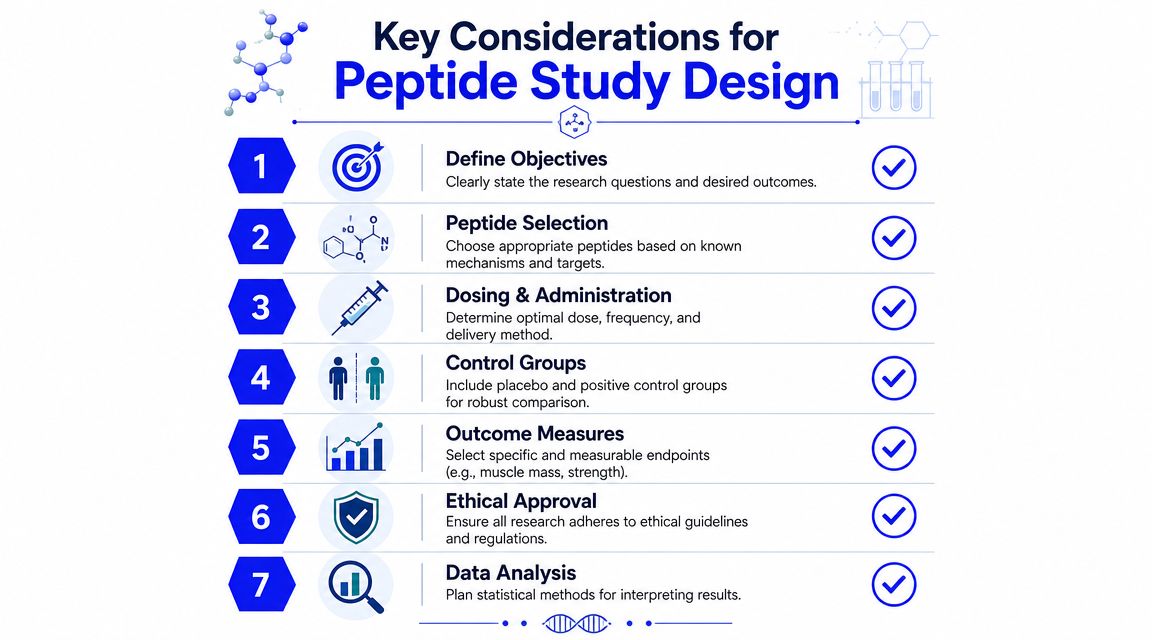
A practical checklist helps:
The most common design mistake is comparing a peptide to nothing meaningful. Better comparators include resistance training alone, nutritional support alone, or a plausible combination condition if the aim is to test additive effects.
This is also where overhyped compounds should be handled carefully. Since IGF-1 LR3 is heavily discussed online but currently lacks human studies focused on muscle-growth efficacy, it’s a poor candidate for confident assumptions and a strong candidate for explicit uncertainty in research planning.
Practical rule: If the literature for a peptide is mostly mechanism and online enthusiasm, design the study to test whether any measurable human-relevant effect exists at all before trying to rank it.
Stacking concepts also need restraint. Pairing complementary pathways can make mechanistic sense in a preclinical model, but each added variable makes attribution harder. A simpler study often produces the more valuable answer.
A surprising share of disagreement about “muscle-building peptides” has little to do with peptide biology. It starts much earlier, with whether the material in the vial matches the label, remains stable through handling, and can be traced to batch-level analytical records. If those conditions are not met, the study does not test a defined peptide intervention. It tests an uncertain input.

This distinction matters because peptide research already involves enough uncertainty at the biological level. Online discussions often blur mechanism, anecdote, and outcome data. Poor material quality adds another layer of noise that can make a weak peptide look promising, or a potentially useful one look inactive.
For research use, the minimum standard is straightforward. Investigators should be able to verify identity, stated purity, and relevant contamination screening for the specific lot under study. In practice, that means reviewing a Certificate of Analysis and the analytical methods behind it, commonly HPLC and mass spectrometry, along with any available microbial or endotoxin documentation.
If those records are incomplete, the interpretation problem is immediate. A null result may reflect degradation or mislabeling rather than lack of biological activity. A positive result may be confounded by impurities or inconsistent composition between batches.
A reasonable procurement screen includes:
Post-purchase handling is just as important. Reconstitution solvent, temperature control, freeze-thaw exposure, light exposure, and time in storage can all alter peptide integrity. A carefully synthesized batch can still become analytically unreliable if laboratory handling is inconsistent across samples or timepoints.
That point is easy to miss in articles focused only on hypothetical anabolic pathways. For compounds with limited human hypertrophy evidence, material quality becomes even more important because the expected signal may already be modest or uncertain. Small handling errors can overwhelm the effect size a study is trying to detect.
One factual example is Peptide Warehouse USA, which supplies research peptides for laboratory, analytical, and preclinical contexts and provides batch-linked documentation such as COAs, microbial and endotoxin reports, and stated purity levels across its catalog. Documentation of that kind does not establish efficacy. It does improve traceability, batch consistency, and the odds that a negative or positive result can be interpreted as a property of the peptide itself.
Good peptide research begins with defined material, documented custody, and disciplined handling.
That is less exciting than ranking compounds by hype, but it is closer to how reliable evidence is produced.
The useful way to rank peptides for muscle growth is not by popularity, receptor theory, or online anecdote. It is by the strength of human outcome data. Under that standard, several widely discussed compounds look less persuasive than their reputation suggests. Growth hormone secretagogues have a plausible anabolic rationale, but direct evidence for meaningful hypertrophy in trained humans is still thin. Collagen peptides, despite being less glamorous in muscle-building discussions, have more relevant human data for certain performance and recovery-related outcomes when studied alongside resistance training. IGF-1 LR3 remains a case where mechanistic interest has clearly outpaced human clinical support.
That distinction matters because mechanistic plausibility and real-world effect are not interchangeable. A peptide can increase a signaling molecule, alter a biomarker, or fit neatly into a model of muscle protein accretion and still fail to produce a clear hypertrophy signal in controlled human research. For a field crowded with confident claims, that is the central filter serious readers should keep.
For research teams, the practical standard is straightforward. Define the endpoint first. Then choose the peptide that has evidence closest to that endpoint, whether that means lean mass, recovery, training tolerance, or connective tissue adaptation. Study design should be built around measurable outcomes, not around the assumption that any peptide associated with growth signaling will translate into larger effects in humans.
All compounds discussed here are addressed strictly in a research, laboratory, and analytical context. They are not presented for human consumption, medical use, or self-experimentation. Regulatory status, anti-doping rules, institutional review requirements, and jurisdiction-specific controls all need to be addressed before any work begins.
Qualified researchers and institutions that need documented peptide materials for laboratory or preclinical work can review Peptide Warehouse USA and examine the available catalog and batch documentation before selecting materials for a study.