No products in the cart.

You’re probably seeing the same pattern most careful buyers see. One page pushes bargain pricing, another talks about “research use only,” and a third looks polished but gives you almost nothing you can verify. For those seeking the best place to buy Sermorelin, the usual starting point is price and availability. The safer approach is to start with documentation, traceability, and handling controls.
That matters because Sermorelin is a sensitive peptide. A supplier can look legitimate and still leave major gaps around purity records, batch identification, storage conditions, or shipping practices. If your standard is reproducibility, the best source isn’t the cheapest listing. It’s the supplier that can prove what it shipped, how it was handled, and how you can verify it after receipt.
This guide looks at the buying decision the way a lab manager would. The focus is simple: how to vet a source responsibly in the U.S., what paperwork should exist before you buy, and which shortcuts usually create problems later.
A lot of buyers come to Sermorelin sourcing after a frustrating first pass. The listings sound similar, the product names match, and every seller claims quality. What separates a workable source from a risky one is rarely the marketing copy. It’s the paperwork behind the vial.
For research procurement, the first question isn’t “Who has it in stock?” It’s “Who can document identity, purity, storage expectations, and batch history without hesitation?” If a seller can’t answer those points clearly, the transaction is already weaker than it looks.
Research peptides demand a tighter screen than ordinary e-commerce products. You’re not just buying an item. You’re buying a chain of custody, a handling process, and a standard of transparency.
Practical rule: If you can’t review the supplier before purchase, you may end up trying to validate the product after the fact, when your options are narrower.
A reliable buying process usually includes these checks before checkout:
The strongest suppliers tend to make verification easy. The weakest ones make you infer quality from branding, discounts, or vague promises. That’s the wrong signal to trust when the compound itself is sensitive and documentation is the whole point.
Sermorelin sits in a category where buying channel matters as much as product description. In the U.S., legitimate human-use access is typically prescription-based and pharmacy-supervised. Eden describes Sermorelin as a “prescription-only peptide,” and another firm states its product is sold through a 503A compounding pharmacy with a valid prescription required, as detailed in the Sermorelin prescription overview.
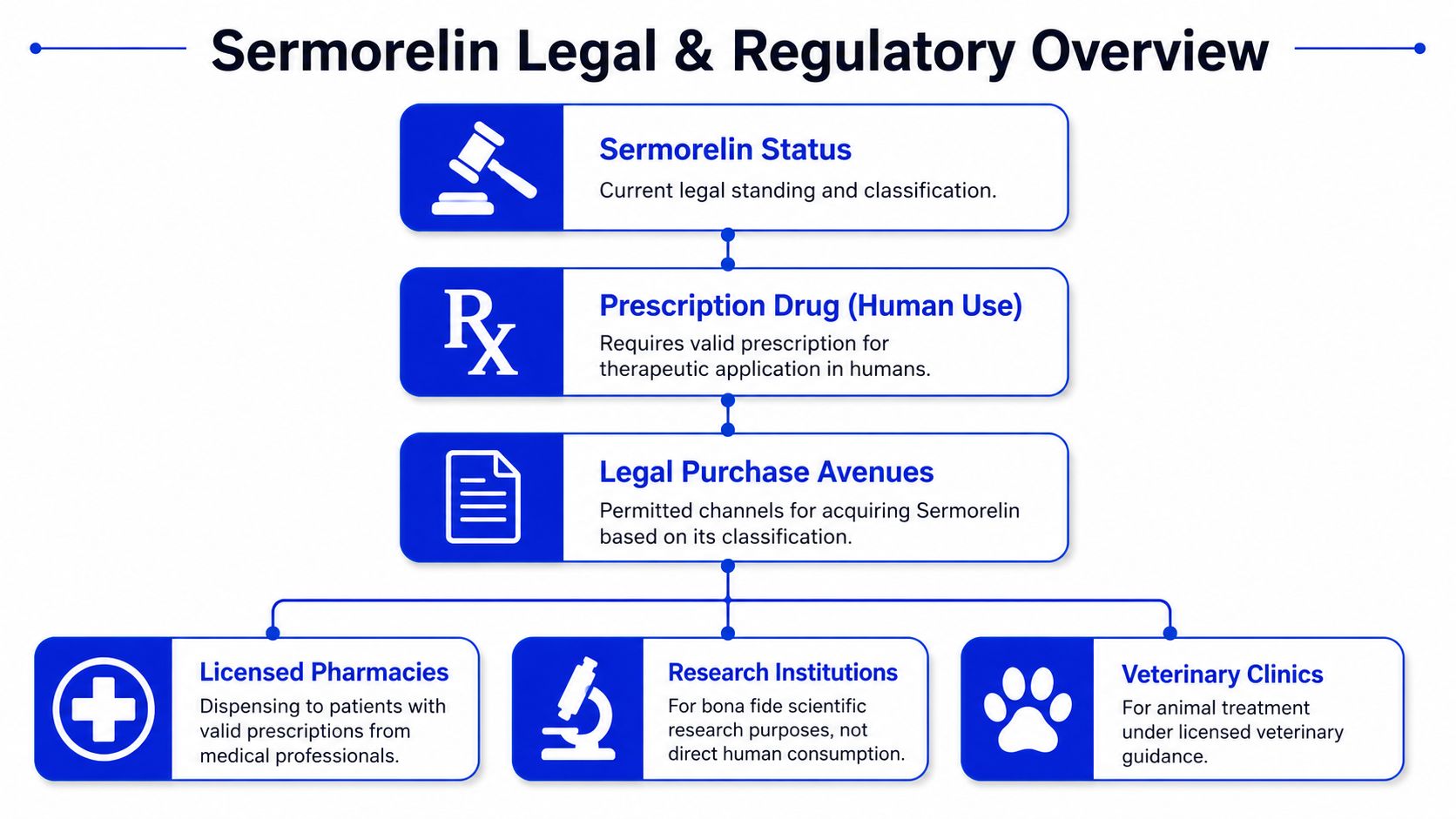
That distinction filters out a lot of confusion. If someone is seeking Sermorelin for personal therapeutic use, the compliant path runs through licensed medical oversight and pharmacy dispensing. It doesn’t run through anonymous peptide storefronts that skip evaluation and only process payment.
For buyers in laboratory and analytical settings, “research use only” language doesn’t remove the need for scrutiny. It increases it. You still need to verify exactly what the supplier means by that label, what controls are in place, and whether the company behaves like a serious research supplier.
A polished product page is not compliance. A documented operating model is closer.
When a supplier uses a research designation, check what sits behind it:
One practical reason this matters is risk control. Eden also warns that unlicensed online sellers may distribute products with incorrect amino acid sequences or contaminants. That’s exactly why experienced buyers treat legality and quality as linked questions, not separate ones.
A common failure point shows up before any order is placed. A supplier has a polished storefront, quick checkout, and broad purity claims, but once you ask for lot records, release testing, or packaging details, the answers become vague. That is usually enough to stop the review.
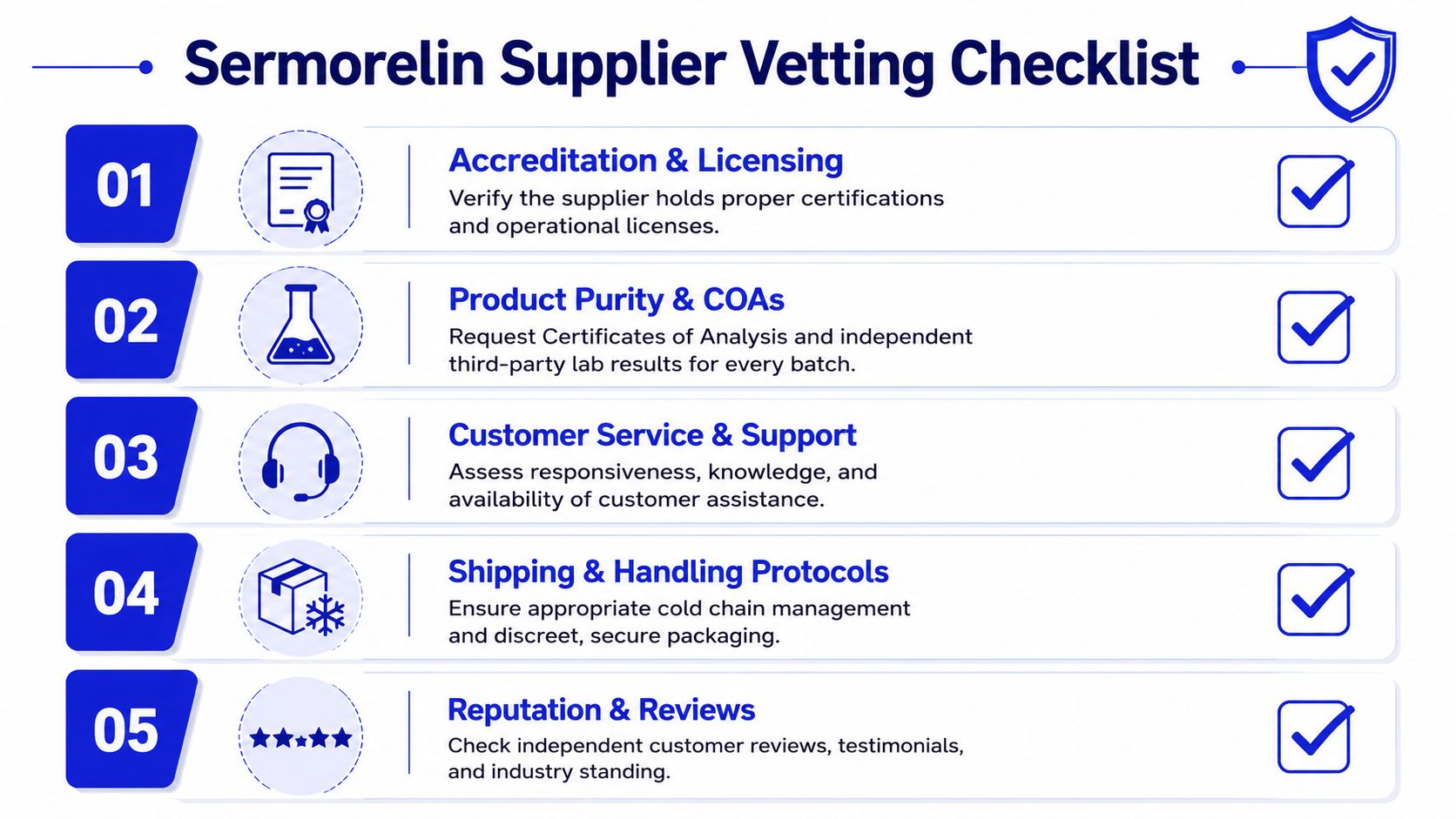
Ask for the Certificate of Analysis for the exact batch under consideration. A sample COA can show the supplier knows the format. A lot-specific COA shows the material you may receive can be traced to a real release record.
Then check whether the document is usable. It should identify the product clearly, reference a batch or lot number, and show the analytical method or at least enough detail to understand what was tested. If support sends a cropped image with no batch reference, no date, or no testing context, treat that as missing documentation.
Use a simple screen before discussing price:
| Verification Point | What to Look For |
|---|---|
| Batch COA | A document tied to the exact lot offered for sale |
| Identity and purity data | Clear naming, readable results, and test information that is not just marketing copy |
| Third-party testing | Evidence that an outside laboratory was involved, or a clear explanation of the release process |
| Lot continuity | Matching lot numbers across COA, vial label, packing slip, and invoice |
| Storage and handling guidance | Specific instructions for storage, shipping conditions, and receipt inspection |
A vendor that expects technical questions usually answers them in a structured way.
Purity matters, but procurement decisions should not rest on a headline number alone. The practical question is whether the purity claim is connected to a documented batch and whether the documentation is current, legible, and consistent with the label.
I look for four things here. Specific product naming. Matching lot references. A report format that appears prepared for real release review rather than public-facing promotion. Support staff who can send the file without delay or confusion.
That last point matters more than many buyers expect. If obtaining routine records turns into a negotiation, post-delivery problem handling usually follows the same pattern.
Traceability is what separates a research supplier you can audit from one you can only hope is accurate. The vial, label, invoice, and supporting documents should point back to the same lot. If any one of those pieces breaks the chain, the material becomes harder to verify and harder to quarantine correctly if a problem appears later.
For US buyers, operational traceability also includes where the material is filled, tested, labeled, and shipped. Some suppliers make broad USA claims but provide little detail when asked who performed the testing, where release occurs, or how temperature-sensitive shipments are packed. Those are basic sourcing questions, not edge-case requests.
Packaging is part of that review. Suppliers handling sensitive research materials should be able to describe container type, secondary protection, and transit controls with precision. Standards used in High-quality Foodpharma packaging are a useful reference point for what careful product protection and presentation can look like in regulated supply chains.
A serious supplier has a documented answer for common failure events. Delayed shipment. Warm package on arrival. Broken seal. Label mismatch. Missing COA. These situations do not prove poor quality by themselves. The response process does.
Ask support a direct question before ordering: what is the procedure if the lot number on the vial does not match the batch paperwork? A credible seller should answer in plain language and explain the replacement, hold, or investigation process. If the reply is evasive, generic, or sales-heavy, that is useful information.
One factual example of role clarity is Peptide Warehouse USA, which presents itself as a research chemical supplier and identifies Sermorelin formats in its catalog. That distinction helps buyers assess the company against the correct procurement standard, with attention on records, handling, and traceability rather than broad promotional claims.
Format affects quality control more than many buyers expect. The label may say Sermorelin, but the practical questions are how it’s formulated, how it’s shipped, and what happens to stability once it changes state.
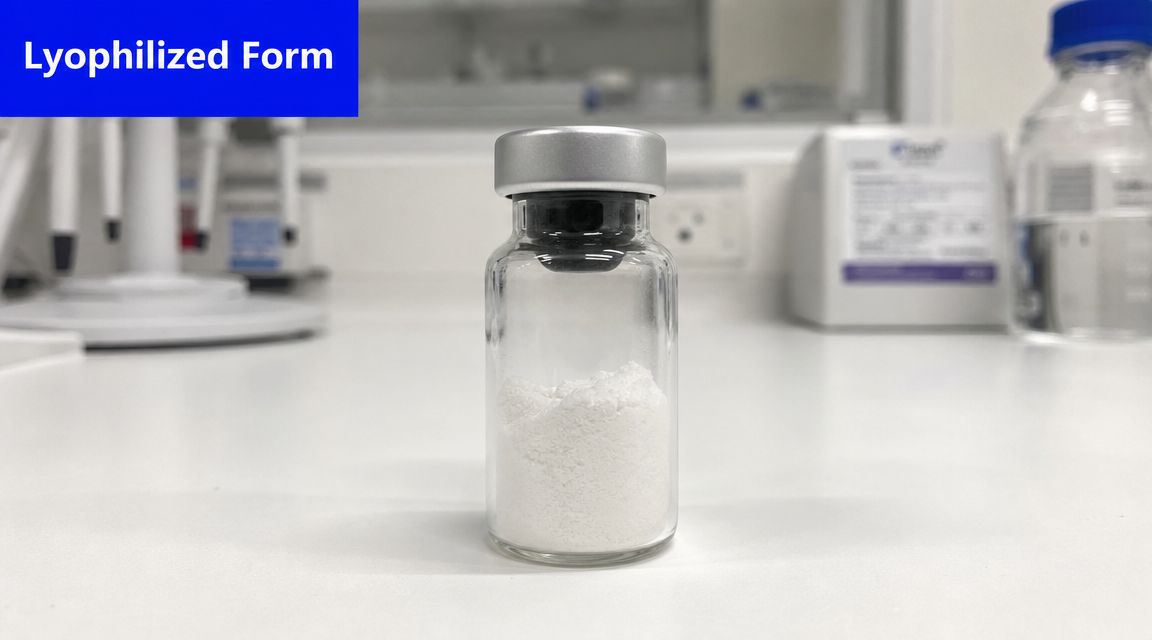
Sermorelin is a 29-amino-acid GHRH analog, and compounded-pharmacy information identifies molecular weight around 3358 Da in product specifications. Those details matter because peptide identity isn’t abstract. Sequence integrity is part of what you’re evaluating when you review a supplier’s documentation and technical sheet in Empower Pharmacy’s Sermorelin acetate information.
In practice, many buyers prefer lyophilized product presentations because they’re easier to ship and store than pre-mixed alternatives. But that convenience only helps if the supplier also gives precise handling guidance and packaging that protects the material in transit.
For organizations comparing shipment standards, the packaging side deserves attention too. Suppliers that invest in controlled presentation and transport often use systems aligned with broader High-quality Foodpharma packaging principles, where barrier performance, handling consistency, and product protection are built into the procurement decision rather than treated as an afterthought.
According to compounded-pharmacy guidance, both dry powder and reconstituted Sermorelin should be refrigerated at 2–8°C (36–46°F), protected from light, and not frozen. That means shipping method is part of product quality, not a separate logistics issue.
A supplier that understands the compound will usually tell you:
If the storage instructions are vague, assume the shipping discipline may be vague too.
When buyers ask where the best place to buy Sermorelin is, this is one of the clearest filters. The stronger source is the one that can document identity and handling in the same breath.
Price gets attention first because it’s visible. Value takes longer to judge because you have to account for testing, support, traceability, shipping discipline, and what happens if something goes wrong. Serious buyers learn quickly that low sticker price can be the most expensive outcome if the material can’t be trusted.
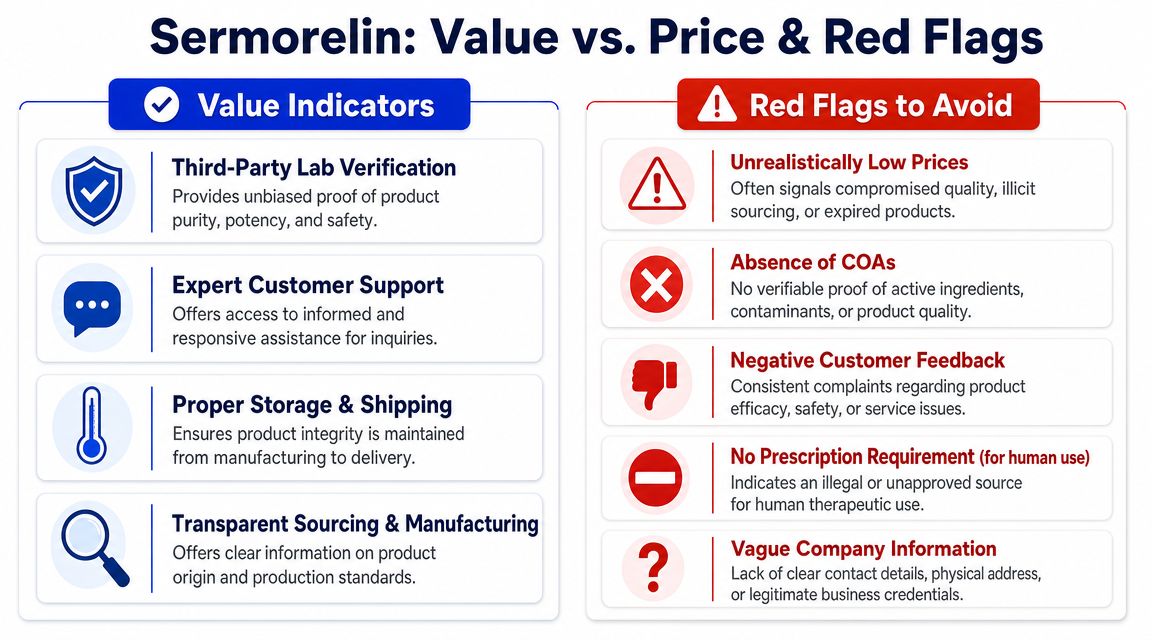
A useful analogy comes from the prescription side. Legitimate therapy with medical oversight often runs $150-$500 per month, with telemedicine often at the lower end of $150-$300, according to Strut Health’s guide to getting Sermorelin safely. That matters because it shows how misleading bare sticker price can be when oversight, evaluation, follow-up, and dispensing all carry real cost.
The same mindset applies to research procurement. The vial price is only one line item. The actual cost includes how much confidence you get from the records, how quickly discrepancies can be resolved, and whether the shipment arrives in a condition consistent with the supplier’s claims.
A slightly higher listed price may still be the better buy if it comes with complete documentation, responsive support, and consistent lot traceability.
Bad suppliers often reveal themselves before checkout. You just need to pay attention to the details they omit.
The best value usually looks boring. Clear records, clear labels, clear answers, and no drama around basic verification.
A good buying decision rarely comes from chasing the lowest listed number. It comes from reducing avoidable uncertainty.
A traceable U.S.-based supplier is easier to evaluate because the operating footprint is clearer. You can review support responsiveness, shipment consistency, document formatting, and business identity with fewer unknowns than you’d face through opaque offshore storefronts.
That doesn’t mean every domestic supplier is automatically strong. It means the verification process is more practical when the company presents a real chain of custody, transparent lot documentation, and clear boundaries around how its products are sold.
The strongest supplier profile usually includes:
For buyers trying to identify the best place to buy Sermorelin, that combination matters more than aggressive discounting. If you’re comparing vendors now, focus on traceability first and explore options from suppliers that can substantiate what they ship.
They’re evaluated in different channels and for different purposes. Pharmacy-dispensed Sermorelin for human use sits inside a prescription and pharmacy-supervised framework. Research-grade sourcing should be assessed through documentation, lot traceability, technical specifications, and whether the supplier clearly limits sales to laboratory, analytical, or preclinical use.
You can verify the supplier’s documentation process, and that’s the first step. Review the COA, confirm the lot number matches the shipment, ask whether testing is batch-specific, and look for independent analytical support where offered. If a supplier can’t present those basics cleanly, there isn’t much foundation for confidence.
They matter because purity alone doesn’t describe the full quality picture. A supplier may highlight a purity figure, but that still leaves open questions about broader quality control. For careful procurement, endotoxin and microbial reports help show whether the company treats quality as a system rather than a single number on a product page.
Keep the questions direct:
The quality of those answers often tells you more than the product page does.
If you’re looking for a research-focused supplier that aligns with the standards covered here, Peptide Warehouse USA is one option to review. Its site presents Sermorelin in 2mg and 5mg formats, states that products are made and tested in the USA, and positions the catalog for laboratory, analytical, and preclinical use only. Learn more and explore options through the product documentation and support resources before you place an order.