No products in the cart.

If you’re searching for research chemicals buy USA, you’re probably in a familiar spot. You need a compound that fits the work, arrives with usable documentation, and won’t derail an assay because the label looked professional while the paperwork didn’t exist.
That’s the core problem in this market. The hard part usually isn’t finding a listing. It’s separating legitimate research procurement from gray-market buying dressed up as laboratory supply. In practice, the safest path is almost never the fastest checkout. It’s the supplier that can prove identity, traceability, and compliance before you pay.
A careful approach matters because the online market has shown persistent turnover and regulatory friction. A 24-week study of surface-web “research chemicals” found 302 unique new psychoactive substances, with a net addition of 38 new NPS during the monitoring window, while 61 were already DEA-scheduled and five became scheduled during the study. The authors also reported that availability did not change after scheduling for those five DEA Schedule I compounds, which shows how online listings can continue even after enforcement milestones (surface-web NPS monitoring study).
A new researcher needs a compound by next week, finds three US sellers in ten minutes, and sees the same promises on every page. Fast shipping. High purity. Research use only. At that point, the true procurement job has not started. It starts when you ask which seller can prove what is in the vial, which lot it came from, and how that lot was released.

The phrase research chemicals buy USA sounds transactional, but serious labs are usually screening for something more specific. They want domestic fulfillment, cleaner documentation, and fewer unknowns in the custody chain. Those are different goals from merely finding a seller with stock.
Search results do not separate legitimate research procurement from gray-market commerce. They lump together established laboratory vendors, small peptide suppliers, import resellers, and anonymous storefronts that rely on polished pages and vague claims. A professional-looking site only shows that someone built a storefront. It does not establish identity, purity, traceability, or release controls.
USADA warns that products marketed as “for research purposes only” may contain unapproved substances and may create risks for positive anti-doping tests or adverse health events because they are not formally reviewed for quality, efficacy, or safety (USADA guidance on research chemicals). In procurement terms, that means a disclaimer is not proof. It is not a substitute for a lot number, a certificate of analysis, raw method details, or any other record your lab can retain.
Paperwork decides whether a vendor belongs in your process.
That matters even more with novel or specialized materials, where the biological and toxicological uncertainty is already high before sourcing errors enter the picture. If the supplier cannot show how identity was confirmed, what impurities were measured, and whether the report is tied to the batch being sold, the buyer is operating on trust rather than evidence.
Legitimate procurement in the US market is less about finding a domestic website and more about finding a supplier that behaves like a documented business. A credible seller can explain what it sells, how batches are tracked, how materials are labeled, and what records are available before money changes hands.
US-based sourcing can help for practical reasons. Communication is usually easier. Shipping windows are shorter. Chain-of-custody questions are easier to resolve. Those advantages only matter if the supplier can connect the material in your receiving log to the same lot listed on the invoice and supporting documents.
The trade-offs are usually straightforward:
| Buying priority | What usually works | What usually fails |
|---|---|---|
| Reproducibility | Lot-specific documents and controlled inventory | Generic purity badges |
| Compliance | Clear business identity and research-use positioning | “No questions asked” sales language |
| Stability | Planned ordering tied to actual usage | Overstocking sensitive materials |
| Risk control | Batch review before PO approval | Deciding from product photos |
That distinction is often missed by new buyers. Gray-market sellers optimize for conversion. Legitimate research suppliers optimize for defensible records. Those are not the same business models, and the difference shows up in the documents long before it shows up in the experiment.
If you are comparing peptide vendors, keep the benchmark simple. Ask whether the company treats each lot as a traceable research input or as a retail item with a purity claim attached. Peptide Warehouse USA, for example, is relevant here only as a product-category example of a US research supplier. The useful question is not the brand name. The useful question is whether the supplier can produce batch-level records that match the material you receive.
Most buying mistakes happen before the order is placed. Researchers look at product selection, price, and shipping speed, then assume quality will sort itself out. It won’t.
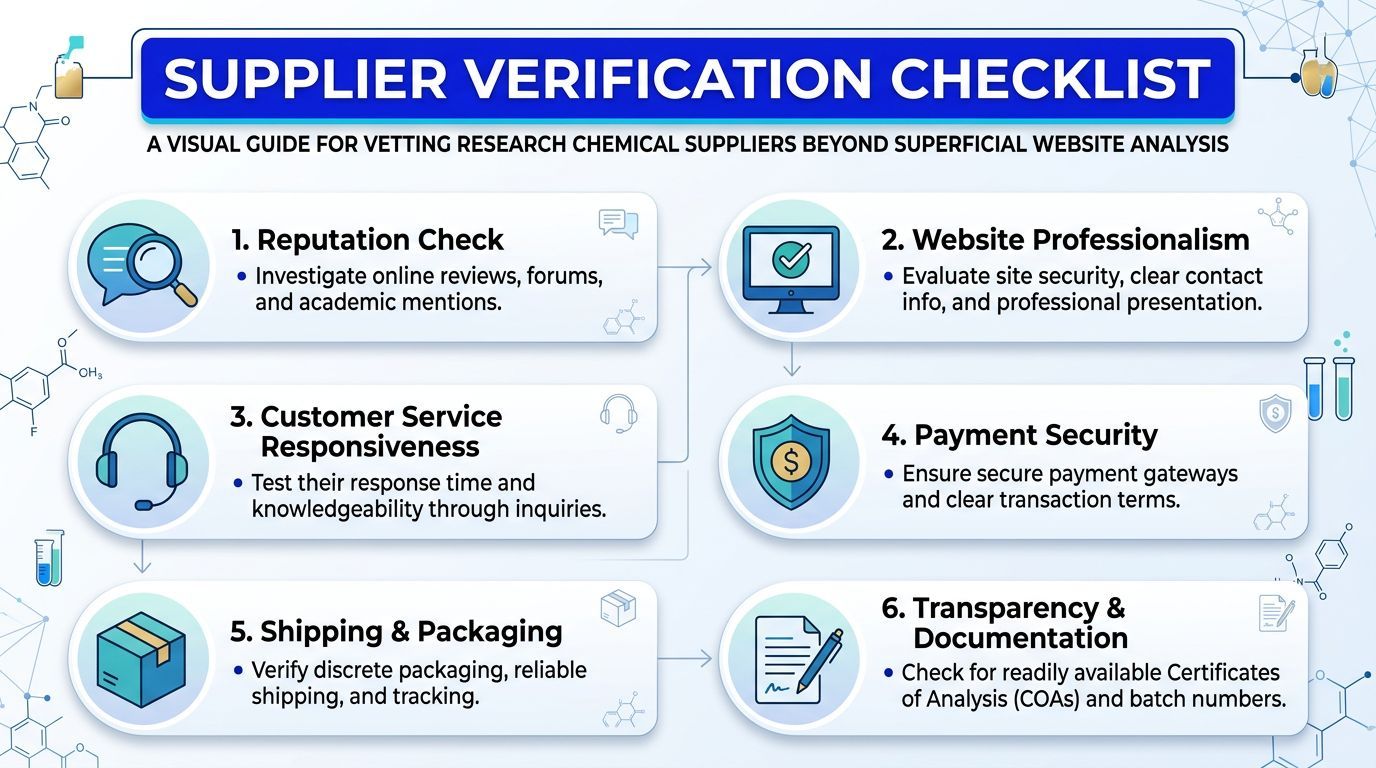
The first screen is business legitimacy. If a supplier can’t establish who they are, where they operate, and how they document batches, stop there.
Use this checklist before you place any order:
Practical rule: If the supplier avoids pre-sale documentation, treat that as your answer.
The core distinction is traceability. For legitimate research, the most important buying question is whether a supplier can provide lot-level identity, chain-of-custody, and legally appropriate documentation, because that’s what separates a documented supply chain from gray-market sellers of relabeled materials (analysis of research-chemical labeling and documentation issues).
A useful supplier conversation sounds more like a vendor qualification call than a retail chat. Ask specific questions and pay attention to whether the answers are direct.
Here are questions worth sending by email so you have a written record:
A weak vendor usually stumbles on the second and third questions. They’ll repeat “99% purity” and ignore identity confirmation. That’s not enough.
A stronger vendor gives you documents, explains methods, and doesn’t act irritated when you ask for details. In legitimate procurement, scrutiny is normal.
You should also watch for behavioral red flags:
A common lab failure starts with a document that looked acceptable at checkout. The vial arrives, the label says 98% or 99%, and someone assumes the material is ready to use. Then the batch record is reviewed, the COA does not match the lot in hand, the method is missing, or the identity data is too thin to support the experiment. That is the point where legitimate procurement separates itself from gray-market purchasing. Real suppliers give you records you can verify and file. Gray-market sellers give you numbers without traceability.
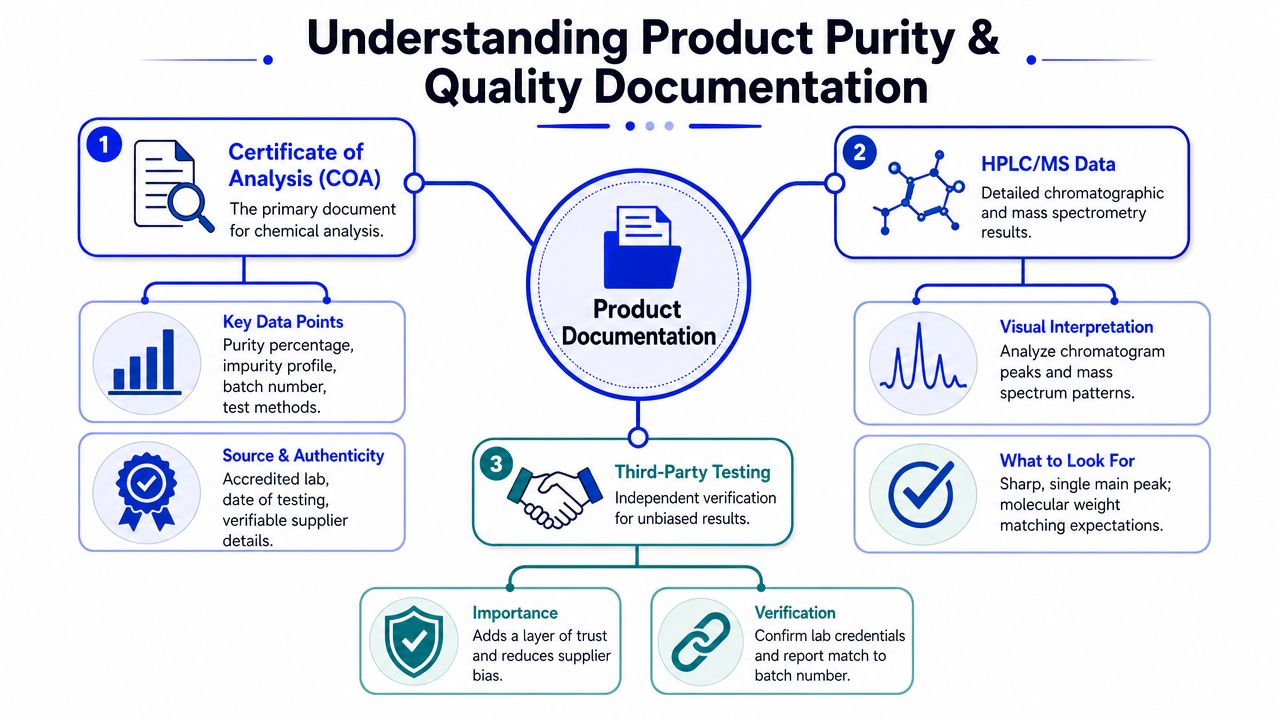
A Certificate of Analysis, or COA, should answer a narrow operational question. Can this exact lot be identified, assessed, received, and reproduced in your lab without guesswork?
Start with lot control. The compound name, catalog reference if used, and lot number should line up across the product page, quote, COA, vial label, and packing documents. If those fields do not match, stop there and resolve it before the material enters inventory.
Then review the analytical content.
| Document element | Why it matters |
|---|---|
| Compound name and lot number | Confirms the report belongs to the material you are receiving |
| Test date | Shows when the batch was analyzed and whether the record is current enough for use |
| Analytical method | Shows how identity or purity was determined |
| Result values | Provides actual findings instead of a marketing summary |
| Lab or issuer details | Gives you a point of accountability if the record must be verified |
A useful COA usually includes more than a purity percentage. It may list HPLC conditions, LC-MS results, NMR confirmation, water content, residual solvent limits, salt form, or appearance. Which items matter most depends on the material. For a simple small molecule standard, a clean identity and purity package may be enough. For peptides, stereochemistry-sensitive compounds, hygroscopic materials, or anything used in quantitative work, missing secondary details can create avoidable variability.
If the supplier provides chromatograms, spectra, or raw-summary analytical pages, review them alongside the COA rather than treating them as optional attachments.
A short visual walkthrough helps if you’re new to reading these reports:
A purity claim only has value if the method behind it is stated clearly enough to interpret the result. “99% purity” by HPLC does not answer the same question as identity confirmed by LC-MS or structure confirmed by NMR. Those methods measure different things. A vendor that collapses all of that into one headline number is asking you to accept risk without defining it.
This matters in day-to-day lab work. Two lots can carry the same purity figure and still behave differently because of residual solvent, water uptake, salt content, co-eluting impurities, or incomplete identity confirmation. If your assay is sensitive, those differences show up as drift, poor reproducibility, or unexplained troubleshooting time.
I review these records for internal consistency before I pay attention to the top-line number. The lot identifier should match everywhere. The method should be named. The result should be specific. The report should read like a controlled release document, not a generic sales attachment.
Use this standard when screening documents:
Third-party testing helps, but only when the report is traceable to the same lot you are buying. An unlabeled “independent test” PDF has limited value. A lot-specific report from an identified lab is far more useful because it gives procurement and QA staff something they can verify, archive, and compare against incoming material.
The practical standard is simple. If the documentation would not survive an internal deviation review, it should not support a purchase decision either.
A compliant purchase should feel boring. That’s a good sign. The site should identify the products as research-use materials, the checkout should be secure, and the post-order communication should support traceability rather than hide behind automation.
A credible workflow usually has a few visible features. There may be an age gate, a research-use acknowledgment, shipping terms, and account tools for tracking the order. None of that proves quality by itself, but it does show whether the supplier is trying to operate like a documented research vendor instead of a disposable storefront.
The transaction itself should support control, not friction. Look for:
A professional seller also won’t blur the line between lab use and personal use. If the site language leans on wink-and-nod marketing, move on.
Receipt is part of procurement, not an afterthought. The package should be opened by someone who can compare the shipment against the order and the supplier’s paperwork.
Use a simple receiving workflow:
A common issue for many labs is a loss of traceability. A compound gets delivered, someone sets it on a bench, and by the time it’s needed no one remembers when it arrived or whether the paperwork matched. Good procurement closes that gap on day one.
A compound can clear procurement, arrive with clean paperwork, and still become unusable within a week. I see that failure mode more often in storage and bench handling than in ordering. The result is the same either way. Lost traceability, questionable data, and a vial no one wants to trust.
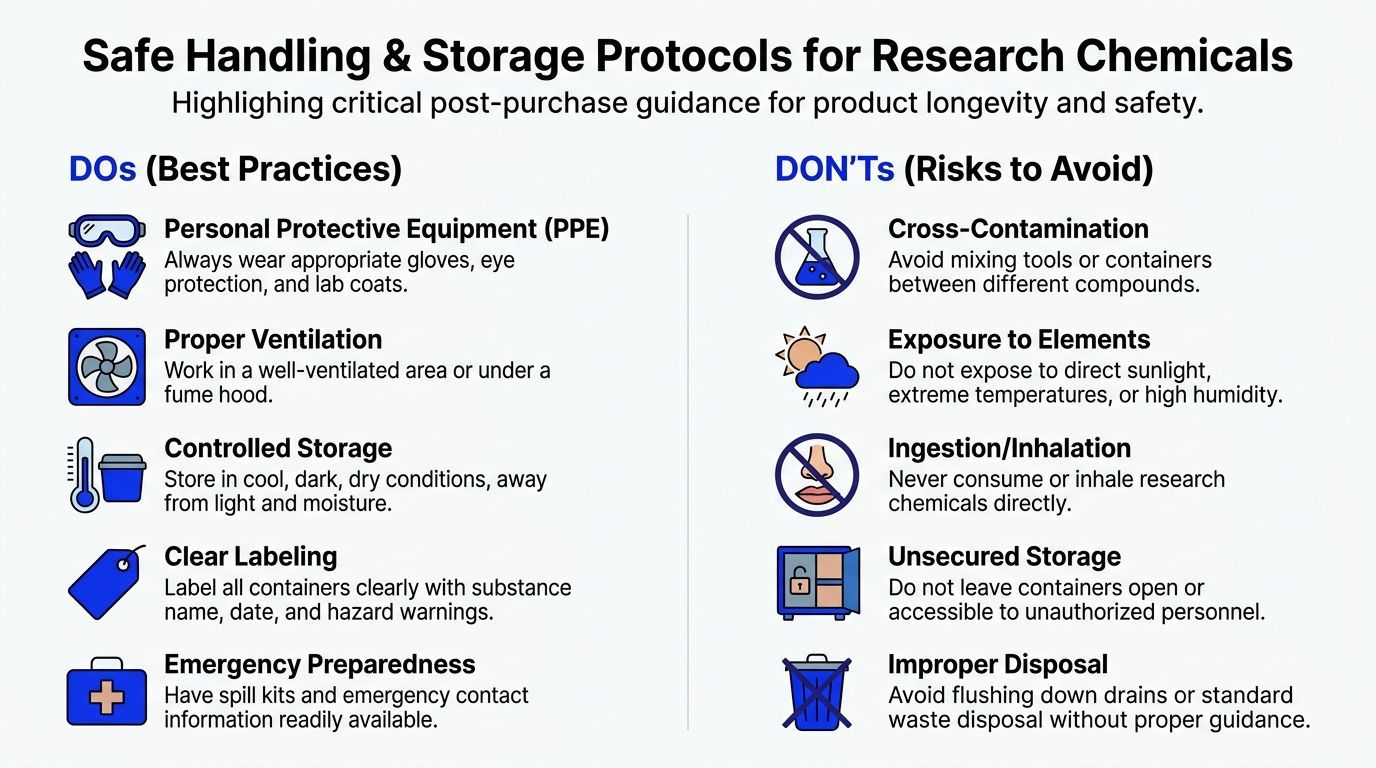
Safe handling starts with the assumption that the label and COA are only the beginning. Once the container is opened, your lab becomes responsible for preserving identity, purity, and chain of custody. That is the practical difference between legitimate research procurement and gray-market buying. Serious labs treat storage records, aliquot labels, and access controls as part of product verification, not as optional housekeeping.
Handle every new material under a written SOP or, at minimum, a documented bench procedure. Small containers create false confidence. The mass may be low, but the exposure risk and contamination risk are still real.
A workable routine looks like this:
Storage decisions should follow the compound’s stability profile and hazard information. Convenience storage causes preventable loss. Light-sensitive material goes into light-protective storage. Hygroscopic material needs dry handling and proper container closure. Freeze-thaw sensitive material should be aliquoted before routine use, not after degradation becomes obvious.
Storage discipline protects reproducibility, not just inventory.
The fastest way to lose confidence in a material is to separate the container from its documentation or use history. Once that happens, the procurement work no longer supports the experiment. The vial may still have a label, but it no longer has a defensible record.
Use a simple storage log for each batch:
| Storage habit | Why it helps |
|---|---|
| Log receipt, opening, and aliquot dates | Preserves a usable history for each batch |
| Store by stability requirement | Reduces degradation caused by heat, moisture, light, or repeated temperature changes |
| Limit inventory for unstable compounds | Lowers waste and reduces the temptation to use aged material |
| Restrict access to authorized staff | Protects chain of custody and reduces handling errors |
Several habits create problems quickly:
Disposal also needs procedure, not improvisation. Unknown residues, expired standards, and partially used vials should go through your institution’s hazardous waste process and chemical hygiene rules. If the identity, concentration, or hazard class is unclear, stop and resolve that before disposal. That pause protects staff and prevents compliance problems later.
A common procurement mistake starts with a simple assumption. A researcher sees a product page, sees “research use only,” and treats that label as proof that the purchase is acceptable. It is not. In practice, the difference between a legitimate research procurement and a gray-market purchase comes down to what can be documented before money changes hands.
Legality depends on the compound, its regulatory status, your intended use, and your institution’s approvals or registrations. “Research chemical” is a sales label, not a legal classification.
For controlled or otherwise regulated materials, a lawful purchase may require DEA registration, protocol documentation, institutional review, or other internal approvals. Check those points first. If your lab cannot document authority to acquire, store, and use the material for the stated project, stop the order.
A legitimate supplier uses that disclaimer to define the permitted use of the material. It sets a boundary. It does not verify identity, purity, stability, or compliance by itself.
That distinction matters because gray-market sellers often rely on disclaimer language as a substitute for real documentation. Serious procurement treats the disclaimer as one line item, then moves to the records that support batch acceptance, such as a COA, lot traceability, and test method details.
Because documentation is an operational choice. A supplier with lot release procedures, retained records, test reports, and defined customer support has invested in a controlled process. A seller with only a storefront and a payment page has not shown the same level of discipline.
This is usually where price comparisons break down. A lower-cost vial becomes expensive if your team has to delay work, repeat verification, quarantine the batch, or discard material because the paperwork does not support use. In a regulated or publication-driven lab, missing records are not a minor inconvenience. They can invalidate the purchase decision.
Plan earlier than the bench schedule suggests. Legitimate federal programs such as the NIDA Drug Supply Program require researchers to submit requests well in advance and provide substantial supporting documentation, which is a useful reminder that compliant purchasing is a scheduled process, not an impulse buy (NIDA ordering guidelines for research chemicals and controlled substances).
Use that standard in your own lab, even for non-federal orders. Leave time for supplier review, document review, internal approvals, receiving, and quarantine if the batch arrives with discrepancies. Labs that buy only when stock is nearly exhausted put themselves in a position where convenience starts overruling judgment.
Start with documents, not branding. Ask for a current lot-specific COA, confirmation of batch numbering, storage recommendations, and any available third-party testing information. Then check whether those records are specific to the material you are buying or just generic templates reused across the catalog.
I tell new staff to watch for one simple pattern. Credible suppliers answer technical questions with records. Gray-market sellers answer with marketing copy.
No. A COA is one part of the file.
Review whether the COA is lot-specific, dated, internally consistent, and tied to a test method. If a purity number appears without method information, batch identification, or release details, treat it as incomplete. Third-party verification, when available, adds confidence because it gives your lab another reference point beyond the seller’s own paperwork. The goal is not to collect documents for appearance. The goal is to decide whether the material is defensible for research use in your setting.