No products in the cart.



If you ask ten people “what is thymosin,” most will answer as if it’s one thing. That’s where the confusion starts. In research settings, thymosin is better understood as a family of peptides, and the difference between one form and another changes the entire experimental question.
That matters because the thymus isn’t just another gland. It acts like a training academy for immune cells, especially T cells, and thymosin-related peptides are part of the signaling language used in that system. Some thymosin peptides are studied for immune modulation. Others are discussed in the context of tissue repair and cell movement. If you blur those categories, your study design gets blurry too.
A careful answer to what is thymosin has to do three things. First, define where thymosin comes from and what it does biologically. Second, separate Thymosin Alpha-1 from Thymosin Beta-4 so you’re not treating unlike molecules as interchangeable. Third, clear up the common mix-up between Thymosin Beta-4 and TB-500, which are related but not the same.
At the bench, “what is thymosin” sounds like a simple definition question. It isn’t. It’s really a question about which thymosin, which biological pathway, and which research endpoint you care about.
The term usually points back to the thymus, a small organ in the upper chest that helps shape immune function. That’s why thymosin peptides show up so often in discussions about T-cell activity, immune coordination, and host defense. But once you move from general biology to actual lab work, broad descriptions stop being useful.
The two names that create the most confusion are Thymosin Alpha-1 and Thymosin Beta-4. They’re often grouped together because they share the word thymosin, yet their research roles are distinct. One is most strongly tied to immune modulation. The other is commonly discussed in relation to repair-oriented biology such as cell migration and tissue response.
Practical rule: Before choosing a thymosin peptide for a study, define the endpoint first. If your readout is immune activation, you’re asking a different question than if your readout is tissue remodeling.
That distinction is the difference between a focused experiment and a vague one.
What does someone usually mean when they ask, “What is thymosin?” In research settings, the useful answer starts with a correction. Thymosin is not a single peptide with one job. It is a family name attached to several peptides, and that distinction matters because Alpha-1 and Beta-4 guide very different study designs.
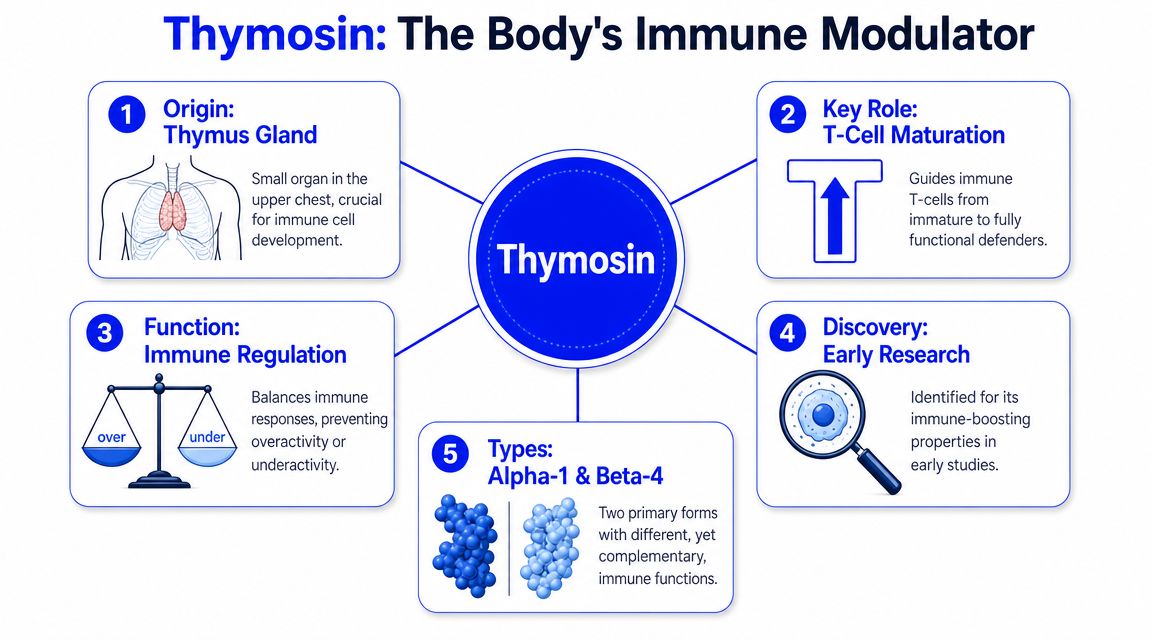
The thymus is the organ that gave thymosin its name, so it helps to start there. Its main relevance is T-cell development. Immature precursor cells arrive, receive a series of selection and differentiation signals, and only a subset leaves as more specialized immune cells that can respond to threats without reacting indiscriminately to self.
That process is why thymus-derived peptides attracted so much scientific attention in the first place. Researchers were not looking at a random gland. They were examining a tissue closely tied to immune education, immune tolerance, and coordinated host defense.
A practical way to view the thymus is as a biological quality-control site. Cells enter in an unfinished state. They leave only after passing checkpoints that shape how they recognize antigens and how they behave in the broader immune network. That context makes thymosin easier to place. The name points back to an organ involved in immune instruction.
A good visual overview helps anchor the concept before you get into peptide-specific detail.
A common point of confusion is the word itself. Thymosin does not refer to one universal compound. It refers to related peptides that differ in sequence, distribution, and research use.
That difference changes the question a lab should ask. If the project is centered on T-cell signaling, antigen presentation, or broader immune coordination, the relevant peptide is usually Thymosin Alpha-1. If the project is centered on actin dynamics, cell migration, angiogenic signaling, or tissue response after injury, researchers usually turn to Thymosin Beta-4 instead.
Terminology can mislead people. Shared naming suggests shared function. In practice, the same family label can cover peptides with distinct biological behavior, much like proteins in the same superfamily can share ancestry but still participate in different pathways.
A concise working framework looks like this:
In laboratory use, “thymosin” is a category label. The peptide choice should follow the biological endpoint you want to measure.
That single clarification prevents a lot of experimental drift. If the peptide and the endpoint do not match, the study question becomes muddy before the first assay is run.
Which peptide fits the experiment in front of you: one that shifts immune signaling, or one that changes how cells move and respond to injury? That is the practical choice behind the Alpha-1 versus Beta-4 distinction.
Thymosin Alpha-1 and Thymosin Beta-4 belong to the same named family, but they support different lines of research. The shared name can lead to the incorrect assumption that their roles are interchangeable. In practice, selecting between them works more like choosing between two assay kits built for different readouts. The label is similar. The endpoint is not.
Thymosin Alpha-1 is the better fit when the study question sits inside immune regulation. Researchers examine it in models involving T-cell activity, antigen presentation, cytokine signaling, and host response under immune stress.
One reason Alpha-1 receives sustained attention is that it has a longer translational history than many research peptides. As noted earlier, its synthetic form, thymalfasin, has been studied in human immune-related settings. That background does not settle every experimental question, but it does give laboratories a clearer chain connecting peptide biology to clinical investigation.
At the bench, this matters because Alpha-1 is usually chosen for studies such as:
If the endpoint is immune coordination, Alpha-1 is usually the more logical starting point.
Thymosin Beta-4 usually belongs in a different experimental lane. Its research use is more closely tied to actin dynamics, cell migration, wound models, angiogenic signaling, and tissue response after injury.
That difference is more than a naming detail. Alpha-1 is often selected to ask, “How does the system regulate immunity?” Beta-4 is more often selected to ask, “How do cells move, reorganize, and support repair?” Those are separate biological problems, even if inflammation appears somewhere in both.
A helpful way to frame Beta-4 is to focus on cell behavior at the local tissue level. In many repair models, the central question is not whether an immune signal increased. The question is whether cells can migrate, attach, remodel, and support recovery in an organized way. Beta-4 enters research because those processes depend heavily on cytoskeletal control and coordinated tissue responses.
Researchers commonly choose Beta-4 for work involving:
Match the peptide to the endpoint. Alpha-1 usually serves immune-focused study design. Beta-4 usually serves tissue-response and repair-focused study design.
That distinction helps prevent a common experimental mistake. A peptide family name gives historical context. It does not mean two peptides act in the same pathway or answer the same research question.
This is one of the most common naming problems in peptide research. Thymosin Beta-4 and TB-500 are related, but they are not the same thing.
The easiest way to think about the difference is to compare a full multi-tool with one frequently used attachment. Thymosin Beta-4 is the larger parent peptide. TB-500 is generally described as a synthetic peptide representing the main active fragment associated with Beta-4 activity.
That distinction matters because full-length molecules and fragments can behave differently in research contexts. A fragment may be studied because it isolates a function of interest. A full-length peptide may be chosen when the investigator wants the broader biological profile associated with the original sequence.
Here’s a quick comparison:
| Attribute | Thymosin Beta-4 (Tβ4) | TB-500 (Thymosin Beta-4 Fragment) |
|---|---|---|
| Basic identity | Full-length thymosin peptide | Synthetic fragment associated with Tβ4 activity |
| Research framing | Often discussed in broader repair biology | Often discussed as a more focused fragment tool |
| Sequence scope | Larger parent structure | Partial sequence representation |
| Practical question | “Do I want the whole signal set?” | “Do I want the best-known fragment?” |
Researchers usually don’t choose between Tβ4 and TB-500 by asking which one is “better.” They ask which one better fits the model.
Some prefer the parent peptide when they want to stay as close as possible to the biology associated with the native full-length form. Others prefer the fragment because it narrows the study question and may align better with historical use in specific peptide research circles.
A sensible decision framework looks like this:
The naming shortcut causes most of the confusion. Tβ4 is the parent concept. TB-500 is the fragment-based concept.
If your records, labels, and assay notes are sloppy here, your conclusions can become sloppy too.
What does the evidence support once you separate thymosin Alpha-1 from thymosin Beta-4?
The answer depends on the question being asked. Alpha-1 has the clearer human clinical literature, especially in immune and infectious disease settings. Beta-4 is discussed more often in repair biology, where much of the work centers on preclinical models, cell migration, tissue response, and remodeling.

For Thymosin Alpha-1, the strongest clinical footing comes from immunology-oriented and antiviral research. A useful place to anchor that discussion is the published hepatitis B literature, including a 1998 randomized controlled trial indexed in PubMed that evaluated thymosin alpha-1 in chronic hepatitis B rather than relying on secondary summaries: PubMed record for the 1998 hepatitis B trial of thymosin alpha-1.
That distinction matters. If Alpha-1 is your study molecule, the literature gives you a map built around host defense, immune signaling, and response modulation. Researchers have also examined it in settings such as HIV, sepsis, melanoma, hepatocellular carcinoma, and immune deficiency states, but those areas are not all supported to the same degree. The practical takeaway is narrower and more useful. Alpha-1 belongs in a research framework centered on immune function.
For Thymosin Beta-4, the signal points in a different direction. Its research use is usually tied to repair-oriented biology rather than antiviral endpoints. In lab terms, that often means asking how cells move, organize, and respond after injury. A simple way to frame the split is this: Alpha-1 is usually chosen for immunity questions, while Beta-4 is usually chosen for tissue-response questions.
A thymosin study can become hard to interpret if the readout does not match the peptide’s known biology.
With Alpha-1, immune assays are the logical fit. Researchers commonly examine T-cell subsets, cytokine production, antigen presentation, and other markers tied to host immune activity. Using a repair-first panel for Alpha-1 is a bit like measuring liver enzymes to study a microscope lamp. You may collect data, but the data may not answer the main mechanistic question.
For Beta-4, the opposite applies. Assays tied to wound closure dynamics, cell migration, angiogenesis-related signaling, cytoskeletal behavior, and tissue remodeling usually make more sense than virological endpoints. The peptide and the assay should point at the same biological system.
A second layer is analytical confirmation. Thymosin Alpha-1 is a defined synthetic peptide, and reference databases list its molecular mass. For example, PubChem identifies thymalfasin, the synthetic form of thymosin alpha-1, with a molecular weight entry that can be checked directly: PubChem entry for thymalfasin.
That kind of identity data does not prove biological activity. It helps verify that the material being studied is chemically what the label says it is.
A practical assay framework looks like this:
Researchers also need to keep safety observations and mechanistic conclusions separate. Reports of mostly local injection-site reactions in Alpha-1 studies help characterize tolerability in research settings. They do not establish efficacy on their own.
A thymosin experiment is only as credible as the material behind it. If the peptide identity is unclear, the purity is uncertain, or the documentation is thin, you’re not testing biology cleanly. You’re testing a supply problem.
The first document to ask for is a Certificate of Analysis, usually called a COA. In a serious research workflow, the COA is not marketing collateral. It is part of your chain of evidence.
A useful COA should help you verify:
If you’re comparing suppliers, don’t stop at a purity headline. Ask whether the batch also has supporting microbial or endotoxin documentation when relevant to your work. A clean-looking label can’t substitute for traceable records.
Good peptide sourcing reduces interpretation noise. Poor sourcing creates false positives, false negatives, and wasted time.
Even a high-quality peptide can be mishandled into poor performance. Lyophilized materials, reconstitution steps, storage temperature, and repeated exposure to heat or light all affect consistency.
A basic handling routine should include:
Researchers sometimes focus so heavily on sequence and mechanism that they overlook simple process errors. In peptide work, those simple errors can drive the result.
A precise answer to what is thymosin starts with one correction. Thymosin isn’t a single catch-all molecule. It’s a peptide family linked to the thymus and to biological functions that include immune regulation and, in some forms, repair-oriented activity.
Within that family, Thymosin Alpha-1 stands apart as the best-studied immune-focused member. It has a defined structure, a documented clinical development history, and research endpoints tied to immune function. Thymosin Beta-4 belongs in a different conversation, one centered more on tissue biology, cell migration, and repair-related models. And TB-500 should be treated as a related fragment concept, not as a perfect synonym for full-length Beta-4.
For researchers, that distinction isn’t academic. It guides assay selection, model design, procurement standards, and how results should be interpreted. If the study goal is immune modulation, choose a peptide and an endpoint set that fit that question. If the goal is repair biology, frame the experiment accordingly.
Quality matters just as much as theory. Verified identity, batch documentation, and disciplined handling are what turn a peptide from a label into a usable research input.
If you’re evaluating high-purity peptides for laboratory, analytical, or preclinical work, Peptide Warehouse USA offers research-use products with batch documentation, including COAs and related testing records. Learn more and explore options that support a more controlled, traceable peptide research workflow.