No products in the cart.

You’re probably looking at a peptide listing, a vial label, or a PDF download right now and asking a simple question that turns out not to be simple at all: does this COA prove anything?
That’s the right question. A lot of buyers stop once they see a lab logo, a purity line, or a QR code. But a COA certificate of analysis is only useful if it connects the exact batch you received to meaningful test results, clear methods, and data that fits your intended research use.
For peptide buyers, the difference matters. A clean-looking document can still be weak evidence if it’s generic, missing batch traceability, or silent about contamination risks that matter for certain lab workflows. Reading a COA well means doing more than spotting a high purity number. It means checking whether the document is specific, complete, and credible.
A COA certificate of analysis is easiest to understand as a quality passport for a single batch. Not for the product line in general. Not for “typical material.” For one specific lot.
That point clears up most of the confusion new researchers have. A product page tells you what a supplier says the material should be. A COA tells you what was measured on the batch tied to your vial.
According to Inbound Logistics’ explanation of a Certificate of Analysis, a COA is a batch-specific quality record tied to identifiers such as the batch or lot number, manufacturing date, and issue date, and it typically includes measured values plus acceptance criteria so buyers can verify whether the material meets specification before use or resale.
Think of it this way. A spec sheet is like a menu description. A COA is the kitchen ticket for the exact plate that came out of the pass. It links the item in your hands to the checks performed on that lot.
If the document isn’t tied to a unique batch, it loses most of its value for quality control.
A proper COA usually includes details like:
Those pieces work together. Remove one, and the chain gets weaker.
Practical rule: If you can’t match the lot number on the vial to the lot number on the COA, stop there. You’re no longer reviewing evidence for that material.
In peptide procurement, the COA is the document that connects the material you received to analytical testing for that lot. That matters for traceability, internal recordkeeping, and basic purchasing confidence.
It also protects you from a common mistake. New buyers often assume a polished label means the contents match the claim. Quality systems don’t work that way. Claims are easy to print. Batch-linked analytical records are harder to fake convincingly.
A useful COA doesn’t just say “high purity” or “tested.” It shows what was tested, what standard was applied, and whether the lot passed.
These two documents often get blurred together.
A product specification tells you the target. A COA shows the observed result for the lot tested. You want both, but they answer different questions.
| Document | What it tells you | What it does not tell you |
|---|---|---|
| Product specification | The intended standard | Whether your exact batch met it |
| COA | The lot-specific test outcome | Whether untested risks were covered |
That distinction becomes critical with peptides, because one number on a page can look reassuring while still leaving major blind spots.
A peptide COA can look dense at first glance, especially if it includes method notes, signatures, acceptance criteria, and multiple test lines. Once you know what each section is doing, the document becomes much easier to judge.
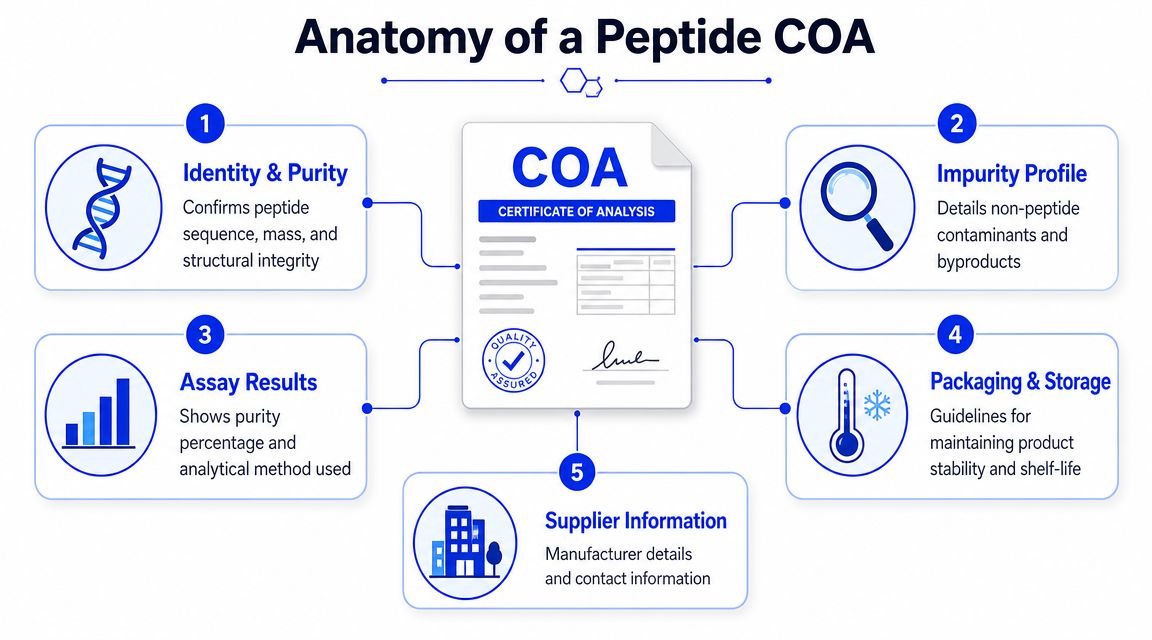
Here, you confirm you’re looking at the right record.
At minimum, you want the product name and a batch or lot identifier that can be matched back to the label, vial, or shipping paperwork. You should also expect dating information. That helps place the analysis in time and shows whether the certificate belongs to a real release event instead of a floating template reused across orders.
If the identity block is vague, the whole document becomes harder to trust. A COA should behave like a traceability record, not a brochure.
This is the line most buyers jump to first. It’s important, but it’s not enough on its own.
The assay or purity section reports the measured result and should sit next to some kind of acceptance standard. That pairing matters. A raw result without a specification doesn’t tell you whether the material passed. A specification without a result tells you only what someone hoped to achieve.
A common misunderstanding is thinking purity answers every quality question. It doesn’t. Purity can tell you how much of the sample matches the expected analyte under the method used. It doesn’t automatically tell you what else might be present outside that test scope.
A single purity result can be useful. It is not the same thing as a complete quality picture.
This section is where experienced buyers slow down.
A complete COA should include analytical methods, because results only make sense when you know how they were generated. The method name tells you what kind of question the lab asked. Identity-focused methods answer one set of questions. impurity-focused methods answer another. Contamination-focused methods answer yet another.
You don’t need to be an analytical chemist to read this part intelligently. Ask simpler questions:
Some robust COAs also include extra context such as traceability or uncertainty information. That doesn’t make every shorter document invalid, but it does tell you the supplier takes analytical context seriously.
This is the section many buyers never ask about, even though it often tells you more than the headline purity figure.
An impurity profile helps you think about what’s not supposed to be there. In peptide work, that matters because a material can look strong on the main assay line while still leaving open questions about byproducts, residual materials, or unrelated contaminants.
You won’t always get a highly detailed impurity breakdown on every COA. But the more the supplier can tell you about how impurities were assessed, the more meaningful the document becomes.
Here’s a practical lens:
| COA feature | What it suggests |
|---|---|
| Only one purity line, no context | Minimal information |
| Purity plus method and acceptance criteria | Better analytical usefulness |
| Added impurity or supporting analytical context | Stronger interpretability |
This is the most overlooked part of peptide COA review.
As noted in SafetyCulture’s overview of certificate of analysis requirements, a complete certificate may need results for microbial contamination, heavy metals, residual solvents, pesticides, mycotoxins, foreign materials, and related safety parameters depending on the product category. That matters because many buyers see a high purity claim and assume contamination risk has been covered. It hasn’t, unless those analytes were tested.
For peptide and research-chemical buyers, the stronger question is not “Is there a COA?” It’s “Which analytes were tested, by what method, and what was not tested?”
That’s where endotoxin and microbial data become important for certain research contexts. If a COA says plenty about purity and nothing about contamination scope, it may be incomplete for your intended use.
A short checklist helps:
Reading a peptide COA is a sequence, not a scavenger hunt. If you jump straight to the purity line, you can miss the more important question, which is whether the document even belongs to the material in front of you.
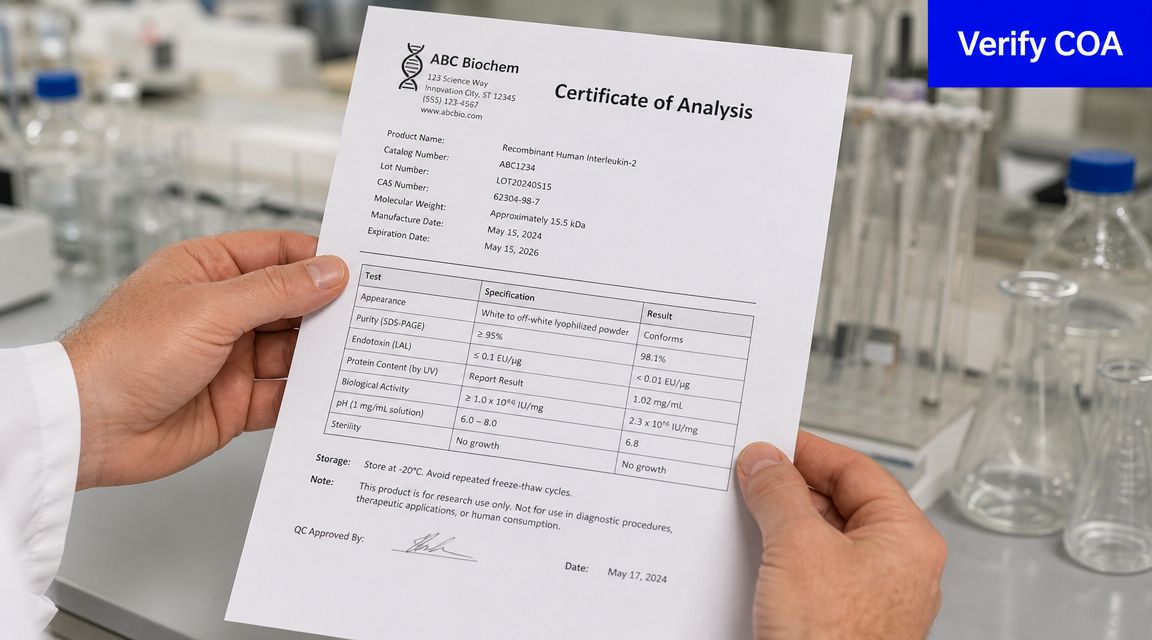
A valid COA is batch-specific, meaning it should report the actual analytical results for the exact lot shipped rather than “typical” values, as explained in CIK Lab’s discussion of batch-specific COAs. So the first step is simple. Compare the lot number on the vial, pouch, or order record to the lot number on the certificate.
If they don’t match, the review is over. You aren’t verifying your material anymore.
Also check whether the document includes dates that make sense for a real batch release. Missing or oddly generic timing details can signal that the file is a reusable template.
Now look at the measured result and the acceptance criteria side by side.
This step sounds obvious, but buyers often read only the result line and skip the pass/fail logic behind it. A COA is more useful when it records the method, the result, and the acceptance standard together. That combination is what lets a quality team make release decisions.
Use this quick flow:
A believable result needs a believable method.
If the COA reports purity, identity, or contamination outcomes, there should be enough analytical context for you to understand what kind of testing was performed. You don’t need to interpret every technical detail. You do need to know whether the document names the method clearly enough to support the claim.
If a supplier says a batch is verified but won’t tell you how it was verified, treat the result as incomplete, not as proven.
A useful habit is to ask for supporting material when needed. If the COA raises questions, request clarification on method scope, sample representativeness, or additional reports tied to the lot.
For a visual walkthrough of how researchers approach document review in practice, this overview is a helpful starting point:
Experienced procurement teams distinguish a readable COA from a meaningful one.
A certificate can be valid within its own scope and still be insufficient for your work. For example, it may document identity and purity while saying nothing about microbial burden or endotoxin. That doesn’t make it fake. It means you need to decide whether the testing scope fits the application.
Use this final verification screen:
If you train yourself to ask that fourth question every time, your COA reviews become much sharper.
Some questionable COAs are easy to spot. Others look polished enough to pass a casual review. That’s why surface checks don’t go far enough.
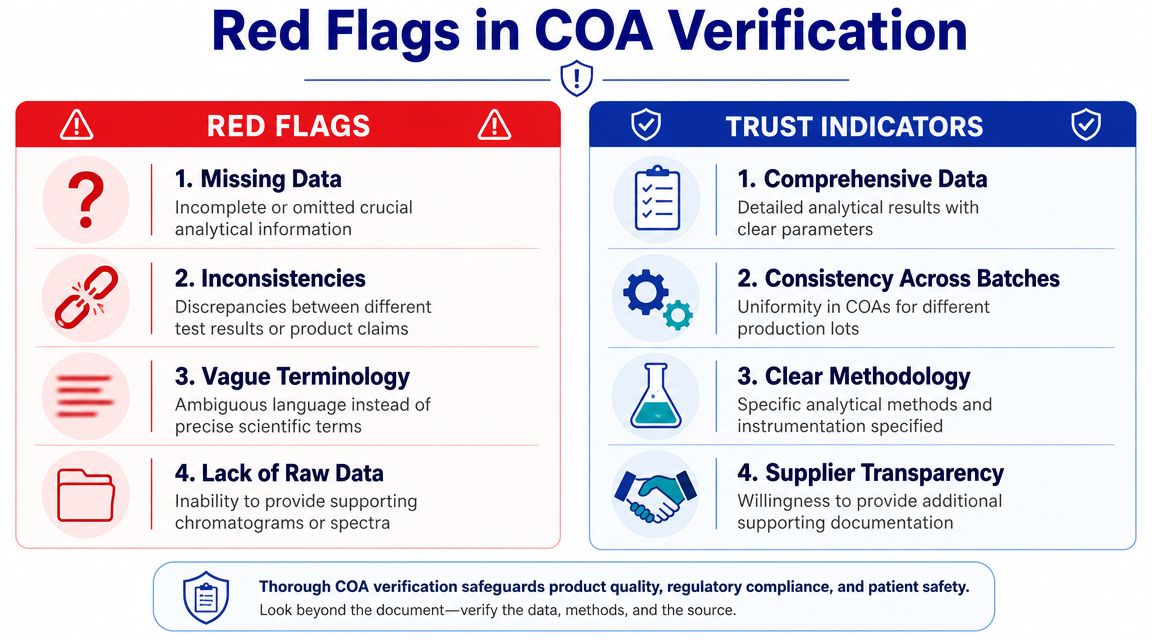
The most common problem is a document that looks official but isn’t lot-specific.
A robust COA should include batch identification, analytical methods, acceptance specifications, dates, and authorized sign-off, and in some cases traceability or uncertainty information, according to Inorganic Ventures’ technical glossary entry on robust COAs. If those elements are thin, missing, or obviously repeated across unrelated lots, the document may function more like a generic template than an actual batch record.
Watch for signals like these:
A QR code, a watermark, or a laboratory name can create false confidence.
The key question isn’t whether the document looks formal. It’s whether it provides enough context to judge method validity, batch traceability, and fitness for purpose. A COA can appear polished while omitting the exact information you need to evaluate it.
That’s why data integrity principles matter. If you want a practical framework for judging whether records are trustworthy, the ALCOA+ principles for data integrity offer a useful lens. They push you to ask whether data is attributable, legible, contemporaneous, original, accurate, and handled in a way that preserves trust.
A COA shouldn’t just look clean. The record behind it should make sense as a controlled quality document.
Buyers get tripped up by impressive purity claims.
A document can show a strong purity result and still leave major unanswered questions if it doesn’t address contamination scope. For some research settings, the absence of microbial or endotoxin information is not a minor omission. It changes how reassuring the certificate really is.
Here’s a simple red-flag comparison:
| Red flag | Why it matters |
|---|---|
| Batch number absent or vague | You can’t tie data to the material received |
| Method not stated | You can’t judge how the claim was produced |
| Acceptance criteria missing | You can’t tell whether the lot met a standard |
| No contamination scope | Purity may be reported without addressing separate risks |
| No sign-off or approval context | Release control looks weak or undocumented |
The biggest mistake is treating every COA as equally informative. They aren’t. Some are real analytical records. Others are just enough paperwork to calm an uncritical buyer.
A preventable procurement mistake often starts the same way. A researcher orders a peptide based on a clean-looking product page, the vial arrives, and only then does someone ask for the COA. At that point, your options are narrower. You are no longer evaluating a supplier. You are trying to explain a gap after money has been spent and timelines have started.
Good purchasing practice treats the COA like a passport, not a brochure. A brochure tells you what a product claims to be. A passport ties identity to a specific holder. Before you buy, you want proof that the lot-specific record exists, that it matches the material being sold, and that the test scope fits your planned work.
Ask for the COA before placing the order whenever possible. Then read it with the purchase decision in mind, not just as a filing requirement. A useful review starts with simple questions.
That last point matters more than many new buyers expect. A real quality team can usually explain why a method was chosen, what the result means, and what the COA does not cover. A weak supplier often sends a polished PDF but cannot explain the record behind it.
The same logic appears in other quality-sensitive categories. Buyers who choose quality probiotics look past label claims and ask how the product was verified, who tested it, and whether the records are specific to the lot in hand.
Once the material arrives, save the COA with the receiving record, product label, and your internal lot log. Do not assume a supplier portal will stay available or that the same file will be easy to find later.
Traceability breaks in ordinary ways. A vial gets moved into a secondary container. A batch number is copied by hand and one digit is wrong. Two PDFs with similar names end up in the same folder. In QC work, small paperwork breaks create large interpretation problems, because you can no longer prove that the document reviewed belongs to the material tested.
A practical file set usually includes:
Transparent suppliers make it easy to request the lot-specific COA before purchase, compare it to the listed product, and ask follow-up questions without getting template answers.
That transparency should extend beyond the main purity number. For some studies, a missing endotoxin report is not a minor paperwork gap. It is a warning sign that the supplier may be presenting a narrow slice of the quality picture. If your work is sensitive to pyrogen contamination, purity alone is like checking that a beaker is clean while ignoring what is dissolved in the water inside it.
Another practical check is document specificity. Generic COA layouts are common, but a generic template should still contain lot-specific values, method references, dates, and approval details. If every batch appears to share the same formatting, same wording, and suspiciously similar results, ask whether the supplier is issuing actual analytical records or recycling a stock document with the batch number changed.
One example is Peptide Warehouse USA, which provides batch-specific documentation for research-use products and offers COA access and analytical clarification through its support process. That kind of supplier behavior helps buyers check the lot record before material enters laboratory work.
A careful buyer asks three direct questions. Can I review the exact lot record before purchase? Does the testing scope match my research risk profile? Can I connect the shipped vial, the label, and the COA without guessing? If any answer is unclear, the procurement review is not finished.