No products in the cart.


If you’re searching for the best place to buy Retatrutide, you’re probably seeing the same pattern everywhere. One site treats it like a breakthrough compound, another treats it like a routine peptide listing, and a third makes the kind of claims that should stop any careful buyer cold.
That confusion matters because Retatrutide sits in an unusual category. It has strong research interest, but it is not yet on the market, and the only legal route for human use today is clinical trial enrollment, with one source noting approval could come as soon as 2026 if late-stage results stay positive, according to this Retatrutide access overview. So when people ask for the best place to buy it, they’re usually mixing together two different goals: legal access for human use and careful sourcing for laboratory research.
That distinction is the whole issue.
If your goal is patient access to approved GLP-1 medications already in circulation, practical pharmacy tracking matters a lot, and this Ozempic availability guide is useful for understanding how that process works in practice. Retatrutide is different. There isn’t a legitimate retail pharmacy channel for it yet, so the right question isn’t “Which vendor has the best deal?” It’s “How do I evaluate whether a research supplier is transparent, technically competent, and operating within the right boundaries?”
Search results make Retatrutide look easier to buy than it really is. That’s because many listings collapse legal status, research sourcing, and consumer demand into one page.
A careful buyer should separate those things immediately. If the question is human use, the answer is clinical trial access, not online checkout. If the question is laboratory sourcing, the answer depends on documentation, identity testing, and whether the seller behaves like a research supplier rather than a gray-market storefront.
The most common mistake is treating peptide sourcing like supplement shopping. People compare prices, package size, and website polish first, when they should start with batch documents and legal positioning.
A supplier can have:
Practical rule: If a site looks more focused on urgency and outcomes than documentation and traceability, slow down.
The best place to buy Retatrutide isn’t a static vendor list. Lists age fast, and they often reward visibility over verification.
A better framework asks:
That approach works whether you’re evaluating Retatrutide today or another peptide six months from now. It also protects you from one of the biggest risks in this category, which is assuming a product page equals a credible supply chain.
Retatrutide is drawing attention because it isn’t just another familiar peptide label with recycled hype. It is associated with GIP, GLP-1, and glucagon pathway research, which is why scientists and buyers alike keep watching it closely.
That interest also has a concrete basis. Public reporting on phase 2 obesity research says Retatrutide produced average weight loss of about 23% to 24% after roughly 11 months at the highest doses, and one report summarizes the broader phase 2 result as about 24% body-weight reduction, with phase 3 trials expected to finish in early 2026, as described in this Retatrutide weight-loss research summary.
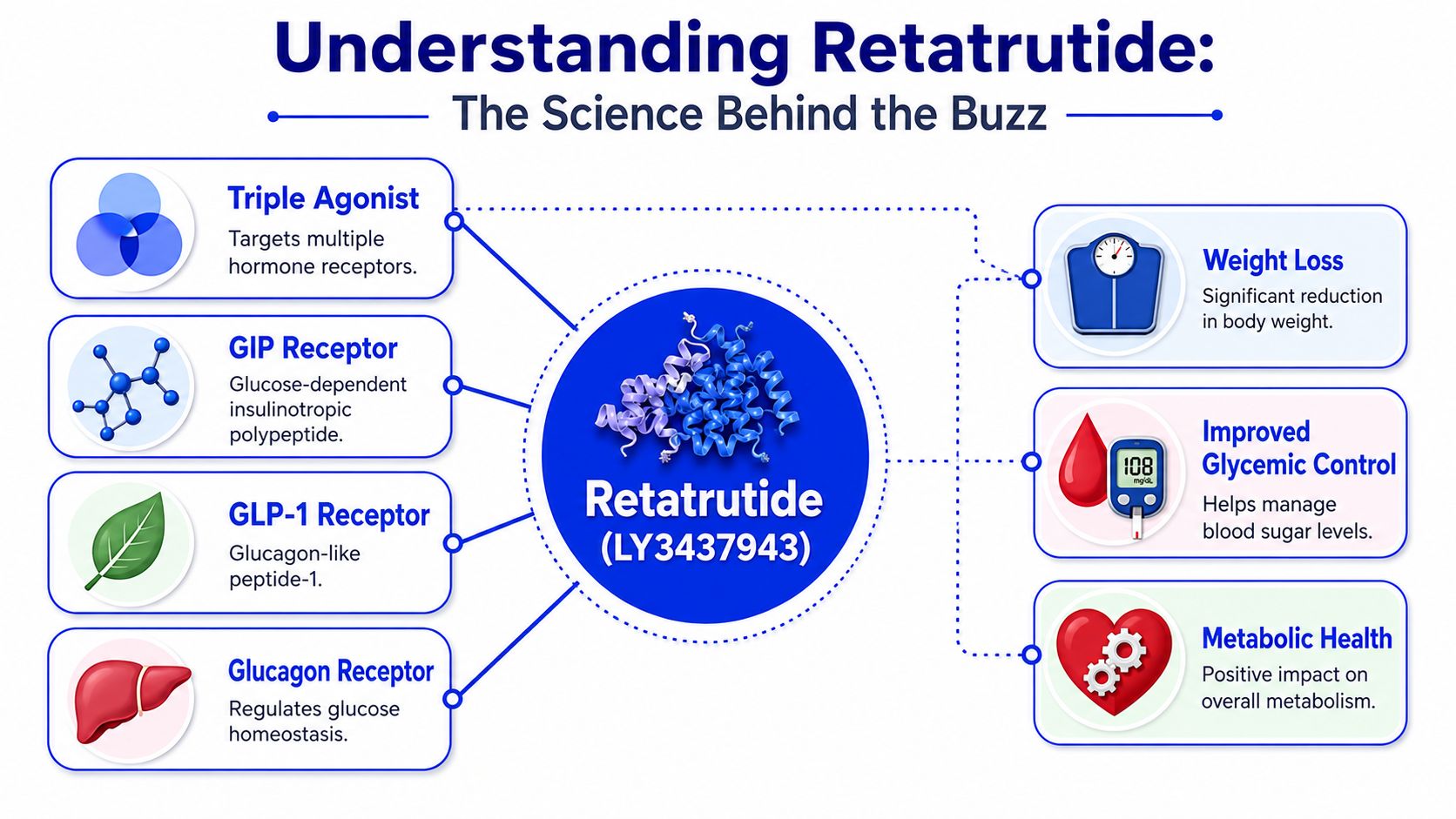
Retatrutide is commonly discussed as a triple agonist. In practical terms, that means researchers are looking at how one molecule may interact across multiple metabolic signaling pathways rather than just one familiar target.
That matters for sourcing because demand rises faster when a compound has:
Once demand spikes, weaker sellers often rush in. They copy product descriptions, post generic PDFs, and rely on buzzwords instead of proof.
With Retatrutide, molecule identity isn’t a minor technicality. It is the core of the buying decision.
A peptide listing is only as credible as the evidence behind it. If the compound in the vial isn’t the correct structure, every downstream assumption collapses. The more attention a peptide gets, the more important it becomes to verify that the seller understands the chemistry and can document it at the lot level.
Buyers often focus on “availability.” Serious labs focus on whether the supplier can prove molecular identity and handling quality.
That’s why the best place to buy Retatrutide, in a research context, usually ends up being the place with the least dramatic sales language and the strongest paperwork.
A lot of confusion comes from the phrase research use only. Some buyers read it as a disclaimer of convenience. Serious suppliers treat it as an operating boundary.
From a regulatory and safety standpoint, the best place to obtain Retatrutide in major markets is a registered clinical trial, because it is not yet FDA-approved and any online seller offering it for routine purchase is operating outside the standard approval pathway, according to this clinical trial and safety explanation.
For a legitimate peptide supplier, research use only means the product is sold for laboratory, analytical, or preclinical work. It should not be marketed as a ready consumer treatment, a shortcut around medical channels, or a substitute for approved prescribing pathways.
That distinction affects how reputable companies write product pages. A careful supplier usually avoids:
Some warning signs aren’t subtle. If a seller markets Retatrutide like a normal online wellness product, that tells you the business is not respecting the legal and safety framework around the compound.
Watch for patterns like these:
| Seller behavior | Why it matters |
|---|---|
| Overt human-use claims | Signals the seller may be operating outside standard approval pathways |
| Vague testing references | Suggests documentation may not support the actual lot sold |
| No distinction between research and personal use | Shows weak compliance discipline |
| Thin support responses to technical questions | Indicates limited control over sourcing or quality records |
A legitimate research buyer should also think about safety from the product side, not just the legal side. If a seller can’t show what’s in the vial, how it was tested, and whether the batch is traceable, the risk isn’t abstract. It affects identity, purity, contamination control, and data reliability.
The safest way to approach the best place to buy Retatrutide is to stop thinking in terms of brand names first. Start with a repeatable checklist. Good suppliers pass it quickly. Weak ones don’t.
Retatrutide should be evaluated by molecule identity and documentation quality, not storefront claims. It is a 39-amino-acid synthetic peptide with non-coded residues and a C20 fatty diacid conjugation, so a credible supplier should provide batch-level identity and purity evidence rather than generic marketing language, as noted in this technical Retatrutide profile.
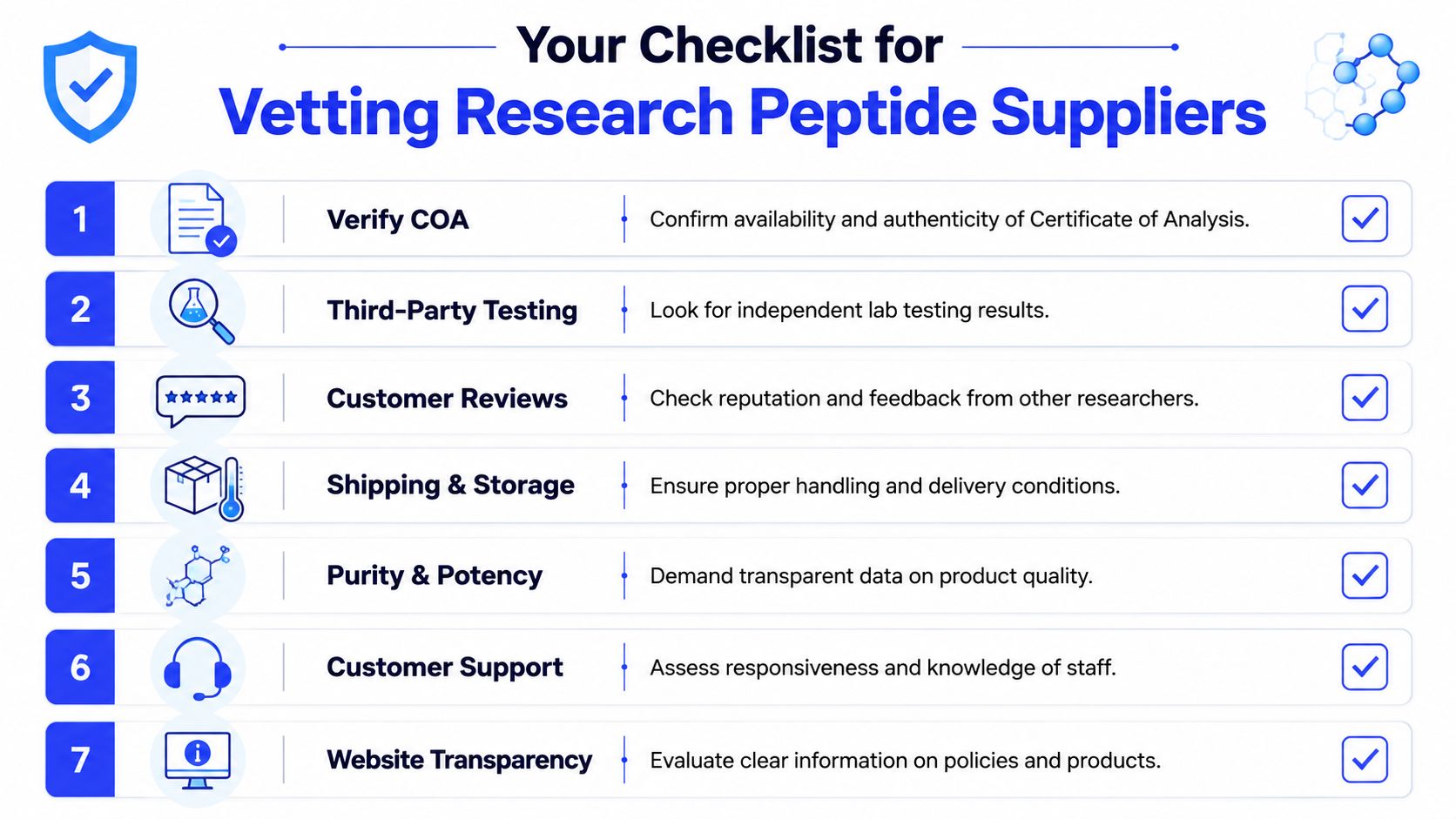
These are the minimum standards.
Once the basics are covered, look at how the company behaves when the details get harder.
A stronger supplier usually provides:
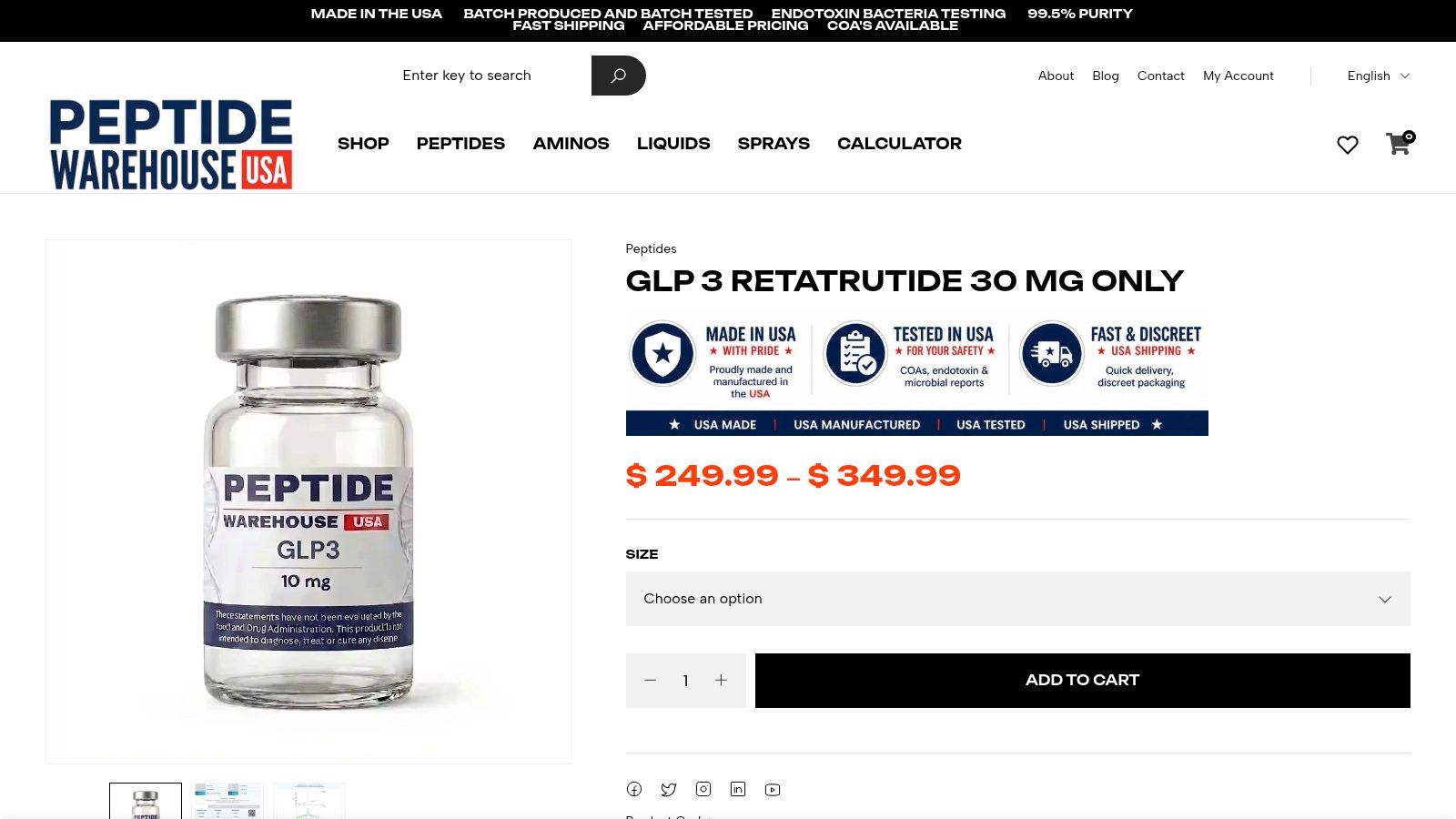
One practical example is Peptide Warehouse USA, which positions its catalog for research, laboratory, and analytical use and states that lots are supported by third-party documentation, including COAs and related reports. That doesn’t remove the need for review. It gives a buyer a factual starting point for due diligence.
Quality filter: If a seller talks more about outcomes than batch records, they’re asking you to trust marketing where you should be demanding proof.
Another useful habit is to compare the product page, the COA, and customer support answers for consistency. If the peptide name, lot references, purity language, or intended-use framing shift from one place to another, that inconsistency matters.
For peptide sourcing, the COA is the document that separates evidence from advertising. A lot of buyers ask whether a supplier “has a COA.” That’s too basic. A better question is whether the COA is specific, current, and consistent with the batch being sold.
This visual is a good reminder of how often buyers stop at the vial and never investigate the paperwork behind it.
Look at the top of the document first. The product name should match the listing exactly or clearly identify the same compound. Then check for a lot or batch number and make sure it aligns with the material you’re ordering or receiving.
After that, scan for the basic anchors of a real certificate:
If you want a broader primer on what makes a certificate trustworthy, this guide to COA for research quality offers a practical framework.
Many product pages lead with purity headlines. The COA should tell you how that claim was determined.
For peptides, buyers usually look for:
A useful rule is simple. If a document gives you a conclusion without showing how that conclusion was reached, keep asking questions.
Here’s a short explainer that helps many buyers get comfortable with the logic behind quality documents:
A supplier doesn’t need to write a textbook. But they should be able to answer direct technical questions without dodging them.
Ask things like:
A polished website can hide weak quality systems. A strong COA usually does the opposite. It makes the supplier’s process easier to inspect.
Once the supplier clears your documentation review, ordering becomes a logistics exercise. That part sounds simple, but plenty of peptide quality problems come from handling mistakes after purchase rather than from the molecule itself.

Before placing an order, confirm the operational details that affect chain of custody and product condition.
Storage should follow the supplier’s handling guidance. Buyers often assume all peptides can be treated the same way. That’s careless.
As a general principle for research compounds:
This is the part many people rush. Don’t. A well-documented peptide can still be compromised by sloppy receiving, casual storage, or inconsistent handling in the lab.
No. Those categories should not be treated as interchangeable.
Research-grade supply is typically positioned for laboratory, analytical, or preclinical use. Clinical trial material is handled within a much tighter regulated framework tied to a registered study, approved protocol, and controlled distribution chain. A site listing a peptide for research use is not the same thing as formal trial access.
That depends on jurisdiction, seller policies, and how the product is represented. The bigger issue is purpose.
If a supplier presents a compound strictly for research use, the buyer should respect that boundary. Problems start when people try to collapse research procurement into personal treatment behavior. That’s exactly the kind of ambiguity serious suppliers try to avoid.
At a basic level, reconstitution means turning a dry peptide preparation into a solution using an appropriate diluent under controlled conditions. The principle is simple. The execution needs care.
A few broad rules matter:
This article isn’t a protocol. For actual lab work, use your internal SOPs and the supplier’s handling documentation.
A COA alone doesn’t settle the issue. Two vendors can both upload a certificate and still differ sharply in reliability.
Look at the full pattern:
One weak signal rarely decides the case. Several strong signals together usually do.
The best sourcing decisions come from alignment. The listing, the COA, the batch label, and the support answers should all tell the same story.
The safest answer to the best place to buy Retatrutide isn’t a ranked list of vendors. It’s a disciplined way of evaluating any supplier before you place an order.
That means checking legal positioning first. Then verify batch-specific documentation, identity support, purity reporting, and company behavior under scrutiny. A serious supplier should make those checks easier, not harder.
Retatrutide attracts attention for good reason, but attention also pulls in weak operators. Careful buyers don’t chase hype. They inspect documentation, ask technical questions, and treat storage and handling as part of quality control.
If you use that framework, you’re far less likely to confuse a polished storefront with a reliable research supply chain.
If you’re evaluating research peptides for laboratory or analytical use, explore Peptide Warehouse USA and review its product documentation, policies, and support materials the same way you would any serious supplier. The right next step isn’t blind trust. It’s informed comparison.