No products in the cart.



Hair research often jumps from a mechanistic signal to a treatment claim. That gap matters with TB-500 hair growth more than most readers realize.
The interest is understandable. TB-500 sits close to thymosin beta-4 biology, and that biology intersects with tissue repair, angiogenesis, and follicle-relevant remodeling. But if you’re evaluating it seriously, the right question isn’t “Could this help hair?” The better question is “What, exactly, has been shown, in what model, and what can’t yet be claimed in humans?”
Most online coverage gets sloppy. It mixes animal findings, indirect theory, and speculative protocols into something that sounds settled. It isn’t settled. A research-oriented view is much more useful, especially for anyone assessing compounds for laboratory, analytical, or preclinical work.
Hair researchers keep returning to one basic problem. Follicles don’t operate in isolation. They depend on vascular support, extracellular matrix signaling, keratinocyte behavior, and local repair dynamics.
That’s why peptides draw attention in hair science. They offer a way to study signaling pathways that conventional cosmetic narratives often ignore. In that setting, TB-500 hair growth becomes less of a consumer trend and more of a mechanistic question.
A useful comparison is platelet-rich plasma. It’s already part of the broader discussion around regenerative approaches to hair, and BotoxBarb explains PRP for hair in a way that helps frame why researchers care about growth factors, blood supply, and repair signaling in the first place. TB-500 enters the conversation from a different angle, but the underlying interest overlaps.
Most hair-loss content sorts options into simple buckets like topical, oral, or procedural. That framework misses how follicle renewal is studied in the lab.
Researchers usually ask different questions, such as:
Practical rule: If a compound’s hair story depends mostly on indirect regenerative biology, treat it as a research hypothesis, not a finished intervention.
TB-500 fits that rule. The scientific interest is real. The human clinical proof for hair use is not.
TB-500 is commonly discussed as a synthetic research fragment associated with thymosin beta-4, often abbreviated TB4. TB4 is the better biological starting point because it’s the naturally occurring protein that generated much of the original interest.
Researchers have long focused on TB4 because it’s involved in processes tied to tissue maintenance and repair. In practical terms, that means cell movement, local healing responses, and regeneration-oriented signaling. Those features are why the compound family keeps showing up in discussions about skin, connective tissue, and eventually hair follicles.
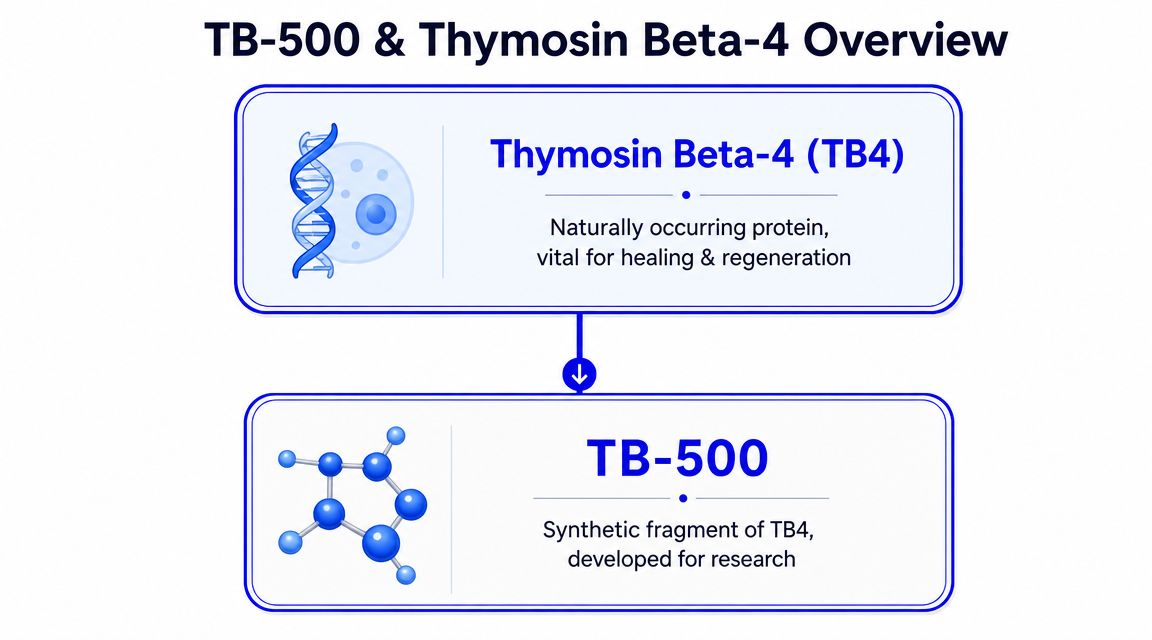
This distinction matters because many articles blur it. They treat findings about thymosin beta-4 as if they automatically prove a clinical effect for TB-500 in hair loss. That leap isn’t justified.
A more accurate way to discuss it is this:
| Term | Best understood as | What that means in practice |
|---|---|---|
| Thymosin beta-4 | A naturally occurring protein | The source of the underlying regenerative biology |
| TB-500 | A research-name derivative tied to TB4 biology | A compound discussed through that biological lineage, not a proven hair drug |
The difference seems technical, but it changes how evidence should be interpreted. If the foundation is TB4 mechanism and preclinical work, then any hair-growth discussion has to stay grounded in that level of evidence.
Hair follicles are dynamic mini-organs. They cycle, remodel, and depend on local support from surrounding tissue. That makes them sensitive to the same biological themes that made TB4 interesting in the first place.
Researchers care about this relationship because follicle health involves:
TB-500 is most useful to think about as a research tool linked to regenerative signaling. It isn’t established as a hair-loss therapy.
That framing keeps the discussion accurate. It also prevents a common mistake, which is assuming that a peptide with wound-healing relevance must therefore have validated hair-regrowth efficacy. It might become useful in future hair research, but that’s different from saying it already works clinically for scalp use.
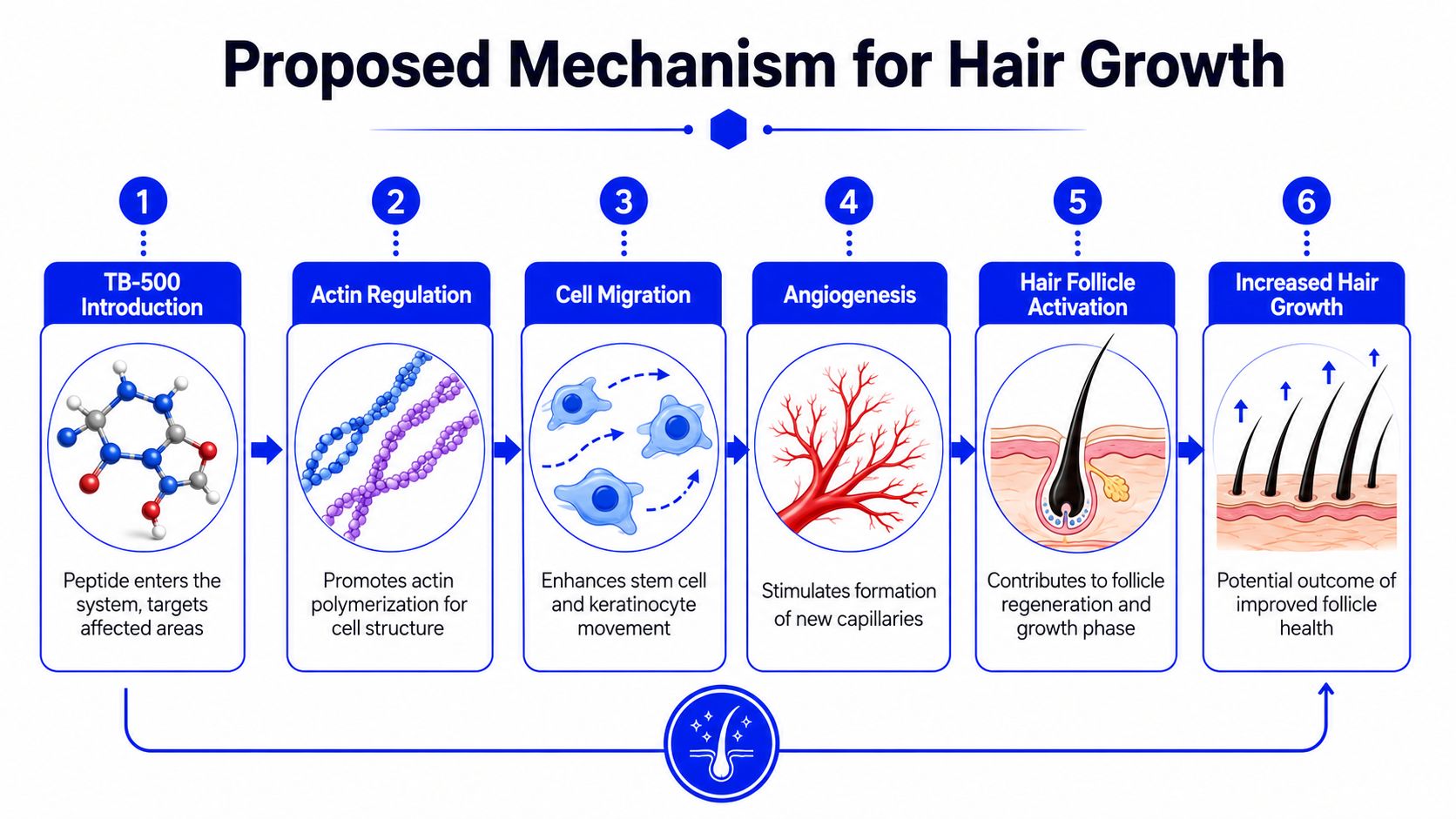
The mechanistic case for TB-500 in hair biology isn’t random. It comes from a specific research lineage focused on angiogenesis, tissue repair, and follicle-adjacent remodeling.
A research-oriented review notes that TB-500-related hair claims have been repeatedly linked to angiogenesis and tissue repair mechanisms that matter to follicles because follicles rely on blood supply and extracellular-matrix remodeling. The same review points to a 2011 transgenic mouse model where investigators observed thymosin beta-4 expression especially around hair follicles and reported accelerated hair growth alongside up-regulated laminin-5 in skin, while a 2026 review summarized positive preclinical outcomes for TB4/TB-500 but still emphasized the absence of large, well-controlled human studies needed for a clinical claim (research-oriented perspective on TB-500 and hair follicle renewal).
A hair follicle cycles through active growth, regression, and rest. Researchers usually describe these as anagen, catagen, and telogen. Any compound discussed for hair has to matter somewhere inside that cycle.
The proposed role here is not that TB-500 acts like a direct cosmetic stimulant. The idea is narrower and more biological. It may alter the local environment in ways that support a healthier or more active follicle state.
One review of preclinical hair-follicle work suggests TB-500 may promote regrowth by increasing local angiogenesis around follicles and stimulating hair-clonogenic keratinocyte migration. That same review cites a rat study reporting regulation of VEGF and MMP-2 through the Wnt/β-catenin/Lef-1 pathway, which it links to faster progression through the active anagen phase and stem-cell migration to the follicle base (preclinical overview of TB-500 hair growth mechanisms).
Researchers tend to center the discussion on three connected mechanisms rather than one headline effect.
Angiogenesis around the follicle
Follicles need nutrient delivery and oxygenation. If local vascular support improves, the follicular environment may become more favorable for active growth behavior.
Cell migration and follicle repopulation
Keratinocyte migration and stem-cell movement matter because follicles continuously rebuild highly specialized structures. A signal that improves orderly migration can be relevant even if it doesn’t directly “grow hair” on its own.
Extracellular matrix remodeling
The follicle sits inside a structural niche. Matrix proteins and basement-membrane interactions influence how the follicle anchors, cycles, and repairs.
A simple way to think about it is that TB-500’s proposed role is environmental. It may help create conditions that are more permissive for follicle activity rather than acting as a direct endpoint drug.
The mechanistic story is plausible because it connects to known follicle needs. Plausible isn’t the same as clinically proven.
That distinction matters in every serious discussion of TB-500 hair growth. The pathway logic is what makes the peptide interesting for research. The lack of definitive human scalp data is what keeps it in the investigational category.
The evidence base for TB-500 hair growth is narrower than many articles suggest. The strongest support comes from animal and preclinical work tied to thymosin beta-4 biology. That’s important evidence, but it isn’t the same as large human efficacy data.

A key reference point is a 2011 mouse study in which thymosin beta-4 over-expression was reported to accelerate hair growth, and the paper concluded that the protein has an important physiological role in hair growth, wound healing, and angiogenesis. A separate 2026 review noted that preclinical hair-growth findings exist for TB4/TB-500, but that more clinical research is needed before these effects can be considered applicable to humans (PubMed record on thymosin beta-4 and hair-growth physiology).
That gives researchers a legitimate starting point. It does not give the market a basis for treating TB-500 as an established hair-growth compound.
Here’s the evidence hierarchy in plain language:
| Evidence type | What it tells you | Main limitation |
|---|---|---|
| Transgenic or animal work | The biology may be relevant to follicles | Animal skin isn’t the same as clinical human scalp outcomes |
| Mechanistic reviews | The pathways make sense scientifically | Reviews don’t replace direct human endpoint trials |
| Human clinical hair trials | Would support real-world treatment claims | This is the missing layer |
The main gap isn’t subtle. There is still no large, well-controlled human evidence base establishing TB-500 as a hair-loss treatment.
That means several common online claims go beyond the literature:
The most responsible reading of the literature is that TB-500 remains an investigational topic in hair science, supported by preclinical rationale rather than confirmed clinical efficacy.
For researchers, that’s not a weakness. It just defines the assignment correctly. The value of TB-500 lies in hypothesis-driven work around regeneration, follicle microenvironment, and delivery strategy. Problems start when preclinical promise gets rewritten as a consumer result.
Could TB-500 be interesting enough for hair research to justify laboratory work, while still falling far short of a clinically validated hair-loss intervention? That is the right framing for this section, because safety, legality, and sourcing determine whether any downstream observation is interpretable.
Near the start of any procurement review, verify that the material is sold in a research-only context, not framed as a consumer hair product or medical treatment. For an investigational peptide with limited direct human hair data, that distinction matters. It affects legal positioning, labeling, and the credibility of the seller.

A recurring problem in this category is the speed with which preclinical interest gets converted into informal protocol advice. Pages discussing TB-500 for hair often move from mechanism to dosing as if the missing human efficacy layer were a minor detail. It is not. If the research question is scalp-specific follicle response, then route of administration, local exposure, tissue distribution, and study endpoints all need to be defined rather than borrowed from unrelated use cases.
One public discussion of peptide use for hair loss makes the evidence gap clear and notes that TB-500 and related peptides are not approved hair-loss treatments, with the hair rationale resting largely on indirect thymosin beta-4 biology rather than established clinical efficacy (expert discussion on peptides and hair-loss evidence gaps).
For researchers, the practical implication is straightforward. Internet dosing claims are not a substitute for a protocol.
The common weak points are predictable:
In a thin evidence base, analytical quality has outsized importance. If researchers cannot rely on standardized human hair protocols, they need to reduce the variability they can control. That starts with the material itself.
For TB-500 procurement, I would expect at least the following:
Poor sourcing can distort results in either direction. An impure or inconsistently manufactured peptide can create false negatives, false positives, or simple noise that gets misread as biology.
Quality filter: If a vendor spends more space promising outcomes than showing batch records, that is a procurement warning sign.
A short visual overview can help clarify what a compliant research posture should look like.
TB-500 should be handled as a research-use-only compound. That language is not cosmetic. It defines the legal and scientific boundaries around the product.
For hair-related work, keep the categories separate:
| Question | Current answer |
|---|---|
| Is there a plausible biological rationale for follicle research? | Yes, based on mechanistic and preclinical work |
| Is TB-500 an established human hair-regrowth therapy? | No |
| Is there a validated human dosing standard for hair studies? | No |
| Does sourcing discipline affect the value of the research output? | Yes |
Researchers who want usable data should treat legality, documentation, and material quality as part of study design, not as purchasing details. That is the practical bridge between promising preclinical biology and work that can hold up under scrutiny.
TB-500 remains one of the more interesting peptide topics in hair science because the biology is coherent. Regenerative signaling, angiogenesis, keratinocyte migration, and matrix remodeling all intersect with follicle behavior in ways that make the compound family worth studying.
What supports the discussion today is preclinical evidence and mechanistic reasoning. What doesn’t yet support it is an established human clinical case for hair regrowth. That distinction is the difference between rigorous research and marketing drift.
Future work will likely matter most in a few areas:
The useful takeaway is simple. TB-500 deserves attention as a research compound linked to thymosin beta-4 biology. It does not deserve inflated claims that skip past the evidence gap.
For labs and individual buyers trying to assess peptide options responsibly, quality documents, traceable batches, and research-only positioning should come before any excitement about benefits of peptides in hair applications.
Researchers requiring documented, research-use-only peptide sourcing can learn more through Peptide Warehouse USA, which supplies TB-500 and related compounds for laboratory, analytical, and preclinical use with batch-level documentation and clear compliance language.