No products in the cart.



Most articles about the Fox04 DRI peptide jump straight to “senolytics remove bad cells” and stop there. That misses the question that matters in a lab. Why does this peptide affect senescent cells in the first place, and how should that mechanism shape the way you source it, handle it, and test it?
That gap matters because FOXO4-DRI isn’t just another peptide on a catalog page. It became important because it gave researchers a workable molecular handle on a difficult biological problem: senescent cells resist death signals that would normally clear damaged cells. If you understand that mechanism clearly, your assay design gets sharper, your controls improve, and your interpretation becomes much more defensible.
What if age related tissue decline is driven less by a uniform slowdown and more by a small set of cells that refuse to exit cleanly?
That question helped shift aging research toward senolytics. These are compounds researchers use to test whether selectively removing dysfunctional senescent cells can improve tissue function in preclinical models. The logic is straightforward. If a persistent cell population is actively disrupting its environment, selective clearance may reveal whether that population is causal or merely associated with decline.

FOXO4-DRI became important in that context because it gave the field a more mechanistically defined probe. Rather than acting as a general cytotoxic stressor, it was designed around a specific protein interaction linked to senescent cell survival. That distinction matters in the lab. A targeted probe gives cleaner hypotheses, more interpretable readouts, and a clearer basis for assay design.
The peptide is typically described as a synthetic senolytic peptide built as an all D-enantiomer retro-inverso construct. For a new researcher, that phrase can sound more complicated than it is. The practical idea is that the peptide was engineered for binding logic and stability, not copied from a native sequence. A useful comparison is a key recut from durable material so it still fits the same lock while tolerating harsher conditions during handling and experimental use.
FOXO4-DRI is best understood as a research tool for testing a biological claim. The claim is that some senescent cells remain alive because they depend on specific survival interactions that healthy cells depend on less. If that claim is true, then interrupting one of those interactions should produce selective effects that can be measured across viability assays, apoptosis markers, and senescence enriched cell systems.
That is why the peptide continues to appear in discussions of senolytic biology.
For graduate students and bench scientists, the value is practical as much as conceptual. FOXO4-DRI is a research tool built around a specific protein interaction, distinct from vague marketing terms like “anti-aging peptide”. That framing affects how you study it. You do not evaluate it like a generic peptide additive. You evaluate it as a mechanism linked reagent, which means purity, sequence confirmation, storage history, solvent choice, and assay timing can all influence whether an observed effect reflects biology or a preparation artifact.
In other words, the molecular mechanism and the bench workflow have to match. If the question is selective senolysis, then the reagent has to be handled and tested in a way that preserves confidence in that conclusion.
Cellular senescence is often taught as permanent growth arrest. That’s true, but it’s incomplete. A senescent cell doesn’t just stop dividing and go quiet. It remains metabolically active and can keep signaling to neighboring cells.
A useful mental model is this: a senescent cell is less like a retired worker and more like a damaged machine left running on the factory floor. It no longer makes product, but it still consumes resources and can disrupt everything around it.
That disruptive behavior is why senescence matters in tissue biology. These cells can accumulate with age or after stress, and their continued presence is associated with tissue dysfunction across multiple organ systems.
Researchers often refer to senescent cells as “zombie cells” because they resist the normal clearance processes that would remove damaged cells. The phrase is informal, but the concept is serious. Persistence is the problem.
Not every non-dividing cell is a target. Many cells enter stable states for useful reasons, including development and wound responses. The challenge is finding compounds that act on harmful senescent survival programs without acting like a blunt toxin.
That’s where the Fox04 DRI peptide enters the conversation. It’s classified as a senolytic peptide, meaning researchers use it to study the selective elimination of senescent cells rather than general cytotoxicity.
A practical way to think about senolytics in the lab:
Practical rule: If your readout only shows lower cell number, you still don’t know whether you observed senolysis, growth inhibition, or assay stress. Mechanism-linked controls matter.
For experimental design, that distinction is important. If you’re testing FOXO4-DRI, you don’t want only a viability readout. You want a panel that asks whether senescent cells declined, whether apoptosis increased, and whether non-senescent controls remained relatively unaffected.
Why would disrupting one protein-protein interaction push a senescent cell toward apoptosis while leaving other cells less affected?
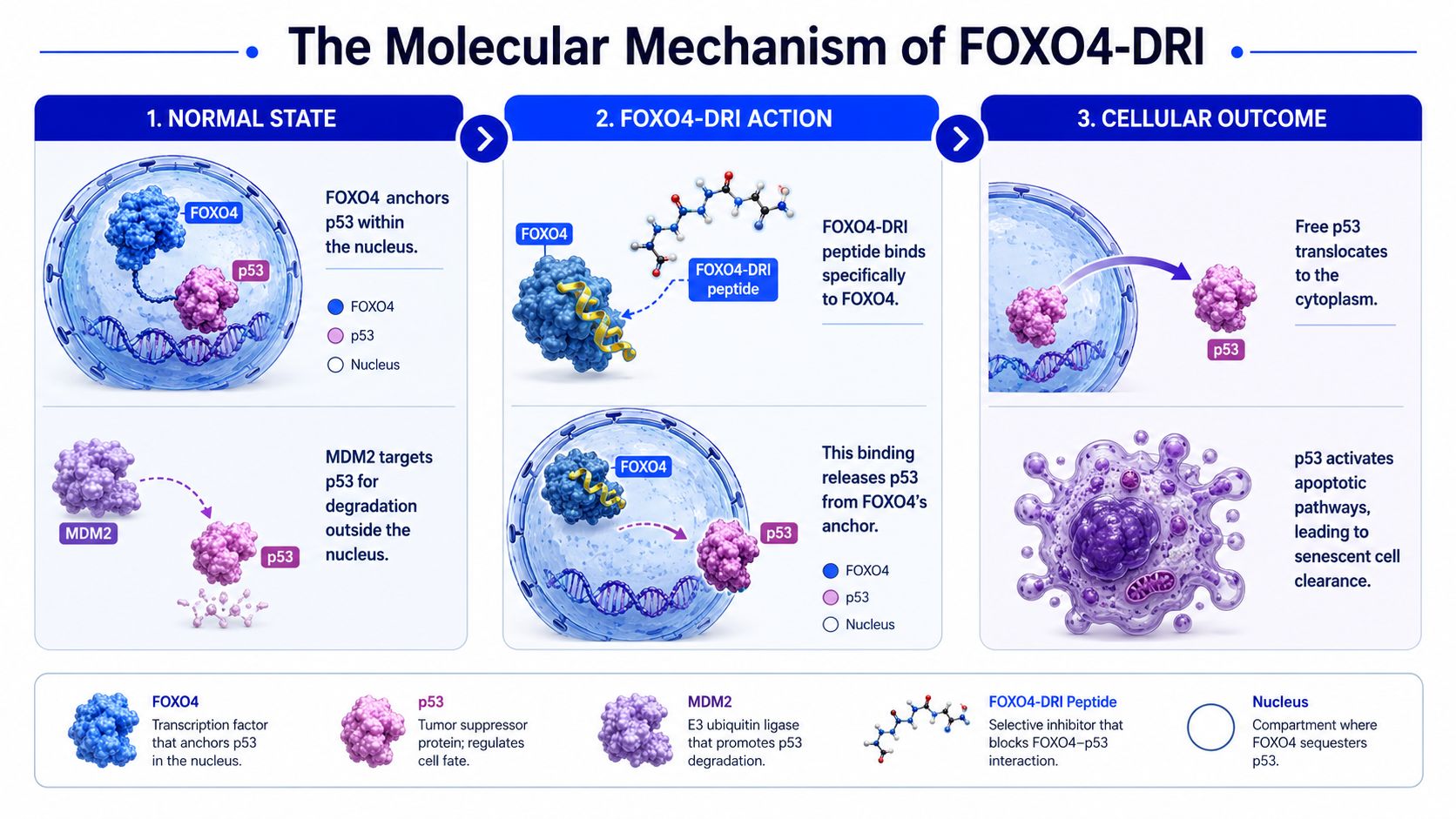
The answer starts with location and binding partners. In senescent cells, FOXO4 interacts with p53, a stress-response protein that can support cell-cycle arrest, DNA-damage responses, or apoptosis depending on context. FOXO4-DRI was designed to interfere with that FOXO4-p53 association. When that interaction is disrupted, p53 can shift out of its prior nuclear context and participate more strongly in apoptotic signaling.
That sequence is the mechanistic center of the peptide. For lab work, it also gives you a roadmap for what to measure. If a study claims FOXO4-DRI activity, the useful question is not only whether cell number dropped. The better question is whether the expected pathway events occurred in the right order.
Senescent cells often remain metabolically active and stress adapted. One part of that adapted state involves FOXO4 and p53. FOXO4 helps maintain a survival-associated setting for p53 in these cells. FOXO4-DRI acts as an antagonist of that interaction.
In a peer-reviewed chondrocyte study published by Aging, FOXO4-DRI treatment was associated with p53 nuclear exclusion, increased apoptotic signaling through a mitochondrial route, and a marked reduction in senescent-cell features in late-passage chondrocytes, as reported in the Aging study on FOXO4-DRI and chondrocyte senescence.
A retro-inverso, all-D peptide design matters here for a practical reason. It is meant to preserve the interaction-facing geometry relevant to binding while improving resistance to proteolytic breakdown. For a researcher, that design detail is not just chemistry trivia. It affects peptide stability during handling, exposure time in culture, and how confidently you can interpret a negative result. If the peptide degrades before target engagement, the assay can look biologically uninformative even when the mechanism is sound.
The mechanistic sequence can be stated directly:
“Nuclear exclusion” sounds abstract until you connect it to function. A protein in the nucleus has access to one set of partners and outputs. The same protein outside that setting can participate in a different response. For p53, that change in molecular context can alter whether the cell remains arrested or progresses toward apoptosis.
A simple lab analogy helps. If you move a reagent from a storage bottle to a reaction mix, its role changes because the surrounding components changed. p53 follows the same logic. Its effect depends not only on how much is present, but where it is and which proteins it can contact.
This is why localization assays are so informative. Immunofluorescence for p53, nuclear-cytoplasmic fractionation, or co-immunoprecipitation for FOXO4-p53 binding can say much more than a single viability endpoint.
A visual walkthrough helps anchor the pathway:
The proposed selectivity is biologically biased, not absolute. Senescent cells appear more dependent on this survival-associated interaction, so interrupting it should affect them more strongly than matched non-senescent controls. That is a testable hypothesis, not an assumption.
This has direct implications for assay design. A useful experiment usually includes three layers of evidence:
Purity and handling also matter more than they first appear. A peptide preparation with impurities, aggregation, or poor reconstitution can create membrane stress or nonspecific toxicity that mimics senolysis. That is why mechanism-linked readouts, matched controls, and lot documentation belong in the same experimental plan. If the biology, peptide quality, and assay outputs all point in the same direction, you can interpret the result with much more confidence.
What should a researcher look for in the FOXO4-DRI literature before bringing the peptide into a study? The most useful answer is not a long list of age-related phenotypes. It is a map of where the mechanism has been tested, which models were used, and how closely the reported readouts match the proposed biology.
The preclinical record developed in stages. Early work established FOXO4-DRI as a peptide used to test whether selective removal of senescent cells could improve tissue function in animal models. That historical role is captured in the dvm360 summary of FOXO4-DRI research history and vascular aging, which discusses its place in the early senolytic literature and later vascular findings.
Later studies asked a more practical question. Does the same FOXO4-p53 disruption hypothesis still make sense when you move from broad proof of principle into a defined tissue system?
In male reproductive aging models, reported work in naturally aged mice and H2O2-induced senescent TM3 Leydig cells linked FOXO4-DRI exposure to an improved testicular microenvironment, relief of age-related insufficiency in testosterone secretion, nuclear exclusion of Ser15-phospho-p53, and selective apoptosis in senescent Leydig cells. That combination matters because it ties a tissue-level outcome to a cell-level mechanism. For a lab scientist, that is far more informative than a phenotype alone. It is the difference between seeing a machine run better and opening the casing to confirm which gear changed.
A related pattern appears in vascular aging studies. The same dvm360 report describes mouse data in naturally aged and induced-aging models where FOXO4-DRI injections were associated with suppression of aortic aging and improved aortic function. It also notes co-immunoprecipitation evidence consistent with disruption of FOXO4 binding to p53. That kind of paired evidence is useful because function and mechanism are measured together, rather than inferred from one another.
Taken together, these studies support a narrower and more scientifically useful conclusion than any broad anti-aging claim. FOXO4-DRI remains relevant in preclinical research because different model systems keep pointing back to the same interaction axis, even when the tissue context changes.
| Study Focus | Model Used | Key Outcome |
|---|---|---|
| Early senolytic proof of principle | Preclinical animal research | Helped establish that selective removal of senescent cells can improve tissue function |
| Male reproductive aging | Naturally aged mice and H2O2-induced senescent TM3 Leydig cells | Reported improvement in testicular microenvironment and selective apoptosis in senescent Leydig cells |
| Vascular aging | Naturally aged and induced-aging mice | Reported suppression of aortic aging, improved aortic function, and prevention of FOXO4-p53 binding |
The literature becomes more convincing when the same mechanism appears across distinct models. That does not establish clinical utility, but it does strengthen confidence in the biological reality of the pathway.
That point has direct consequences for experimental planning. If your system shows senescence markers but gives no sign that the FOXO4-p53 survival axis is engaged, FOXO4-DRI may be a poor mechanistic fit. In practice, the best studies treat the published preclinical literature as a guide for model selection, target-engagement readouts, and interpretation criteria, not as a shortcut to assume the peptide will work in any senescent context.
A targeted peptide is only as useful as the batch you receive. That sounds obvious, but it’s where many projects drift into ambiguity. Researchers often debate biology when the underlying problem is material quality or incomplete documentation.
When you buy a peptide such as FOXO4-DRI, the Certificate of Analysis should function like a batch-specific identity card. It should let you answer basic questions about what you have, how it was tested, and whether the documentation matches the vial in your hand.
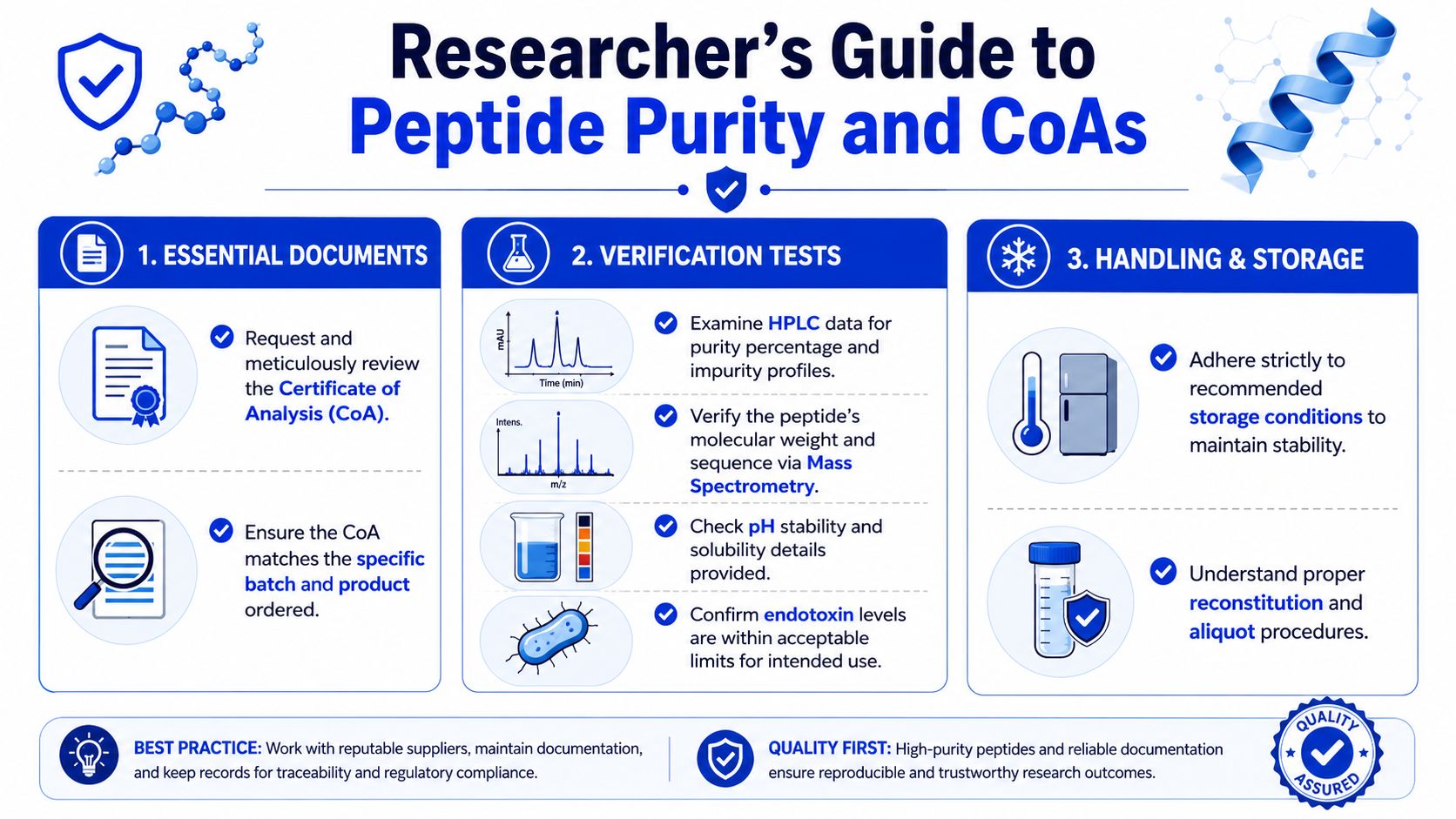
At minimum, careful researchers usually look for:
One practical example in the market is Peptide Warehouse USA, which states that its catalog is supported by batch documentation including COAs, microbial and endotoxin reports, and stated purity levels up to 99.5% for supported lots in company documentation. That matters because transparent paperwork gives a lab something concrete to audit before any experiment begins.
Don’t treat peptide sourcing as a checkout task. Treat it as the first analytical step in your study.
Ask questions such as:
A peptide with unclear documentation can still produce a signal. The problem is that you won’t know whether the signal belongs to the biology or to the batch.
For FOXO4-DRI, that uncertainty is especially costly because the experiments are usually mechanistic. If your compound quality is poorly documented, every downstream claim gets weaker.
Good handling practices don’t make poor material good, but poor handling can make good material unreliable very quickly. With a peptide used in mechanistic work, avoid casual bench habits.
Keep the lyophilized material in conditions that minimize moisture exposure, repeated warming, and unnecessary light exposure. The exact storage recommendation should follow the supplier’s documentation for that lot, but the principle is straightforward: stable dry storage reduces variability before first use.
Labs that already manage sensitive biomaterials often use the same discipline for peptide inventory that they use for cell banks and reference standards. If your team needs a broader framework for cold-chain planning and sample preservation, this guide to biobanking and research is a useful operations-focused reference.
Reconstitution should be planned backward from the assay. Decide the working concentrations you need, then create a stock concentration that minimizes repeated freeze-thaw cycles and pipetting error.
A simple workflow often works best:
Some practical habits save a lot of trouble later:
For FOXO4-DRI, consistency matters more than convenience. If you vary solvent handling or storage patterns across experiments, you can create noise that looks biological but isn’t.
How do you tell whether FOXO4-DRI is clearing senescent cells for the reason you expect, rather than just stressing every cell in the dish? That question should shape the assay before you choose the dose.

FOXO4-DRI is most useful when the experiment is built around its proposed mechanism. The peptide is intended to disrupt a survival interaction in senescent cells, so your readouts should test three separate questions: did the cells start senescent, did treatment trigger apoptosis, and was the effect selective for the senescent population? If you skip any one of those, interpretation gets weak fast.
A practical assay set usually includes:
This layered design matters for a simple reason. Senolysis is a selective phenotype, not just a drop in viability. A viability assay alone is like judging an enzyme inhibitor only by whether the culture looks unhealthy. You need enough context to separate target-linked cell death from general toxic stress.
Published studies can help define that context, but they should function as reference points rather than templates. As noted earlier, preclinical FOXO4-DRI work in senescence models shows that the biological response depends heavily on the system used. Cell identity, the way senescence was induced, treatment duration, serum conditions, and the sensitivity of the endpoint assay can all shift the apparent response window.
That is why range-finding studies are worth doing carefully. Start with a small concentration series, include untreated and vehicle controls, and decide in advance what result would count as selective senolysis. For example, if senescent cells show apoptotic activation while proliferating or quiescent controls remain largely unaffected, that supports the intended biology. If both populations decline together, the cleaner interpretation is nonspecific toxicity until proven otherwise.
The connection between sourcing and assay design is critical. Impure material, inconsistent reconstitution, or poorly documented lot changes can blur a dose response and make a mechanism-based compound look erratic. In practice, assay quality depends on chemistry quality. If the peptide varies, your biology will appear to vary too.
For preclinical work, dosing context should therefore be recorded as a full experimental condition, not just a number in a methods table. Note the lot, purity, vehicle, stock concentration, final exposure time, and the exact definition of your senescent versus control populations. That level of discipline makes repeat experiments easier and makes negative data more useful.
The Fox04 DRI peptide matters because it gave senescence research a concrete mechanistic tool. Rather than treating senescent cells as a vague hallmark of aging, FOXO4-DRI let researchers test a specific idea: some senescent cells survive by maintaining a FOXO4-p53 interaction, and disrupting that interaction can push them toward apoptosis.
That mechanism is the primary anchor for practical lab work. It shapes how you choose controls, how you interpret p53 localization, how you distinguish senolysis from broad cytotoxicity, and why purity and batch documentation matter so much. The preclinical literature supports FOXO4-DRI as a meaningful reference compound in senescence biology, especially across early proof-of-principle work and later organ-specific models.
Used properly, it’s a research compound for laboratory and preclinical investigation, not a shortcut to sweeping claims. If you’re building a senescence workflow, focus on traceable sourcing, disciplined handling, and assays tied tightly to mechanism. That’s where useful data starts.
If you’re sourcing research peptides for senescence studies, Peptide Warehouse USA is one place to learn more and explore options for high-purity, research-use compounds supported by batch documentation and COA-based review.