No products in the cart.


If you’re trying to buy BPC-157 online, you’re probably seeing the same pattern I see when reviewing suppliers: big purity claims, fast shipping promises, and very little clarity about what matters. That creates risk at the exact point where a research purchase should be most controlled.
The practical answer isn’t to chase louder marketing. It’s to treat BPC-157 procurement like any other sensitive lab input. Documentation, lot traceability, contamination controls, business transparency, and regulatory clarity matter more than branding. Buyers who focus on those basics usually avoid the worst mistakes.
This guide takes that procurement-first approach. It stays away from speculative benefit claims and focuses on what you can verify before paying, what to inspect when the order arrives, and how to separate a legitimate research-use supplier from a page that only looks convincing.
A familiar procurement failure starts with a clean product page, a fast checkout flow, and a PDF that looks technical at first glance. The problem shows up later, when the vial label, lot number, and test record do not align well enough to support the work. By that point, the price was never the actual risk. The risk was introducing undocumented material into a research process that depends on traceability.
BPC-157 sourcing should be handled as a records problem first and a purchasing task second. The compound sits in a market crowded with research-use listings, inconsistent supplier standards, and marketing language that often outpaces the underlying paperwork. In practice, the useful distinction is not which seller sounds confident. It is which seller can document what was made, how it was identified, and which batch was shipped.
I use a simple procurement screen for compounds in this category. First, define the research use clearly enough that purchasing staff and receiving staff are applying the same standard. Second, review the supplier as an operating business, not just a product page. Third, confirm that the batch offered for sale can be tied to lot-specific documentation. Fourth, verify that the shipment received matches the order record and labeling. Fifth, protect the material after receipt with controlled handling and storage.
Practical rule: If verification takes more effort than payment, the supplier is creating avoidable risk.
This approach shifts attention away from unproven benefit claims and toward evidence you can inspect. A polished storefront does not establish quality. A documented chain from listing to lot record to received vial does.
Careful buyers are usually trying to reduce uncertainty before the material ever reaches the bench. If the procurement file contains gaps, conflicting identifiers, or generic testing language, the problem has already entered the study.
Before reviewing purity, price, or shipping speed, fix the use case. That’s the filter that keeps the whole purchase process grounded.

Independent medical commentary notes that there are no well-done human clinical trials demonstrating efficacy for BPC-157, no evidence-based dosing, and no established long-term safety profile. The same commentary also notes that regulatory sources classify it as unapproved and not suitable for compounding, which is why buyers should prioritize documentation integrity instead of therapeutic marketing when they purchase.
That has a direct purchasing implication. A research-use product with clean paperwork is still not the same thing as a clinically validated product. Buyers often blur that line because product pages are written to feel familiar, but compliant procurement starts by keeping those categories separate.
Research-grade documentation can support a research purchase. It does not convert an investigational compound into an approved therapy.
A legitimate research seller usually does three things clearly.
First, it labels the product for research or laboratory use only. That language isn’t a formality. It tells you how the seller understands the transaction.
Second, it avoids promising healing, recovery, or performance outcomes for human use. Claims like that create legal and compliance problems because they suggest a use case the product classification doesn’t support.
Third, it presents business information in a way that can stand up to scrutiny. If the site hides its identity while making aggressive claims, the compliance posture is already weak.
Here is a simple comparison:
| Review point | Lower-risk signal | Higher-risk signal |
|---|---|---|
| Product framing | Research-use language | Human-use implication |
| Evidence posture | Documentation-centered | Benefit-centered |
| Safety discussion | Cautious and limited | Confident and expansive |
| Regulatory clarity | Explicit disclaimers | Ambiguous positioning |
A lot of confusion in this category comes from buyer intent. Some shoppers are searching for a research compound. Others are really trying to find therapy access. Those are not the same path, and a trustworthy seller shouldn’t blur them.
A typical procurement mistake happens before any vial is ordered. A buyer sees a polished site, a clean label, and a purity claim, then skips the harder questions about who is selling the material and how their records hold up under review.
That is backwards. For research purchasing, supplier quality starts with identity, recordkeeping, and accountability.
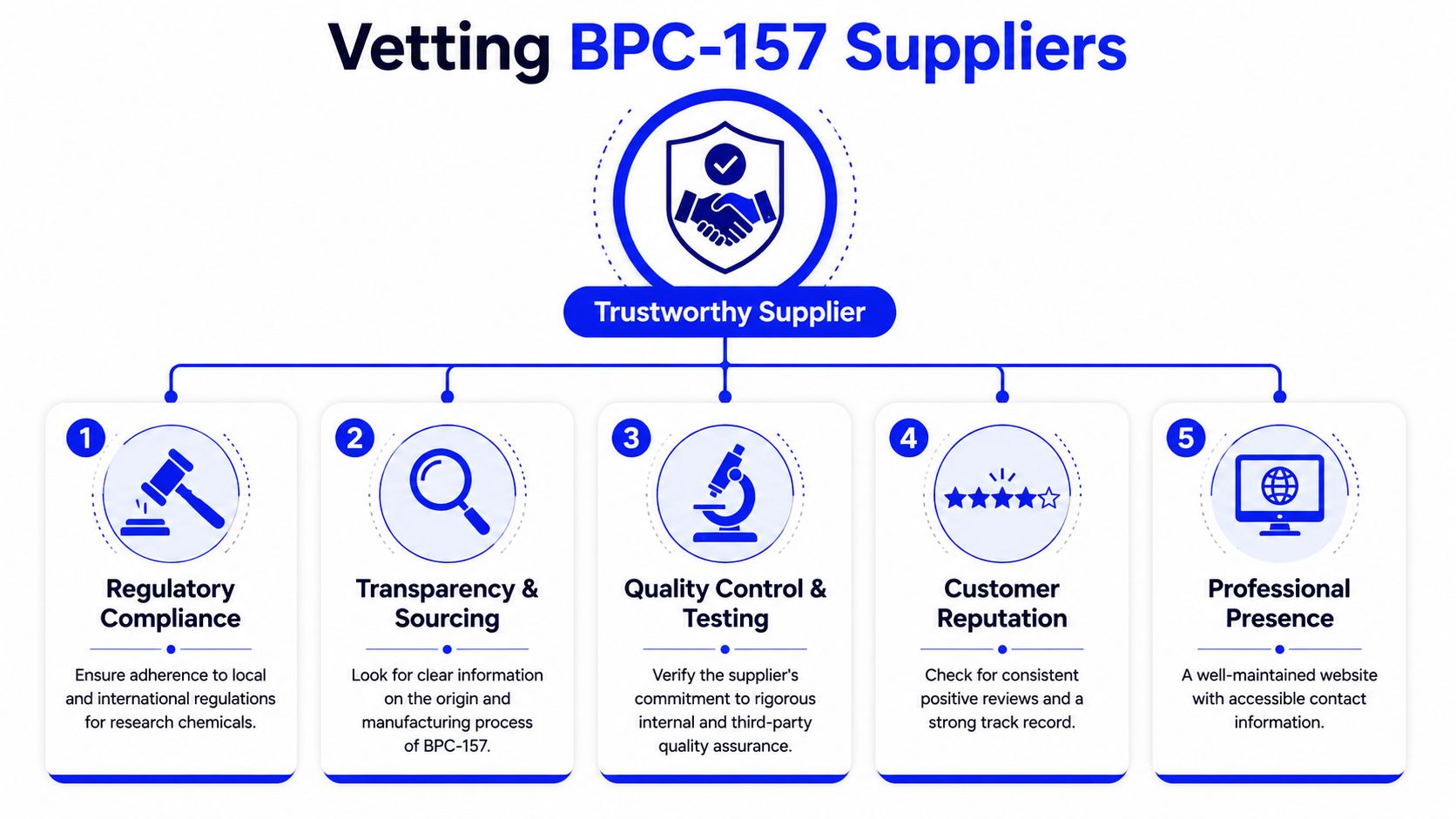
Start with the business itself. If the operator is hard to identify or difficult to reach before purchase, post-sale problem resolution usually gets worse, not better.
A credible supplier page should show a legal business identity, working contact channels, posted order and shipping policies, and product information that stays consistent from listing to checkout. Documentation access matters here too, but the main question is simpler: can this seller support an auditable purchase, or are they only set up to collect payment?
Use this checklist during review:
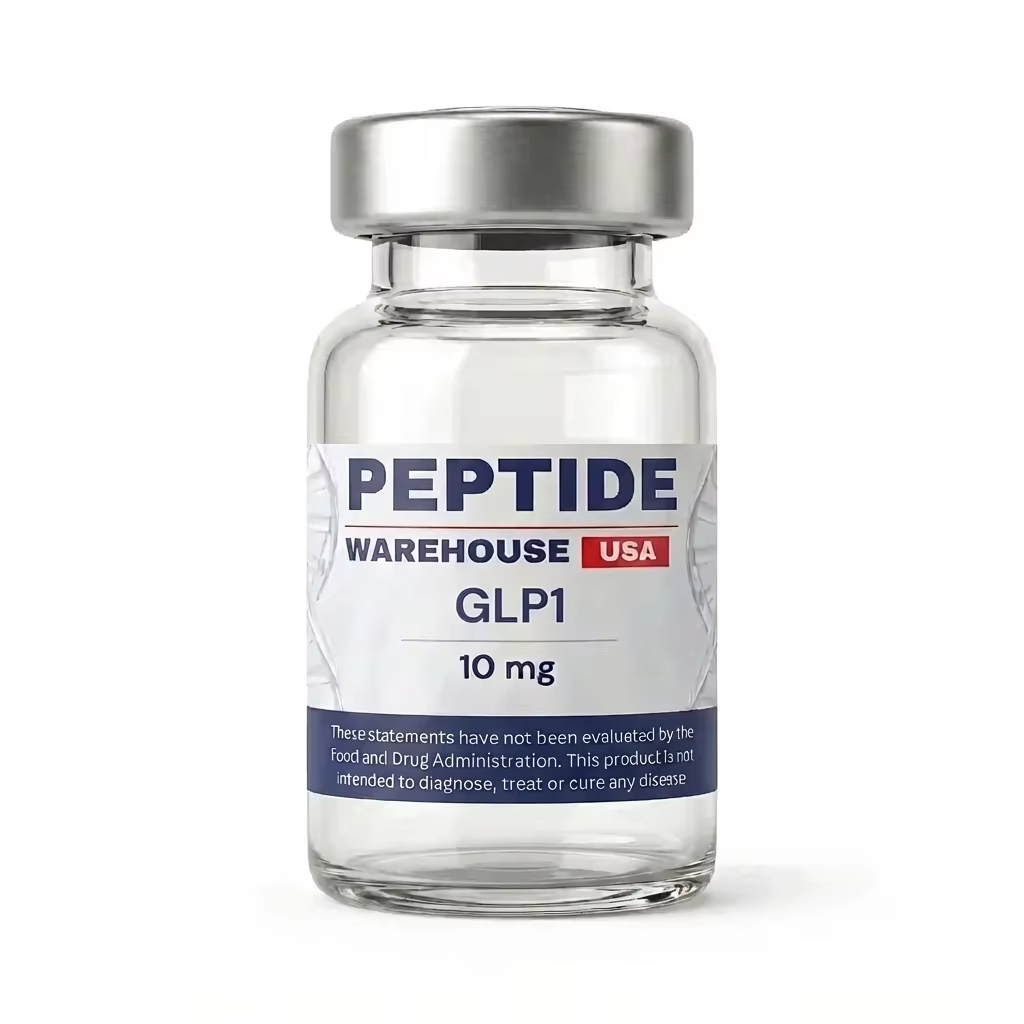
Peptide Warehouse USA is one example of a seller that presents itself with visible support, account tools, and posted shipping and returns information. Treat that as a starting point for review, not proof of quality. The standard is documented accountability.
A short video can help frame what supplier evaluation should look like in practice:
Public listings can still help with screening. They show how sellers position themselves and what they choose to document in plain view.
Use those listings as a comparison tool, not a buying signal.
A seller may advertise high purity, fast domestic shipping, or favorable pricing and still fail basic procurement review if lot records are unclear, support channels are weak, or business details do not line up. In practice, documentation discipline is a better predictor of a low-friction order than marketing claims.
I treat vendor screening as a records exercise first and a product review second. That approach catches problems early. It also keeps the focus where it belongs for legitimate research purchasing: traceability, compliance posture, and whether the supplier can produce paperwork that matches the material shipped.
Ask direct questions before placing an order:
Those questions remove a lot of noise. A polished storefront may look credible. Procurement decisions should rest on whether the seller can document the transaction from listing to lot.
A procurement failure often starts with a document that looks polished enough to pass a quick glance. The COA is usually that document. If it cannot be tied cleanly to the material being sold, it does not reduce risk. It adds it.
For BPC-157 research procurement, the COA is a control document, not a marketing asset. The question is not whether the PDF says “high purity.” The question is whether the record supports traceability from the supplier’s inventory to the lot that arrives at the lab.
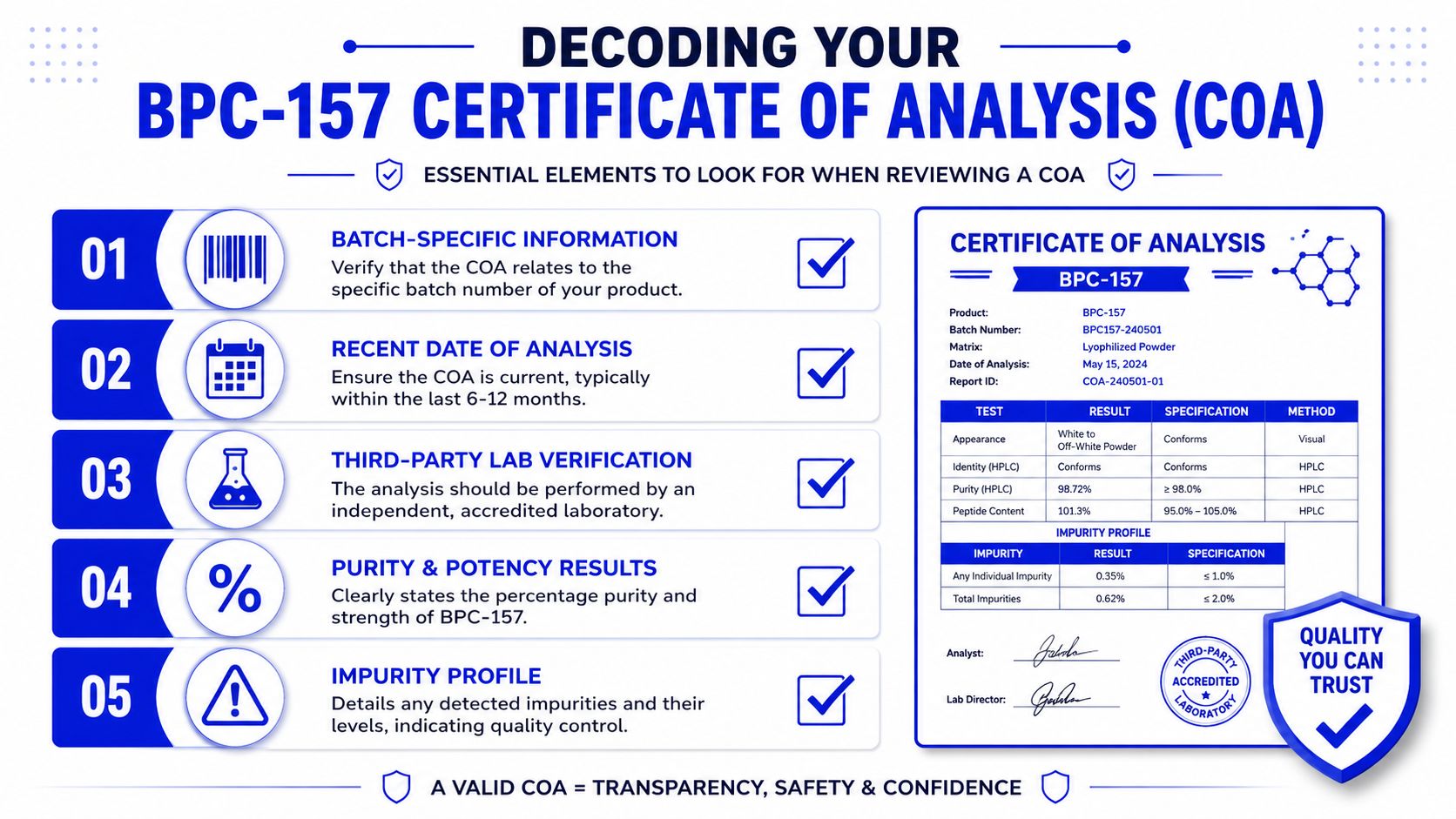
A reliable COA is batch-specific. It identifies a real lot, shows when testing occurred, and gives enough detail to confirm that the file belongs to the material under review. A generic report reused across multiple listings has limited value, even if the formatting looks professional.
I treat COA review as a documentation check first. If the supplier cannot connect the report to the vial label and sales record, the review stops there.
Start with the identifiers.
The lot or batch number on the COA should match the label format used on the product and the shipment paperwork. If the invoice references one code, the vial uses another, and the COA shows a third, the problem is not cosmetic. It means the paper trail is weak.
Then check the analysis date. The date should make sense for the inventory being offered for sale. Older reports are not automatically invalid, but a supplier should be able to explain whether that same lot is still in distribution and stored under conditions that preserve integrity.
After that, read past the headline purity line. Purity matters, but it is only one field in the release record. Identity, assay method, impurity profile, and any microbiological or endotoxin testing included in the report all help show whether the supplier is documenting the batch with care.
Focus on these points:
Procurement note: A COA earns trust by closing documentation gaps. If it creates new ones, record the discrepancy and treat it as a failed review item.
A weak COA often shares the same signs. Branded header. Broad purity claim. Little or no batch detail. Sometimes the file is technically real but still unusable for procurement because it does not tie back to current inventory.
A stronger COA supports verification. It shows what was tested, when it was tested, which lot was tested, and who issued the results. That gives the buyer something concrete to reconcile against labels, invoices, and receiving records.
Use this quick screen:
| COA trait | More reliable | Less reliable |
|---|---|---|
| Batch reference | Specific lot listed | No lot listed |
| Date | Clearly shown | Missing or vague |
| Testing detail | Multiple relevant fields | Single headline claim |
| Seller behavior | Easy access to records | Delays or evasiveness |
| Match to shipment | Labels align | Labels conflict |
If a supplier answers a documentation question by sending a different PDF that still does not match the batch, that response is useful. It shows how the supplier handles record control under basic scrutiny. For legitimate research purchasing, that process quality matters as much as the assay result itself.
Some suppliers disqualify themselves fast. You don’t need a deep audit if the seller is already signaling that compliance and documentation are secondary.
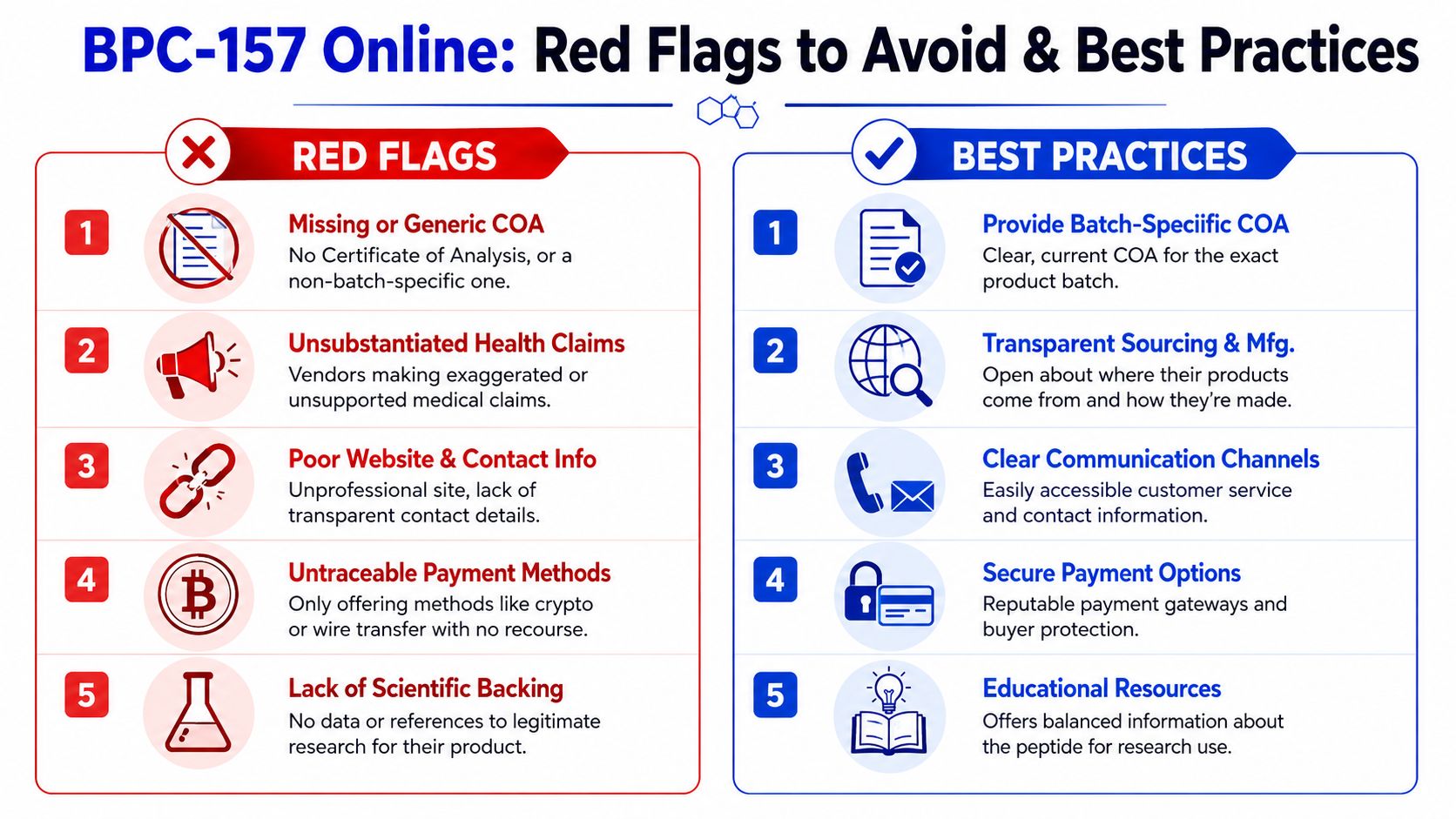
Many pages targeting people who want to buy BPC-157 online fail to explain the product’s investigational and non-FDA-approved status clearly. A major red flag is any marketing that suggests healing or recovery for human use, because that misrepresents the product’s legal classification and the limited evidence for clinical use.
That kind of copy tells you the seller is willing to blur the line between research supply and therapeutic marketing. Once that line is blurred, every other claim deserves more skepticism.
Watch for wording like:
If the page reads like a treatment ad, don’t evaluate it like a lab supplier.
Bad operators often leave the same fingerprints.
One is weak contact information. If you can’t find a real support path, you’ll have trouble resolving batch questions, damaged shipments, or missing records.
Another is poor policy transparency. Shipping terms, return handling, and order support shouldn’t feel hidden.
Then there are payment and documentation problems. A seller that pushes untraceable payment methods while offering thin documentation is asking you to accept all the downside.
Use this disqualification list:
A careful buyer doesn’t need every answer up front. But you do need enough evidence to justify moving forward. If the seller creates friction around verification, that’s your answer.
Once you’ve chosen a supplier, the job shifts from screening to control. Ordering and post-delivery handling are where avoidable mistakes happen.
Keep your own records clean from the start. Save the product page, the lot-linked documentation you reviewed, the order confirmation, and any pre-sale communication.
Choose payment methods that preserve transaction records and buyer protection where available. That’s basic procurement hygiene, especially when you’re ordering sensitive research compounds.
For teams refining their delivery workflow, ECORN’s shipping expertise is a useful operational read because it breaks down the practical side of shipping expectations, communication, and fulfillment planning in a way that applies well to research purchases too.
Don’t treat delivery as the end of the process. Treat it as an incoming quality check.
Review the shipment before filing it away:
If something doesn’t match, document it immediately and contact the supplier while the shipment condition is still fresh and easy to verify.
Most research peptide handling problems are procedural, not mysterious. Material that arrived with acceptable documentation can still become less useful if storage is casual or inconsistent.
Use a basic internal protocol:
The goal is simple. Preserve the same traceability after delivery that you demanded before purchase.
Buying BPC-157 online for research doesn’t need to be a gamble. It becomes manageable when you ignore the loudest claims and evaluate the supplier the way a procurement officer would evaluate any controlled input.
The strongest buyers do a few things consistently. They keep the use case clear. They screen the business before the product copy. They insist on batch-linked documentation. They inspect shipments on arrival and maintain traceability after receipt.
That framework works because it reduces uncertainty at every stage. It also keeps the purchase aligned with what BPC-157 is in the current market: an investigational research compound that should be judged by records, not promises.
If you’re comparing sources, use this article as a working checklist. The more disciplined your procurement process is up front, the fewer surprises you’ll have later in the lab.
If you’re looking for a research-use supplier with transparent batch documentation, clear policy information, and a catalog that includes BPC-157, learn more at Peptide Warehouse USA and explore whether its documentation-first approach fits your procurement process.