No products in the cart.


You've got a vial of lyophilized GHK-Cu on the bench, a target dose in mind, and very little room for sloppiness. That's usually the moment people search for a GHK-Cu dosage calculator. They don't just need arithmetic. They need a repeatable way to turn vial strength, reconstitution volume, and target dose into a draw they can measure.
Most calculator pages stop at the formula. That helps, but it doesn't answer the practical questions that come up in real research work. Existing guidance often covers reconstitution math and syringe units while also noting there's no universally accepted dosage standard and no FDA-approved dosing guideline for general therapeutic use, which leaves a gap around starting points, use-case differences, and adapting to different vial strengths and mixing volumes, as noted in this GHK-Cu dosage overview.
That gap matters because the math is fixed, but the decision-making isn't. If you work with peptides regularly, this is similar to how athletes use calculators to optimize protein for muscle gain. The tool is only useful when the inputs match the goal.
A GHK-Cu dosage calculator is best understood as a conversion tool, not a dosing authority. Its job is simple. It takes the amount in the vial, the amount of diluent added, and the target dose you want to test, then converts that into a measurable draw in mL or U-100 syringe units.
That distinction clears up a lot of confusion in the lab. The calculator isn't telling you what biology will do. It's making sure the amount you intended to prepare is the amount you withdraw.
Peptide handling becomes unforgiving when the target is small and the measurement space is tight. If the draw is only a fraction of a milliliter, any unit mix-up can shift the prepared amount far from the intended protocol.
The useful part of a calculator isn't convenience. It's consistency across repeated preparations.
In practice, that means fewer transcription errors, cleaner handoffs between colleagues, and easier protocol review. When someone else checks your math, they should be able to reconstruct the same concentration and the same draw volume from the same inputs.
What works is treating the calculator like part of a standard operating procedure:
What doesn't work is guessing a draw because it “looks close,” or copying someone else's units without checking their concentration. Those shortcuts create noise in the experiment before the experiment even starts.
Every accurate calculation starts with a small set of inputs. If even one is wrong, the final draw will be wrong too. That's why experienced researchers don't rush to the calculator first. They confirm the inputs first.
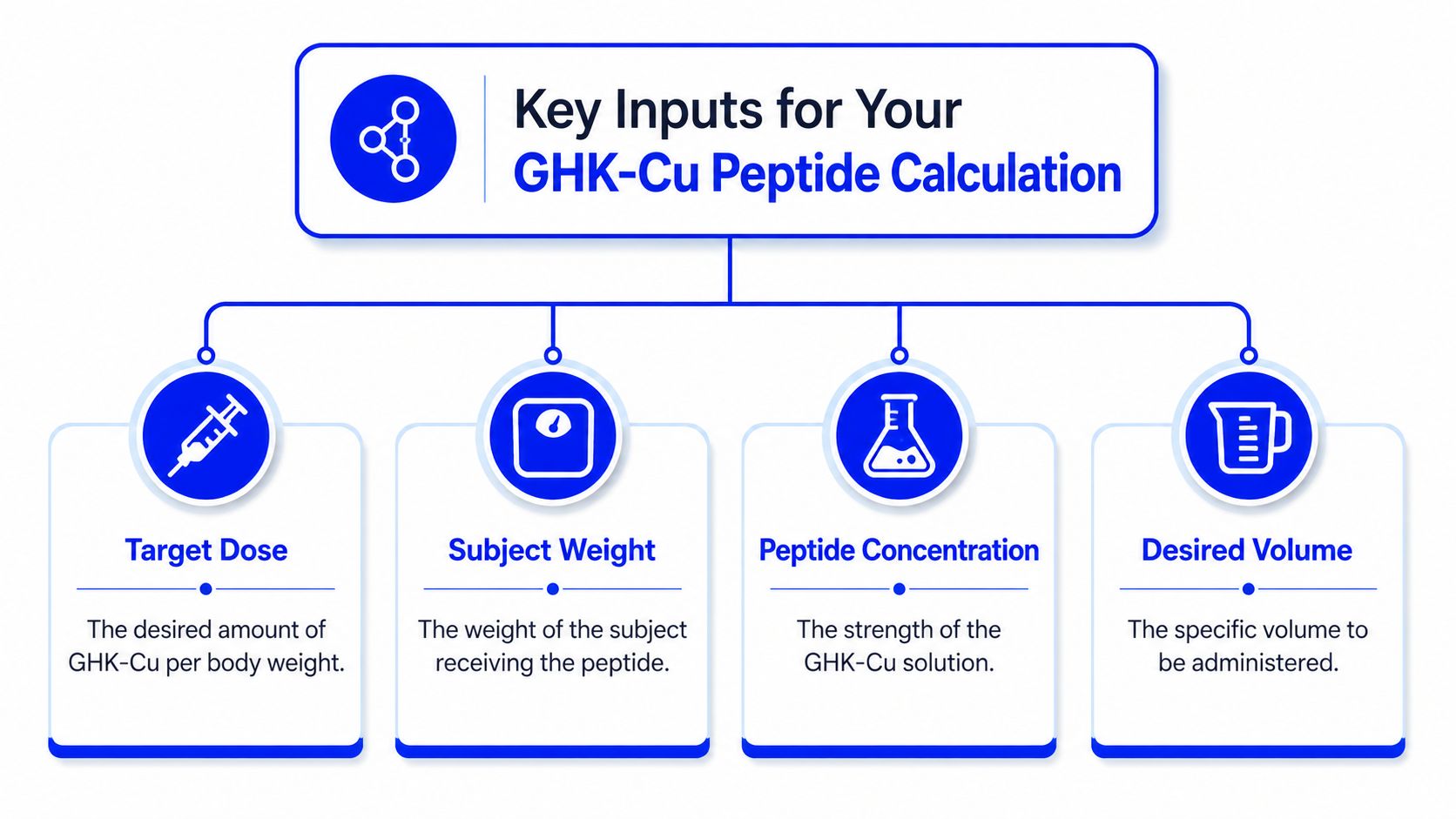
The core inputs are straightforward:
A calculator then uses those values to convert the target dose into a measurable withdrawal amount. One published explanation of the workflow describes the GHK-Cu dosage calculator as a unit-conversion tool that uses vial amount, reconstitution volume, and target dose to output mL or U-100 syringe units, while stressing standard metric relationships such as 1 mg = 1,000 mcg and giving a common example of 100 mg diluted with 3.0 mL to produce about 33.3 mg/mL in solution, as shown in this GHK-Cu dosage calculator guide.
Most preventable errors come from unit confusion. A researcher may think in milligrams, then enter micrograms, then read the result in syringe units without checking the concentration layer in between.
Use this quick checklist before entering anything:
Practical rule: The calculator is only as reliable as the units you feed into it.
Some visual guides mention inputs like subject weight or desired administration volume. In a pure reconstitution workflow, those aren't always primary variables. The essential variables remain the same: vial amount, diluent volume, and target dose. If your protocol adds body-weight logic, that decision should happen before the conversion step, not inside it.
A common lab mistake happens after the math seems finished. A researcher enters the vial amount and diluent volume, gets a number from the calculator, then draws to a syringe mark without checking what that number represents. The calculator can give the right answer and the protocol can still fail if concentration, volume, and syringe markings are not kept separate.
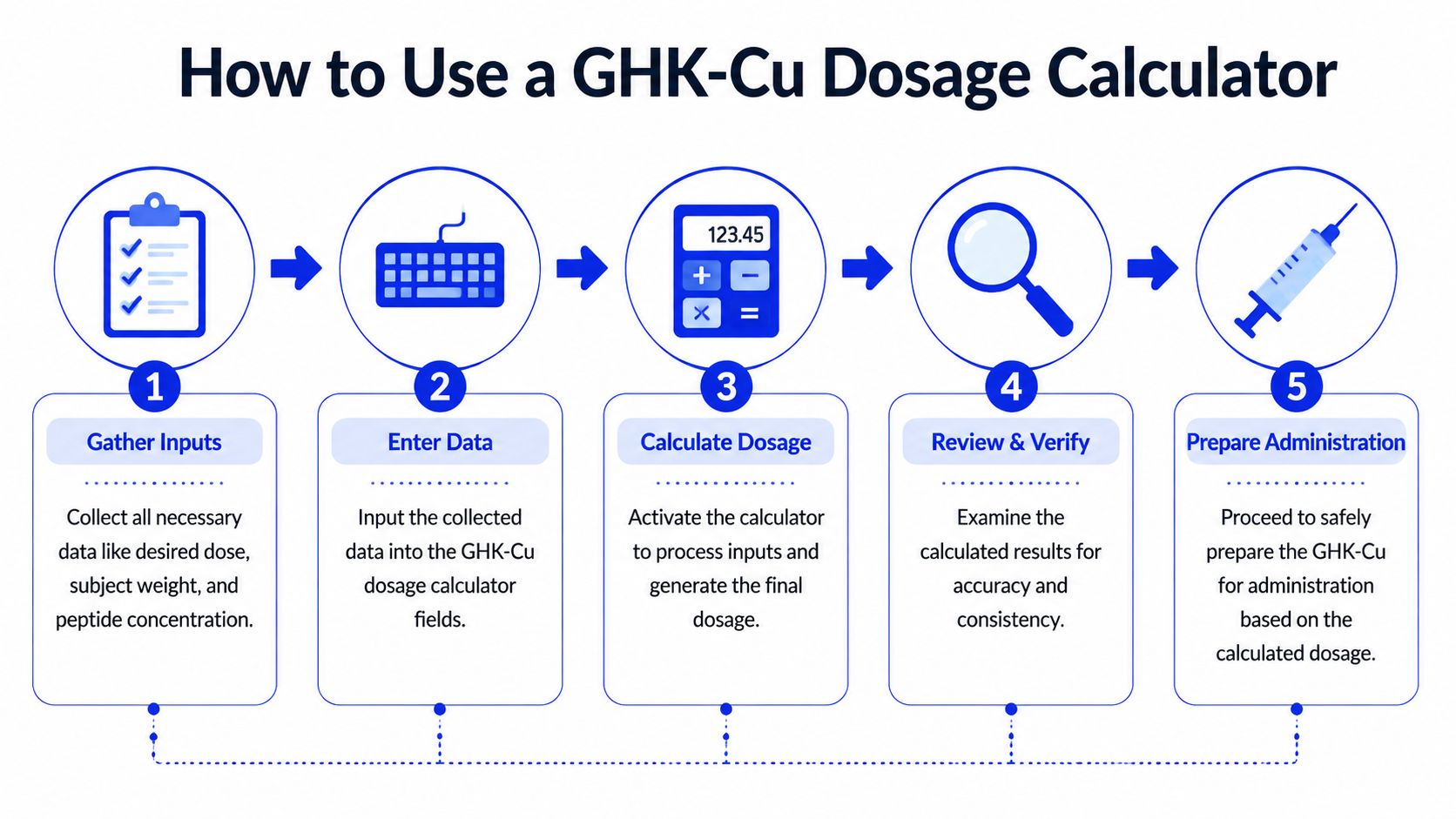
Use the calculator in the same sequence every time. Enter the total peptide mass in the vial, enter the total reconstitution volume, confirm the resulting concentration, then calculate the volume needed for the target dose. That order matters because every later number depends on the concentration being correct first.
Concentration = Total peptide mass ÷ Total volume
After concentration is established, calculate the draw volume for the dose you plan to administer in the research model.
Required volume = Desired dose ÷ Concentration
If your protocol uses a U-100 insulin syringe, convert that final mL value into syringe units only after the volume is known. Syringe units are volume markings. They are not a direct expression of peptide mass.
The practical reason for following this sequence is simple. It lets you audit each step. If the final draw volume looks odd for the dose range you intended, you can trace the problem back to concentration, reconstitution volume, or a unit conversion instead of guessing where the error started.
A worked example makes the logic easier to verify. A vial containing 50 mg reconstituted with 5 mL yields 10 mg/mL. If the target is 1 mg, the required draw is 0.1 mL, which corresponds to 10 units on a U-100 syringe. That is the kind of clean setup many researchers prefer for repeat dosing because the syringe reading is easy to confirm and less prone to interpretation errors.
For researchers who prefer to see the process demonstrated, this walkthrough is useful:
Calculation errors often start before the number appears on screen. In practice, the weak point is usually the handoff from formula to bench measurement, especially when teams switch between mg, mcg, mL, and syringe units during the same protocol.
Watch for these specific failure points:
There is also a research design question behind the math. The calculator tells you how to prepare and measure a dose. It does not tell you whether that dose is a sensible starting point for the model you are running. That judgment comes from the protocol, the administration route, the concentration you can measure reliably, and how much draw precision your equipment allows. In other words, good dosing starts before the calculator and is confirmed after it.
Use any online calculator as a verification tool, not a substitute for checking the logic by hand. That habit keeps protocols reproducible and makes it easier to catch bad inputs before they become bad dosing records.
Examples are where the calculator stops being abstract. Once you've worked through a few realistic scenarios, you can spot bad inputs much faster.

Published dosage guides describe standard injectable use at 1–2 mg daily, with topical use often discussed in 100–500 mcg ranges. The same guide gives a specific worked example where 5 mg of peptide mixed with 3 mL of bacteriostatic water yields a draw of 0.15 mL or 15 units for a 250 mcg target, as shown in this GHK-Cu peptide dosage guide.
A common bench situation is a 50 mg vial reconstituted with 5 mL and a target of 1 mg per draw.
The concentration is:
50 mg ÷ 5 mL = 10 mg/mL
Then calculate the draw volume:
1 mg ÷ 10 mg/mL = 0.1 mL
On a U-100 syringe, 0.1 mL corresponds to 10 units. That makes this setup easy to work with because the concentration and the syringe markings line up cleanly.
This kind of preparation is practical when the protocol sits in the milligram range. It reduces the temptation to estimate partial unit markings and makes repeated draws easier to standardize.
Now shift to a smaller target. You have a 5 mg vial, reconstitute it with 3 mL, and want a 250 mcg draw.
The published example gives the concentration as 1.7 mg/mL and the resulting draw as 0.15 mL or 15 units for that 250 mcg target. In practical terms, this shows why calculators matter more as the target gets smaller. The lower the target amount, the less room you have for visual estimation.
Smaller target doses don't change the math. They change how much precision your handling demands.
This is also where researchers should pause and select a starting point that fits the model. If the intended work is closer to topical or formulation testing, a microgram-scale target may make more sense than a milligram-scale draw. If the work is structured around injectable research conventions, the commonly described milligram range may be the more relevant starting frame. The calculator won't choose that for you. It only converts the decision into a measurable volume.
| Vial Mass | Solvent Volume | Concentration | Draw for 1 mg Dose |
|---|---|---|---|
| 50 mg | 5 mL | 10 mg/mL | 0.1 mL |
| 100 mg | 3.0 mL | about 33.3 mg/mL | about 0.03 mL |
The second row illustrates a trade-off. Higher concentration can reduce draw volume, but very small draw volumes can be harder to measure consistently. In many labs, the most usable setup isn't the most concentrated one. It's the one that produces a draw large enough to measure cleanly without wasting material.
Most dosing mistakes aren't caused by difficult math. They come from routine lapses: a mislabeled note, a rushed conversion, a skipped verification step.
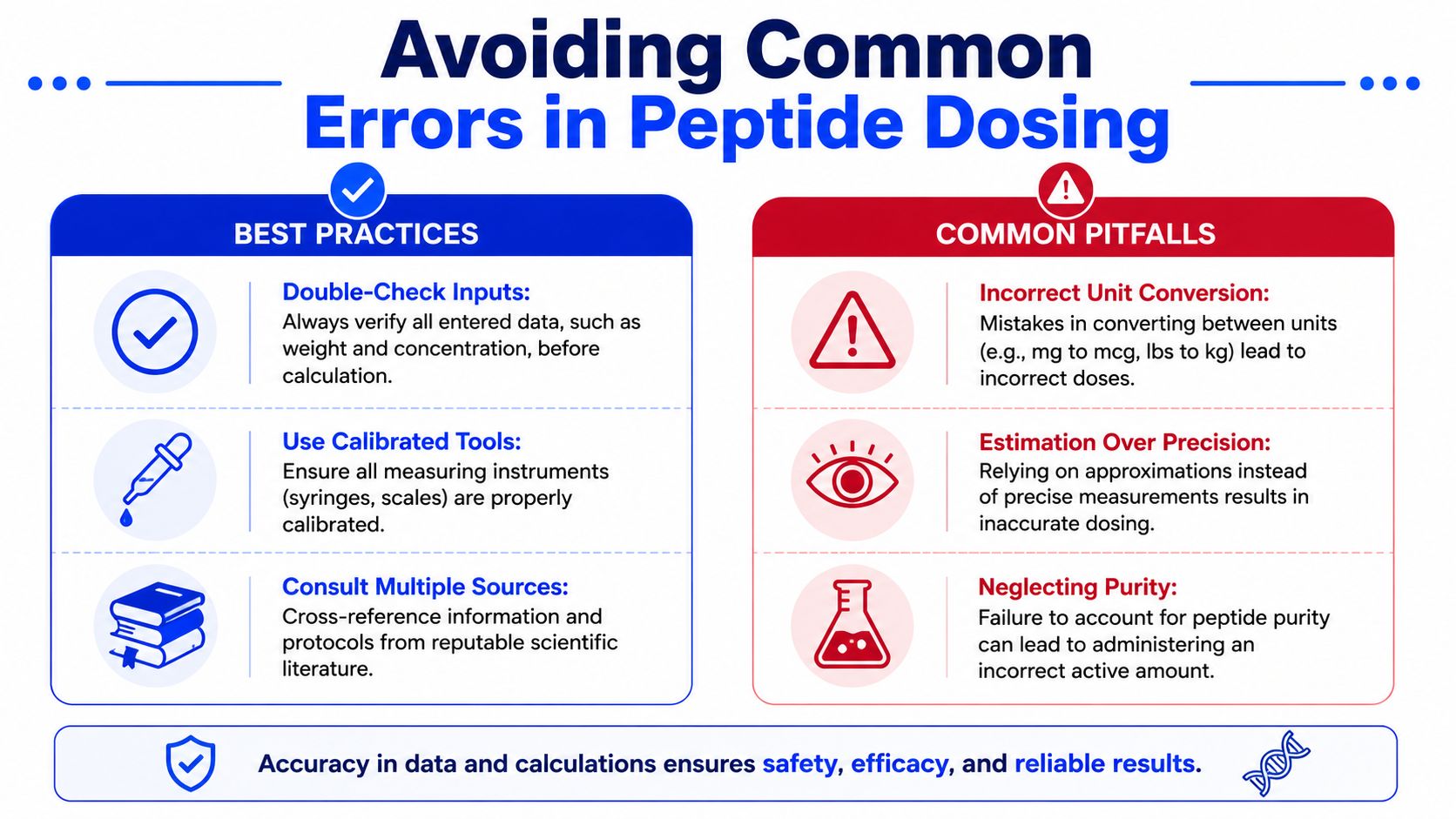
The first problem is confusing mg with mcg. This sounds basic until you're moving quickly between notes, labels, and calculator fields. If the target amount is entered in the wrong unit, the final mL output may look tidy while representing the wrong dose entirely.
The second is concentration drift. That happens when the amount of diluent added doesn't match the amount recorded. Since every later calculation depends on concentration, a small mismatch at reconstitution carries through the whole protocol.
A third issue is purity handling. Researchers sometimes calculate from the nominal vial label and forget to check supporting batch documentation such as the COA. In analytical work, that can matter when you're trying to maintain consistency across lots.
A reliable prevention routine is short enough to follow every time:
Accuracy comes from habits, not from calculators alone.
What doesn't work is estimating off the syringe barrel, rounding midway through the calculation, or assuming every GHK-Cu vial is mixed the same way. Those shortcuts save seconds and cost repeatability.
The strongest use of a GHK-Cu dosage calculator is practical and disciplined. Confirm the vial amount. Record the exact reconstitution volume. Set the target dose based on the research model. Then convert that decision into a measurable draw and verify it before preparation.
That approach keeps the workflow clean. It also helps different people in the same lab reproduce the same preparation without reinventing the math every time.
There's also a wider lesson here. Whether you're evaluating peptide materials or choosing effective wellness supplements, product selection only becomes useful when paired with careful interpretation, documentation, and consistency.
GHK-Cu and related compounds should be handled strictly within laboratory, analytical, and preclinical settings. They are not a substitute for medical guidance, and they should not be treated as consumer wellness products or used for human consumption. In serious research, source quality, lot traceability, and batch documentation matter just as much as getting the syringe units right.
If you need a reliable source for research materials and documentation, learn more about Peptide Warehouse USA and explore options for GHK-Cu and other laboratory-use peptides.