No products in the cart.



You order a peptide, antibody, or assay reagent because the spec sheet looks fine. The package arrives on time. The label says the right name. Then your controls drift, your cell response looks weaker than expected, and two people in the same lab get different results from what should have been the same setup.
That situation is why sourcing matters. In life science work, a reagent isn't just a line item in procurement. It becomes part of your data. If the material is poorly documented, inconsistent between lots, or handled carelessly after arrival, the experiment may still run, but the result won't carry the weight you think it does.
That matters even more in a market this large. The global life science tools market was estimated at USD 167.82 billion in 2024 and is projected to reach USD 401.01 billion by 2033, with a 10.21% CAGR from 2025 to 2033. Within that market, cell biology technology held 33.94% of share in 2024, which underscores how central cell-based workflows are to modern research.
New researchers often focus on the obvious question first. Is the product available? Experienced researchers ask a harder one. Can we trust this material enough to build a study around it?
This guide is written from that second perspective. It walks through the main categories of products for life science research, how to judge quality beyond a purity number, what documentation matters, where peptides fit in modern lab work, and how to handle procurement and storage in a way that protects reproducibility.
A failed experiment rarely announces one clear cause. Most of the time, the problem shows up as noise. One assay plate behaves differently from the last one. A peptide performs well in a pilot and poorly in the repeat. A material listed as high purity still creates inconsistent data because the lot wasn't characterized the way your workflow needed.
That uncertainty is expensive in a way budgets don't always capture. You lose sample material, technician time, instrument time, and confidence in the conclusion. If the reagent sits inside a long chain of dependent steps, one poor purchasing choice can subtly distort weeks of work.
Many buying decisions are made under pressure. A freezer stock is low, a study deadline is close, or a replacement needs to be ordered quickly. Under those conditions, teams often compare three things first: product name, purity claim, and shipping speed.
Those details matter, but they don't answer the core quality question. A supplier can state a purity figure and still leave you with weak traceability, unclear batch history, or limited contamination testing. That's where reproducibility starts to slip.
Practical rule: If you can't reconstruct what lot was used, how it was tested, and whether the same quality standard will apply to the next order, treat the material as a risk to downstream data.
Reliable sourcing is a method, not a guess. It means checking whether a product's identity is supported by actual analytical data, whether documentation is lot-specific, and whether the supplier can support repeat ordering without changing the quality profile unexpectedly.
For products for life science research, that mindset separates browsing from procurement. You aren't just buying a vial. You're selecting an input that has to hold up under review by your own team, your collaborators, and sometimes auditors or regulators.
A new team member should learn this early. Good experiments don't start at the bench. They start when someone asks better questions before the order is placed.
Labs buy thousands of items, but most products for life science research fall into a few practical groups. If you're new to sourcing, it helps to organize them by the role they play in the experiment rather than by catalog section.
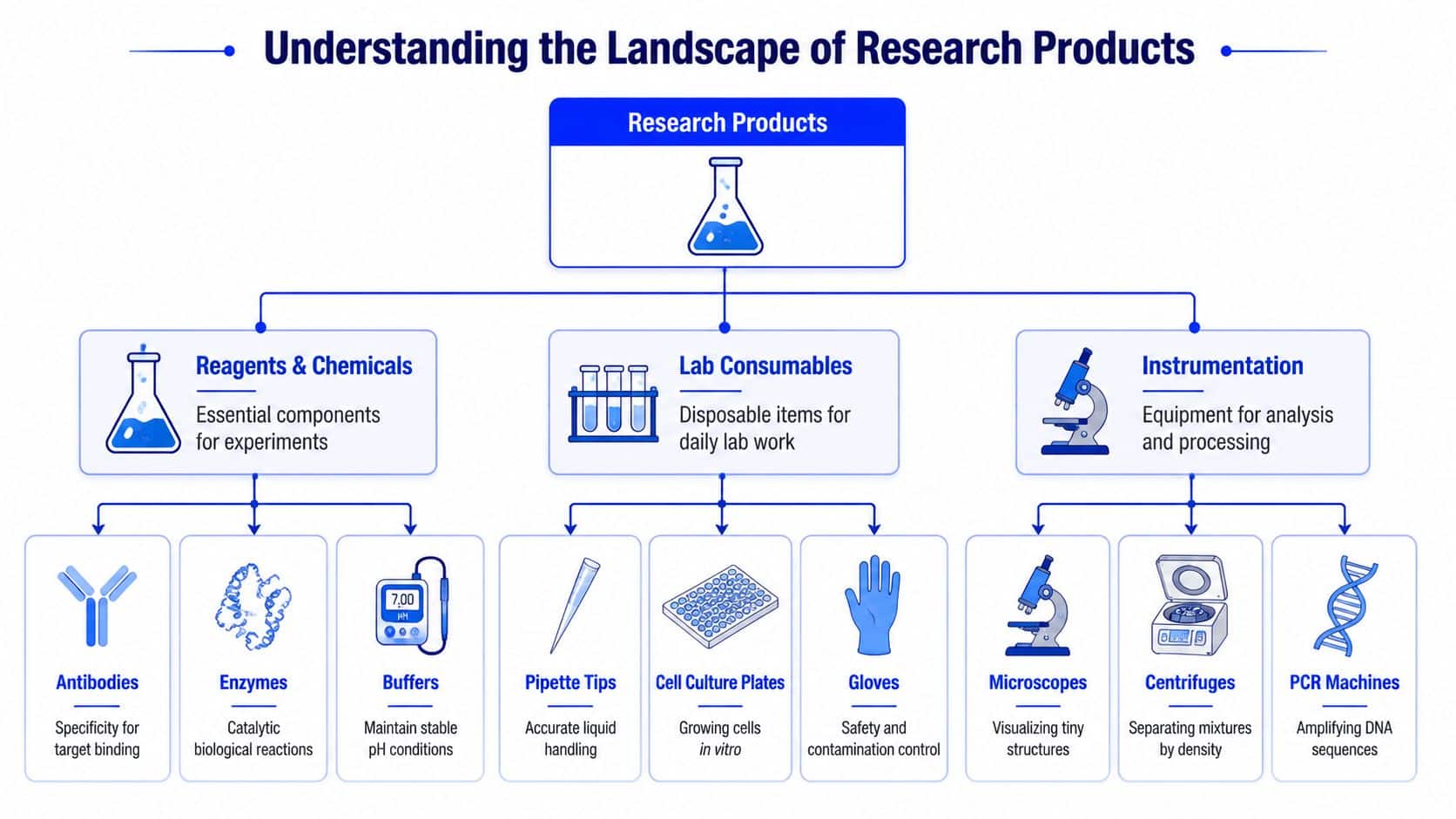
The first group is reagents and chemicals. These are the active materials that make the biology or chemistry happen. Antibodies, peptides, enzymes, buffers, stains, media components, and analytical standards all sit here.
The second group is consumables. Pipette tips, tubes, plates, gloves, filters, vials, and sealing films don't usually carry the scientific hypothesis, but they still affect contamination control, volume accuracy, and workflow consistency.
The third group is instrumentation. Microscopes, centrifuges, PCR systems, plate readers, and analytical platforms create, detect, or interpret the signal. Without the right instrument, even a well-made reagent can produce weak or misleading output.
A simple way to think about it is this:
If you're working with immune assays, target specificity becomes especially important. A quick review of the difference between antigens and antibodies helps newer team members avoid a common sourcing mistake, which is buying a detection reagent without fully understanding what molecular interaction the assay depends on.
Peptides belong in the reagents category, but they deserve separate attention because they're often evaluated too casually. In plain language, a peptide is a short chain of amino acids. In research settings, peptides are often used to probe signaling, receptor interactions, assay response, tissue-related mechanisms, and comparative preclinical behavior.
Some are used as reference compounds. Others are used in screening workflows or exploratory models. Their role can be highly specific, which means small differences in identity, impurity profile, or storage history may matter more than people expect.
A peptide with the right name but weak documentation isn't equivalent to a peptide with the right name and verified lot-level analytical support.
That distinction becomes more important as labs depend on digital procurement systems, shared study designs, and multi-site collaboration. The product has to be understandable not only to the scientist using it, but also to the systems and records around it.
A familiar lab problem starts like this. Two teams order what appears to be the same compound, both products list a strong purity value, and both arrive on schedule. Weeks later, one team gets clean, repeatable data and the other spends days trying to explain noisy results. The difference often starts before the vial is opened.
Evaluation should begin with a simple question. If this material affects a key assay, what evidence shows that this specific lot is suitable for the work?
Purity is part of that answer, but only part. A purity number works like a summary grade on a student transcript. It tells you something useful, but it does not show how identity was confirmed, whether the result belongs to your lot, how contamination was checked, or whether the next reorder will behave the same way. For reproducible research, those details matter as much as the headline figure.
One external overview makes the same point in practical terms. A useful purchasing discussion focuses on documentation, reproducibility, and operational reliability, not just product availability. That matches how experienced lab managers review suppliers. They ask whether the material can be traced, verified, and reordered with confidence.
Before you compare products, compare supplier habits. A clean product page can hide weak batch control. A plain product page can still represent a well-run supplier if the records are clear and lot tracking is disciplined.
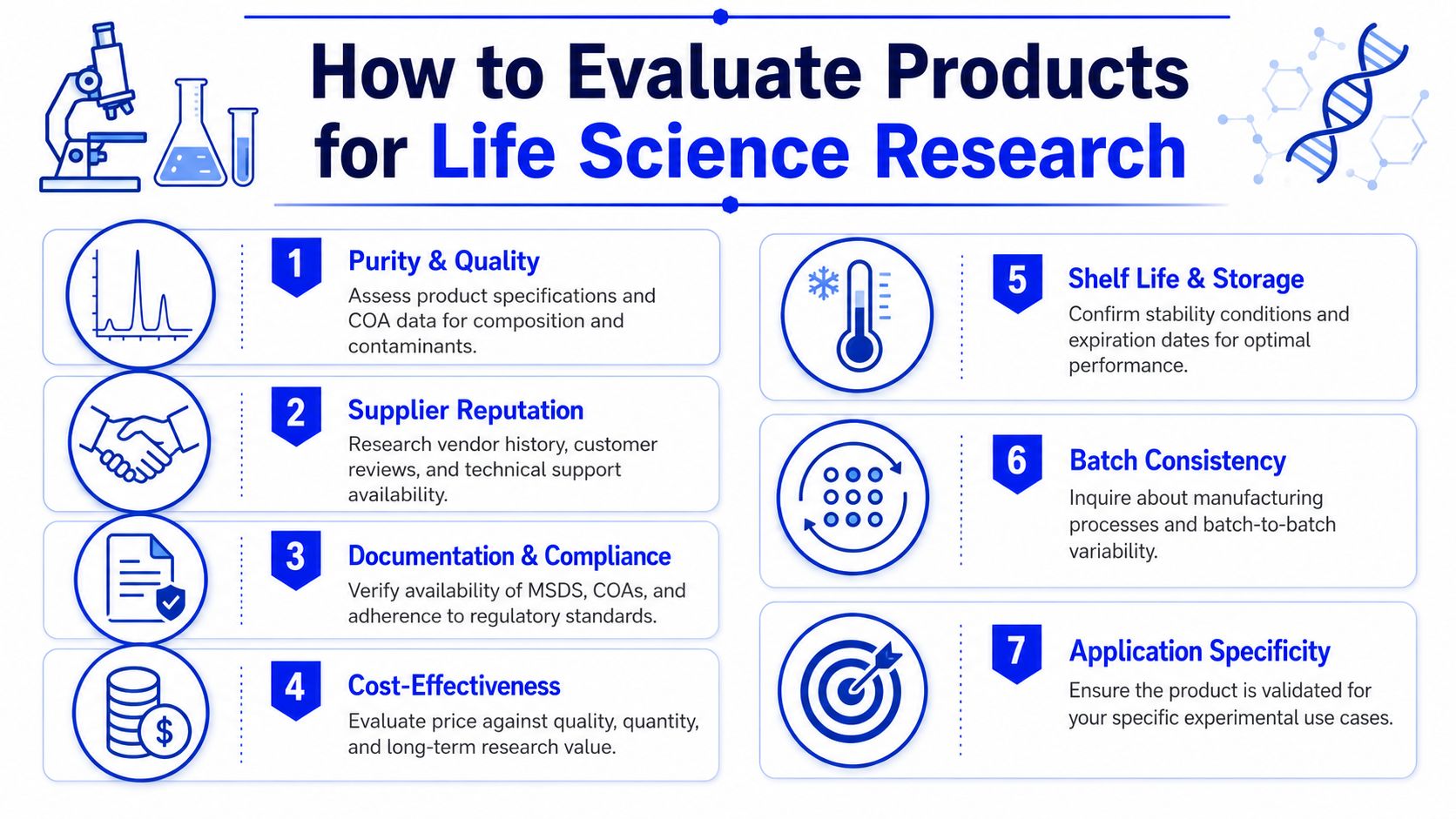
Use these seven checks when reviewing a research product.
Identity support
Confirm how the supplier verified that the material matches the stated product identity. For peptides and similar compounds, this usually means asking for the analytical evidence tied to the lot, not a generic product description.
Lot-specific documentation
Sample reports help with initial screening, but your purchasing decision should rely on records for the exact batch you receive. If the paperwork cannot be matched to the vial in your hand, traceability breaks immediately.
Contamination controls
Sensitive workflows can fail for reasons a purity percentage does not capture. Depending on the assay, microbial status, endotoxin reporting, or related contamination checks may be just as important as the main assay result.
A short technical explainer can help newer buyers understand the evaluation mindset before they go deeper into documents.
Batch consistency
Reproducibility depends on what happens at reorder. Ask whether the supplier uses a stable manufacturing process, consistent release criteria, and documented batch tracking. If your project may run for months, lot-to-lot variation needs attention early, not after results diverge.
Storage and stability details
Handling instructions should be clear enough for a new staff member to follow without guessing. Look for storage temperature, light or moisture sensitivity, reconstitution guidance, and any limits on freeze-thaw cycles or in-use stability.
Application fit
A material can meet specification and still fit the experiment poorly. Screening work, receptor studies, cell-based assays, and comparative preclinical models place different demands on documentation, handling, and impurity tolerance. Match the product to the workflow, not just to the catalog name.
Support quality
Supplier transparency shows up fastest when you ask a technical question. Can the team explain test methods, clarify a discrepancy, or provide follow-up records quickly? Slow or vague answers usually become bigger problems once the experiment is underway.
A useful test is this: could you explain and defend the purchase in a lab meeting after an unexpected result?
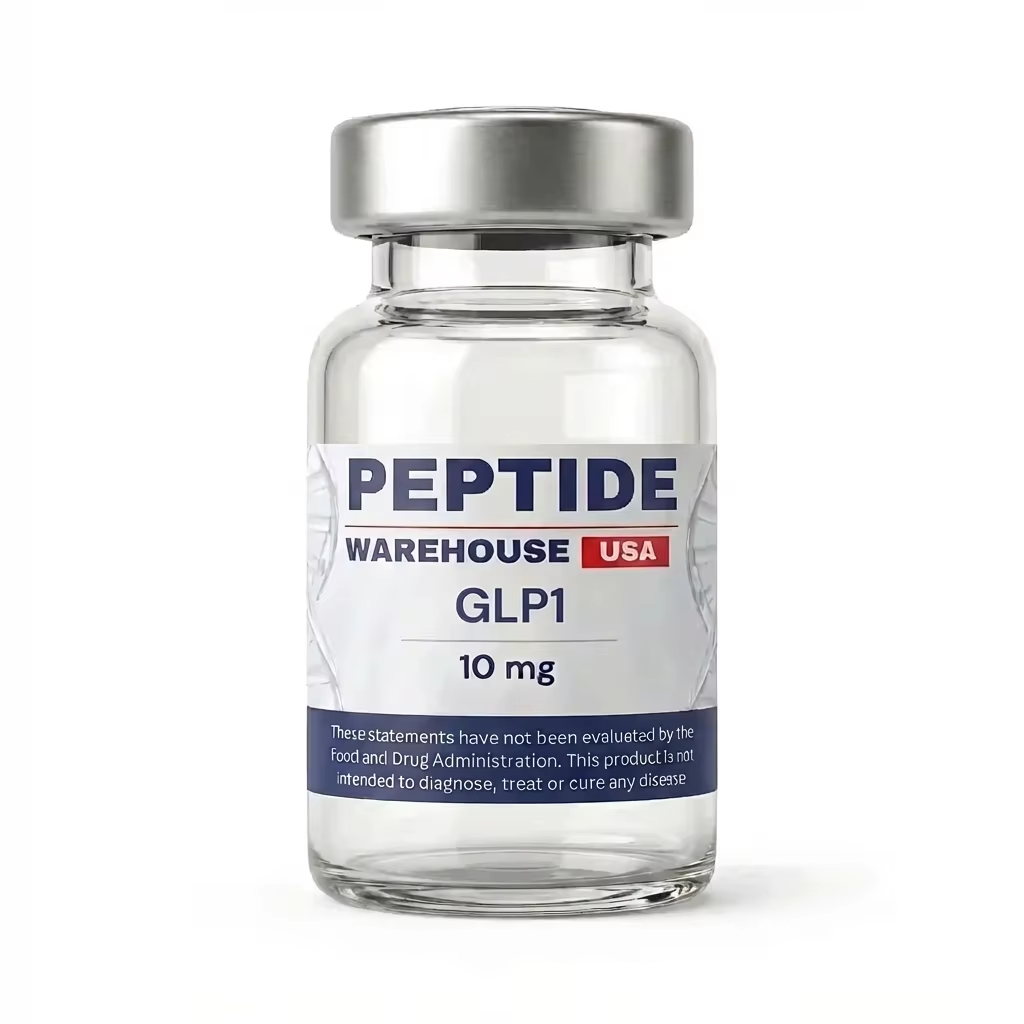
For teams reviewing peptide suppliers, Peptide Warehouse USA is one example of a vendor that presents research products with reference to lot documentation such as COAs, microbial reports, and endotoxin reports. That documentation-first approach gives buyers more to work with than a purity claim alone, especially when studies depend on repeat orders and consistent experimental behavior.
A failed experiment often starts with a small paperwork miss. The vial label looks right, the purity number seems acceptable, and the material goes into the assay. Two weeks later, a result will not reproduce, and the team is left asking a question that should have been settled on day one: what exactly did we use?
A Certificate of Analysis, or COA, is the starting point for that answer. It should let you confirm identity, tie the document to the exact lot in your hand, and show enough supporting detail to defend the material in a lab meeting or an audit trail. McKinsey notes that reliable life science data products depend on governance, interoperability, lineage, and reuse, and that traceable documentation is essential for turning raw materials and data into reliable assets. The same rule applies to reagents. If the paper trail is weak, the experimental record is weak.
Read a COA in the same way you would check a sample map before loading a plate. Start with the identifiers. Product name, lot number, catalog code, and release date should match the received item exactly. If one field is vague or inconsistent, stop and resolve it before the material reaches the bench.
Then move to the test data. New buyers often focus on the purity line and stop there. That is like judging a book by the title page. Purity answers one question. Identity, contamination status, method description, and lot linkage answer several others that matter just as much for reproducibility.
| Document Type | What It Helps Confirm | Why It Matters in Practice |
|---|---|---|
| Certificate of Analysis | Lot identity, specification limits, and pass or fail results | Shows the batch was reviewed against defined criteria |
| HPLC report | Peak pattern and purity-related composition | Helps you judge whether minor components could affect the assay |
| Mass spectrometry report | Expected molecular mass | Supports that the material matches the intended compound |
| Endotoxin report | Endotoxin level or contamination status | Helps protect cell-based and immune-sensitive assays from distorted readouts |
| Microbial report | Bioburden or contamination status | Adds context for workflows where biological contamination can alter results |
A strong document set works like chain-of-custody records in forensic work. Each page should connect cleanly to the next, with no guessing about what was tested, when it was tested, or which batch the result belongs to.
That is why weak documentation usually looks weak in specific ways.
Documentation is the evidence file for your reagent. Another scientist should be able to trace what entered the experiment without relying on memory or vendor assurances.
If a supplier cannot explain a discrepancy in the paperwork, answer a method question directly, or provide the underlying lot record promptly, treat that as part of the evaluation. Good documentation does more than satisfy procurement. It reduces troubleshooting time, helps repeat orders behave as expected, and gives your team a firmer basis for comparing results across studies and over time.
A peptide order can look routine on paper and still derail a study. The sequence matches, the label looks familiar, and the purity figure seems acceptable. Then one screening round behaves differently from the last, and the team has to decide whether the biology changed or the material did.

That problem shows up often with peptides because they seem straightforward. In practice, they behave more like precision parts than generic supplies. A small difference in synthesis quality, handling history, salt form, or reconstitution behavior can alter assay performance enough to blur conclusions.
Industry coverage points out that AI-driven drug discovery and precision medicine are changing demand for research products. For labs, that usually means more screening, tighter timelines, and stronger pressure to compare results across many plates, operators, and study phases.
Under those conditions, a peptide has to do more than arrive with a high purity claim. It needs to arrive with enough batch-specific support that your team can use it confidently, reorder it predictably, and explain any shift in performance without guessing. That is why supplier transparency matters more as workflows scale.
Different peptide programs put stress on different parts of the sourcing process.
BPC-157 and TB-500 often come up in laboratory discussions tied to tissue and recovery-focused research models. These studies can involve modest signal changes, so lot consistency matters. If one batch dissolves differently, carries more residual impurities, or arrives with thinner records than the last one, the comparison can become difficult to defend.
GHK-Cu is frequently examined in skin-related and regenerative research settings. Here, the peptide itself is only part of the equation. Complexation state, storage history, and handling discipline can all affect how reliably the material behaves in sensitive assay systems.
GLP-1 analogues attract attention in metabolic research workflows, especially where teams expect repeat orders over longer project timelines. In that setting, procurement needs a supplier who can answer practical questions early. Can the vendor provide the same form and specification again? Do lot records stay consistent enough to support side-by-side studies months later? If the answer is unclear before the first order, it usually stays unclear after the third.
A useful way to evaluate peptide products is to match the sourcing standard to the experiment's risk of misinterpretation:
The lesson for new buyers is simple. Peptides are not unusually mysterious, but they do punish casual sourcing. A peptide that looks interchangeable in a catalog may behave very differently in a real experiment if the documentation, batch control, and supplier support are thin.
A reagent can arrive with a clean COA, a matching lot number, and acceptable purity data, then still become the weak point in your experiment. The failure often happens after purchase. A vial sits too long at receiving. Someone relabels a tube without the lot number. A stock solution gets thawed and refrozen until the signal starts to drift. Procurement and storage are part of experimental control for that reason.
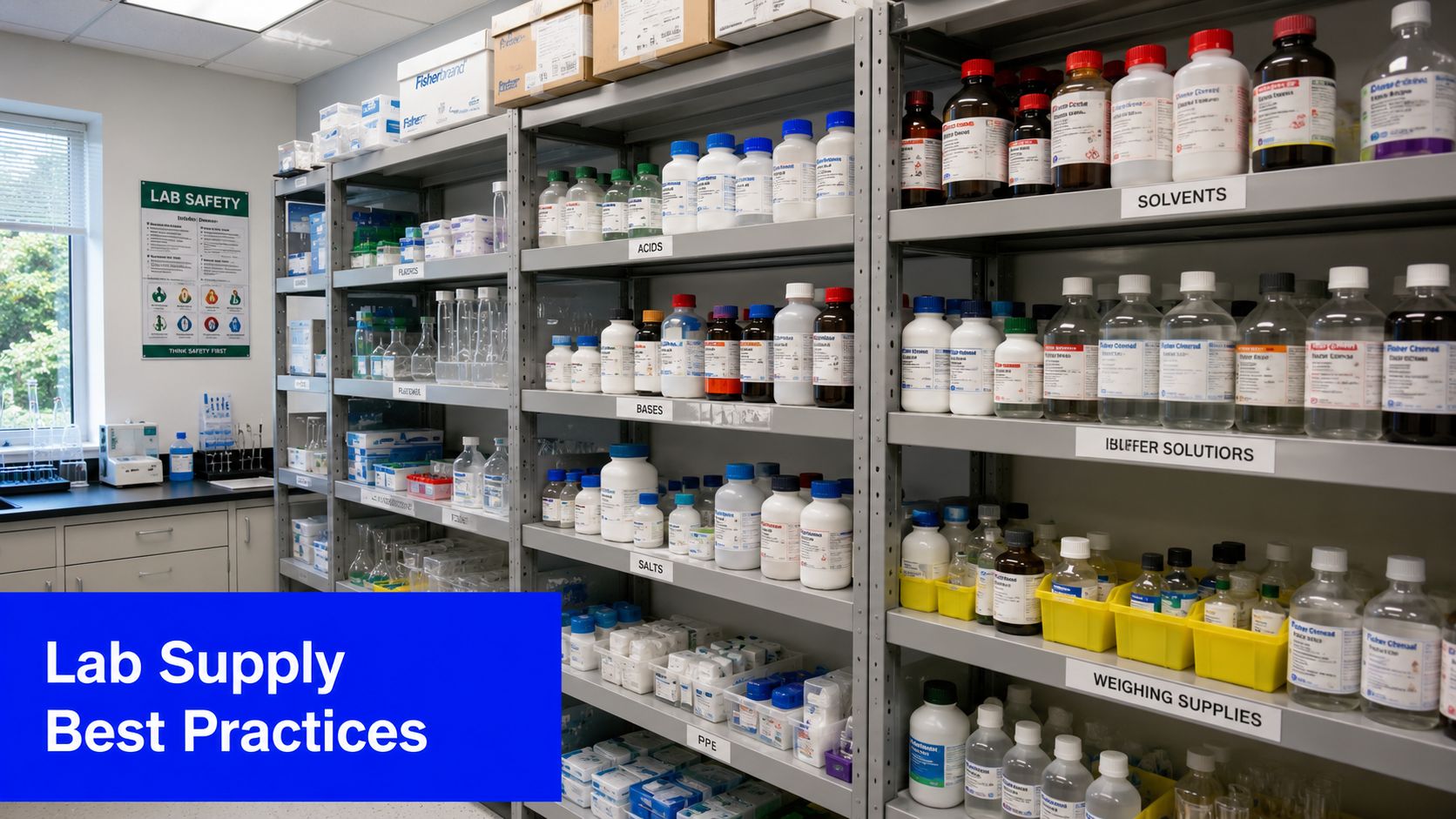
Good labs make purchasing routine and traceable. The goal is not just to get material through the door. The goal is to make sure a future team member can look back and understand what was ordered, why it was accepted, and whether the same standard was applied to the next lot.
That process works like chain-of-custody for evidence. If one handoff is poorly documented, confidence drops even if nothing was technically wrong with the material itself.
Use a repeatable process such as this:
A simple purchasing form helps here. Include vendor name, catalog number, lot number, date received, storage requirement, required documents reviewed, and the initials of the person who approved the material. That turns procurement from memory-based judgment into a repeatable lab practice.
Once the package arrives, storage instructions should be treated like assay instructions. They are not background details. They define the condition of the material you are about to test.
For lyophilized peptides and related research compounds, the common risks are easy to underestimate. Light exposure, moisture, temperature swings, and repeated opening can all change how a material behaves. After reconstitution, the margin for error often gets smaller. A stock that was prepared correctly on day one can become unreliable a week later if the tube is handled casually.
A few habits protect both the sample and the record:
Good storage practice protects more than the reagent. It protects your ability to interpret the result later.
New team members often need the clearest coaching for the following scenarios. If two tubes carry the same handwritten name but came from different lots, they are not interchangeable by default. If one aliquot was reconstituted last month and another this morning, they may not belong in the same comparison. Small handling differences can create large interpretive problems, especially in sensitive assays.
If the material supports cell-based work or contamination-sensitive assays, receiving procedures, wipe-down routines, and PPE use need the same level of consistency. Careful sourcing loses value quickly when bench handling is inconsistent.
Reliable products for life science research don't announce themselves with one number. They show their quality through identity support, lot-specific records, contamination controls, and consistent handling from shipment to assay.
That changes how smart buyers work. They stop asking only whether a compound is available and start asking whether it is traceable, reproducible, and operationally dependable for the exact workflow in front of them. That shift is what protects data quality when experiments become more complex, collaborative, and documentation-heavy.
The practical standard is simple. Look beyond purity claims. Read the COA carefully. Check for batch-level support. Store materials as if future interpretation depends on it, because it does.
Labs that build those habits make troubleshooting easier and results more credible. They also train new team members faster, because the purchasing logic becomes visible instead of tribal.
For the broader lab environment, the same principle applies to routine cleanliness and supply handling. If you're reviewing process discipline across the bench, this guide to sanitation best practices for PPE supply is a useful reminder that contamination control starts with ordinary habits, not just specialized assays.
When you treat sourcing as part of the science, not a task before the science, your work stands on firmer ground.
If you're comparing peptide suppliers and want a documentation-first option for laboratory and analytical use, learn more at Peptide Warehouse USA and explore options that support traceability, lot review, and more confident procurement.