No products in the cart.



Most articles about Cortagen peptide benefits jump straight to a list of promised effects. That skips the core question. When a compound looks impressive in nerve-injury models, how much of that signal should a serious researcher treat as meaningful, and how much should remain a hypothesis waiting for stronger human evidence?
Cortagen is interesting because it sits in a scientifically productive gray zone. It has a plausible bioregulatory concept, a defined peptide structure, and preclinical findings that are hard to ignore. At the same time, the public discussion around it often expands faster than the evidence base. That's where confusion starts.
For research-minded readers, the value isn't in hype. It's in separating what has been observed from what is still inferred. Cortagen deserves that kind of treatment because neural repair is one of the most difficult problems in biology. A small peptide that appears to influence regeneration and recovery pathways is worth attention, but only if we read the literature carefully and keep animal data distinct from human potential.
Neural tissue doesn't repair itself the way skin or bone does. That's the central frustration in neurology and regenerative biology. A damaged peripheral nerve may regrow to some extent, but functional recovery depends on more than simple regrowth. The fibers have to mature, reconnect appropriately, and conduct signals effectively.
That's why compounds like Cortagen draw attention. Researchers aren't just looking for faster tissue turnover. They're looking for signals that a molecule might help guide repair quality, cellular resilience, and recovery at a deeper regulatory level.
Cortagen is usually described as a synthetic tetrapeptide bioregulator associated with neural tissue research. The appeal is straightforward. If a short peptide can influence repair-related programs inside damaged cells, it could become a useful tool in preclinical models of nerve injury and perhaps later in more advanced translational work.
Still, a careful reader should resist the temptation to jump from “interesting mechanism” to “proven intervention.” That leap happens all the time in peptide discussions. It's especially common when rodent data are strong and public-facing human evidence is thinner.
Working standard: With Cortagen, the most defensible position is cautious optimism. The preclinical signal is real enough to justify research interest, but broad wellness claims go beyond what the public evidence clearly supports.
The most useful way to think about Cortagen is as a research compound with a compelling neuroregenerative story, a plausible gene-regulatory framework, and a noticeable evidence gap that still needs to be closed.
Cortagen is a synthetic tetrapeptide composed of four amino acids: Ala-Glu-Asp-Pro. It is generally described as a peptide bioregulator derived from research on compounds associated with the cerebral cortex, which is why it is discussed primarily in the context of neural tissue rather than broad recovery or performance claims.
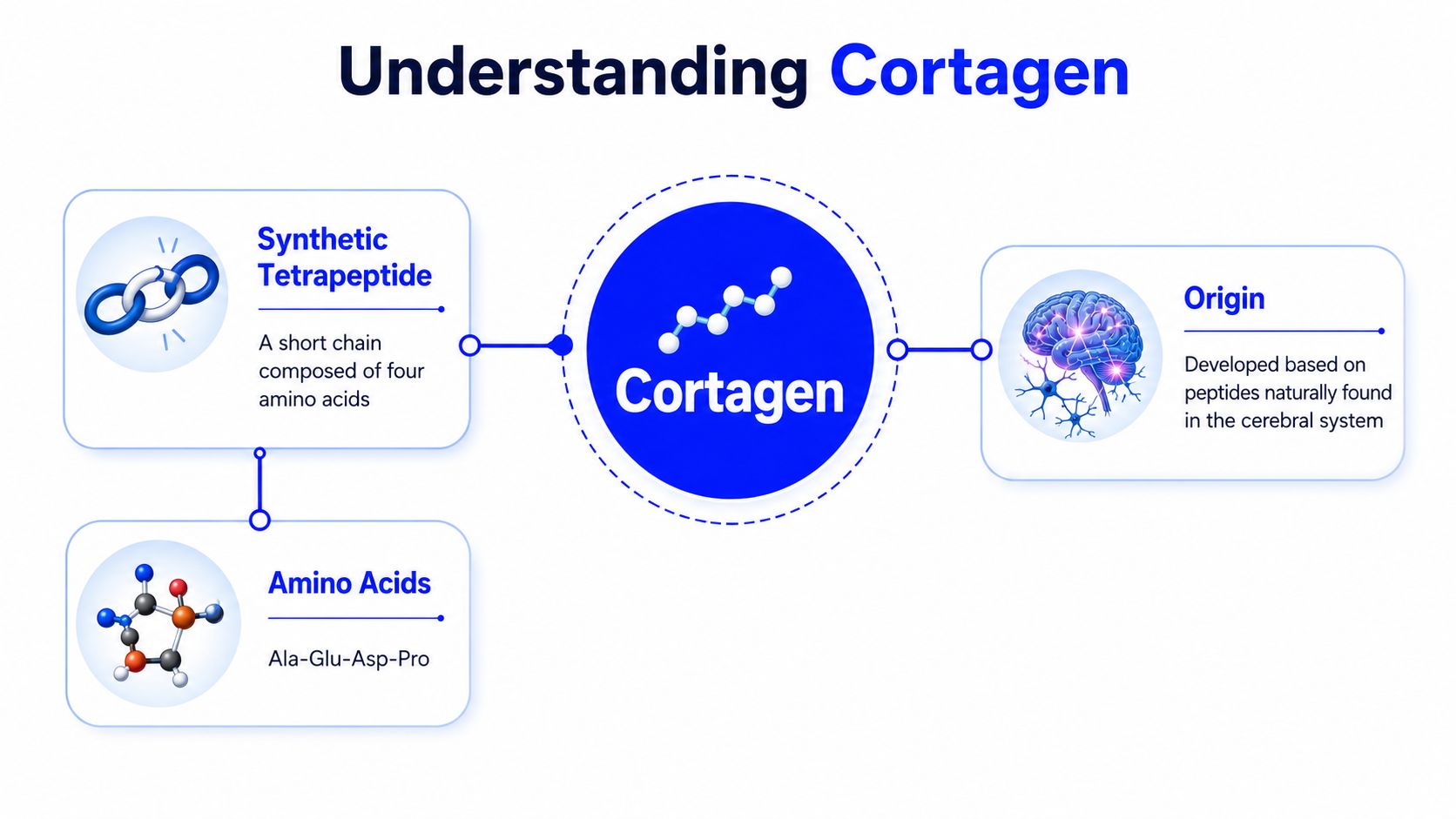
Its proposed role is more selective than that of a classic stimulant or receptor-driven drug. Cortagen is studied as a signaling peptide that may influence how cells regulate repair-related activity. That is a subtle mechanism. In practice, researchers are asking whether a very small peptide can shift the instructions a cell follows, rather than forcing a rapid, one-pathway response.
A useful comparison is a lab protocol that changes how a whole culture behaves without directly building any structure itself. The protocol does not create the cells or replace damaged tissue. It changes the conditions under which the cells respond. Cortagen is discussed in a similar way. Its interest lies in whether it can alter cellular regulation in a direction that favors organized recovery.
This distinction is important in neural research because nervous tissue recovery depends on more than cell survival alone. Neurons, glial cells, and surrounding support tissue respond to local molecular signals that shape inflammation, structural repair, myelination, and long-term function.
Public descriptions of Cortagen often frame it as a modulator of gene expression linked to repair and age-related biology. That proposed mechanism is one reason the peptide continues to attract interest in preclinical work. If a compound can influence transcriptional programs relevant to neural resilience, it could affect the quality of recovery, not just the speed of visible regrowth.
That possibility is scientifically interesting. It is not the same as clinical proof.
The main point to keep in view is that a gene-regulatory hypothesis sits near the beginning of the evidence ladder. It can help explain why researchers test a peptide in nerve injury models, but it does not establish that the same effects occur in humans, or that any observed molecular changes translate into meaningful patient outcomes.
For Cortagen, the working model is fairly narrow and should be stated carefully:
Cortagen is best understood as a research peptide with a proposed regulatory role in neural tissue. The appeal comes from that mechanism, but the confidence level remains much higher for preclinical rationale than for human application.
That evidence gap is easy to miss in peptide discussions. Mechanistic language can sound more settled than it really is. With Cortagen, the reasonable position is that the proposed mode of action is biologically plausible and worth studying, while firm conclusions about human benefit still require much better clinical evidence.
If Cortagen has a genuine research signal, where does it appear most clearly? In the preclinical literature, the strongest case comes from peripheral nerve injury models rather than broad claims about brain health, cognition, or anti-aging.
In rodent studies using sciatic nerve transection followed by surgical repair, Cortagen treatment was associated with a 27% increase in nerve fiber regeneration and a 40% improvement in conduction velocity, as reported in the PubMed record for study 15159690. Those are not interchangeable endpoints. One describes how much tissue regrew. The other asks whether the repaired nerve conducted signals more effectively.
That distinction is important in nerve biology. A regenerating cable is only useful if current can pass through it in an organized way. In the same sense, a repaired peripheral nerve needs both structural regrowth and restoration of electrical performance.
Public summaries of that research line also describe longer regenerated nerve segments, recovery of conduction capacity relative to untreated animals, stronger effects in thick myelinated A-fibers, and less neuroma formation at the suture site. Those points are directionally interesting, but they should be treated more cautiously than the linked quantitative findings because they are often presented in secondary summaries rather than in the primary abstract most readers can easily access.
“Regeneration” can sound like a single event. In practice, peripheral nerve repair is a sequence. Axons have to extend, myelination has to be organized, and the rebuilt pathway has to transmit impulses with enough speed and stability to support useful function.
Cortagen draws attention in this model because the reported changes span more than one layer of recovery. Higher fiber regeneration suggests increased structural repair. Better conduction velocity suggests that the repaired tissue may also be maturing in a more functional way.
Reports of reduced neuroma formation add another reason for interest. A neuroma is not just extra tissue. It is often a sign that healing has become disorganized, with axons growing into a painful or inefficient mass instead of reconnecting cleanly. In that sense, lower neuroma formation would point toward better repair quality, not only faster repair.
The preclinical appeal of Cortagen comes from a specific pattern. Researchers saw signs of greater regrowth and signs that the regrowth may have been better organized electrically and structurally.
That is a more precise claim than saying the peptide “helps nerves heal.” It may support certain aspects of repair in a defined animal injury model. That is promising, but still narrow.
The rodent findings can be summarized this way:
| Metric | Observed Improvement | Context |
|---|---|---|
| Nerve fiber regeneration | 27% | Rodent sciatic nerve transection and suturing model treated with Cortagen |
| Conduction velocity | 40% | Same rodent sciatic nerve injury model, suggesting better functional recovery |
| Fiber subtype response | Qualitative improvement | Public summaries describe stronger gains in thick myelinated A-fibers |
| Neuroma formation | Qualitative reduction | Public summaries report less neuroma formation at the suture site |
A careful reading keeps the scope tight.
That final point deserves emphasis. Rodent nerve studies are useful for generating hypotheses and prioritizing compounds. They are not a shortcut to clinical proof. Cortagen's reputation comes largely from this preclinical signal, and the signal is interesting. The gap between that signal and publicly available large-scale human evidence remains substantial.
How much confidence should a reader place in Cortagen once the discussion shifts from rodent repair models to human treatment? Less confidence than many peptide summaries imply, but not so little that the compound becomes uninteresting.
Public descriptions indicate that Cortagen has seen clinical use in some regional medical settings, particularly in Russia, and that it has been discussed in connection with neurological recovery. As noted earlier, that historical use matters. It means Cortagen is more than a laboratory curiosity. It also does not answer the question most researchers care about, which is whether the human evidence is broad, standardized, and easy to evaluate by modern clinical standards.
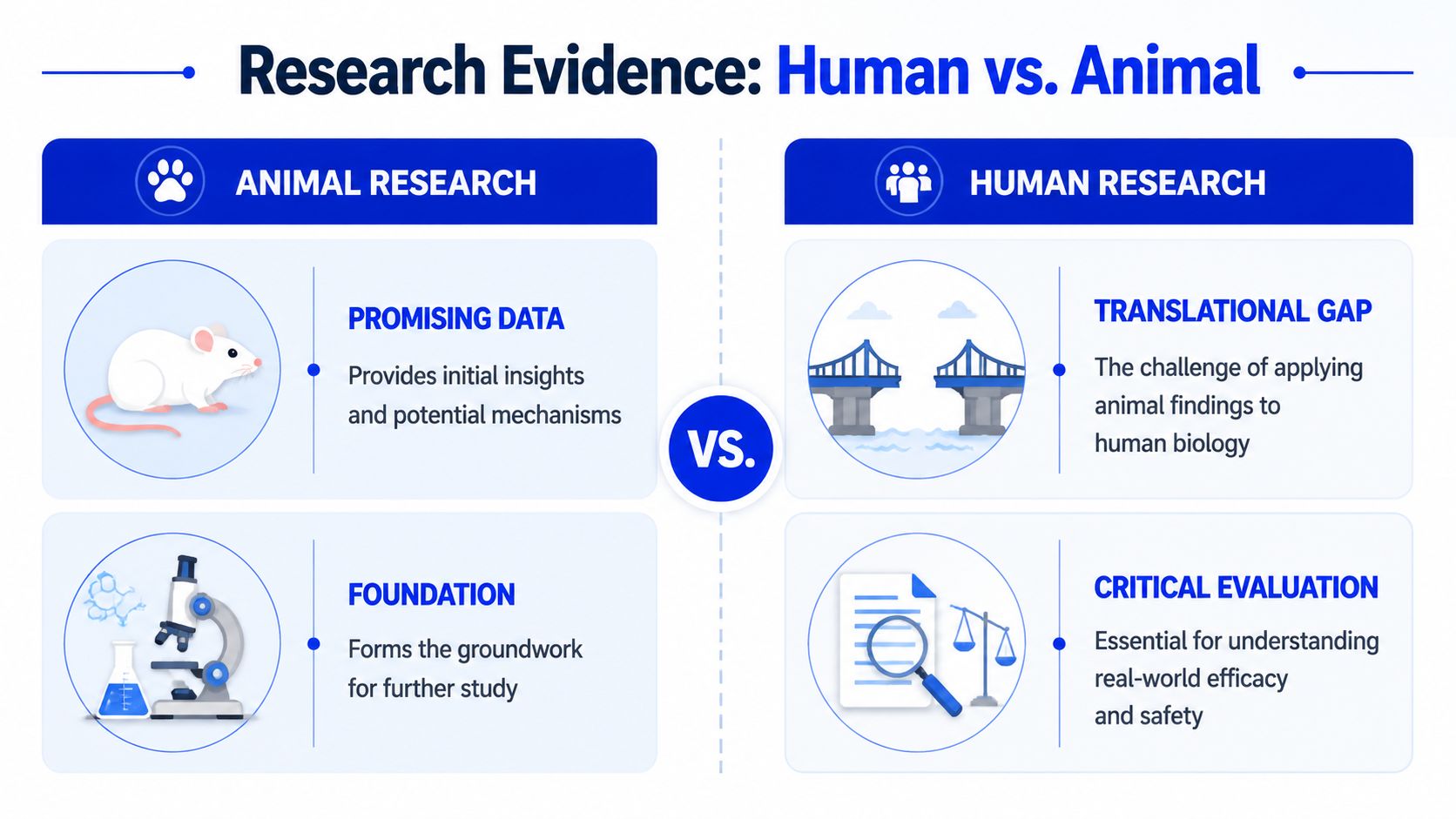
That distinction matters because historical clinical use and high-quality public clinical evidence are different categories of support. A compound can be used in practice for years and still lack the kind of large, internationally visible trial record that lets outside researchers judge effect size, reproducibility, patient selection, and endpoint quality with confidence.
For Cortagen, that is the central tension.
Many peptide articles lose credibility by failing to address the translational gap. Animal studies and human studies answer different questions. In a rodent nerve injury model, researchers can control timing, injury type, tissue sampling, and outcome measures far more tightly than they can in real patients. That makes the animal signal useful for hypothesis generation. It does not make it a clinical verdict.
A helpful analogy is drug screening in cell culture versus treatment in a hospital. The first tells you whether a biological effect may exist under controlled conditions. The second asks whether that effect survives biological complexity, variable dosing, mixed patient backgrounds, and clinically meaningful endpoints. Rodent work sits closer to the first side of that continuum than many benefit lists acknowledge.
Cortagen illustrates the problem clearly. The preclinical case is most persuasive in peripheral nerve repair. Once the conversation expands into cognition, anti-aging, broad neuroprotection, or generalized recovery, the confidence level drops because the publicly available human evidence does not appear equally developed across those claims.
A careful reading leads to three restrained conclusions:
That is not a dismissal. It is a calibration.
For a graduate-level reader, the practical interpretation is straightforward. Cortagen looks like a plausible research candidate with a defined preclinical signal and an incomplete public clinical record. That profile can justify further study, especially in neuroregeneration. It does not justify treating the molecule as a fully established human intervention across a wide range of neurological outcomes.
Safety language around peptides often gets sloppy because people mix preclinical tolerance with clinical endorsement. Those are not the same thing. The available material on Cortagen supports a more limited statement: animal and historical summaries describe a generally favorable safety profile, with minimal to no side effects reported in preclinical contexts.
That's useful, but it doesn't erase uncertainty. A compound can look well tolerated in animal work and still require much better human characterization. Dose, formulation, route, and target population all affect what “safe” really means in practice.
This is especially important with compounds that are discussed in neuroregeneration and neuroprotection. Researchers can become enthusiastic because the mechanism sounds elegant. Good lab practice demands the opposite instinct. The more biologically interesting a compound is, the more carefully it should be handled and interpreted.
Cortagen should be approached as a research compound, not as a proven consumer wellness ingredient. That distinction isn't a technicality. It protects data quality, regulatory compliance, and ethical standards.
A responsible framework includes the following:
Non-negotiable point: Research-only labeling is a scientific safeguard. It prevents investigators from pretending the evidence is more mature than it is.
Readers also need a plain-language reminder. Cortagen is not FDA-approved for medical use in the United States. Any legitimate discussion of benefits has to stay within an evidence-based research frame rather than drift into direct medical advice or unsupervised use claims.
That's not a drawback for serious scientists. It's the correct posture for an early-stage bioregulatory compound with promising but incomplete translational support.

The fastest way to ruin a peptide experiment is to start with poor material. When researchers discuss Cortagen peptide benefits, they often focus on mechanism and skip procurement quality. That's backward. If the input is compromised, the biology you observe may be meaningless.
The practical checklist is straightforward:
Purity claims should also be read carefully. A supplier should present them transparently and support them with batch-level records. Marketing language alone doesn't help your assay.
Once a peptide arrives, handling discipline matters almost as much as sourcing. Cortagen is commonly provided as a freeze-dried powder for stability. Researchers typically keep peptides protected from heat, moisture, and light, then use validated lab procedures for reconstitution and storage according to their protocol requirements.
Small lapses can distort outcomes. Repeated temperature stress, contaminated reconstitution practices, or weak recordkeeping introduce noise that later gets mistaken for biology.
A useful lab habit is to standardize a short intake workflow:
Good peptide work starts before the experiment begins. Most reproducibility problems are handling problems first, biology problems second.
If your lab is studying neural repair, reproducibility matters even more because endpoints can be subtle. Signal quality, not just signal strength, determines whether a result is worth following up.
Cortagen stands out because it combines a plausible bioregulatory concept with meaningful preclinical nerve-repair data. That's enough to make it important in neuroregeneration research. It's not enough to justify sweeping claims across every domain where peptides are marketed.
The clearest takeaway is that the most credible Cortagen peptide benefits remain tied to peripheral nerve repair models and related recovery biology. The biggest open question is not whether Cortagen is interesting. It is. The bigger question is how well those signals translate into rigorously measured human outcomes across defined neurological settings.
That's where future work should focus. Better human-accessible clinical reporting, clearer endpoint selection, and more reproducible translational models would help move the conversation from “promising” to “actionable.” Researchers interested in broader brain science ecosystems may also find the Orange Neurosciences OBI guide useful as context for how structured neuroscience research networks support more rigorous development pathways.
Cortagen deserves attention precisely because the story is unfinished. The field doesn't need another inflated benefit list. It needs careful experiments, clean materials, and realistic interpretation.
If you're sourcing research-grade compounds for laboratory and analytical work, Peptide Warehouse USA is worth exploring. The company focuses on high-purity research peptides, batch-level documentation, and transparent COA-backed sourcing for investigators who want dependable materials and a cleaner path to reproducible results.