No products in the cart.


If you’re looking at research peptides for sale right now, you’re probably dealing with the same problem most new buyers face. Ten vendors make similar purity claims, half of them post polished product pages, and almost none make it easy to judge whether a vial is suitable for real laboratory work.
That confusion matters because bad procurement ruins good science. A weak supplier doesn’t just create a purchasing headache. It can compromise assay reliability, waste samples, and force your team to question every result that follows.
The safer approach is to treat peptide sourcing as a verification process, not a shopping exercise. Demand has expanded quickly, with the global market for research-grade peptide synthesis projected to reach USD 157.5 billion by 2028 from USD 90.1 billion in 2023, at an 11.8% CAGR in preclinical and analytical applications, according to BCC Research’s peptide synthesis market projection. In a crowded market, diligence is part of the job.
Buying peptides for a lab isn’t the same as buying routine consumables. With pipette tips or solvents, basic sourcing errors are usually obvious fast. With peptides, poor quality can hide until a cell culture behaves strangely, a control drifts, or a repeat run fails to reproduce the first result.
That’s why experienced researchers build a procurement framework before they place an order. The actual question isn’t who has research peptides for sale at the lowest listed price. The question is which supplier gives you enough evidence to trust what arrives in the vial.
A workable framework usually starts with four checks:
Practical rule: If a vendor makes procurement feel easy but verification feel difficult, you’re in the wrong place.
New researchers often focus on peptide names first and supplier quality second. In procurement, that order should be reversed. Once you know how to evaluate documentation, testing, and compliance, the buying process gets much cleaner.
A lot of confusion in this market comes from one basic mistake. Buyers lump all peptides together as if a research reagent, a compounded product, and an FDA-regulated drug sit in the same category. They don’t.
Research-grade peptides are sold for laboratory, analytical, and preclinical use. In practice, that means work such as assay development, cell-based experiments, method validation, and other non-clinical applications. Buyers may look at compounds such as BPC-157, TB-500, or GHK-Cu because they’re commonly discussed in research settings, but that doesn’t turn them into approved consumer products.
The useful mental model is simple. A research peptide is a material for controlled investigation, not a finished therapeutic product. The standards you apply should reflect that distinction at every step, from sourcing to storage to internal documentation.
For teams building a broader preclinical workflow, RiverAxe offers insights for life science organizations that help frame where sourcing discipline fits inside study design and development planning.
The most important line in this category is the one between legitimate lab procurement and gray-market misuse. That line is often blurred online. As The Hill’s reporting on injectable peptides and regulatory concerns notes, there is a critical distinction between research-grade peptides for lab use and gray-market injectables for off-label human experimentation, and many sellers obscure that gap.
That matters because language shapes buyer behavior. If a product page lists vague “benefits of peptides,” dosing-style language, or performance claims aimed at personal use, the seller is no longer behaving like a clean research supplier. They’re signaling a market the product isn’t legally intended to serve.
A legitimate research catalog usually looks different:
If the listing tells you how a person might use the peptide instead of how a lab should verify it, you’re not looking at a research-focused procurement environment.
A peptide vendor can say “high purity” on every page of the site. That statement means very little until you break quality into three separate questions. Is it pure, is it what the label says it is, and is it safe to handle in the context of your laboratory work?
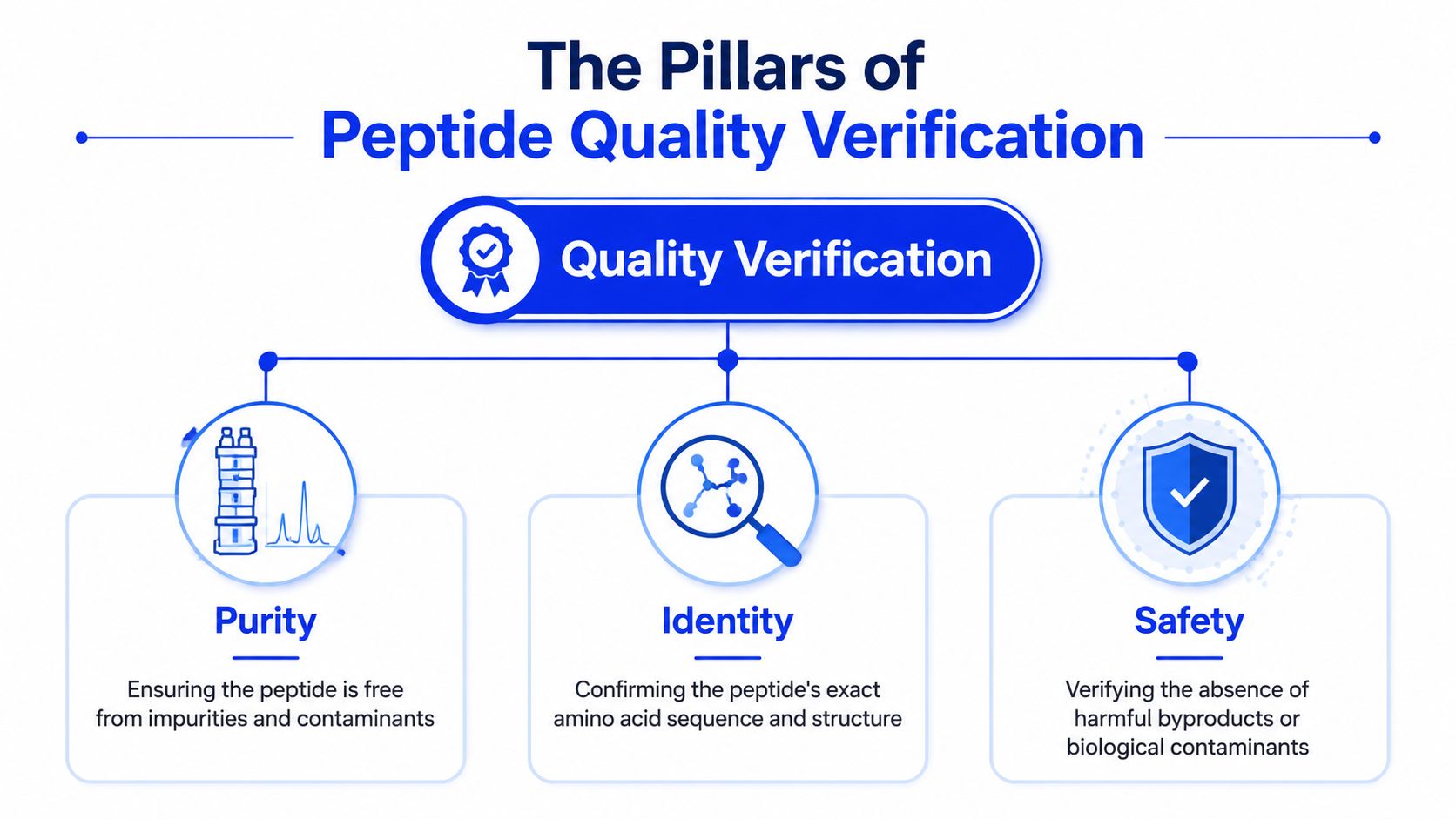
Purity is usually the first metric buyers notice, and often the one they overvalue. A listed purity figure can be useful, but only when it’s tied to a lot-specific document that identifies the batch and the analytical method used.
According to Massey Drugs’ guide to peptide quality and safety, research-grade peptides aren’t subject to the mandatory quality controls required for FDA-regulated drugs, and a lot-specific Certificate of Analysis (COA) is the primary verification tool. The same guide warns that generic COAs without traceable lot data are a major red flag.
When you review purity, look for:
A polished PDF without lot traceability is not evidence. It’s marketing collateral.
Purity tells you how clean a sample may be. It doesn’t fully confirm that the peptide is the exact compound you intended to order. Identity matters because a mislabeled peptide can produce neat-looking data that’s completely irrelevant to your project.
Strong suppliers stand apart by not relying on one broad quality claim. They show that identity has been checked through appropriate analytical documentation, and they make it possible for the buyer to connect the document to a specific batch.
A clean sample of the wrong compound is still a failed purchase.
For researchers working around stringent product standards, it’s useful to understand how demanding peptide verification can become in regulated settings. Eliquent’s summary of FDA requirements for generic peptide injections explains that FDA review requires API sameness and identification and characterization of impurities at defined thresholds, using validated analytical methods such as chromatography and mass spectrometry. Even if you’re buying only for research use, that framework is a reminder to take identity seriously.
Safety in peptide procurement isn’t just about personal handling. It’s about whether contaminants can distort the experiment. Endotoxins, microbial contamination, instability, and poor storage history can all affect outcomes.
This is one reason experienced labs ask for more than a COA. They want supporting test records when available, especially for contaminants that can disrupt cell work or other sensitive systems.
Use this quick filter when reading vendor claims:
If you want one hard rule, use this one. Never treat a peptide listing as verified until the documents prove the batch exists, the batch was tested, and the paperwork matches what you’re being shipped.
A new batch arrives two days before an assay window. The label matches the order, but the lot paperwork is generic, support is slow to respond, and no one on the team can confirm how the material was stored before shipment. At that point, the purchase has already created risk. Good peptide procurement starts earlier, with a screening process that catches weak suppliers before they enter the study file.
Researchers discussing peptide variability have pointed out that batch failures, instability, and mislabeling are real procurement problems when suppliers lack disciplined quality controls, as discussed in this expert discussion on peptide quality variability. The practical response is a repeatable checklist. Use it the same way every time, especially when a catalog looks polished enough to lower your guard.
The first decision is whether the company behaves like a laboratory supplier or a storefront built to close quick sales. Product selection matters, but supplier behavior predicts how problems will be handled after payment.
Review the vendor at the company level first:
If a supplier cannot pass that first screen, there is no reason to spend time comparing vial sizes or pricing.
This step saves projects.
Ask for the exact documents tied to the lot you expect to receive, or get a clear explanation of how lot-specific records are released with the order. Do not rely on a sample COA if the actual batch has not been identified.
Use this pre-order sequence:
Request lot-specific records
Confirm the COA belongs to the batch being sold, not a placeholder from a prior run.
Match identifiers across documents
Product name, lot number, concentration or mass, and test date should align across the listing, COA, invoice, and vial label.
Check what was tested
Purity alone is not enough for every project. If the supplier offers endotoxin, microbial, or stability-related records, review them and decide whether they fit your study risk.
Record the basis for approval
Save the product page, quoted lot details, quality documents, invoice, and shipping confirmation in the study file.
That last step gets overlooked by early-stage researchers. Later, if a result looks abnormal, procurement records often determine whether the team can rule materials in or out quickly.
A practical buying decision usually comes down to four questions.
If the answer to any of those questions is unclear, treat the order as higher risk. Sometimes the right call is to pay more for better traceability. Sometimes it is to delay the purchase and get the missing records first. That trade-off is normal. Replacing bad material after it disrupts a study costs more than a slower approval cycle.
| Attribute | High-Trust Supplier (Green Flag) | High-Risk Supplier (Red Flag) |
|---|---|---|
| Contact information | Clear support channels and business details | Hard-to-find or inconsistent contact details |
| Product page style | Technical, batch-focused, research-oriented | Consumer-style claims, vague “benefits,” dosage-style language |
| COA availability | Lot-specific and traceable | Generic, duplicated, or missing |
| Batch consistency | Acknowledges batch-level verification | Treats every vial as interchangeable |
| Quality support | Can discuss testing and handling | Deflects questions or replies with slogans |
| Order records | Clear invoices, labels, and shipping chain | Sparse records and unclear shipment traceability |
Buy from the supplier that can verify the batch, explain the paperwork, and keep records straight from quote to delivery. Avoid suppliers that substitute marketing language for documentation.
Many buyers become casual at this point, and that’s a mistake. In peptide procurement, legal language is operational language. If your team ignores it, your documentation, purchasing workflow, and study boundaries start to drift.
Under U.S. federal law, peptides labeled for research use only are sold for laboratory purposes and are explicitly prohibited from being marketed or used for human consumption, according to this legal overview of RUO peptide status under federal law. That restriction applies to the seller’s marketing and the buyer’s intended use.
So when you see RUO or “not for human consumption,” read it as a legal boundary, not a soft disclaimer. It means the product belongs in a research workflow. It does not belong in any consumer, clinical, or self-experimentation context.
The legal problem often starts before checkout. Some sellers try to preserve RUO status on paper while using product descriptions that imply therapeutic, cosmetic, performance, or recovery use. That kind of mixed messaging creates risk for everyone involved.
The cleanest procurement environments usually have these features:
This discipline isn’t just about reducing enforcement risk. It protects the integrity of your purchasing record. If your procurement file ever needs review by an internal compliance team, grant administrator, or institutional lead, clear RUO alignment matters.
When a supplier blurs the line between reagent and remedy, the buyer inherits the risk.
Keep your own side clean too. Purchase records, internal notes, inventory logs, and study documentation should all reflect laboratory intent. That consistency helps your team stay compliant and keeps the procurement trail defensible.
A verified batch can still become a bad sample if your receiving and handling process is sloppy. Procurement doesn’t end at delivery. It ends when the material is stored, logged, and prepared in a way that preserves study integrity.
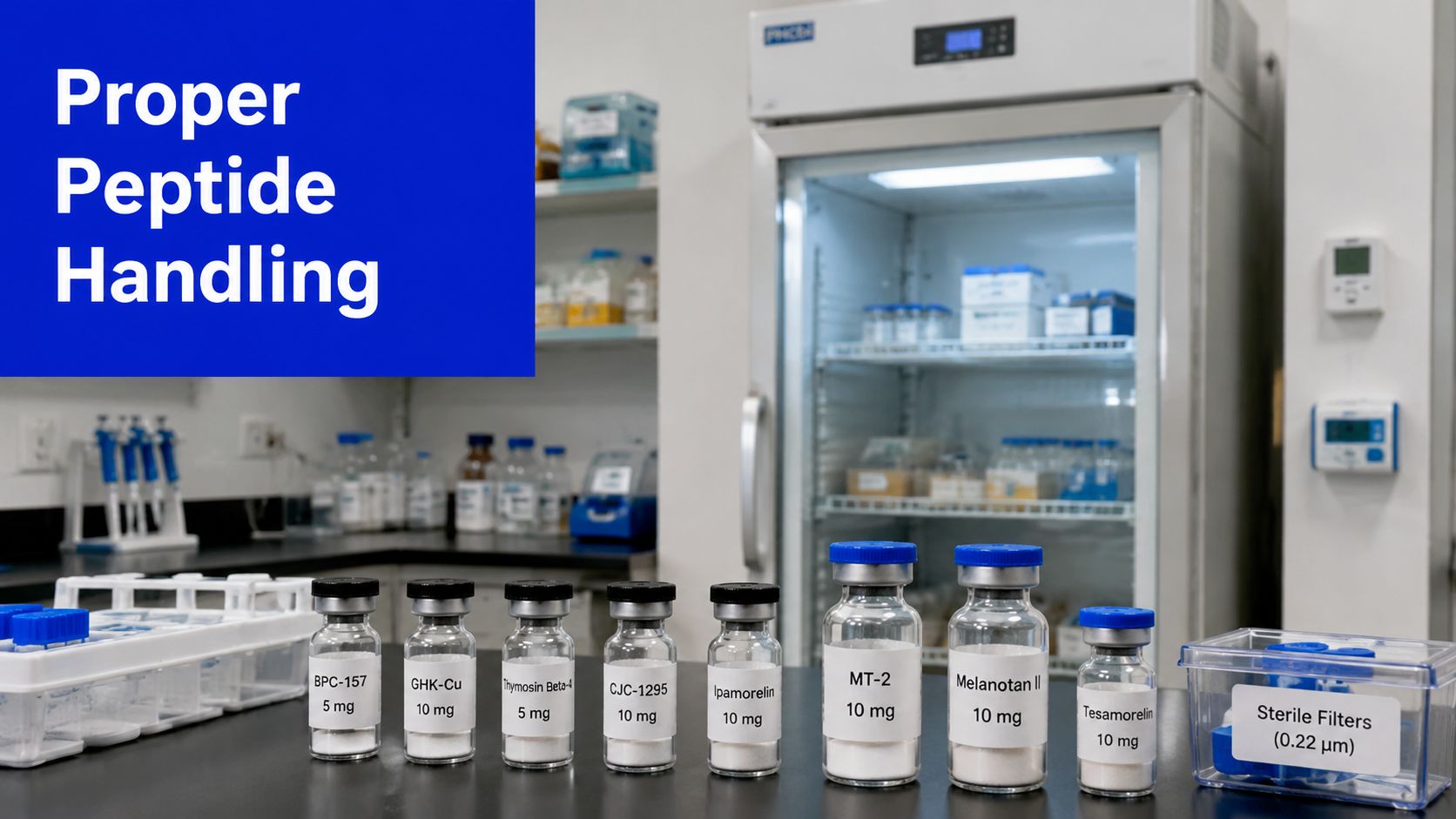
When a shipment arrives, inspect it before it disappears into general lab inventory. Confirm the label matches the purchase record, the lot aligns with the supporting documents, and the packaging condition is acceptable for your storage protocol.
For lyophilized peptides, practical handling usually includes:
Small handling mistakes create avoidable uncertainty. If the vial sat on a bench, changed hands without logging, or got relabeled casually, you’ve weakened the traceability you worked to establish during procurement.
Reconstitution should happen under your lab’s standard sterile handling practices and documented SOPs. In many research settings, teams use bacteriostatic water or another validated laboratory diluent appropriate to the assay design, then prepare aliquots to reduce repeated freeze-thaw handling.
A simple operational approach is usually best:
For a visual overview of lab-oriented preparation practices, this walkthrough is a useful reference point:
Good peptide procurement is mostly discipline. You don’t need a perfect market to get reliable materials. You need a repeatable buying standard that screens out weak suppliers, verifies each lot, and keeps your team inside clear research-only boundaries.
The practical order of operations is straightforward. Classify the material correctly. Verify purity, identity, and safety documentation. Vet the seller before the product. Then protect the batch after delivery with clean storage, handling, and records.
That approach saves more than money. It protects project timelines, internal confidence, and the credibility of your data.
If you’re reviewing research peptides for sale and want a cleaner buying process, use this guide as a procurement checklist. Compare vendors against it. Ask harder questions. Keep records that can stand up to scrutiny. Then explore options that provide transparent lot documentation and research-use compliance before you place the order.
RUO labeling sets the intended use as laboratory or experimental work. It does not authorize human consumption, and it should shape how the product is marketed, purchased, logged, and handled inside a research setting.
Research-grade materials don’t carry the same mandatory regulatory quality controls used for FDA-regulated drug products. In practice, that means the buyer has to rely much more heavily on supplier transparency, batch documentation, and internal diligence.
Not always. A COA is the starting point, not the finish line. It needs to be lot-specific, traceable, and consistent with the actual shipment. Supporting quality documents add confidence, especially for sensitive lab work.
Consumer-style claims, dosage-style language, vague purity statements, and weak batch traceability are all warning signs. A trustworthy research listing usually emphasizes documentation and intended laboratory use.
No. A well-known compound name doesn’t verify a specific batch. Procurement quality comes from the supplier’s documentation, controls, and consistency, not from how often a peptide is discussed online.
If you’re ready to apply this framework with a supplier that states its research-only boundaries clearly and provides batch-level documentation, learn more about Peptide Warehouse USA and explore options for laboratory, analytical, and preclinical sourcing.