No products in the cart.


You’re probably in the same spot most new buyers hit the first time they search how to buy peptides online. Ten browser tabs are open. Every supplier claims high purity. Every site has polished product pages. Very few make it easy to tell whether you’re dealing with a legitimate research supplier or a grey-market vendor hiding behind vague language.
That confusion matters. In peptide procurement, the difference between a usable research compound and a questionable vial often comes down to documentation, traceability, and whether the seller behaves like a laboratory supplier. The biggest shortcut is also the most overlooked one: stop evaluating peptides by marketing copy and start evaluating them by the Certificate of Analysis, supplier transparency, and legal compliance.
Researchers who buy well tend to follow the same pattern. They screen the company first, verify the lot-specific paperwork second, check the legal posture third, and only then place an order. That approach cuts through most of the noise around peptide benefits, peptide stacks, and format comparisons because it focuses on what can be verified.
A careful buyer doesn’t start with the peptide. A careful buyer starts with the source.
That’s the first practical lesson behind how to buy peptides for laboratory use. If you begin by chasing the lowest price, fastest checkout, or boldest product claims, you’ll usually end up evaluating the wrong signals. Reliable procurement starts with the supplier’s operating behavior: whether they provide traceable lot data, whether they can support a researcher with real documentation, and whether their site is clearly structured for lab and analytical use rather than implied human use.
The market is crowded because peptide demand spans many interests. Some buyers are looking at preclinical models. Others are comparing compounds used in muscle growth, healing and repair, anti-aging, fat loss, or weight-loss research. That broad attention has created a lot of noise. It has also made it easier for risky vendors to blend in by borrowing laboratory language without meeting laboratory standards.
Practical rule: If a seller makes it easier to buy than to verify, slow down.
A compliant path is much simpler than it looks. First, screen the supplier for transparency. Second, inspect the COA and confirm that it’s tied to the actual lot. Third, make sure the product is being marketed strictly for research use, with no implied therapeutic claims. Fourth, order through secure checkout and handle the shipment like any stability-sensitive research material.
Those steps work because they mirror how experienced labs buy almost everything important. The label matters. The paperwork matters more. The vendor’s behavior matters most.
The fastest way to improve procurement quality is to stop treating all peptide websites as interchangeable. They aren’t.
Some companies operate like real research suppliers. Others operate like grey-market storefronts that happen to use scientific language. That distinction is critical because LegitScript’s 2025 analysis of grey-market peptide risk noted that 84% of grey-market peptides lack mandatory sterility, purity, or potency testing, and some vials contained only saline or incorrect compounds.
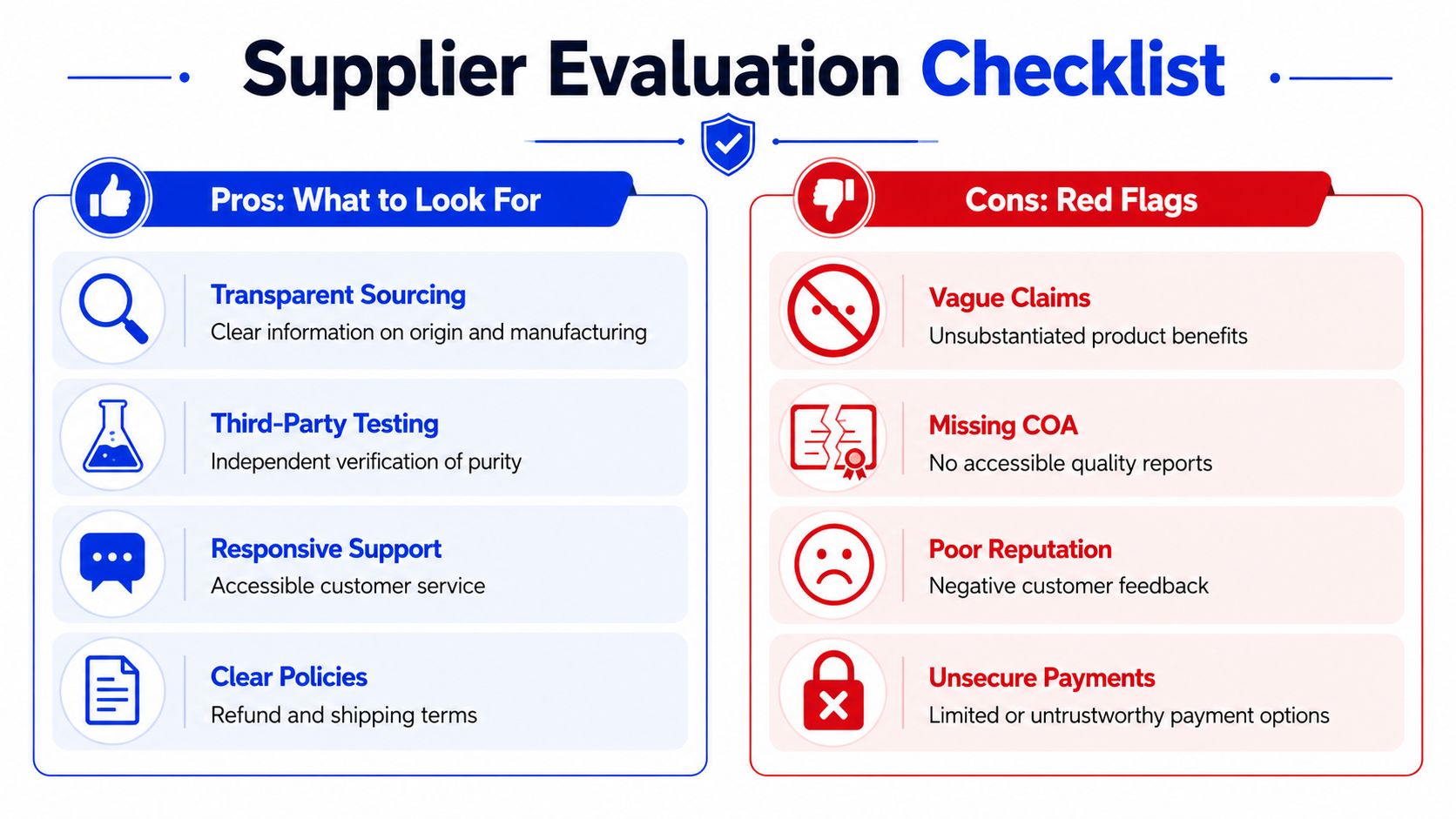
A legitimate research peptide supplier usually makes verification easy. You can find company information without digging. Product pages describe the compound in research terms, not in direct medical promises. Support channels are visible, and the business can answer basic questions about lot documentation, storage, and fulfillment.
You should also expect boundaries. Serious suppliers state For Research Use Only or similar laboratory-use restrictions plainly. They don’t wink at personal administration in the FAQ, product descriptions, or checkout flow.
A real research supplier sells to researchers. A risky vendor sells the fantasy of research while implying human use.
Another useful signal is how the company handles documentation before purchase. Professional suppliers don’t act irritated when you ask for lot-specific records, testing details, or clarification on shipping conditions. They expect those questions because competent buyers always ask them.
Look closely at site hygiene too:
| Green Flags (Signs of a Legitimate Supplier) | Red Flags (Signs of a Risky Vendor) |
|---|---|
| Lot-specific COAs tied to actual inventory | Generic COAs reused across products or lots |
| Clear research-use labeling | Language that implies personal use or therapeutic effect |
| Responsive support that answers technical questions | Evasive replies or no meaningful support |
| Published policies for shipping, returns, and account management | Missing policies or vague checkout terms |
| Transparent sourcing and testing posture | No traceable testing information |
| Secure payment flow | Unclear or untrustworthy payment setup |
A few red flags deserve extra weight. If the seller has no traceable COA, no identifiable testing lab, and product copy that leans into implied treatment language, that combination usually tells you enough. You don’t need to keep persuading yourself it might be fine.
A supplier can look organized at checkout and still ship material you cannot verify. The COA is where legitimate research procurement separates from grey-market selling.
If I am assessing a new peptide source, I spend more time on the certificate than on the product page. A polished site is easy to build. Lot-level analytical records are harder to fake well, and much easier to audit.

A usable COA is specific to the batch in front of you. At minimum, it should identify the lot, report a purity result, name the analytical method, show the testing date, and identify the lab that performed the work. Some suppliers advertise purity figures as high as 99.5%, but that number only matters when it appears on a lot-specific report tied to your material and backed by a stated method, as discussed in this legal overview of peptide COA requirements.
Here is the practical review I use:
The distinction matters. A legitimate research supplier provides records that let a competent buyer trace a result back to a specific lot. A grey-market vendor often provides a certificate that looks technical but cannot be tied to actual inventory.
That gap becomes even more important for imported materials. Shipping paperwork, relabeling, and handoffs between manufacturers and resellers can break traceability if the supplier is careless. For a useful overview of medical and pharma import challenges, review how documentation failures create downstream risk.
Weak COAs usually fail on traceability before they fail on chemistry. The document may look polished, but a few checks expose whether it belongs to a real batch or to a marketing folder.
Watch for these patterns:
A simple test works well here. Ask whether someone outside the company could tie that document to one specific batch and understand what was tested. If the answer is no, the COA is not strong enough for routine purchasing.
When the certificate raises questions, verify beyond the PDF. Independent testing, often with mass spectrometry for identity confirmation and HPLC for purity review, is a reasonable step when qualifying a new supplier, checking a new formulation, or resolving a batch that does not match prior results.
A common procurement mistake starts with a simple assumption. A vial listed online, a polished product page, and a posted COA can make a seller look legitimate even when the legal posture is wrong from the first click.
For peptide purchasing, the first legal distinction is between research supply and human-use drug distribution. Those are separate channels with different rules, different claims limits, and different seller behavior. A legitimate research supplier stays inside the research lane in its labeling, marketing copy, checkout flow, and support responses. Grey-market vendors usually fail here before they fail on chemistry.
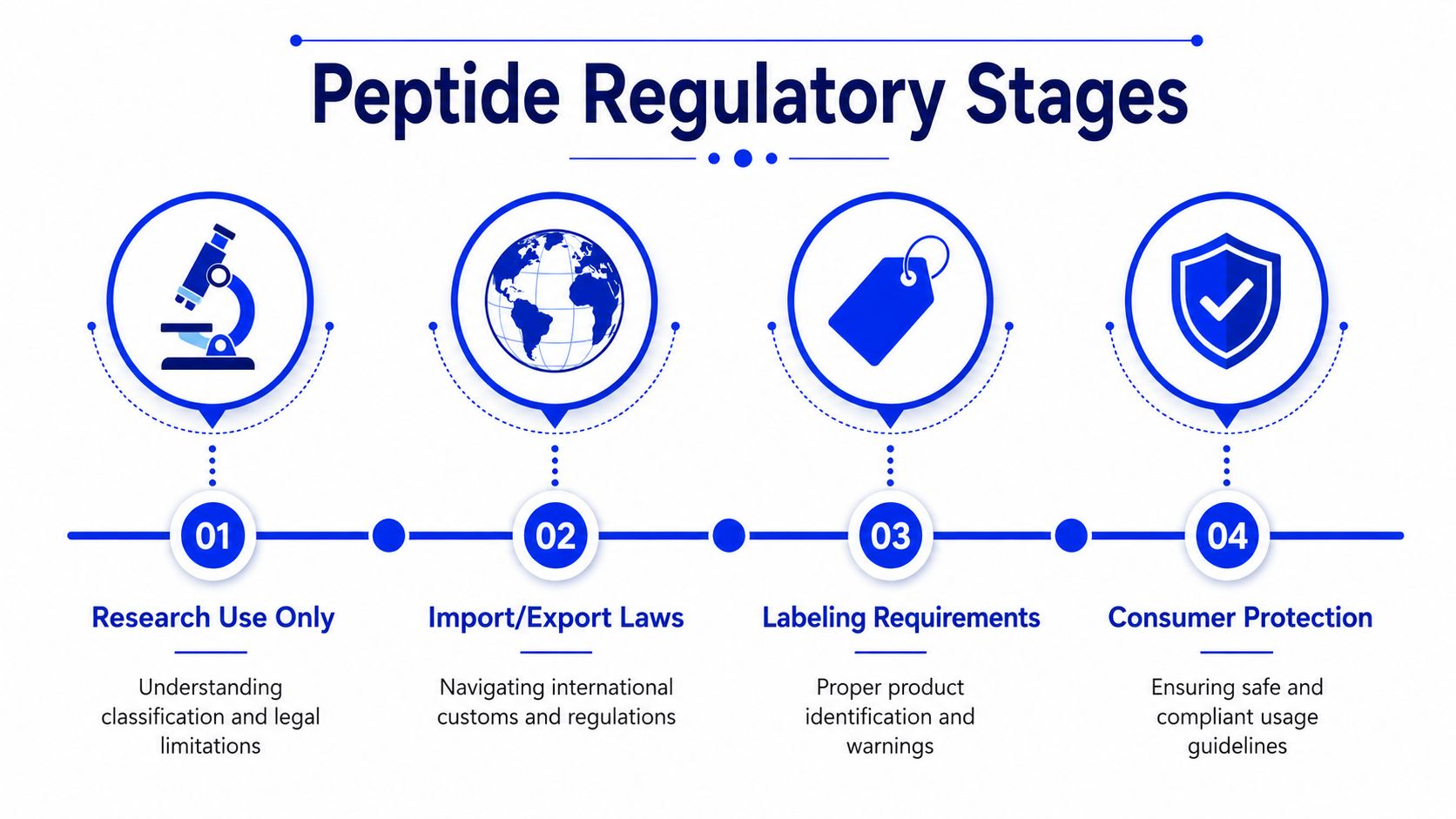
Labels such as Research Use Only and Not for Human Consumption matter only if the seller acts consistently with them. If a vendor posts dosing language, therapeutic claims, or consumer health promises, the label stops carrying much weight as a compliance signal.
That is one reason I do not evaluate legal risk separately from documentation quality. The same seller who cuts corners in marketing often cuts corners in batch control. A real supplier can connect the item offered for sale to a lot-specific COA, keep its claims inside laboratory-use boundaries, and answer basic traceability questions without improvising. Grey-market sellers tend to blur all three.
High-interest categories such as weight-loss, muscle-building, and anti-aging peptides create the most confusion. Sellers in that segment often copy the look of laboratory supply while writing for end users. That mismatch is a warning sign.
State rules can add another layer. New York, for example, has taken steps aimed at restricting sales of products marketed for weight loss or muscle building to minors, which gives compliant vendors a reason to use age screening and location-aware controls, as summarized in this overview of peptide age-gating compliance. Before relying on any state-specific rule, verify the current statutory text or current agency guidance rather than a reseller summary.
Online discussions often collapse all peptide access into one category. That leads buyers to compare research suppliers, telehealth offers, compounded preparations, and grey-market retail pages as if they were interchangeable. They are not.
For laboratory procurement, the practical question is narrower. Is the material being sold and documented as a research compound, by a seller whose records, claims, and batch paperwork all align with that use case? A COA helps answer the quality side of that question, but it also supports the legal side because it ties the offered material to a defined batch instead of a vague marketing promise.
Importing adds more points of failure. Customs classification, temperature control, product description accuracy, and shipment paperwork all affect whether the material arrives as ordered or gets delayed, rejected, or questioned. This overview of medical and pharma import challenges is useful because it shows how compliance problems often begin before the shipment reaches receiving.
The safest approach is disciplined and boring. Confirm what the product is, how it is labeled, what claims surround it, whether the batch documents match the item offered, and whether the seller behaves like a research supplier at every step. That process filters out a large share of avoidable risk.
A peptide order can look fine on screen and still fail your quality standard by the time it reaches the bench. The weak points are usually mundane. Incomplete lot records, poor cold-chain execution, vague labeling, or careless storage after delivery.
Good procurement includes those last steps.

A legitimate research supplier usually has a boring ordering process, and that is a positive sign. Clear account access, traceable order status, standard payment options, readable shipping terms, and support information that matches the company name all suggest a real operation. Grey-market vendors often fail here. They hide basic policy details, make support hard to reach, or present products with polished marketing but weak batch documentation.
Before paying, verify four things:
I treat the COA as part of the ordering decision, not as paperwork to glance at later. If the supplier cannot show which batch you are buying, the transaction is already weaker than it should be.
Open the shipment as if you may need to defend every step of receipt and storage later. Start with the outside condition. Then inspect the inner packaging, temperature protection if used, vial integrity, labeling, lot number, and document match.
For many buyers, a short handling refresher helps:
Record any discrepancy immediately. That includes broken seals, missing lot identifiers, labels that do not match the invoice, damaged lyophilized cakes, leaked liquid, or promised documents that are absent on arrival. A careful supplier can usually address a shipping issue. A poor one often responds with vague assurances and no batch-level clarification.
Storage comes next, and small mistakes matter. Keep peptides away from unnecessary heat, direct light, moisture, and repeated temperature cycling. If reconstitution is part of your laboratory workflow, use clean technique, note the solvent and date, relabel the vial clearly, and place it under the temperature conditions specified by your internal protocol and the compound’s handling requirements.
Treat receipt, inspection, and storage as one chain of custody. The supplier’s COA establishes what the batch is supposed to be. Your receiving process confirms that the batch you ordered is the batch you received, in a condition suitable for research use.
Yes. A supplier COA is the starting document, not the final word. If the COA is missing method details, shows inconsistent batch information, or looks like a template reused across products, send a retained sample to an independent laboratory for mass spectrometry and, when appropriate, HPLC purity testing.
That step is not for every order. I use it when qualifying a new supplier, checking an unfamiliar format, or investigating a lot that does not behave as expected in the lab.
Grey-market material creates the highest verification burden. Independent reviews and enforcement-focused discussions have repeatedly raised the same concern: mislabeled peptides are common enough that batch-level confirmation is a sensible control for higher-risk purchases. That is one of the clearest practical differences between a legitimate research supplier and a grey-market seller. A legitimate supplier expects scrutiny and can support it with lot-specific records.
These terms describe different supply contexts, not interchangeable quality labels. Research grade usually means a compound is sold for laboratory, analytical, or preclinical work, supported by identity and purity documentation such as a COA and related batch records. Pharmaceutical grade refers to material produced and distributed within a regulated drug manufacturing and dispensing system.
The common buying mistake is treating a high stated purity number as proof that both categories are effectively the same. They are not. A research supplier may provide strong documentation and still be outside any channel intended for human use.
For procurement, the practical question is simple. Does the seller market the product as a research compound, provide batch-specific documentation, and stay within the proper compliance boundaries? If not, the risk is not just technical. It is also procedural.
Format by itself does not answer the quality question. The same checks still apply: traceable lot numbers, product-specific COAs, matching labels, and clear research-use positioning.
Alternate formats do deserve closer review because weak vendors often use them to shift attention away from the underlying documentation. If the paperwork is thin, the labeling is vague, or the seller relies on marketing language instead of batch records, treat that as a warning sign. In this part of the market, presentation is easy to manufacture. Verifiable documentation is harder to fake consistently.
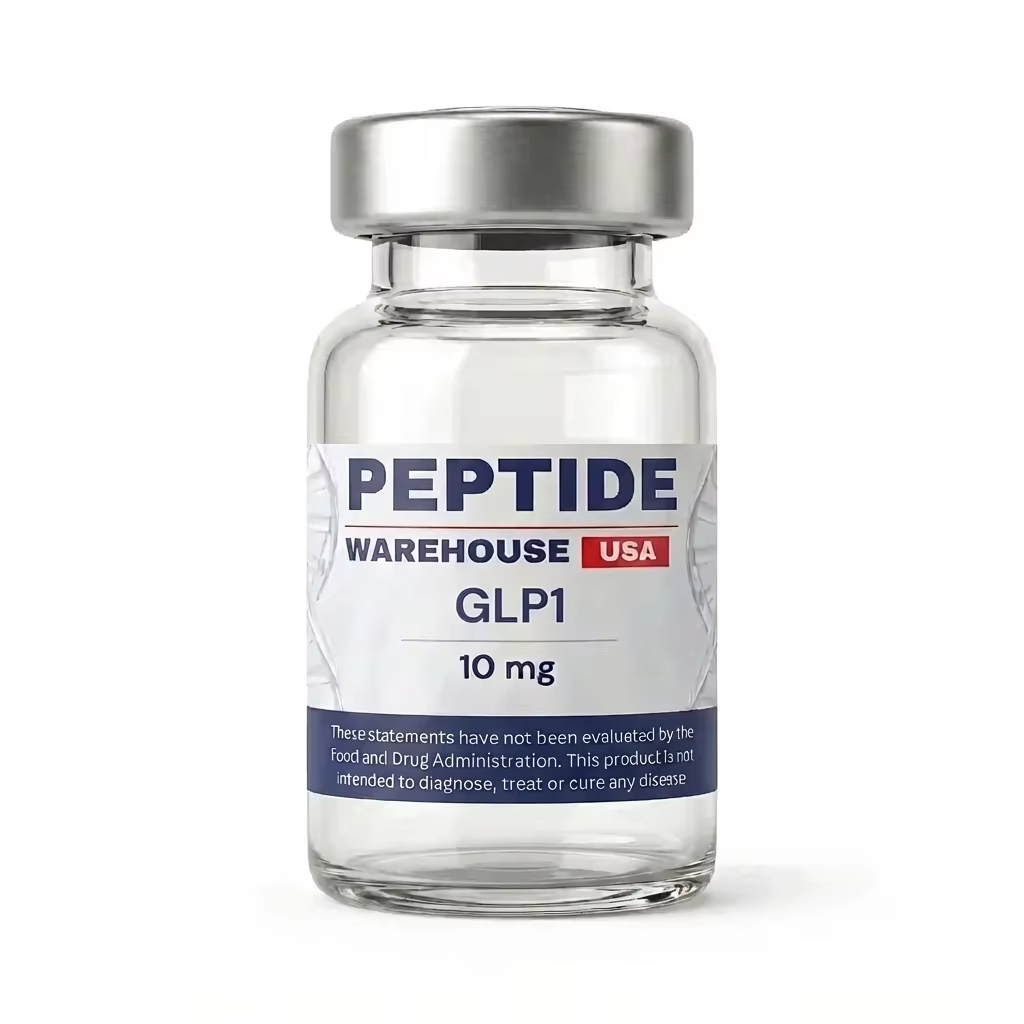
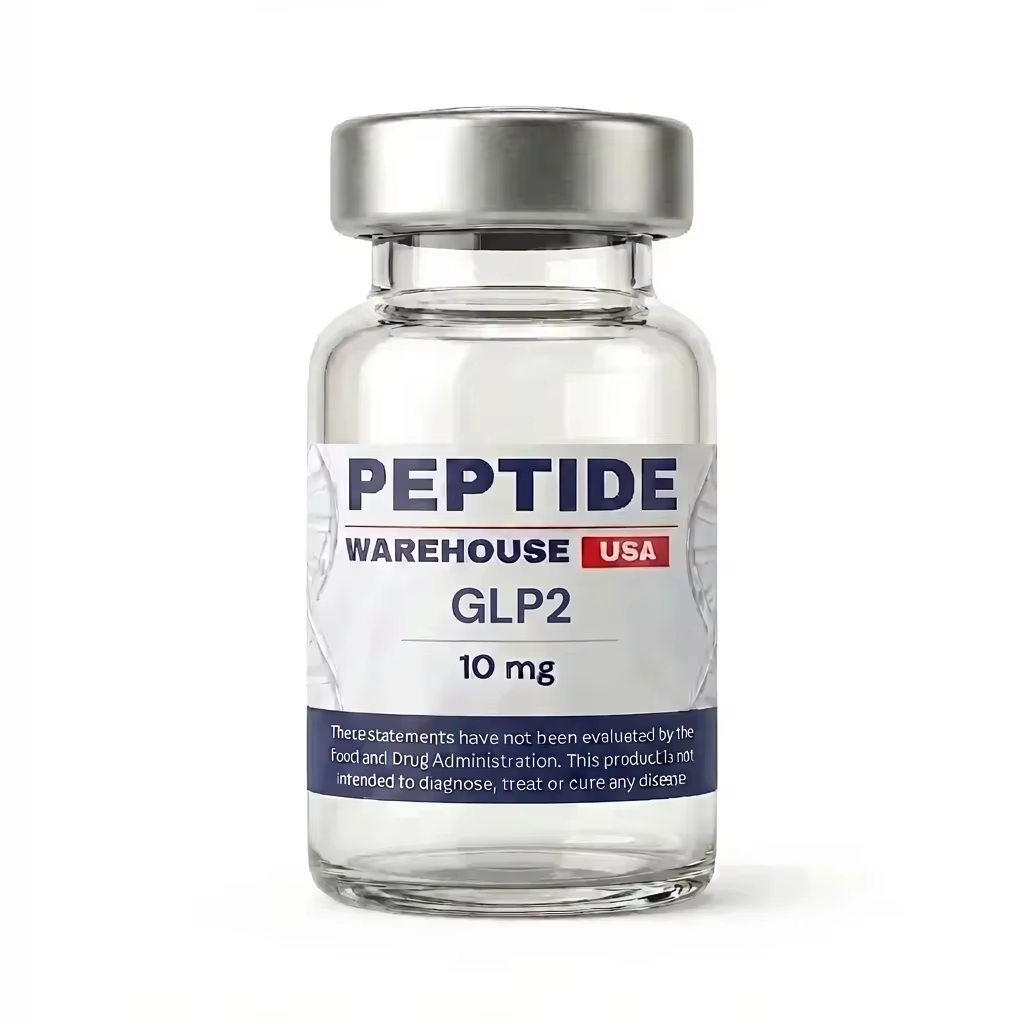
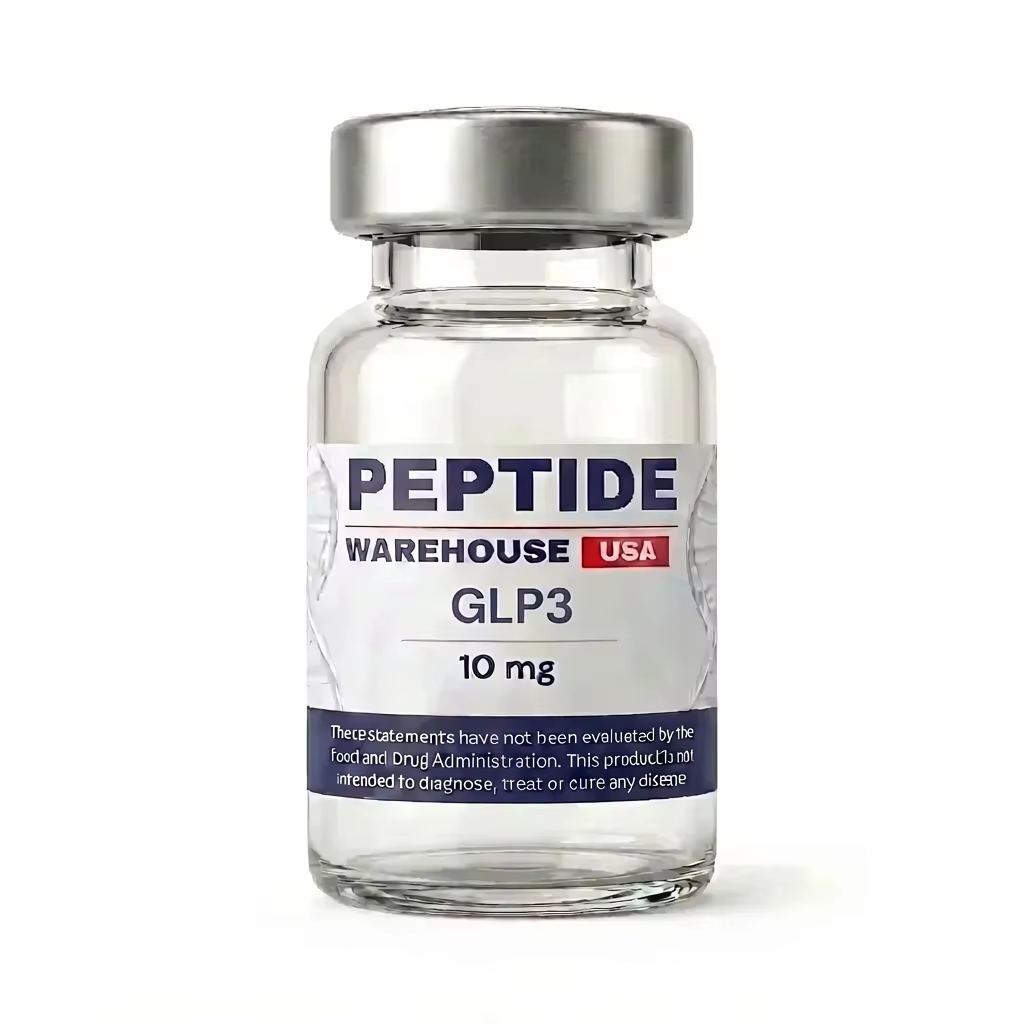
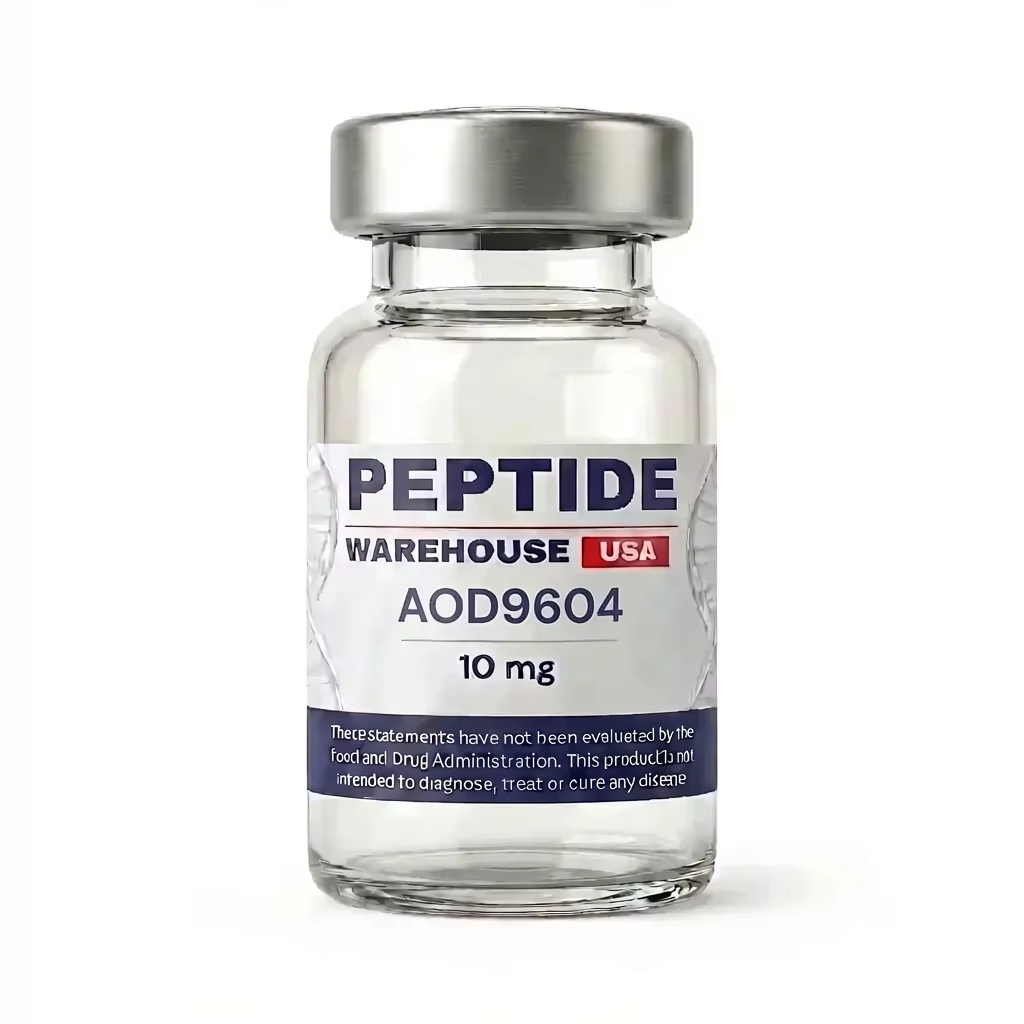
If you want a research-focused source with transparent batch documentation, Peptide Warehouse USA is worth exploring. The company supplies USA-made research peptides and related compounds for laboratory, analytical, and preclinical use, with lot-specific COAs, microbial and endotoxin reports, and stated purity levels up to 99.5%. Learn more, review the available compounds, and explore options that fit a documentation-first procurement workflow.