No products in the cart.


Most discussions of anxiety-focused peptides stop at effects. They rarely ask a more important research question: how do you evaluate the molecule, the delivery system, the evidence, and the supplier as one connected workflow?
That gap matters with Selank nasal spray. If you’re studying a peptide with central nervous system relevance, the science doesn’t begin at dosing and it certainly doesn’t end at mechanism. It starts with molecular identity, continues through pharmacology and formulation, and reaches into procurement, storage, and documentation. A peptide can look compelling on paper and still produce unreliable research if the material is poorly characterized or handled casually.
Selank has drawn sustained attention because it sits at an unusual intersection of anxiolytic research, peptide science, and intranasal delivery. Researchers are interested in how it differs from conventional small-molecule approaches, why it is formulated as a nasal spray, and what current evidence supports. They also need to know where the limits are, especially around long-term safety and dependency claims.
Many anxiolytic compounds force a tradeoff. You may see calming effects, but with sedation, cognitive blunting, or a slow onset that complicates interpretation. That’s one reason Selank nasal spray keeps appearing in peptide research conversations.
Selank is best understood as a research compound with a distinct design logic. It isn’t just another calming agent. It’s a synthetic peptide built from a known biological template, investigated for anxiolytic and nootropic properties, and commonly delivered intranasally to support central nervous system access.
For graduate students and research-minded readers, the interesting question isn’t just whether Selank appears promising. It’s why the molecule was designed the way it was, how its brain-facing mechanisms differ from conventional options, what the current studies say, and how to verify that the material in your lab matches the label on the vial or spray bottle.
Practical rule: With peptide research, mechanism, formulation, and material quality have to be evaluated together. If one piece is weak, the whole dataset becomes harder to trust.
A useful way to think about Selank is as a full-lifecycle compound. You need to understand the sequence, the receptor-level actions, the rationale for nasal delivery, the current evidence base, and the basic procurement safeguards that keep a project reproducible. That combination is what turns curiosity into disciplined research.
Selank is a synthetic heptapeptide with the amino acid sequence Thr-Lys-Pro-Arg-Pro-Gly-Pro (TKPRPGP). In plain terms, that means it is a laboratory-made chain of seven amino acids, designed from the biological template of tuftsin rather than isolated as a naturally occurring compound.
That distinction matters early in a research workflow. If a vial is labeled “Selank,” a researcher should be able to map that claim to a precise sequence, a defined molecular identity, and an intended design rationale. Without that foundation, later discussions about formulation, storage, or experimental interpretation become much less reliable.
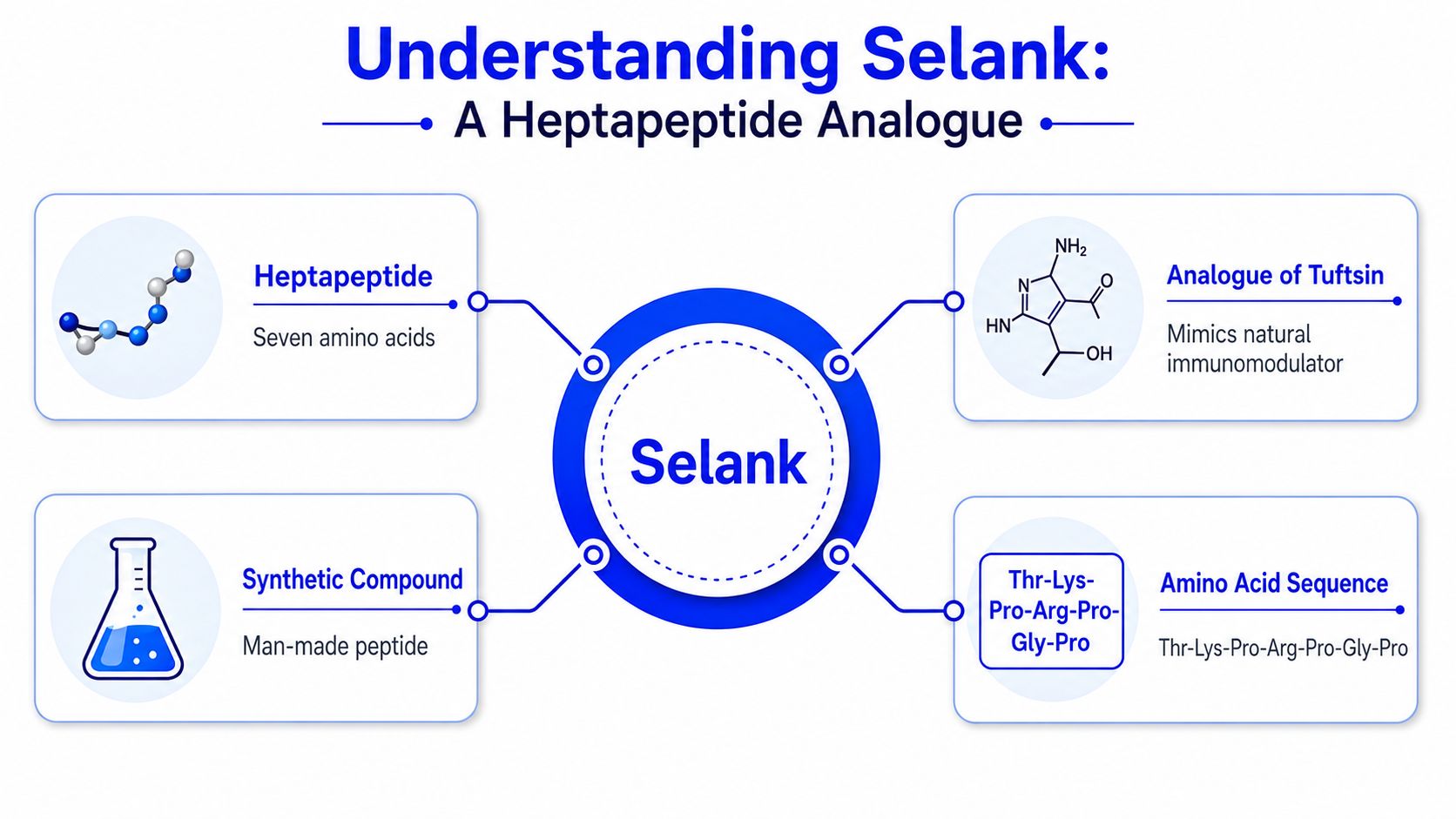
“Heptapeptide analogue of tuftsin” can sound more complicated than it is. A useful comparison is a reference design in medicinal chemistry. Tuftsin provides the biological starting pattern. Selank keeps the relationship to that pattern but exists as a separate engineered molecule with its own research profile. It should be treated as a distinct peptide candidate, not as tuftsin renamed for convenience.
The analogue concept is important because native signaling peptides are often short-lived. In biology, rapid breakdown helps keep signals brief and tightly controlled. In laboratory research, that same fragility can make a compound harder to study consistently. Designing an analogue gives investigators a molecule better suited to controlled preparation, verification, and repeated experimental handling.
That is also where procurement starts to matter. With a research peptide, the scientific question is never only “what is it supposed to do?” The earlier question is “what exactly was supplied?” Sequence identity, purity documentation, batch records, and handling conditions all shape whether Selank in a nasal spray format is the compound the label describes.
Preclinical discussions of Selank have also linked it to stress-response pathways and to reduced breakdown of endogenous enkephalins. Those associations help explain why the peptide attracts interest in anxiolytic research, but they do not make it interchangeable with approved psychiatric drugs or appropriate for casual consumer framing. The appropriate context is still controlled research use.
For readers who want a practical companion resource focused on research context, this guide on Selank for laboratory use offers a helpful overview of how labs think about the peptide outside of consumer-style claims.
A concise way to define Selank in a research setting is this:
Selank is easiest to understand as a designed research molecule with a defined sequence, a specific biological lineage, and a handling burden that starts before any experiment begins.
How can a seven-amino-acid peptide produce measurable behavioral effects without fitting neatly into the usual sedative drug model? That question explains why Selank remains interesting to researchers. The pharmacology is discussed less as a single receptor story and more as a network problem involving inhibitory signaling, stress-related neurochemistry, and the practical limits of what current evidence can establish.
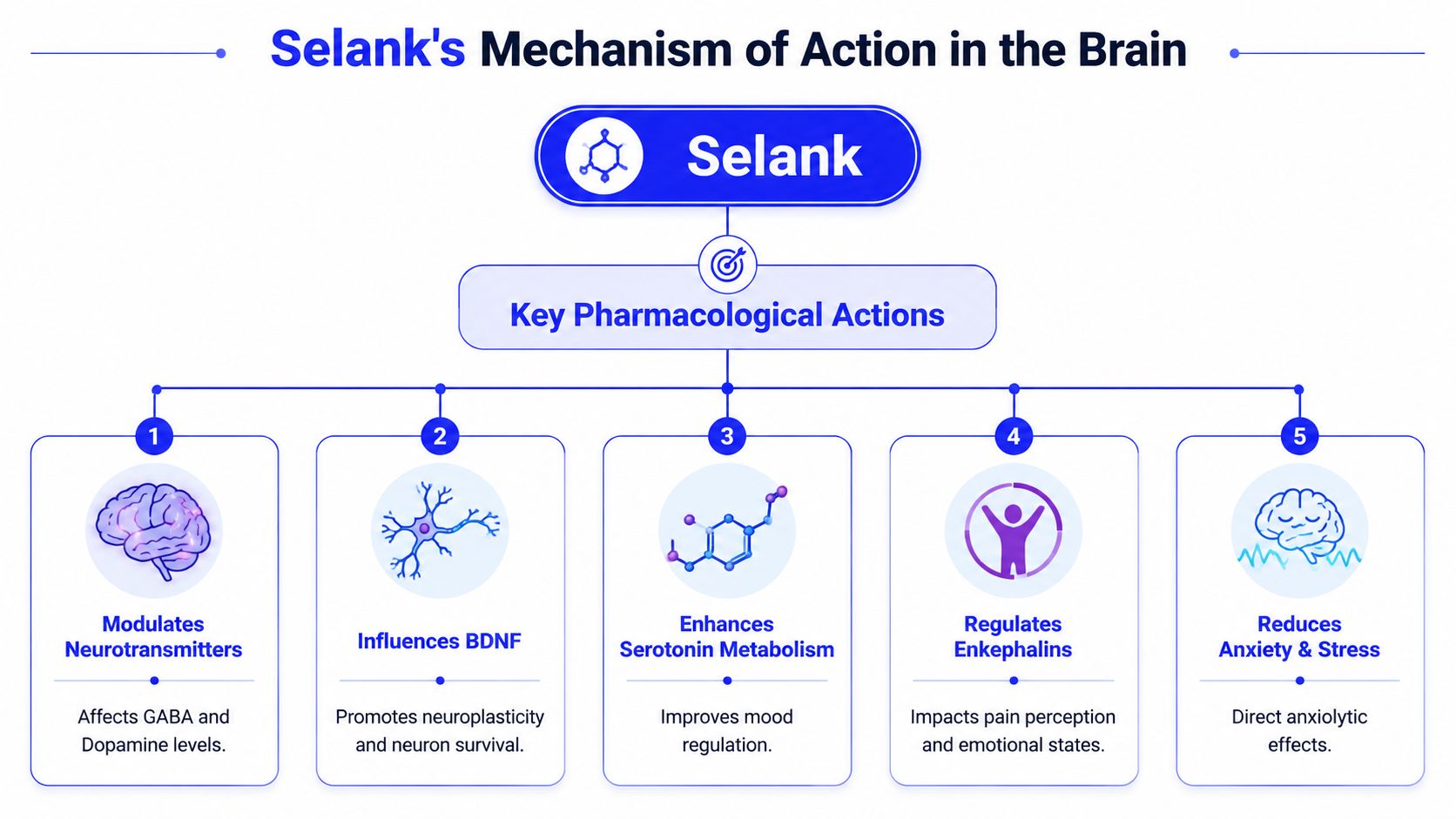
One of the main mechanistic themes is GABAergic modulation. Selank is commonly described as an allosteric modulator in relation to GABA receptor activity, which places it in the broader neighborhood of anxiolytic signaling while keeping it pharmacologically distinct from classical benzodiazepines. For a research audience, the useful point is not simple similarity. It is the location of influence. A compound acting allosterically changes receptor behavior through an indirect regulatory site rather than the primary binding site itself.
A mechanical analogy helps here. The orthosteric site is like the main key slot in a lock. An allosteric modulator alters how smoothly the lock turns by adjusting the surrounding mechanism. The door still depends on the key system, but the response profile can shift. That is why researchers discuss Selank as a modulator of inhibitory tone rather than as a straightforward sedative.
This distinction matters during experimental design.
If a compound reduces visible anxiety by broadly suppressing arousal, interpretation becomes harder. Lower movement, slower reaction time, and blunted task engagement can look superficially favorable, yet reflect sedation. Selank attracts interest because reports have often described anxiolytic-like effects without the same degree of cognitive dulling usually associated with older sedative models. That claim still requires careful handling, especially when comparing findings across species, tasks, and formulations.
Serotonergic language often appears alongside these discussions because mood and stress circuits are tightly interconnected. Researchers who want a quick refresher on serotonin terminology may find Integrative Psychiatry of America’s 5-HT guide useful before evaluating peptide-specific mechanisms.
Selank has also been described in preclinical literature as influencing enkephalin-related signaling by reducing enzymatic breakdown of endogenous enkephalins. In plain terms, that would mean the peptide may shift how long certain native stress- and mood-associated signals remain active. The proposed effect is modulatory, not binary. Researchers are not looking at a simple on-state versus off-state model, but at a change in signal persistence and system balance.
That systems-level framing helps explain why Selank is difficult to summarize with a single receptor diagram. GABA-related effects may shape inhibitory tone. Enkephalin-related effects may alter stress processing. Secondary discussions sometimes include downstream effects on attention, emotional reactivity, or adaptive responses to stress. Each of those possibilities belongs in a hypothesis map, not in a claim of settled mechanism.
The practical implication for researchers is straightforward: mechanism should guide procurement and protocol choices. If a lab is studying a peptide whose effects may depend on subtle receptor and enzymatic interactions, material quality becomes part of the pharmacology question. Sequence confirmation, purity testing, batch consistency, and storage history all affect whether an observed result reflects Selank itself or degraded material in a nasal formulation.
The current mechanistic picture can be summarized this way:
| Research dimension | Why it matters |
|---|---|
| GABA-related modulation | Supports study of anxiolytic-like effects without assuming the same receptor behavior as benzodiazepines |
| Enkephalin pathway interest | Suggests a route by which stress and mood signaling could be altered indirectly |
| Cognitive interpretation | Helps researchers ask whether calmer behavior reflects preserved function or generalized suppression |
| Quality dependence | Makes supplier verification and handling conditions part of valid pharmacology work |
Here’s a short visual explainer for readers who want another angle on the mechanism discussion.
Mechanistic language is a starting point, not proof of clinical effect. It helps researchers decide what to measure, which confounders to control, and how strict to be about sourcing and storage in a research-only setting.
The evidence base for Selank is often discussed in broad terms, but the most useful reading comes from separating what has been observed in human data from what remains inferential or preclinical.
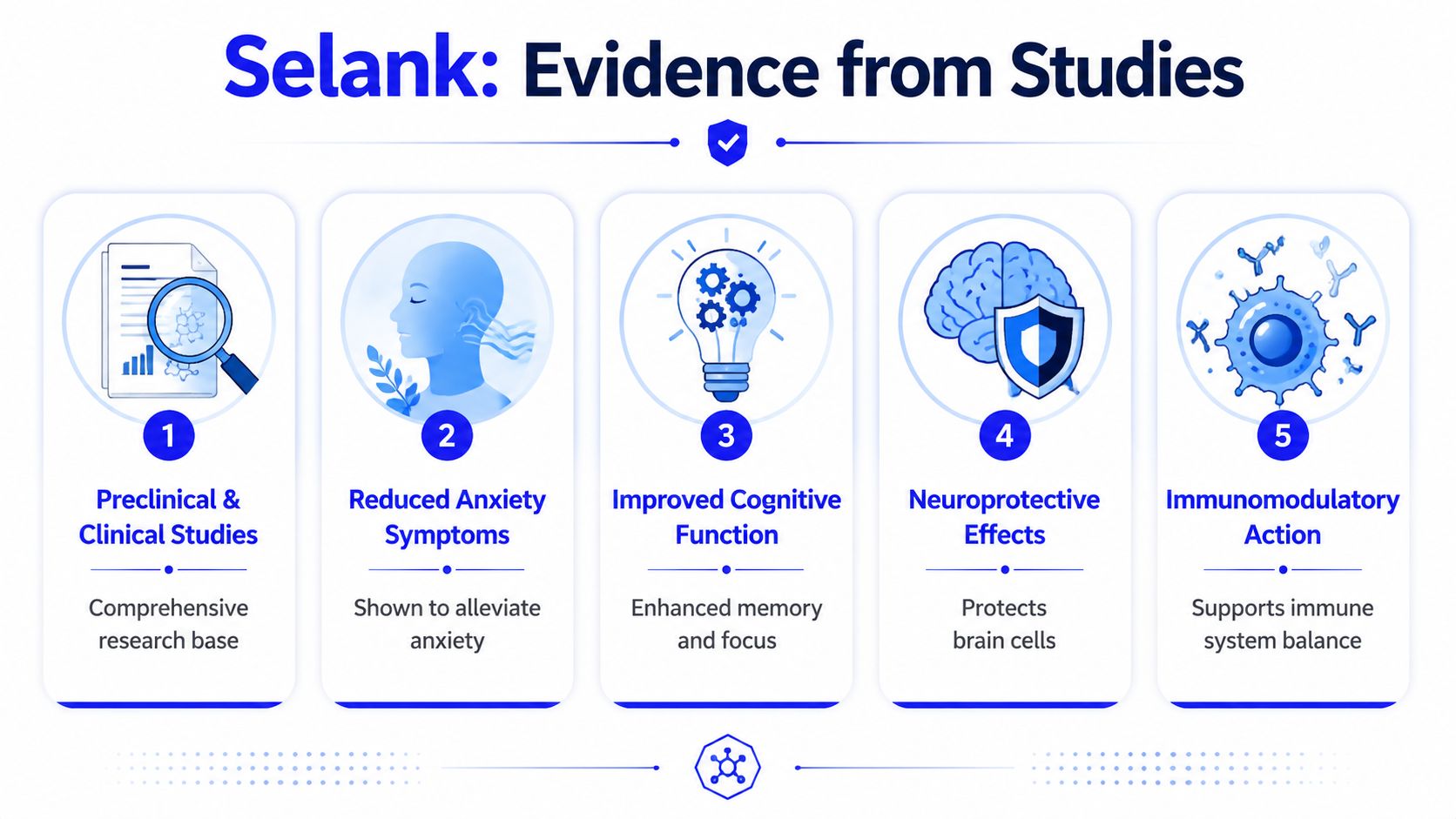
In a clinical study of 20 patients with generalized anxiety disorder administered intranasal Selank, 40% of individuals responded rapidly, achieving a 65% reduction in anxiety scores within 3 days, while the remaining 60% demonstrated a 61% reduction at the 14-day mark. The same report stated that there was no sedation or cognitive dulling, according to the clinical discussion of intranasal Selank.
Those figures are notable for two reasons. First, the response pattern wasn’t uniform. Some participants appeared to respond quickly, while others improved on a slower timeline. Second, the report highlights a behavioral profile that researchers care about greatly: observed anxiety reduction without the usual clouding effect that can complicate task performance or interpretation.
Russian clinical history is also frequently referenced in discussions of Selank as a selective anxiolytic, with favorable tolerability and published reports describing mild side effects such as nasal irritation, occasional headache, and transient dizziness. Published descriptions also report no dependence, withdrawal, or abuse potential in the available literature, though long-term certainty remains limited in Western research settings.
A small human study can be important without being definitive. It can justify further work, but it shouldn’t be treated as the final word.
Preclinical evidence broadens the picture. Animal-model work has described antidepressant-like and anxiolytic effects, along with reductions in aggression and fear responses across species. That doesn’t prove identical outcomes in humans, but it helps explain why Selank has remained interesting over time.
The clearest way to read the full body of evidence is as a layered model:
Readers often want a simple yes-or-no answer on whether Selank “works.” Research rarely gives that kind of neat conclusion. A more accurate statement is that Selank has an intriguing evidence base, including human findings, but still sits in a category where careful interpretation is more appropriate than certainty.
Why has intranasal Selank remained the dominant formulation in research discussions? The answer starts with peptide biology. Small peptides are informative only if enough intact material reaches the tissue being studied, and route of administration has a direct effect on that problem.
For central nervous system research, the nasal cavity is of interest because it may provide a more direct interface with brain-relevant pathways than oral delivery or standard systemic exposure alone. Researchers study this route partly to reduce losses from gastrointestinal breakdown and extensive peripheral metabolism. In practical terms, the formulation is not just a container for the peptide. It is part of the experimental design.
A useful comparison is package handling. Oral administration sends a peptide through multiple destructive checkpoints before any meaningful fraction might remain available. Intranasal delivery shortens that path. It does not remove every source of loss, but it can improve the odds that a fragile molecule remains intact long enough to matter in a CNS-focused model.
That research logic also explains why formulation details deserve close scrutiny.
Published and informal research protocols often describe intranasal Selank in microgram-scale exposures delivered across repeated daily administrations. As noted earlier, those protocol ranges should be treated as study conventions rather than universal dosing rules. In a research-only setting, the more important question is whether the stated exposure can be reproduced from bottle to bottle and day to day.
That is where formulation quality becomes scientifically relevant. If a spray device delivers variable volume, if peptide concentration drifts during storage, or if excipients alter stability, the nominal protocol on paper may not match the material exposure in the experiment. A behavioral assay can look inconsistent for pharmacologic reasons, but it can also look inconsistent because the formulation was never uniform.
Researchers usually track several variables at the same time:
This lifecycle view is easy to miss. A lab may understand Selank’s proposed mechanism yet still generate weak data if procurement, formulation verification, and storage controls are loose. For nasal spray research, mechanism and materials quality have to be evaluated together.
How much confidence should a lab place in a Selank result if the underlying material cannot be traced back to a clearly documented batch? For peptide research, procurement is part of experimental design. A weak sourcing decision can introduce uncertainty before the first dose is ever prepared.
Selank may be discussed for its pharmacology, but researchers still need to answer a more basic set of questions first. Was the lot correctly identified? Does the purity profile match the stated specification? Can another lab, or the same lab six months later, verify what was used? Those questions sit at the front end of the full research lifecycle, between understanding the molecule on paper and handling it correctly at the bench.
A credible peptide supplier should provide batch-specific records, not broad marketing claims. At minimum, researchers usually look for a Certificate of Analysis (COA) plus supporting analytical data such as HPLC and mass spectrometry.
Each document serves a different purpose. A COA links the physical vial to a defined lot. HPLC helps characterize the purity profile, which is similar to checking whether a signal is clean or mixed with background noise. Mass spectrometry helps confirm molecular identity by testing whether the measured mass aligns with the expected peptide. If any of those records are missing, generic, or disconnected from the lot in hand, interpretation becomes less secure.
Quality checkpoint: Agreement between the label, the batch record, and the analytical file matters more than agreement between the label and a product page.
Some research programs also review additional release data, including microbial or endotoxin reporting, if those measures are relevant to the planned laboratory workflow. The exact panel depends on the study design. The principle is straightforward. Better documentation narrows the range of plausible errors.
A practical review process usually starts with traceability and then moves to analytical detail:
One factual example in this category is Peptide Warehouse USA, which is described earlier in the article as a supplier of research peptides and related compounds for laboratory and preclinical settings. The useful point for researchers is not the brand name by itself. It is the documentation model: batch-linked COAs, clearly stated analytical testing, and records a lab can examine before accepting material into inventory.
This kind of review works like instrument calibration. Researchers do not assume an analytical balance is accurate because it turns on and displays a number. They verify performance against a standard. Peptide sourcing deserves the same mindset. If a lab cannot defend the identity, traceability, and documented quality of the starting material, it cannot fully defend the conclusions drawn from the experiment.
Once Selank enters the lab, handling becomes part of data quality. Peptides are sensitive materials. Exposure to heat, repeated handling, contamination, and poor labeling can all reduce confidence in the sample.
Researchers generally protect peptide integrity with simple, disciplined habits:
Those points may sound basic, but most reproducibility problems are basic. Good peptide handling looks a lot like good sterile technique. You reduce opportunities for drift, contamination, and confusion before they affect the assay.
The broader safety context also matters. The definitive long-term safety and dependency profile of Selank remains unestablished despite anecdotal use. While early research suggests low dependency risk, the long-term effects are not well established, making it essential to adhere to strict research-only protocols, especially as it is not FDA-approved in the US, according to the review of Selank peptide safety and dependency uncertainty.
That statement should shape laboratory behavior. In the United States, Selank should be approached as a research-only compound rather than as an approved therapeutic product. That means clearer labeling, narrower claims, stricter protocol control, and more conservative interpretation of any observed benefit.
Treat uncertainty as part of the protocol. If long-term safety isn’t established, your handling, documentation, and reporting standards should become stricter, not looser.
What makes a peptide worth sustained laboratory attention: an interesting mechanism, a plausible delivery route, or the ability to study it under controlled and traceable conditions? For Selank, the answer is all three.
Selank remains promising for anxiolytic research because its appeal does not rest on a single feature. Its identity as a tuftsin analogue gives researchers a defined molecular starting point. Its reported central nervous system activity gives that structure pharmacologic relevance. Its nasal spray formulation gives investigators a practical way to study intranasal delivery in protocols focused on brain-targeted exposure. Like any useful research compound, though, its value depends on the full workflow around it, not just the molecule itself.
That workflow matters more than many summaries acknowledge. A peptide can look compelling on paper and still produce weak or confusing results if the batch record is incomplete, the purity profile is unclear, or storage conditions drift between experiments. Selank research therefore works best when molecular interest and laboratory discipline are treated as parts of the same system. The relationship is similar to assay design and instrument calibration. One without the other limits confidence in the result.
For investigators studying the broader benefits of peptides in anxiolytic and nootropic research, Selank deserves careful examination rather than exaggerated claims. The useful questions are practical ones. Is the material identity documented? Is the formulation appropriate for the experimental model? Can the lab maintain traceability from procurement through storage, preparation, and final readout? Those questions shape whether findings are reproducible and whether comparisons across batches or studies mean anything.
Researchers who want to explore compliant sourcing can review Peptide Warehouse USA for research-only peptide materials, documentation practices, and product options relevant to laboratory and analytical workflows.