No products in the cart.


You’re probably here because you’ve already bought peptides, or you’re about to, and now you’ve hit the part that trips up a lot of new researchers. The peptide itself gets most of the attention. The solvent often gets treated like an afterthought. That’s a mistake.
Many seeking where to buy BAC water for peptides desire a store list. That’s useful, but it’s not enough. A better question is this: how do you buy bacteriostatic water that won’t compromise your peptide, your records, or your entire experiment? Procurement in a research setting isn’t about finding the cheapest vial. It’s about verifying what’s in it, how it was tested, and whether the supplier can prove those claims.
A good sourcing process protects more than sterility. It protects concentration accuracy, batch consistency, and the practical benefits of peptides in analytical and preclinical workflows. Below is the framework I’d give a new lab tech before I’d let them place a reorder.
A common failure point in peptide work happens before the peptide is even fully dissolved. A researcher uses the wrong diluent, assumes all sterile water is interchangeable, and only notices the mistake after the vial has been punctured several times and the sample history is no longer clean.
Bacteriostatic water is sterile water prepared for repeated access under controlled handling. For peptide reconstitution, that matters because many peptides are supplied as lyophilized powders and need a diluent that supports clean mixing while giving the vial limited antimicrobial protection after the stopper is first pierced.
The defining feature is the preservative. Bacteriostatic water contains benzyl alcohol, which suppresses bacterial growth in multi-use handling. Plain sterile water does not. Distilled water is a different category entirely and is not a substitute for controlled peptide reconstitution.
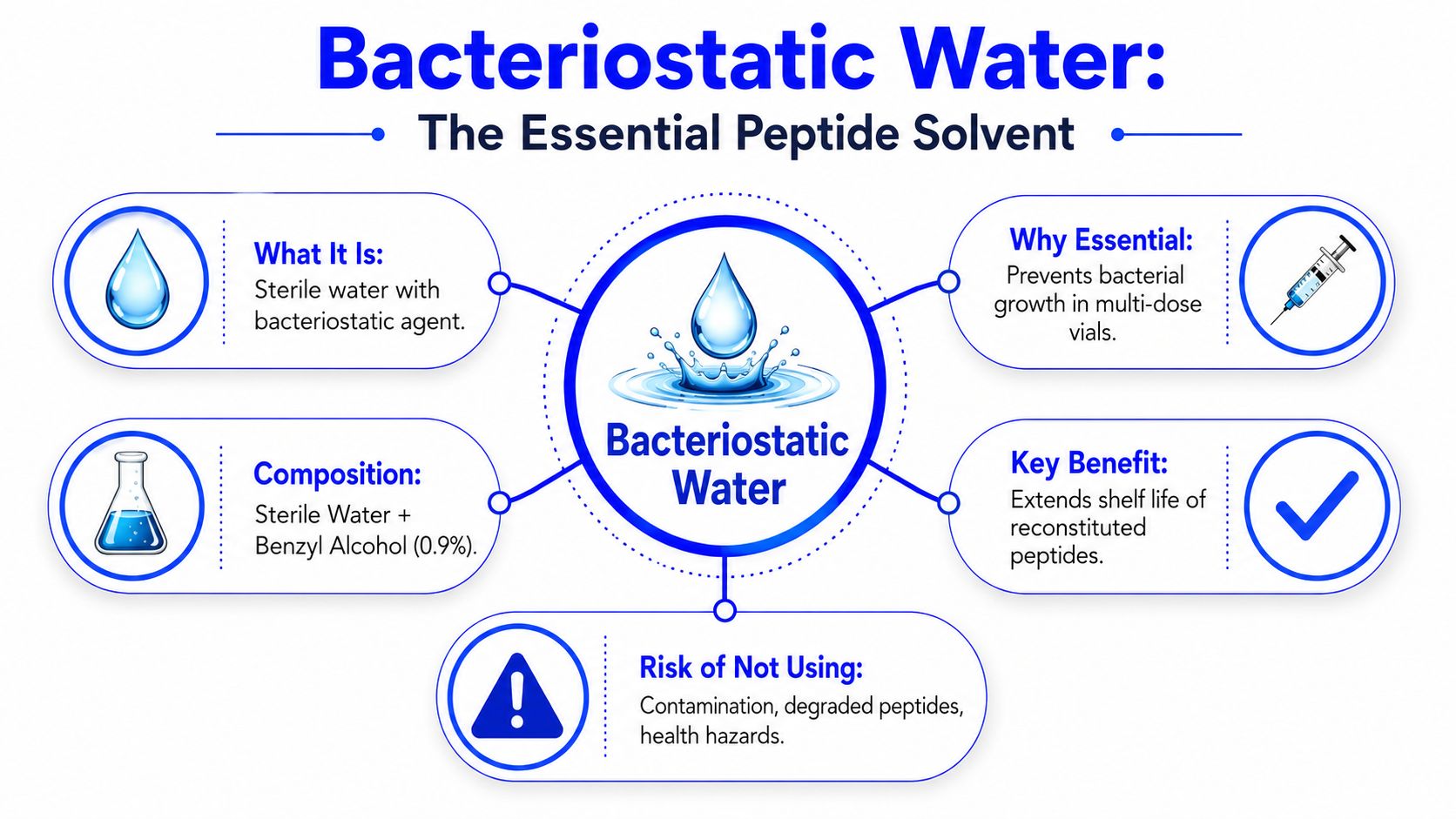
That preservative does not correct poor aseptic technique. It reduces risk within a defined use pattern. Those are very different things, and good procurement decisions start with understanding that difference.
A lab buyer should read bacteriostatic water as a controlled input, not a commodity bottle. The question is not just whether the vial says “BAC water.” The question is whether the product specification can support the way the solvent will be used.
For peptide reconstitution, four checks matter first:
In practice, these details answer the questions that matter at the bench. Will the solvent behave consistently from vial to vial. Can repeated withdrawals be defended in your records. If results shift, can the diluent be ruled in or out with confidence.
That is why experienced buyers ask for documentation before they ask about price. A low-cost vial with weak records is not a savings if it introduces uncertainty into every sample prepared with it.
The procurement mindset is simple. Verify what the product is, how it was made, and whether the supplier can prove it. If those points are unclear, the solvent has already failed the first quality screen.
Cheap BAC water often creates expensive problems. The first failure usually isn’t dramatic. It’s subtle inconsistency. A peptide dissolves poorly, a sample looks off, results drift, or a vial that should be trustworthy becomes something you can’t defend in your notes.
That’s why low-quality solvent is a bad trade. You can do everything right with the peptide and still lose the experiment because the reconstitution medium wasn’t what the label claimed.
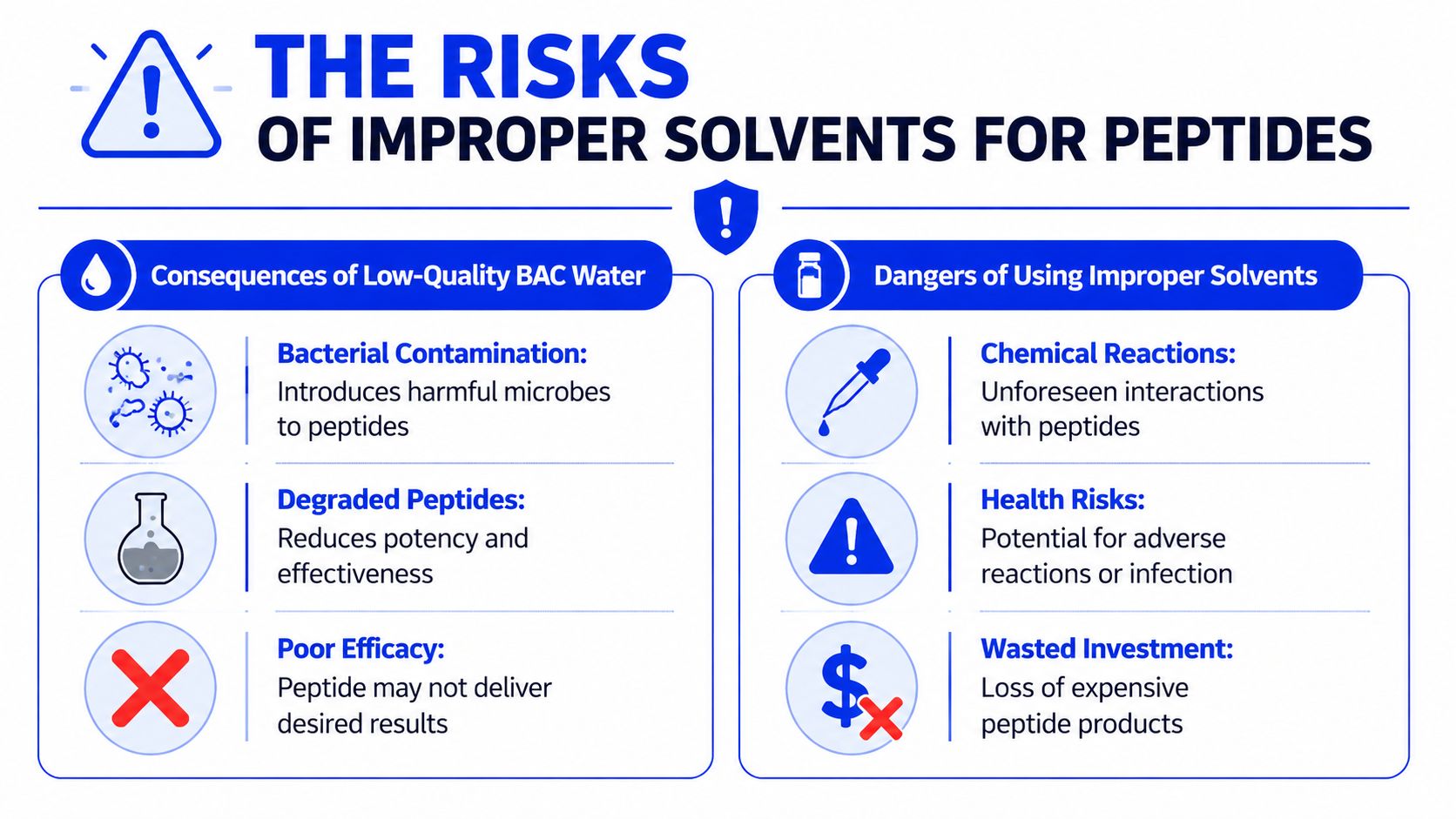
A solvent can fail your process in several ways:
If the solvent is suspect, every downstream observation becomes harder to interpret.
This issue isn’t theoretical. The market has already shown what happens when buyers lean on uncontrolled channels. Since 2023, bacteriostatic water availability has been disrupted, with major online listings and Amazon vendors disappearing under increased FDA scrutiny, while independent lab testing of gray-market alternatives found products with pH outside the required 4.5 to 7.0 range and even zero benzyl alcohol in some samples, effectively making them regular sterile water without antimicrobial properties, as described in this market review video on BAC water quality failures.
That last point matters more than most buyers realize. A vial can be marketed as bacteriostatic water and still fail the core requirement that makes it bacteriostatic.
Here’s the practical takeaway. If a vendor sells through unstable storefronts, has weak documentation, and can’t provide batch-linked proof, you’re not just taking a quality risk. You’re taking a records risk. If something goes wrong, you may not even be able to reconstruct what lot you used or whether the product matched its own label.
A common failure point in peptide work happens before reconstitution starts. A buyer finds a vial that looks right, the listing sounds technical, and the price is acceptable. Then the lot cannot be traced, the seller cannot produce supporting records, and the solvent becomes the weakest control point in the workflow.
Buy from channels that can support an audit trail. The right source is the one that can tell you who made the vial, which lot you are receiving, and what documentation matches that lot.
For most research buyers, specialized suppliers are the most practical starting point. They usually treat bacteriostatic water as a documented lab input, not a convenience add-on, which changes how they handle inventory, labeling, and customer requests.
What makes this channel stronger is not branding. It is process. Good suppliers can usually provide batch-linked paperwork, answer direct questions about product identity, and keep fulfillment consistent enough that you are not guessing whether the vial you reordered matches the one you validated last month.
What to look for:
What to watch for:
Pharmacists and established medical supply channels can also be a sound option, especially when the buyer needs known commercial packaging and a clearer distribution path. This route tends to work best when the seller can confirm manufacturer details and the product arrives with readable lot and expiration data.
The trade-off is access. Availability can be tighter, ordering may be less flexible, and documentation is not always presented in a research-friendly way at the point of sale. That does not make the source poor. It means the buyer still has to verify that the records and the vial match before the material enters use.
Buy the lot, not the listing. Procurement decisions should follow traceability, not convenience.
Open marketplaces are the highest-risk option because the listing interface is built for speed, not verification. Different sellers can rotate through the same product page, images may be reused across unrelated inventory, and support questions often stop at shipping status rather than batch documentation.
The problem is not only counterfeits. It is loss of control. If a seller cannot provide lot-linked proof, you cannot confirm whether the vial in hand matches the product description, whether storage was handled properly, or whether the next reorder will come from the same source.
Use this channel only if the seller can provide the same traceability you would require from a research supplier. If they cannot, reject the listing and move on.
| Source Type | Quality Assurance | COA Provided? | Typical Cost | Recommendation |
|---|---|---|---|---|
| Specialized research suppliers | Usually the strongest option if documentation is current and batch-linked | Often yes | Moderate | Best fit for most research buyers |
| Pharmacists and established medical supply channels | Often good when manufacturer details and distribution records are clear | Sometimes | Varies | Good option if traceability is confirmed |
| Open marketplaces | Highly variable | Inconsistent | Varies | Avoid unless the seller can verify the exact lot with matching records |
Anyone can claim a vial is USP-grade. The label and the paperwork are where that claim either holds up or falls apart.
Start with the product page, but don’t stop there. A clean website is useful for navigation, not proof of quality.
A legitimate vial should give you enough information to connect the physical product to a specific production record. At minimum, inspect these details before you accept it into inventory:
A mismatched label isn’t a minor issue. It’s often the first visible sign that the product chain is sloppy.
A Certificate of Analysis should answer three questions fast. What is it, what lot is it, and did testing confirm the critical specifications?
When I review a COA for BAC water, I look for these core checkpoints:
Benzyl alcohol confirmation
The preservative level should match the product identity. If the product is sold as bacteriostatic water, the COA should support that claim.
Sterility and endotoxin documentation
BAC water used in peptide workflows should have clear sterility support and microbial or endotoxin reporting where provided by the supplier.
Lot match
The lot number on the vial, the outer packaging, and the COA should all align exactly.
Here’s a useful explainer to review before you compare documents:
A strong vendor usually doesn’t stop at one PDF. The better setups include a COA plus related records such as microbial screening, endotoxin reporting, or sterility statements tied to the same batch.
Use this simple acceptance checklist:
If a seller refuses to provide records until after payment, I’d treat that as a procurement failure. Good suppliers understand that quality review happens before the order is approved.
A clean COA means very little if the vial spends two days overheated on a porch, gets punctured with poor technique, and then sits on a bench with no date on it. Procurement does not stop at checkout. It ends when the material is received, logged, stored correctly, and used within the product’s stated handling limits.
Start at receiving. Check the outer package for damage, then inspect the vial itself under good light. The glass should be intact, the stopper seated correctly, the seal undisturbed, and the label fully legible. Confirm the lot against your purchase record before it goes into inventory.
Then assess whether the shipment condition makes sense for the product and the season. A seller does not need elaborate packaging for every order, but they should ship in a way that protects the vial from preventable heat exposure, freezing, breakage, and label damage. If the package arrives wet, crushed, open, or missing identifiers, quarantine it and document the issue before anyone uses it.
Storage instructions matter most after first puncture. Follow the labeled storage range for the specific product you bought, and treat the manufacturer’s stated in-use period as a hard limit, not a suggestion.
Good vial handling is basic lab discipline applied consistently:
I treat opened BAC water the same way I treat any other controlled lab input. It needs a receive date, an open date, a storage location, and a clear disposition point. That recordkeeping may feel strict for a simple diluent, but it protects the peptide work that comes after it.
Bad handling usually shows up late. You do not notice the problem when the vial is put back in the refrigerator. You notice it when results become harder to reproduce, and by then the root cause is harder to prove.
Most buying mistakes are easy to prevent once you know what to screen out early. The fastest way to improve sourcing is to disqualify bad options before you compare good ones.
These issues usually tell you the seller is operating like a reseller, not a controlled supplier:
Don’t confuse product availability with supplier reliability. A vial in stock isn’t the same as a vial you can defend in your records.
The vial itself can also warn you off.
One bad solvent lot can waste far more than the vial cost. It can invalidate peptide material, repeat work, and muddy experimental interpretation.
For a multi-use peptide workflow, that’s not the standard choice. The core issue is that bacteriostatic water is selected for its preservative system and controlled reuse profile. If you substitute another diluent, you change the handling assumptions for that vial.
Sterile water and saline may have roles in other contexts, but they aren’t interchangeable with bacteriostatic water when your process depends on repeated access to the same vial. If the peptide manufacturer or your lab protocol specifies a different diluent, follow that protocol and document the reason.
That’s a bad idea for research procurement. DIY mixing creates too many uncontrolled variables, including preservative concentration, sterility assurance, filtration quality, and recordkeeping gaps.
A good purchasing process removes uncertainty. Homemade BAC water adds uncertainty at the exact step where you should be reducing it.
They’re not interchangeable. Bacteriostatic water is a standardized sterile diluent used for routine peptide reconstitution where that solvent is appropriate. Acetic acid is a different type of reconstitution medium used in specific cases based on peptide characteristics and protocol requirements.
If a peptide protocol calls for acetic acid, use acetic acid. If it calls for BAC water, use BAC water. Don’t swap based on convenience.
Yes. An unopened vial still has a manufacturer expiration date, and that date matters. Don’t treat sealed inventory as timeless just because it hasn’t been punctured.
Good stock control helps here:
Use an approval checklist and stick to it. That keeps you from panic-buying the first vial you find when supply tightens.
A practical checklist looks like this:
That process is slower than buying from a marketplace listing. It’s also how you avoid preventable failures.
If you’re sourcing peptides and related research liquids from a supplier that emphasizes batch transparency, third-party documentation, and U.S.-based fulfillment, learn more about Peptide Warehouse USA and explore options that fit a documentation-first procurement workflow.