No products in the cart.


You've probably seen peptides discussed as if they're just another wellness product. They aren't. That assumption is where most confusion starts.
Research peptides are short chains of amino acids used as laboratory tools to study biological mechanisms, test hypotheses, and support analytical or preclinical work. They are not the same thing as an approved consumer product, and they're not interchangeable with finished medicines, supplements, or cosmetics. That wall matters because regulation, purity, documentation, storage, and intended use all change once a molecule moves from the bench to the marketplace.
If you're asking what are research peptides, the useful answer isn't just “small proteins.” It's that they're highly specific compounds handled under research standards, purchased with documentation, and used to generate valid data under controlled conditions. In a real lab, that means sequence accuracy matters, impurity profiles matter, storage conditions matter, and the Research Use Only boundary matters.
The commercial interest around peptides is large and growing. The global peptide synthesis market was valued at $90.1 billion in 2023 and is projected to reach $157.5 billion by the end of 2028, with a 11.8% CAGR from 2023 through 2028, according to BCC Research on global peptide synthesis markets. That scale makes procurement easier than it used to be, but it also makes sloppy sourcing easier.
A new lab technician needs to understand both sides at once. You need the molecular basics, and you need the discipline to treat these compounds as research materials, not lifestyle products.
The shortest accurate answer is this: research peptides are short amino acid chains prepared and validated for laboratory investigation.
That definition matters because people often hear “peptide” and think of a broad consumer category. In the lab, the term is narrower. You're dealing with a specific sequence, a stated identity, a measured purity profile, and an intended research context. If any one of those is unclear, the compound may still be a peptide, but it isn't behaving like a reliable research reagent.
A peptide's sequence determines what it can do. Even a small change in amino acid order can change folding, stability, and how the molecule interacts with other targets, as described by Creative Proteomics on why peptide sequence determines structure and function. That's why sequence confirmation isn't paperwork for paperwork's sake. It sits at the center of reproducible science.
Outside the lab, “peptide” gets used loosely. Inside the lab, you need tighter language.
A useful way to separate categories is this:
Practical rule: If the molecule is being bought to generate data, not to deliver a human-use outcome, you're in research-peptide territory.
A consumer can tolerate vague marketing language. A laboratory can't. If your assay depends on a known sequence and clean material, uncertainty about identity or handling turns into bad data very quickly.
That's also why procurement is part of good science. When a lab evaluates a peptide, it isn't just buying a vial. It's buying traceability, documentation, storage integrity, and a realistic chance that the next batch will behave like the first one.
Research peptides are made from the same raw language biology uses everywhere else: amino acids. According to JPT's overview of research areas using peptides, research peptides are short chains of amino acids, typically comprising 2 to 50 amino acids, and they support work in cell therapies, vaccines, neo-epitope therapies, immunological studies, and proteomics research.
Think of amino acids as letters. A short letter string forms a word. A longer and more structured string can become a sentence. Biology works similarly. The order of amino acids creates a peptide, and that order shapes what the molecule can bind, signal, or influence.
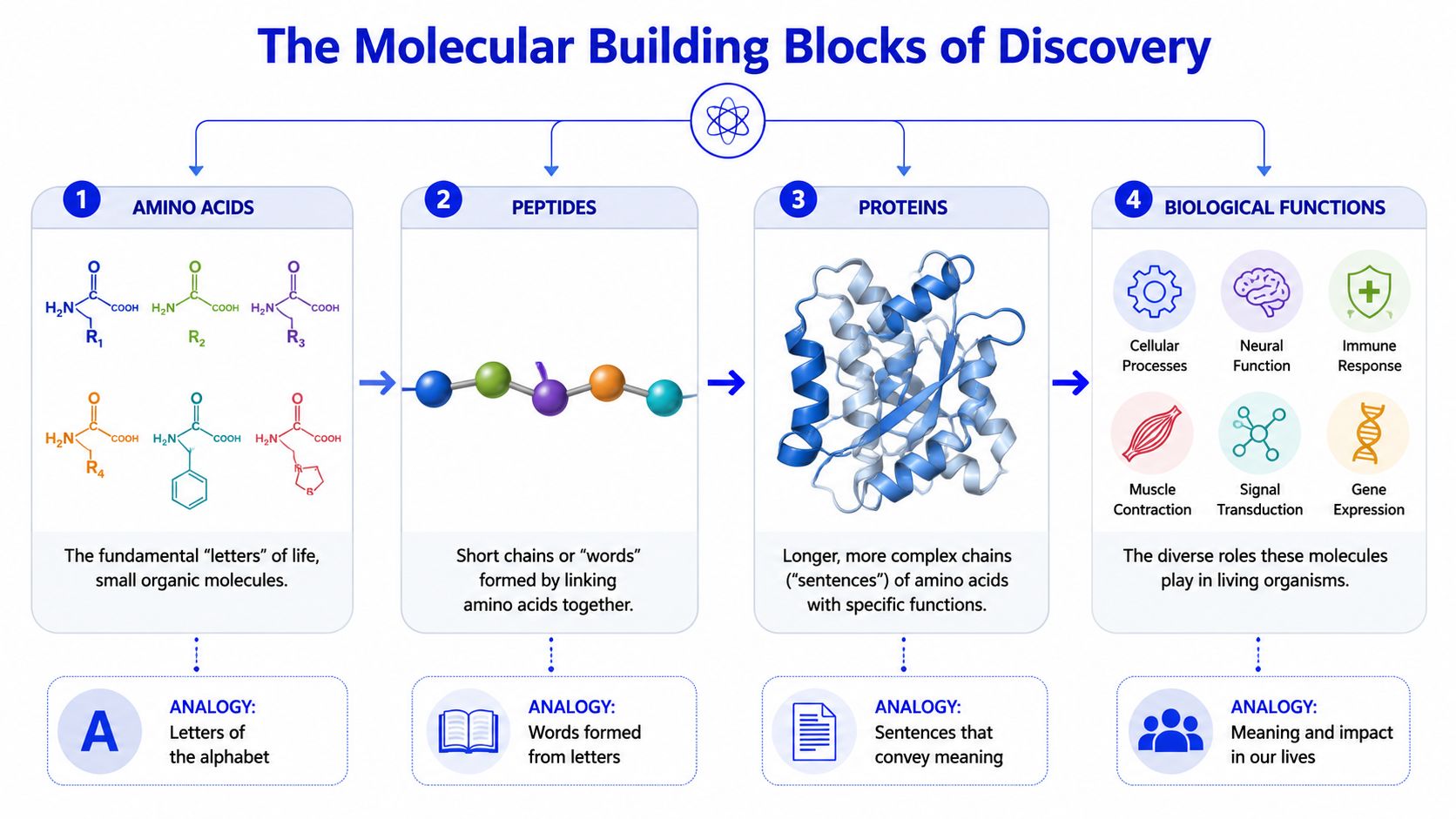
Amino acids link together through peptide bonds. As that chain grows, the molecule can take on more complex structural and functional behavior.
Here's the simplest mental model:
Some therapeutic peptides fall into a distinct pharmaceutical size range. A review in PMC on therapeutic peptides as a drug class notes that therapeutic peptides usually have molecular weights between 500 and 5,000 Daltons and often act as hormones, growth factors, neurotransmitters, or ion channel ligands that bind cell surface receptors with high affinity and specificity.
That receptor-level specificity is one reason peptides are so useful in research. They let scientists test very targeted biological questions.
A quick visual can help reinforce the concept:
Not every peptide discussed online is being treated like a proper research material. A legitimate research peptide is selected or synthesized so a scientist can ask a controlled question and observe a measurable result.
That usually means the peptide is used to examine things like:
In the lab, a peptide isn't interesting because it's trendy. It's interesting because its sequence gives you a testable hypothesis.
Another point that surprises new technicians is that many peptides studied in research were first identified in biology before being synthesized for controlled investigation. Chameleon Peptides on how peptides work describes the broad idea that many peptides studied in research are naturally occurring molecules first discovered in biological systems and later synthesized for controlled study. That doesn't make them consumer-ready. It means the lab often starts with something biology already uses.
The names tend to blur together until you sort them by the question a lab is asking. That is the useful frame. A research peptide is not a consumer good with a branding story. It is a defined sequence used to test a narrow hypothesis under controlled conditions, with documentation, handling rules, and limits on how results should be interpreted.
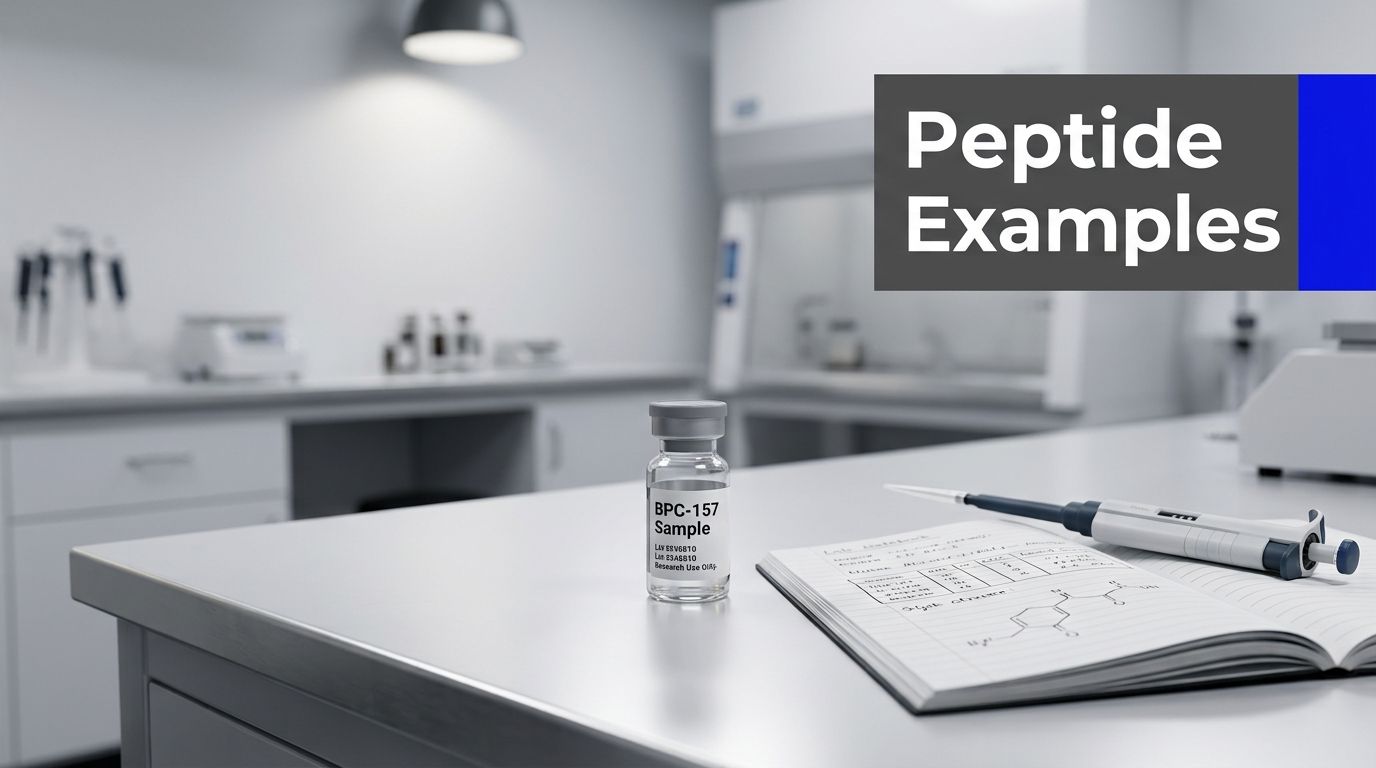
A good way to picture the difference is this. In a lab, the peptide is one part of a controlled system, much like a calibrated reagent in an assay. In the consumer world, people often talk about the same names as if a label alone proves safety, quality, or suitability for human use. It does not. That gap is exactly why legitimate researchers classify peptides by study area, verify lot data, and keep strict boundaries around research use only materials.
Some peptides are studied in models related to tissue response, recovery signaling, angiogenesis, or structural remodeling after injury. These are mechanistic questions. The goal is usually to observe how a defined sequence behaves in a cell system, assay, or preclinical model, not to assume a clinical outcome.
Examples often discussed in this category include:
This category creates confusion for new readers because the language sounds close to treatment language. The distinction matters. A peptide studied in a repair model remains a research material until it has been evaluated through the appropriate regulatory and clinical pathway.
A related compliance issue matters here too. ABC7 Chicago's report on Americans injecting unproven peptides notes criticism that online “research peptides” are often imperfect synthetics used at doses far beyond natural human levels, and that Dr. Eric Topol stated none have undergone adequate clinical trials despite widespread use. The same report notes peptides such as BPC-157 and TB-500 are banned by international sports authorities as doping substances.
Other peptides are examined for their behavior in skin biology, matrix turnover, wound environment signaling, or collagen-related pathways. In these projects, the peptide functions more like a probe than a product. Researchers use it to isolate a biological response and measure it with methods such as cell assays, microscopy, transcript analysis, or protein expression work.
A familiar example is:
That distinction between probe and product is worth keeping in view. A peptide can be scientifically interesting in a skin model and still be entirely unsuitable for casual purchase or unsupervised use. Research settings depend on controlled concentration, known purity, documented storage conditions, and methods that account for degradation or contamination.
Some peptides draw attention because they are used in neurobiology and signaling research, where small sequence changes can alter receptor interaction, downstream signaling, or behavioral readouts in experimental systems. Peptides are useful here because they can be highly specific. That makes them strong tools for studying mechanism and understanding how biological systems work.
Examples include:
For a new lab technician, the practical lesson is simple. Similar names do not mean interchangeable materials, and online popularity does not equal laboratory suitability. The researcher still has to confirm identity, purity specifications, lot traceability, storage requirements, and whether the material is appropriate for the exact model being run.
Peptide Warehouse USA is one supplier that lists compounds such as PT-141, BPC-157, GHK-Cu, TB-500, Selank, and Semax for research, laboratory, and analytical use only, with documentation tied to each lot.
A research peptide earns its place in a lab when it helps produce interpretable data. That can happen at several stages of the workflow, from assay setup to preclinical screening.
The larger market reflects how central peptides have become in development pipelines. The global peptide therapeutics market, which depends heavily on research peptides for early-stage development and screening, was valued at $140.9 billion in 2025 and is forecast to grow to $294.6 billion by 2033, expanding at a 8.7% CAGR from 2026 to 2033, according to Grand View Research on the peptide therapeutics market.
Some peptides are used because they behave well as standards, controls, or assay components.
Common analytical roles include:
If you've ever tried to validate an assay with poor starting material, you already know the problem. Your instrument can be perfectly calibrated and your methods can be sound, but if the analyte itself is inconsistent, your output won't mean much.
In preclinical work, peptides often help teams ask early mechanistic questions before anything resembling a finished therapeutic program exists.
Researchers may use peptides to:
Good preclinical peptide work doesn't prove a product belongs in humans. It tells you whether the underlying idea is worth deeper investigation.
That distinction is the practical chasm many people miss. The lab values research peptides because they reduce uncertainty in discovery. Consumers often misunderstand that same early-stage status as proof of use. It isn't.
The words Research Use Only aren't decorative. They define the boundary of lawful and responsible handling.
When a peptide carries an RUO label, the message is straightforward. The compound is intended for laboratory investigation, not for human consumption. That line exists because a research chemical and a consumer product operate under different expectations for approval, labeling, safety guidance, and use.
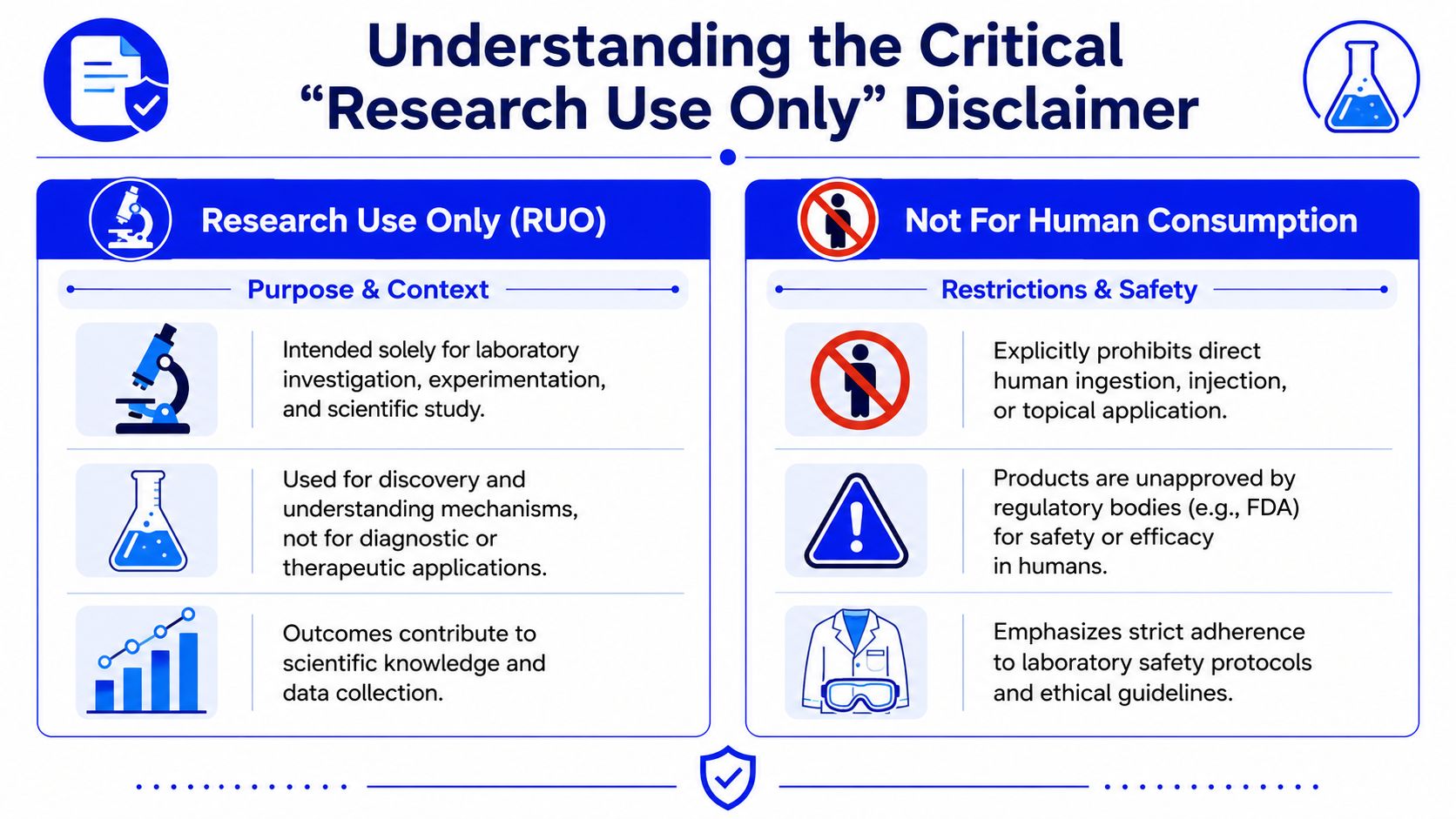
The cleanest reason is that many research peptides have not been evaluated as human-use products through the appropriate regulatory path. That means there may be no approved safety guidance, no established efficacy framework, and no lawful basis for marketing them as treatments.
A Reuters report states that the Research Use Only label has been exploited to bypass FDA approval while users self-inject for unproven benefits. It also reports that Alabama's medical regulator, on May 26, 2026, warned providers that these peptides lack FDA evaluation and safety guidelines, making composition verification impossible. The same Reuters report notes that nearly 20 peptides were added to the FDA's 2023 non-compoundable list because of serious safety risks, while online promotion for weight loss and anti-aging continued without clinical trials, according to Reuters on Alabama's warning regarding non-FDA-approved peptides.
The common mistake is treating “available to purchase” as if it means “approved to use.” It doesn't.
A peptide can be:
and still be completely inappropriate for human use.
Boundary to remember: A research label doesn't soften the risks of misuse. It clarifies that the product was never positioned for that use in the first place.
There's also an ethical issue. When a lab buys an RUO peptide, the expectation is controlled handling by trained personnel. When the same compound gets discussed online as a shortcut to anti-aging, muscle growth, or fat loss, the scientific context gets stripped away while the uncertainty remains.
That's why reputable suppliers keep the wall intact. They don't blur research materials into lifestyle products, because doing so confuses the buyer and undermines the purpose of the classification.
If you're buying for a lab, don't start with branding. Start with evidence of identity and quality.
A peptide can arrive in a clean vial with a polished label and still be a poor research material. What matters is whether the supplier can show that the stated sequence, concentration, and impurity profile were evaluated.
A Certificate of Analysis, or COA, is one of the first documents you should ask for. It should help you verify what the batch is supposed to be and how it was checked.
Look for these basics:
If a supplier offers microbial reports and endotoxin reports alongside a COA, that adds useful traceability for many labs. It doesn't replace method review, but it improves procurement confidence.
The core analytical benchmark for research-grade peptides is HPLC-MS, which combines high-performance liquid chromatography with mass spectrometry. According to PMC on analytical validation standards for research-grade peptides, research-grade peptides are defined by analytical validation via HPLC-MS, which is used to distinguish the desired peptide sequence from synthesis impurities. The same source notes that chemical purity is typically specified as >50% where the peptide is the highest peak in the HPLC chromatogram, and that rigorous quality control includes a COA confirming identity and concentration.
That last point is important because people misuse the term “pure” all the time. In chromatography, purity isn't a vibe. It's an analytical statement tied to a method and a result.
A practical buyer's checklist looks like this:
| Check | Why it matters |
|---|---|
| Batch-specific COA | Confirms you're reviewing the actual lot, not a template |
| HPLC data | Shows peak profile and impurity separation |
| MS confirmation | Supports identity of the intended sequence |
| Handling documents | Helps preserve material integrity after receipt |
If the supplier can't explain how identity was confirmed, you're not evaluating a research reagent. You're guessing.
Even a well-made peptide becomes a bad reagent if you store it poorly. Handling is part of quality.
The exact storage plan depends on the sequence. Nature's review on peptide stability and handling explains that peptides containing Cysteine, Methionine, or Trp should be stored under anaerobic conditions at -20°C to reduce oxidation, while peptides containing Asp, Glu, Lys, Arg, or His are prone to moisture absorption and should be kept in a desiccator. The same source notes that lyophilized peptides can remain stable for years at -20°C away from light, while reconstituted peptides are much more vulnerable and should be stored at -80°C in acidic buffers at pH 4 to 6, with freeze-thaw cycles avoided.
Treat the powder and the solution as different materials.
That's why aliquoting matters. If a tube will be opened repeatedly, repeated temperature changes can damage the material long before you notice a failed experiment.
A disciplined lab usually buys with the following questions in mind:
These habits don't make procurement glamorous, but they do keep experiments interpretable. Reliable sourcing, clear documentation, and fast fulfillment support continuity when a project can't wait on preventable delays.
If your lab needs documented research peptides for analytical or preclinical work, Peptide Warehouse USA offers USA-made research compounds with batch documentation, including COAs, microbial reports, endotoxin reports, and stated purity levels up to 99.5% for research use only. Learn more, review the catalog, and explore options that fit a documentation-first procurement process.