No products in the cart.



If you're comparing two peptides for a metabolism-focused project, the confusing part isn't the labels. It's that both can get lumped into the same broad category of “fat loss” even though they act through very different biology. That's why MOTS-c vs AOD-9604 is less a simple product comparison and more a question of experimental fit.
One peptide acts more like a direct adipose-focused tool. The other changes how cells manage energy. For labs studying body composition, insulin resistance, mitochondrial signaling, or exercise metabolism, that difference matters early, not late. It shapes model selection, endpoints, tissue focus, and how you interpret results.
Researchers also run into a practical crossover question when metabolic studies overlap with appetite-based interventions. If your work touches GLP-1 contexts, resources on replenishing electrolytes on GLP-1 can help frame fatigue and hydration variables that may otherwise blur metabolic readouts.
In lab conversations, AOD-9604 and MOTS-c often sound closer than they are. Both come up in discussions about fat metabolism, body composition, and metabolic support. But once you move from marketing language to pathway logic, their separation becomes sharp.
AOD-9604 is best understood as a peptide aimed at direct lipolysis. MOTS-c is better framed as a peptide involved in metabolic flexibility, meaning how efficiently cells shift between fuel sources and manage energy stress. That's a major distinction for study design.
AOD-9604 is a modified fragment of human growth hormone derived from amino acids 176 to 191 and was designed to target fat metabolism without significantly affecting growth hormone or IGF-1 levels, while avoiding effects such as water retention, organ growth, or blood sugar imbalance according to Ed Rubin MD's AOD-9604 and MOTS-c comparison. MOTS-c, by contrast, is a mitochondrial-derived peptide tied to cellular energy regulation rather than an HGH-derived fragment.
The confusion usually comes from endpoint overlap. A study might report interest in fat reduction, improved glucose handling, or better energy utilization, and both peptides seem relevant on the surface.
But the questions they answer are different:
A peptide that reduces fat mass and a peptide that improves metabolic flexibility may both change body composition, but they don't test the same hypothesis.
That difference is what separates a tidy experiment from one with attractive results and weak mechanistic clarity.
AOD-9604 is best understood as a peptide chosen for a narrow question. If a study asks whether adipose tissue can be pushed toward fat breakdown without introducing the broader endocrine effects associated with full growth hormone, AOD-9604 is often the cleaner tool.
Structurally, it is a modified fragment corresponding to residues 176 to 191 of human growth hormone. Functionally, researchers usually discuss it in terms of two adipose-facing actions: promoting lipolysis and reducing lipogenesis. That makes its research role different from compounds studied for whole-body energy sensing or mitochondrial signaling.
Its origin can mislead experimental planning.
Because AOD-9604 comes from the C-terminal region of growth hormone, some readers assume it should be treated like a reduced version of HGH. A better comparison is a fragment taken from a larger machine and used for one defined task. The interest is not general growth signaling. The interest is a more selective effect on how fat cells handle stored lipid.
That distinction matters when endpoints are easy to blur. A reduction in fat mass can result from lower food intake, higher energy expenditure, improved insulin sensitivity, altered substrate selection, or direct adipose lipolysis. AOD-9604 is usually placed in the last category. In study design terms, it belongs in experiments centered on adipocyte behavior rather than models built around metabolic flexibility.
Researchers following exercise-nutrition models sometimes discuss similar endpoint separation in contexts such as weight training on empty stomach, where the key question is whether a change reflects substrate mobilization, whole-body energy adaptation, or both. The same logic applies here. Clear mechanism comes from matching the compound to the biological question.
The most useful readouts are local and body-composition focused, not broad systemic adaptation markers.
Common endpoints include:
This is why AOD-9604 often fits targeted fat-reduction experiments better than insulin-resistance models. If the central question is whether a compound improves how tissues switch between glucose and fat under metabolic stress, the mechanism is too narrow. If the central question is whether adipose tissue itself can be pushed toward direct lipid mobilization, the fit is much better.
Practical rule: Use AOD-9604 when the hypothesis centers on direct adipose lipolysis, not on broad cellular energy regulation.
Its narrow scope is useful. A compound aimed at direct lipolysis gives cleaner interpretation in fat-focused experiments because it is less likely to blur the readout with the wider metabolic adaptations that define peptides such as MOTS-c.
A researcher choosing between two peptides can end up asking the wrong question. If the model is built around insulin resistance, impaired glucose disposal, or poor switching between carbohydrate and fat use, MOTS-c belongs in a different category from compounds selected for direct adipose lipid release.
MOTS-c is a 16-amino acid mitochondrial-derived peptide encoded within the 12S rRNA region of mitochondrial DNA. That origin matters because it points to a signaling role in cellular energy control rather than a narrow effect on stored fat alone, as described in the PMC review on MOTS-c biology and therapeutic potential.
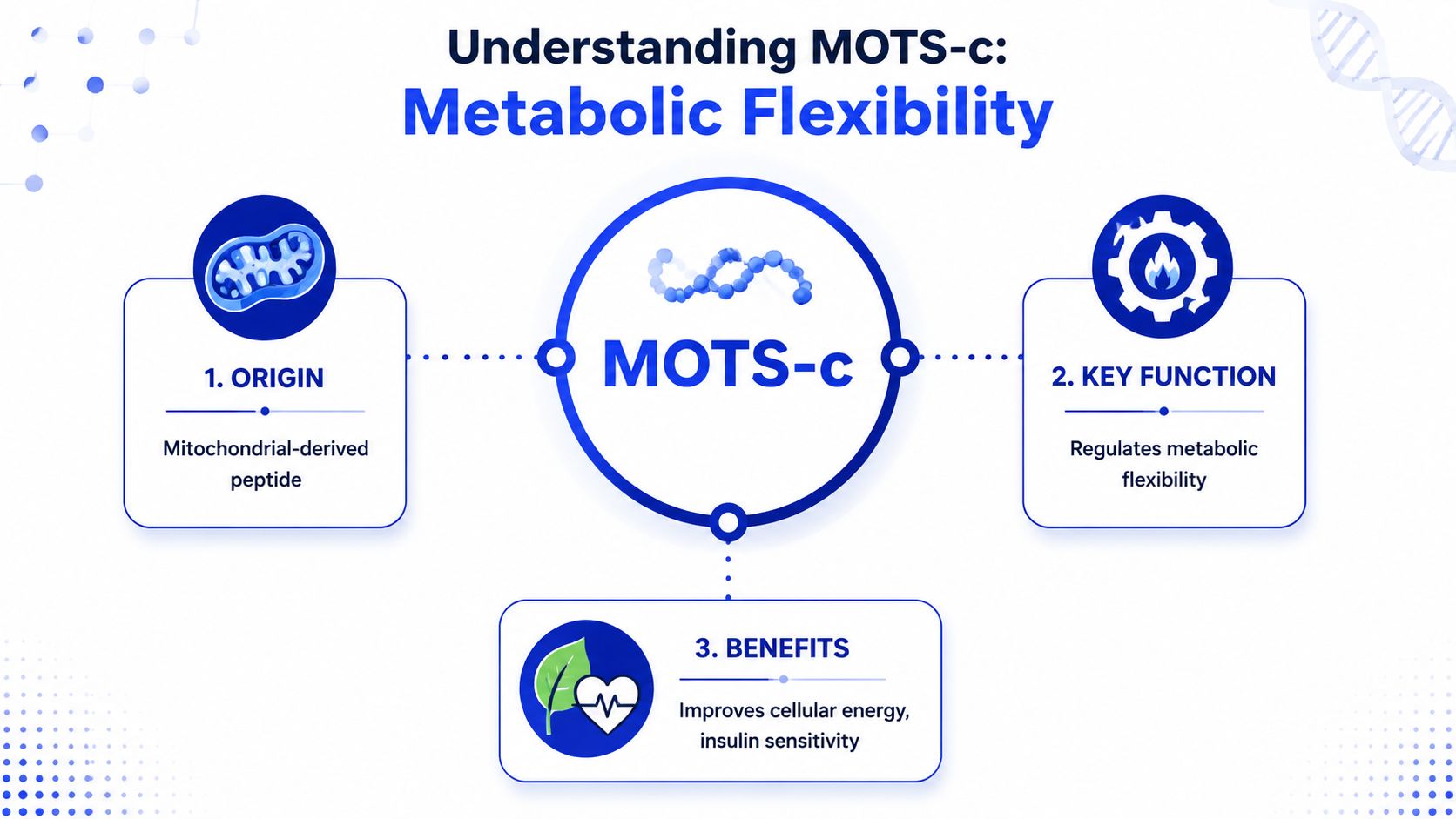
The clearest way to understand MOTS-c is to start with the study question it fits. Researchers usually turn to it when they want to test whether a tissue can respond better to metabolic stress, use glucose more effectively, or shift between fuel sources with less dysfunction.
That is the idea behind metabolic flexibility. In practical terms, it means a cell or tissue can adjust substrate use as conditions change, such as fasting versus feeding, rest versus exercise, or normal diet versus high-fat diet exposure. A useful analogy is a hybrid engine that switches smoothly between power sources depending on demand. The interest is not just how much fuel is burned, but whether the system chooses and handles the right fuel at the right time.
Mechanistically, MOTS-c is commonly linked to AMP-activated protein kinase, AMPK, a central energy-sensing pathway. Once that pathway is engaged, researchers often track endpoints such as:
This is why MOTS-c is often studied in skeletal muscle and whole-body metabolism models, not only in adipose-focused designs. For context on how fuel selection questions show up in exercise settings, even broad reading on weight training on empty stomach helps frame the difference between releasing fat and improving the machinery that decides which substrate to use.
AOD-9604 fits experiments centered on direct lipolysis. MOTS-c fits experiments centered on impaired energy handling.
That distinction sounds simple, but it changes endpoint selection, tissue priority, and model choice. If the hypothesis involves defective glucose metabolism after high-fat feeding, reduced insulin responsiveness, or poor mitochondrial adaptation under metabolic stress, MOTS-c gives a cleaner mechanistic match. If the hypothesis is limited to whether adipose tissue can be pushed toward triglyceride breakdown, the readout is too narrow to capture what makes MOTS-c interesting.
Preclinical work has linked MOTS-c with reversal of diet-induced insulin resistance, improved glucose metabolism, and favorable changes in body-weight regulation in metabolically stressed models, all within a broader pattern of altered energy homeostasis rather than a pure fat-mobilization effect, as described in the same review.
Here's the embedded video for a broader visual overview of the topic:
MOTS-c is best suited to experiments where the defect in metabolic flexibility is the main subject, especially in models focused on insulin resistance, skeletal muscle fuel use, or mitochondrial adaptation.
In other words, MOTS-c works less like a direct lipolysis trigger and more like a regulator of how the metabolic system adapts under stress.
| Attribute | AOD-9604 | MOTS-c |
|---|---|---|
| Molecular origin | Modified fragment of human growth hormone | Mitochondrial-derived peptide |
| Primary mechanism of action | Direct stimulation of lipolysis and inhibition of lipogenesis | AMPK activation linked to metabolic flexibility |
| Main target tissue emphasis | Adipose tissue | Skeletal muscle and broader cellular energy systems |
| Typical research focus | Fat metabolism and body-composition studies | Insulin sensitivity, glucose utilization, mitochondrial function |
| Overall role | Direct lipolysis agent | Systemic metabolic regulator |
The cleanest summary comes from a direct mechanistic comparison. AOD-9604 targets fat metabolism by influencing how the body breaks down stored fat, while MOTS-c regulates cellular energy by improving mitochondrial efficiency and glucose utilization in skeletal muscle, which is why their typical use cases differ, as described by Sanctuary Wellness Institute's AOD-9604 vs MOTS-c overview.
AOD-9604 acts more like a specialist. It points the experiment toward adipose tissue and stored triglyceride handling. If the model asks whether a peptide can promote fat mobilization directly, AOD-9604 aligns well.
MOTS-c acts more like a systems regulator. It shifts attention toward cellular fuel selection, mitochondrial function, and insulin-linked efficiency. In those settings, fat loss may appear downstream, but it isn't the only or even primary mechanistic story.
That distinction matters when selecting endpoints.
Decision shortcut: Choose by pathway first, not by shared marketing outcome.
Another way to put it is this. AOD-9604 asks what happens to fat cells. MOTS-c asks what happens to metabolic control.
AOD-9604 may produce a result that looks attractive in a body-fat study without telling you much about insulin signaling or mitochondrial adaptation. MOTS-c may improve metabolic markers or exercise capacity without behaving like a direct adipose-focused compound.
So when colleagues compare MOTS-c vs AOD-9604, the useful question isn't “which is better?” It's “which mechanism matches the biological problem under study?”
That's the question that keeps the interpretation honest.
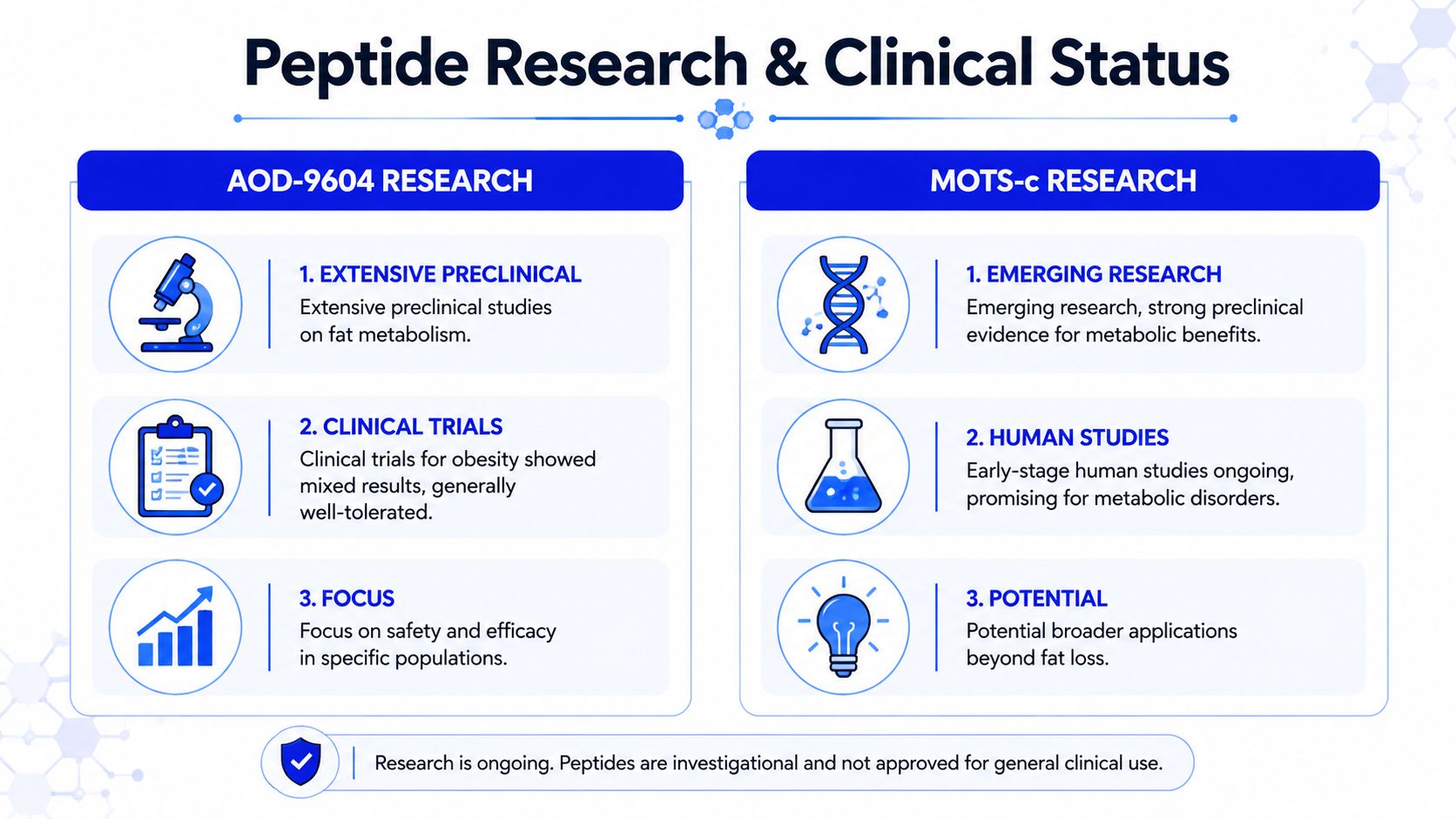
A common study-design problem looks like this. One lab wants to test whether a compound reduces fat mass in an adipose-focused model. Another wants to test whether a compound restores fuel switching in insulin resistance or exercise stress. Both projects sit under the broad label of metabolism, but the evidence base for AOD-9604 and MOTS-c supports those questions in different ways.
The literature is not balanced between them. AOD-9604 has a longer history of investigation tied to body composition and adipose biology. MOTS-c has a stronger mechanistic identity in cellular energetics, mitochondrial signaling, and metabolic adaptation, with much of that work still centered in preclinical systems.
AOD-9604 is generally studied in a narrower lane. The research emphasis has been adipose-related outcomes, especially lipolysis, fat oxidation, and changes in body-composition measures. That narrower scope helps experimentally. If the hypothesis is direct fat mobilization, the readouts are easier to define and the mechanistic story is less diffuse.
Typical study contexts include:
That does not mean the biology is simple. It means the question is usually more constrained. AOD-9604 is often treated like a tool for asking what happens at the level of fat handling, rather than what happens to whole-system metabolic control.
MOTS-c sits in a different evidence category. Its literature is often more interesting mechanistically and less settled translationally. Research has linked MOTS-c to AMPK-associated signaling, mitochondrial homeostasis, glucose utilization, exercise capacity, and adaptation to metabolic stress. Those are system-level questions, so the outputs are broader and sometimes harder to interpret cleanly.
That breadth is useful in studies such as:
A useful analogy is this. AOD-9604 is often studied like a targeted reagent aimed at adipose turnover. MOTS-c is studied more like a metabolic control signal that can change how the cell chooses and uses fuel.
More human-facing discussion around AOD-9604 does not make it the better choice for every metabolic experiment. It makes it the easier choice for a specific class of experiments. If the endpoint is fat reduction, adipocyte activity, or body-composition change, the available evidence is easier to map onto the design.
MOTS-c presents the opposite pattern. Its evidence often gives a stronger rationale for experiments about metabolic flexibility, insulin-linked dysfunction, or mitochondrial adaptation, even when the clinical trail is less mature. For a researcher, that matters more than a simple count of studies.
| Research question | AOD-9604 | MOTS-c |
|---|---|---|
| Direct lipolysis or adipose reduction | Better aligned | Indirect fit |
| Insulin resistance or impaired fuel switching | Limited mechanistic range | Better aligned |
| Mitochondrial adaptation or exercise-linked metabolism | Less central | More central |
| Simpler endpoint selection | Easier | More complex |
The practical reading is straightforward. AOD-9604 is usually easier to justify in a fat-focused protocol. MOTS-c is usually more informative in models asking whether metabolism has lost flexibility and whether that flexibility can be restored.
That distinction keeps the evidence in the right frame. It prevents a direct lipolysis agent and a metabolic flexibility regulator from being treated as if they answer the same experimental question.
The most important design choice comes before sourcing, dosing logic, or assay selection. It's deciding whether the experiment is testing direct lipolysis or metabolic flexibility.
That distinction isn't academic. It changes tissue selection, biomarker panels, and what counts as a meaningful result.
A useful framing from Lamkin Clinic's discussion of MOTS-c and metabolic flexibility is that MOTS-c activates AMPK to shift fuel preference, while AOD-9604 directly stimulates lipolysis. The same discussion highlights why this matters in insulin resistance settings, noting that MOTS-c's AMPK activation reversed high-fat diet-induced insulin resistance in diabetic models.
In practical terms:
For research use, the basic handling principles are the same ones that apply to any peptide workflow. Labs should prioritize product documentation and consistency over marketing language.
Focus on these checks:
If the handling is loose, the biology becomes harder to trust.
This is also where compliance language matters. Peptides sold for laboratory work should remain framed as research-use materials, not as products for human consumption. That keeps the experimental context clear and the documentation aligned with actual use.
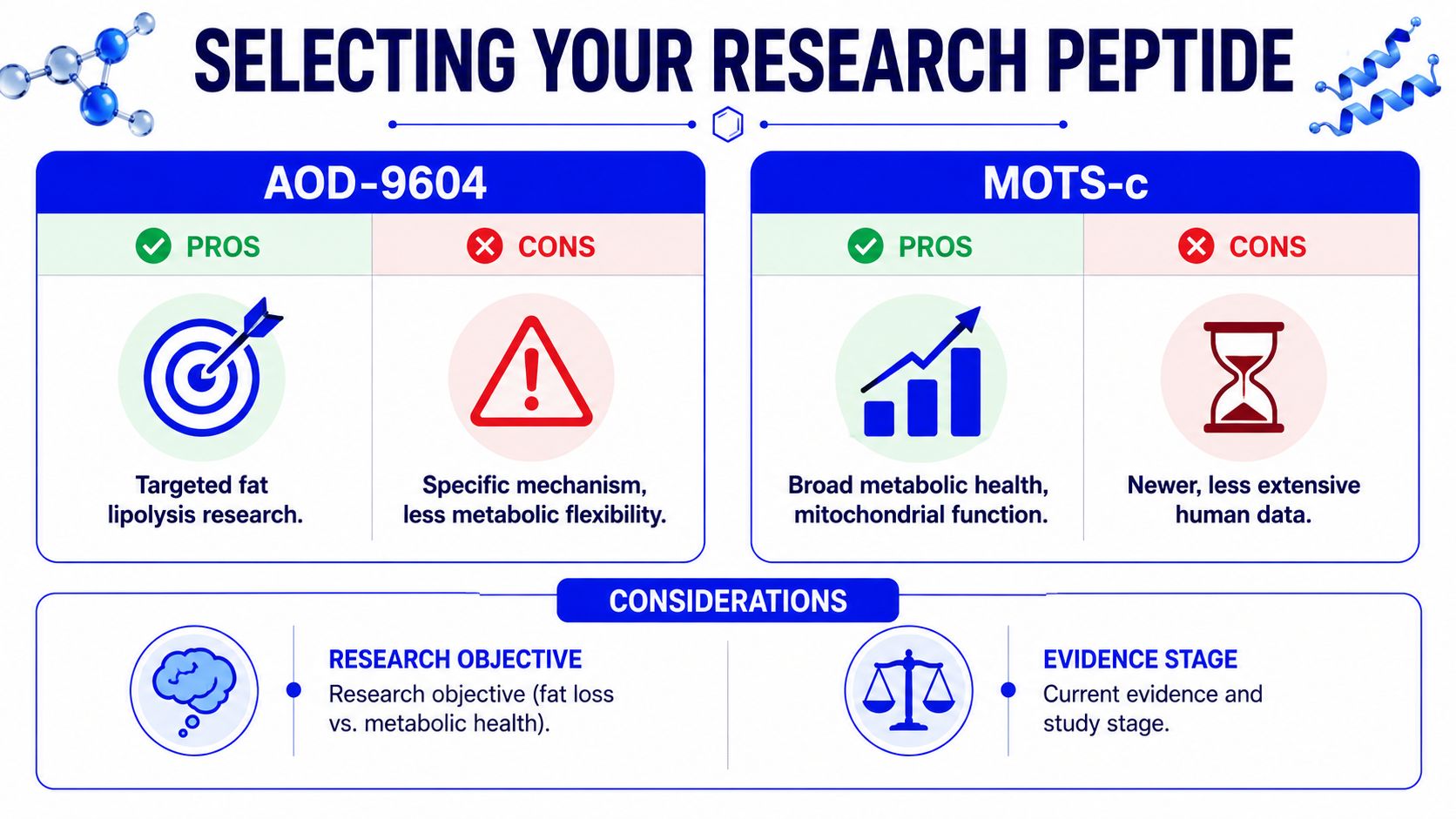
The right choice depends on what you need the experiment to explain. If the peptide is only there because it's associated with “fat loss,” the design is already too vague.
AOD-9604 is usually the stronger option when your study is built around direct adipose effects.
That includes work such as:
Its advantage is precision. It lets you ask a tighter question about fat handling.
MOTS-c is generally the better fit when your project centers on metabolic dysfunction rather than fat mass alone.
That often means:
Its strength is systems relevance. You're not just asking whether stored fat changes. You're asking whether the metabolic environment changes.
Researchers also ask whether MOTS-c could complement appetite-driven compounds such as GLP-1 agonists. The cautious answer is that there is conceptual interest, but the evidence base is still limited.
A useful summary from InShapeMD TX on peptides for fat loss and metabolism notes that emerging expert commentary suggests MOTS-c's mitochondrial efficiency may complement GLP-1 appetite suppression by enhancing cellular energy utilization once caloric intake is reduced, with particular relevance to GLP-1-related fatigue. That same discussion also makes clear that peer-reviewed human study data and clinical guidelines for that combination are not established.
So the mechanism-driven takeaway is simple:
The best peptide choice is the one that makes your endpoint easier to interpret, not the one with the broadest marketing appeal.
For labs comparing benefits of peptides across body-composition and metabolic-health models, that principle keeps the design disciplined. It also keeps downstream conclusions defensible.
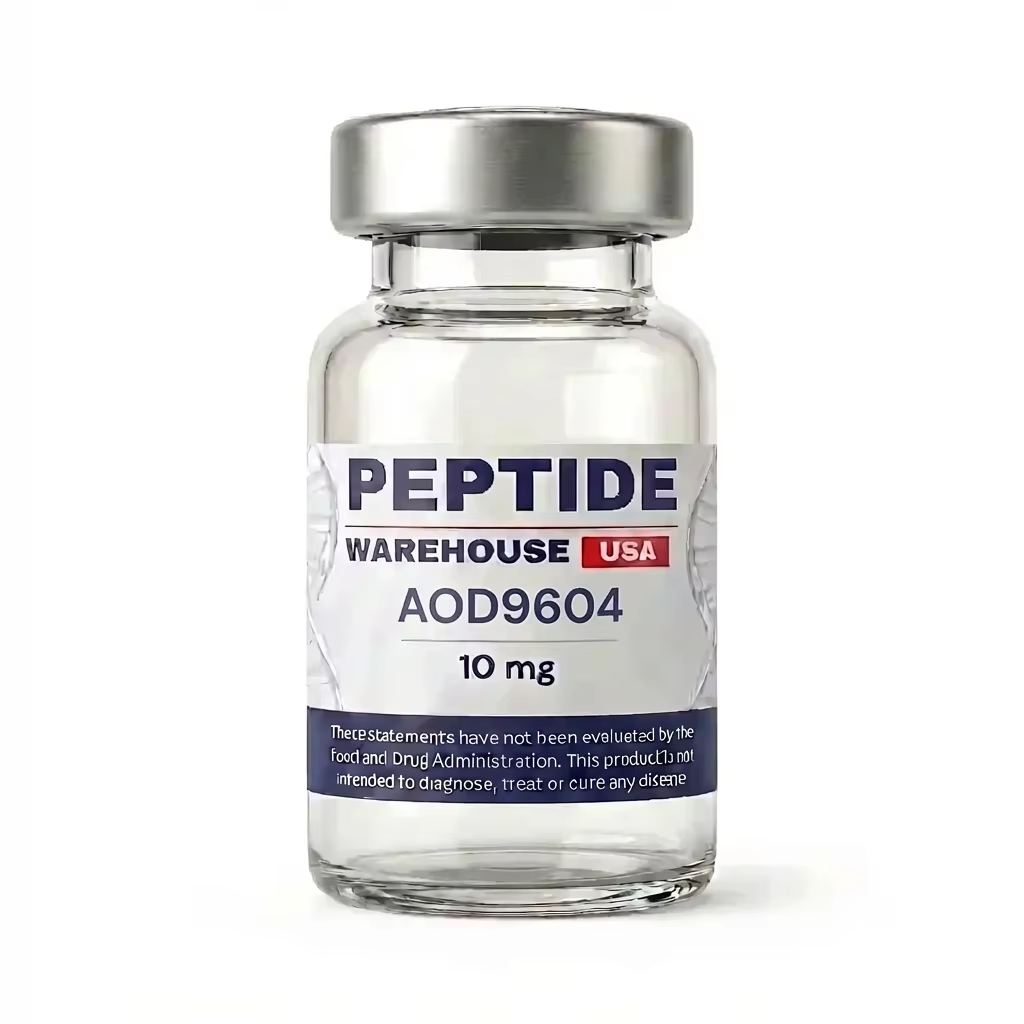
If you're sourcing research peptides for laboratory, analytical, or preclinical work, Peptide Warehouse USA is worth exploring. The company supplies high-purity research peptides manufactured in the USA with batch testing, third-party documentation, COAs, microbial and endotoxin reports, and stated purity levels up to 99.5%, giving researchers a clearer path to consistency and traceability. Learn more and explore options if you need a research-use supplier focused on documentation, fast shipping, and a US-based supply chain.