No products in the cart.

You're probably looking at a product page right now that says BPC 157 peptide made in USA, maybe with a purity claim, a COA thumbnail, and language that sounds reassuring without saying much. That's the exact point where buyers get into trouble. Domestic manufacturing can signal better process control, cleaner documentation, and easier traceability, but it does not mean the peptide is FDA approved, legal for human use, or exempt from the rules that govern research chemicals.
For a lab manager, procurement lead, or first-time peptide buyer, the real job isn't finding the loudest “USA-made” claim. It's separating manufacturing quality from legal status, and then verifying both with documents instead of marketing copy. That distinction matters more with BPC-157 than with almost any other research peptide because the supply chain language often sounds cleaner than the regulatory reality.
BPC-157 isn't a vague “healing peptide” category. It has a specific chemical identity. It is a synthetic pentadecapeptide made of exactly 15 amino acids with the sequence Gly–Glu–Pro–Pro–Pro–Gly–Lys–Pro–Ala–Asp–Asp–Ala–Gly–Leu–Val, and it has the molecular formula C₆₂H₉₈N₁₆O₂₂ with a molecular weight of approximately 1,419.56 g/mol according to the referenced chemical description.
That level of specificity matters because peptide quality starts with identity. If a supplier can't clearly state what the compound is, how it's characterized, and how batch identity is confirmed, the “high purity” label doesn't mean much. A peptide can be labeled correctly online and still arrive with incomplete characterization, weak documentation, or a report that isn't batch-specific.
When buyers search for BPC 157 peptide made in USA, they're usually trying to solve for three things at once:
Only the first two are partially addressed by domestic sourcing.
A U.S.-based manufacturing or finishing process may improve traceability, make communication easier, and reduce the odds that you're buying from a faceless reseller. It may also mean the supplier can provide documents faster and answer technical questions in plain language. That's useful in real procurement work, especially when a lab needs consistency across repeat orders.
Practical rule: Treat “Made in USA” as a quality-control clue, not a compliance badge.
The paradox is simple. A domestic label can reflect better operational discipline, but it doesn't create FDA approval, lawful human marketing, or a medical-use pathway. That's where many buyers get misled. The phrase sounds safer than it is.
For research buyers, the best use of the claim is narrow and practical. Read it as a signal to ask harder questions about batch records, testing methods, storage, packaging, and chain of custody. Don't read it as proof that the compound sits inside a normal pharmaceutical framework.
A good procurement mindset is to split the question in two. First, was it manufactured and tested in a way that supports reliable research use? Second, is the supplier describing the product in a legally compliant way? Those are separate screens, and BPC-157 forces you to pass both.
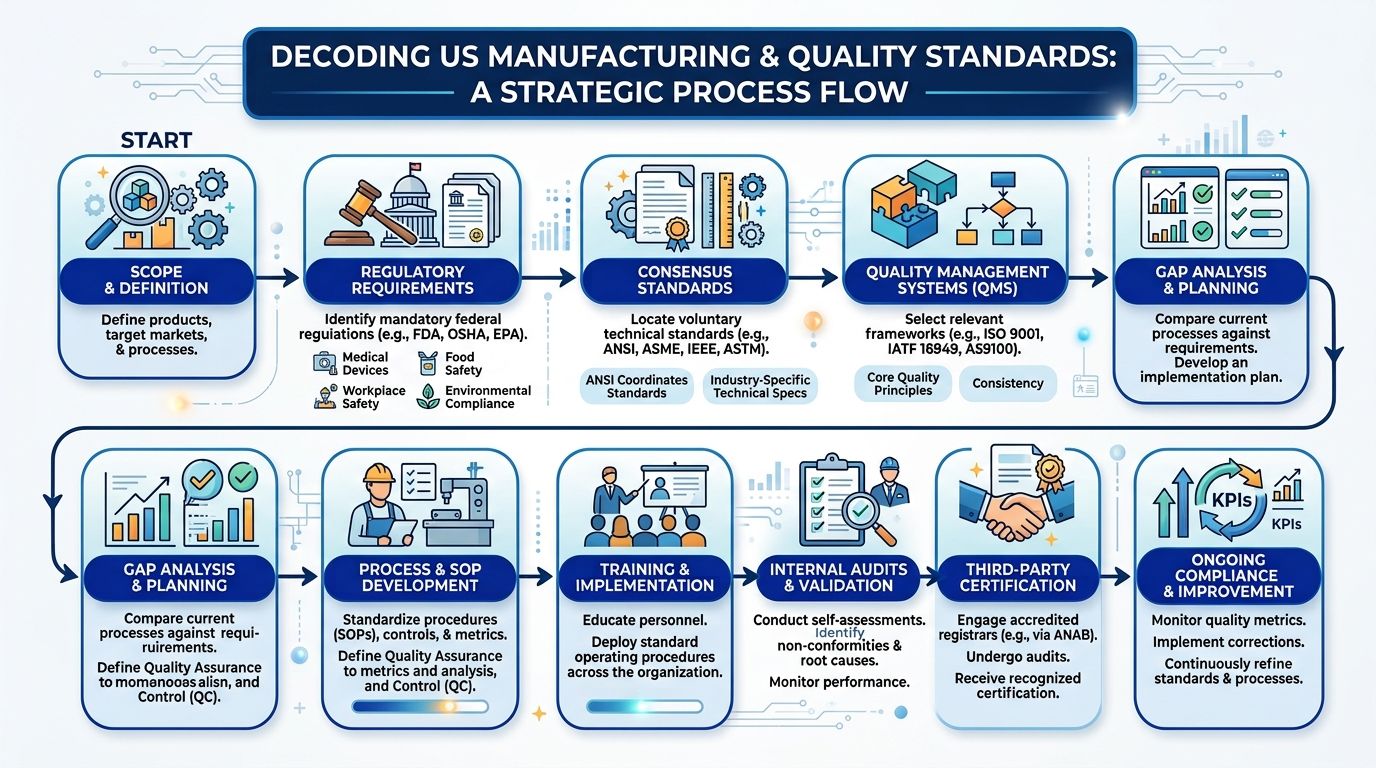
A well-run peptide operation works like a biochemical recipe with strict checkpoints. The recipe matters, but the checkpoints matter more. If the supplier can't explain the path from synthesis to final vial, the rest of the sales page is noise.
In practical terms, buyers should expect a production chain that includes synthesis, purification, drying, packaging, and release testing. For peptides, that usually means attention to sequence fidelity, impurity control, and final handling conditions that protect stability.
Here's the short version of what you want to hear from a supplier:
“GMP” also needs translation. In this market, some vendors use the term loosely. For a research chemical supplier, what matters is whether they follow documented process controls, batch discipline, cleaning procedures, and recordkeeping that resemble serious manufacturing behavior. If they use GMP language, ask what that means in their facility, not just on their homepage.
A serious supplier doesn't just mention quality. They produce paperwork that ties quality to a specific lot. The minimum package should let you verify that the vial in hand matches the tested batch on paper.
Look for these items:
Good vendors make you less dependent on trust. The documents do the talking.
You also want to know whether the supplier can support downstream logistics. If your institution has shipping controls, hazardous materials review, or receiving protocols, operational fit matters as much as chemistry. Teams that manage regulated shipments often benefit from reviewing broader guidance on shipping restrictions for pharmaceuticals, especially when internal compliance staff treat peptide orders with extra scrutiny.
One more point that new lab managers often miss. A polished COA image on a website isn't enough. Ask whether the report is current, batch-specific, and available in full. A supplier that hesitates there is telling you something important.
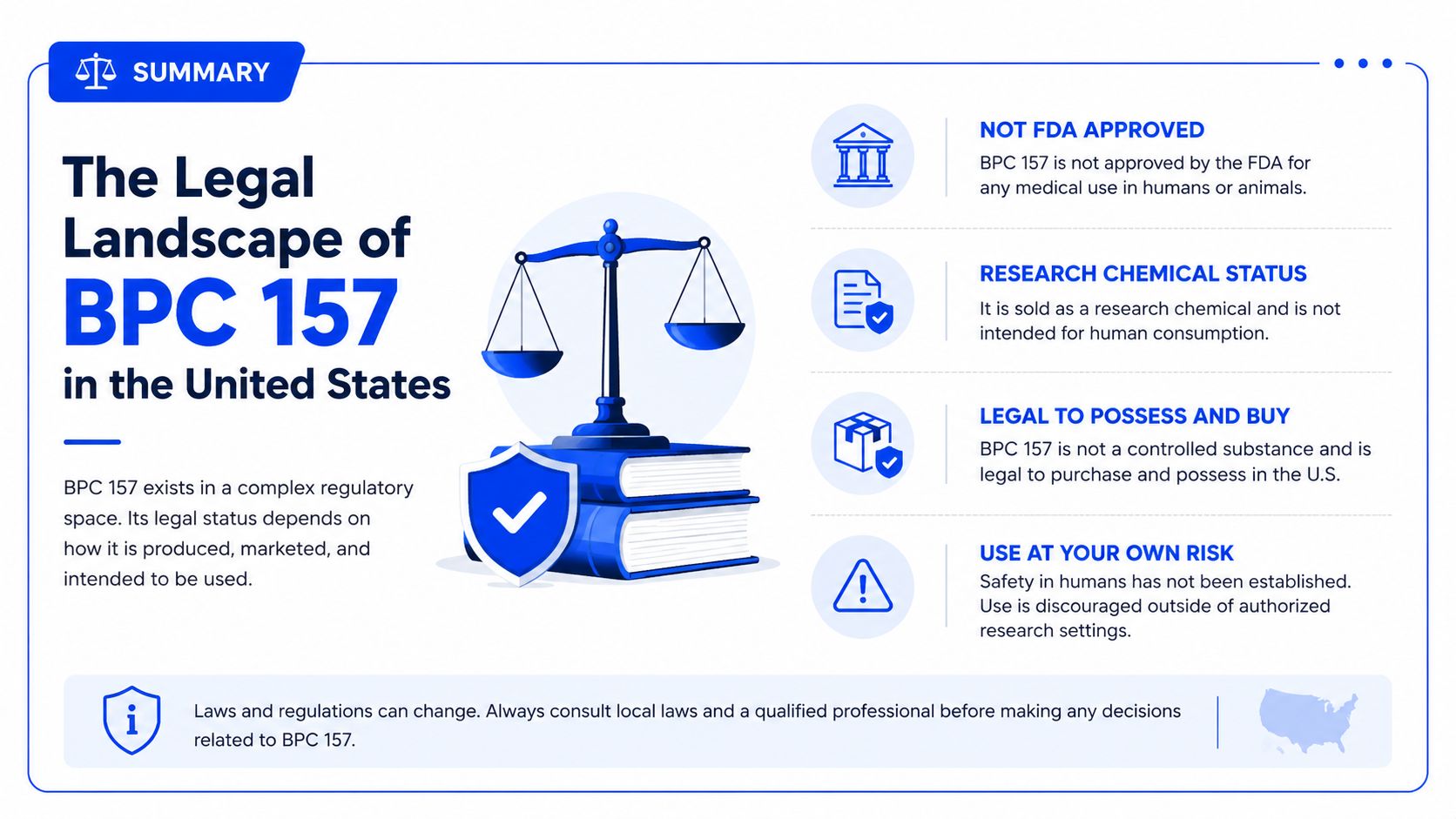
The legal status of BPC-157 is where the “USA-made” story usually falls apart. Domestic manufacture does not convert an unapproved compound into an approved one. It also doesn't let sellers market the product for treatment, cure, or prevention of disease.
The clearest regulatory point is this: the FDA explicitly classified BPC-157 as a Category 2 bulk drug substance in September 2023, which prohibited its use in compounding by licensed 503A pharmacies because of “potential significant safety risks”, according to the cited regulatory summary. The same source states that no licensed compounding pharmacy in the United States could legally manufacture or dispense it to patients under that framework, and although an April 2026 Federal Register notice removed it from Category 2, the compound remained non-approved and still sat in regulatory limbo.
That single fact answers one of the most common buyer questions. If a product page suggests that “made in America” somehow means “pharmacy legal” or “FDA compliant for human use,” that claim doesn't hold up.
The legal caution lines up with the evidence gap. As of March 2026, BPC-157 had been examined in over 210 animal studies spanning 30 years, yet there were only 3 tiny human pilot studies with fewer than 30 total subjects, with zero randomized controlled trials or placebo-controlled efficacy trials published as of May 2026, according to the reviewed evidence summary. That source also notes the sole published human efficacy signal came from a small cohort study in which 10 of 12 patients reported complete symptom resolution and 2 reported 80% reduction, but the design lacked a comparator and used phone-survey methodology, which makes the findings insufficient for broad conclusions.
Bottom line: extensive animal literature does not erase the lack of meaningful human validation.
This shortage of human evidence helps explain why regulators and compliance teams remain conservative. It also explains why anti-doping bodies don't give the compound the benefit of the doubt. The same regulatory summary notes that WADA prohibits BPC-157 at all times for athletic use, and USADA emphasizes its unapproved status and speculative benefits.
For research buyers, that creates a simple legal filter:
A compliant supplier should sound restrained. If the copy reads like a clinic brochure, procurement should stop there.
The first thing I check is whether the supplier behaves like a documentation company that happens to sell peptides, or a marketing company that happens to mention testing. That difference shows up fast.
Research-grade BPC-157 should be labeled under research chemical protocols with the statement “For research use only, not for human or veterinary use,” and it is not approved by the FDA, EMA, or Health Canada for human pharmaceutical use, according to this product compliance reference. If that language is missing, softened, or buried, the supplier is already creating avoidable risk.
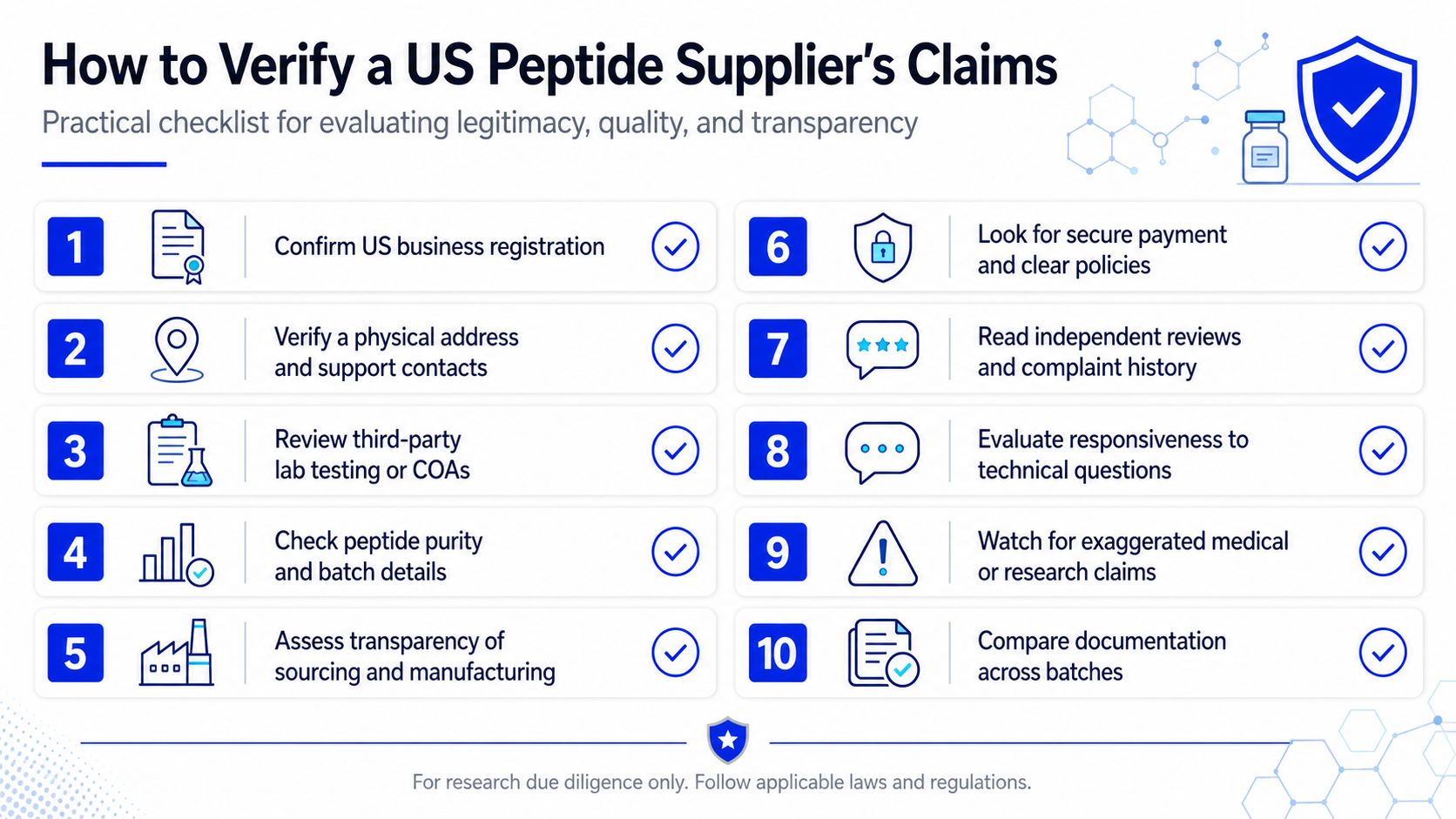
Use this practical sequence when vetting a seller:
The infographic below is a useful mental model for due diligence.
A short video walkthrough can also help buyers think more critically about supplier claims and review habits before placing an order.
Some warning signs are subtle. Others are blatant. Both matter.
“If the paperwork looks generic, assume the quality controls are generic too.”
Watch for these red flags:
What works is boring. Clear labels, current reports, consistent lot tracking, and restrained claims. That's what a dependable research supplier looks like.
A U.S. supplier usually has one major advantage. You can audit the story more easily. That doesn't guarantee quality, but it lowers the effort required to verify it.
In practical procurement terms, domestic suppliers often make it easier to get lot documents, speak to a real support team, and resolve shipping or packaging issues quickly. For small labs and independent researchers, that alone can justify paying more if repeatability matters.
Country of origin does not change the compound's regulatory status. BPC-157 holds no FDA approval for any human or veterinary indication and is legally classified only as a research chemical that cannot be marketed to treat, cure, or prevent diseases, regardless of country of origin, according to this legal status reference.
That means an international source and a domestic source share the same core limitation on human-use claims. The difference is usually operational, not legal.
| Factor | Verified US Supplier | Anonymous International Supplier |
|---|---|---|
| Traceability | Usually easier to verify company identity, batch records, and support history | Often harder to verify the actual manufacturer or chain of custody |
| Documentation access | More likely to provide readable, batch-linked reports on request | Reports may be incomplete, generic, delayed, or difficult to validate |
| Communication | Faster support, easier time-zone alignment, clearer follow-up | Slower responses and less accountability if something arrives wrong |
| Shipping reliability | Typically simpler domestic fulfillment and returns handling | More customs uncertainty and longer problem-resolution cycles |
| Quality confidence | Better if claims are backed by current COAs, HPLC, and identity testing | Highly variable, especially when the seller is a reseller rather than a producer |
| Price | Often higher because buyers pay for process visibility and service | Often lower upfront, though hidden risk is higher |
| Legal status | Research-only status still applies | Research-only limitations still apply |
Buyer's rule: Pay for verified process control, not for patriotic branding.
The best domestic suppliers win on visibility. The worst domestic suppliers just wrap the same uncertainty in cleaner packaging. That's why document review matters more than geography alone.
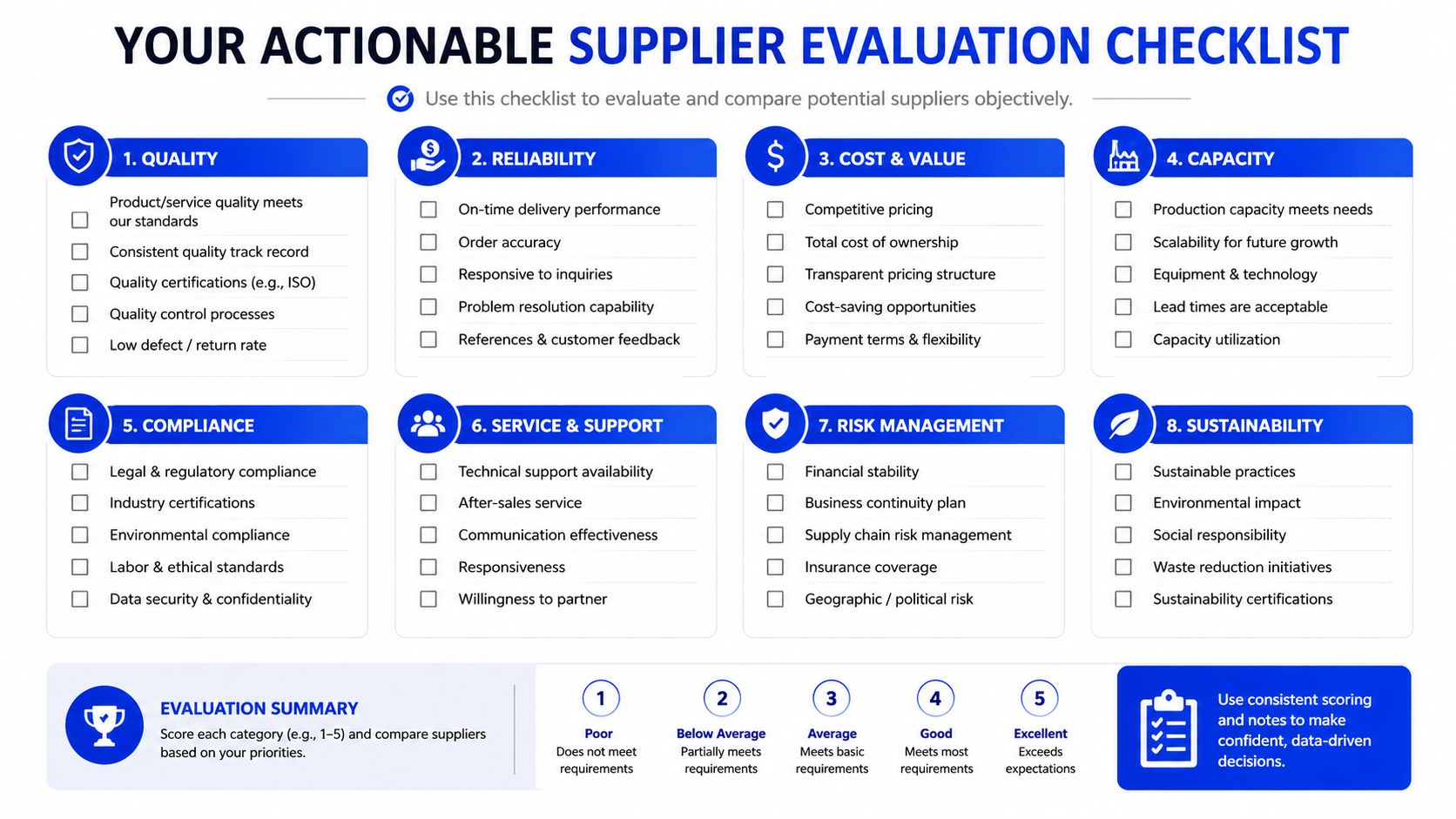
A good checklist should be simple enough to use during a live purchasing decision. If a seller can't pass these screens, move on.
Ask these questions first:
If those basics fail, there's no reason to evaluate purity claims any further.
Now get specific:
At this stage, many suppliers drop out. They may have a nice site, but the records don't stay connected from webpage to shipment.
The final screen is operational:
One useful habit is to score suppliers as yes, no, or unclear on each item. “Unclear” should count against the seller. In peptide procurement, ambiguity usually means more work later.
For labs comparing multiple options, this process often reveals the best vendor before price even enters the picture. The strongest suppliers tend to be the ones with the least theatrical marketing. They show the batch, show the paperwork, answer the question, and stay inside compliance boundaries.
If you're evaluating a source for BPC 157 peptide made in USA, that's the standard worth using. Not hype. Not country-of-origin shorthand. Verified process, clear documentation, and honest legal framing.
If you want a U.S.-based source built around batch transparency, third-party documentation, and research-use-only compliance, learn more at Peptide Warehouse USA. You can explore options for high-purity research peptides, review available support resources, and evaluate whether their documentation standards fit your lab's procurement process.