No products in the cart.



Why does the CJC 1295 Ipamorelin blend keep showing up in peptide discussions as if its benefits are already settled science when the actual evidence base is much narrower than the marketing suggests?
That gap matters. Researchers and informed buyers often see two true statements blended into one misleading conclusion: each compound has a plausible growth hormone related mechanism, and each has at least some separate human data. But that still doesn't equal direct proof for the blend itself. If you're trying to understand where the science ends and the hype begins, that's the question worth asking first.
A careful review shows that many claims around this stack rely on inference rather than direct validation. Some people exploring ways to optimize your hormones encounter peptide discussions early, but the responsible approach is to separate regulated medical care from research compounds that remain outside approved therapeutic use.
Interest in the CJC 1295 Ipamorelin blend comes from a simple idea. If two peptides influence growth hormone signaling through different routes, combining them might produce a broader or more useful response than either one alone. That idea is scientifically interesting. It is not the same thing as clinical proof.
One of the biggest points of confusion is the way commercial content presents the blend. Some guides describe the CJC-1295 and Ipamorelin combination as clinically established, but that claim isn't supported by controlled human pharmacology studies for the specific blend, as discussed in this review of the evidence gap around CJC-1295 and Ipamorelin.
That distinction changes how an informed reader should evaluate claims about muscle growth, fat loss, recovery, or anti-aging. A mechanism can be plausible. A hormone signal can shift in the expected direction. Yet the downstream outcome people care about may still be uncertain if the combination itself hasn't been tested directly.
Core principle: Mechanistic plausibility tells you why a compound might work. Clinical proof tells you whether it actually does what people claim in real subjects under controlled conditions.
The blend also sits in a research-only context. Neither peptide is approved for routine therapeutic use in humans, so any serious discussion has to start with regulatory reality, not just receptor diagrams or anecdotal enthusiasm.
For a lab technician, that means treating this peptide stack the same way you'd treat any novel investigational material. Start with identity, mechanism, formulation, and quality controls. Only then move to hypotheses about endpoints such as GH pulsatility, IGF-1 response, tissue signaling, or metabolic markers.
A few misunderstandings come up repeatedly:
The benefits of peptides can only be discussed responsibly when the underlying evidence level is clear. For this blend, the key takeaway is simple: the mechanism is compelling, the market narrative is loud, and the direct human evidence for the combination remains missing.
The easiest way to understand the blend is to separate the two components first. They are often sold together, discussed together, and sometimes even assumed to be interchangeable with one another. They aren't.

CJC-1295 is generally understood as a growth hormone-releasing hormone analog. In plain terms, it is designed to interact with the signaling system that encourages the pituitary to release growth hormone.
In peptide discussions, readers will often see references to DAC and No DAC forms. That's where confusion starts. The DAC version has published human trial data. The No DAC form, often discussed in premixed blend products, is much less clearly characterized in peer-reviewed human literature.
For a non-specialist, the practical point is this: when someone says “CJC-1295,” they may be talking about related but not identical formulations. Those differences matter because pharmacokinetics, duration of action, and safety interpretation can shift with formulation.
Ipamorelin belongs to the growth hormone secretagogue category and is commonly described as a ghrelin receptor agonist. Rather than acting like the GHRH side of the system, it interacts with a different receptor pathway that can also support growth hormone release.
That receptor distinction is why the peptide is attractive in stack discussions. Researchers aren't looking at two copies of the same signal. They're looking at two separate signaling inputs that converge on a similar endocrine output.
A simple way to think about the split is:
| Peptide | Main class | Primary pathway focus |
|---|---|---|
| CJC-1295 | GHRH analog | Pituitary GHRH receptor signaling |
| Ipamorelin | GH secretagogue | Ghrelin receptor related signaling |
These peptides are studied together because they don't approach growth hormone regulation from the same starting point.
That doesn't prove the blend produces superior real-world outcomes. It does explain why the combination keeps attracting attention in research settings and product catalogs. The appeal comes from pathway complementarity, not from a strong body of direct blend trials.
The central scientific argument for the blend is dual-pathway signaling. Instead of asking one receptor system to do all the work, the combination aims to engage two different upstream routes that influence growth hormone output.
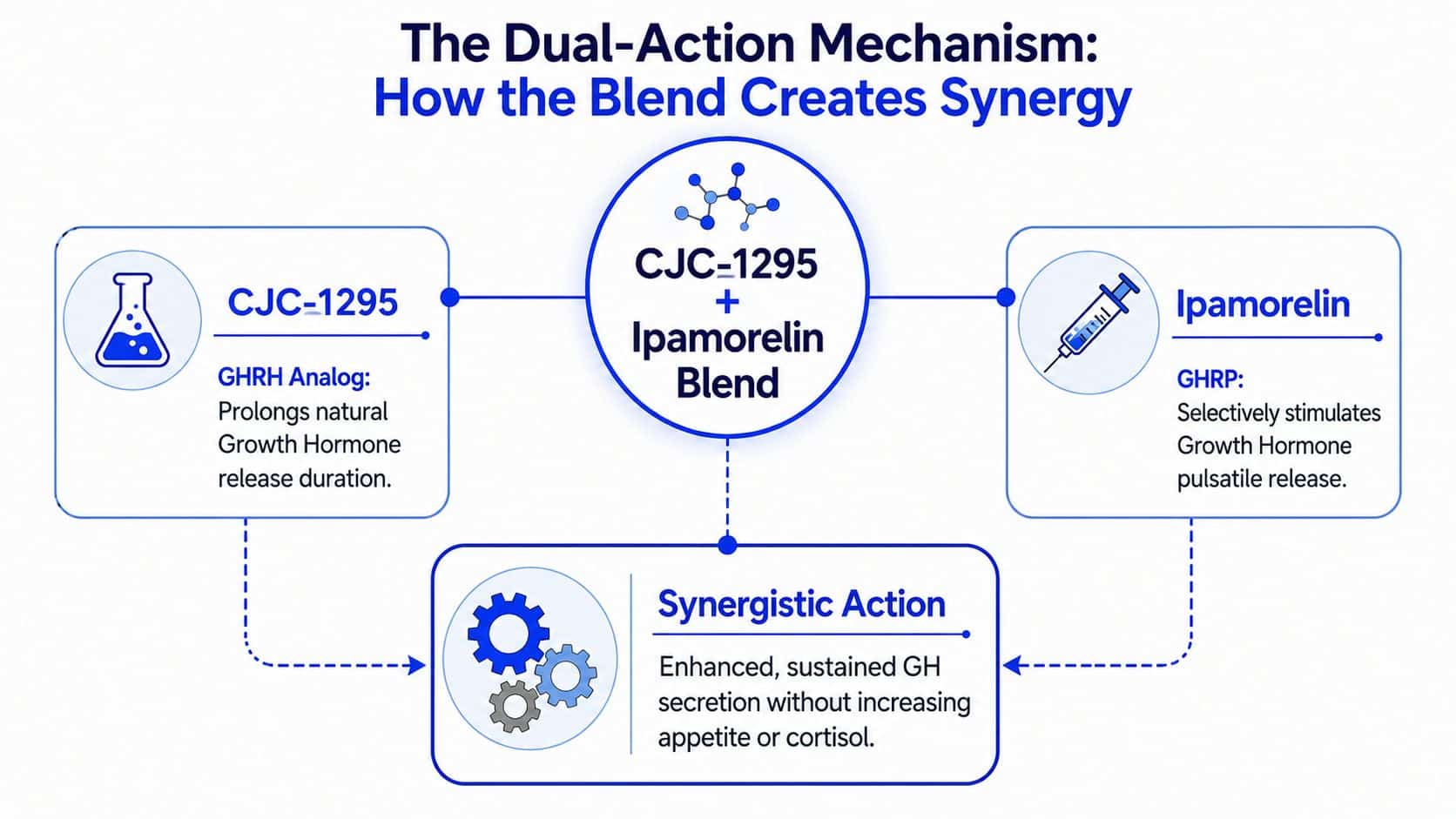
A useful analogy is two keys opening two different locks on the same secure system. CJC-1295 targets the pituitary GHRH receptor pathway, while Ipamorelin acts through a ghrelin-mimetic route. Both pathways can influence growth hormone release, but they do it through different receptor inputs.
According to the mechanistic description provided in this overview of the CJC-1295 and Ipamorelin dual-pathway interaction, CJC-1295 (Modified GRF 1-29) activates pituitary GHRH receptors through the cAMP/PKA intracellular signaling pathway, while Ipamorelin acts as a ghrelin-mimetic agonist to increase basal expression of growth hormone. That complementarity is what people mean when they describe the blend as synergistic.
The phrase “maintaining the hormone's natural expression cycle” also appears in that mechanistic framing. That's important because many buyers assume synergy means forcing more hormone release. The actual idea is more nuanced. The blend is discussed as a way to support growth hormone signaling without completely overriding normal pulsatile behavior.
“Synergy” gets overused in peptide marketing, but the underlying concept here is straightforward. If one peptide increases signaling through the GHRH receptor axis and the other stimulates a ghrelin-related pathway, the combined output may exceed what you would expect from either pathway alone.
That is still a mechanistic hypothesis, not a validated clinical endpoint.
Researchers are interested in several possible consequences of this dual-action setup:
A receptor-level rationale can be strong even when outcome-level evidence is still thin.
Many articles often overstep. They move from “the pathways complement each other” to “the blend builds lean mass, strips fat, and improves recovery.” That leap isn't justified by mechanism alone.
For a technician or early-stage researcher, the right question isn't “Does this stack work?” The better question is “Which biological outputs are directly supported by evidence, and which claims are just extrapolations?” With the CJC-1295 and Ipamorelin blend, the mechanistic case is clear enough to study. The performance and anti-aging claims are far less settled.
This is the section where market language usually falls apart. The blend is commonly described as proven, established, or clinically backed. Those labels don't match the published record.
As summarized in this review of the current clinical evidence status for CJC-1295 and Ipamorelin together, there are no published peer-reviewed clinical trials specifically studying the CJC-1295 and Ipamorelin combination administered together as of searches through June 2026. The same source notes that Phase I and Phase II human trials exist for the compounds individually, but zero rigorous studies have evaluated the combined stack, and the FDA has not approved either CJC-1295 or Ipamorelin for any human indication.
That single point should reset expectations. If someone claims the blend is clinically proven for physique change, recovery, or anti-aging in humans, they are going beyond the evidence.
A careful reader can still make limited, reasonable inferences.
First, the separate mechanisms suggest that a combined endocrine signal is plausible. Second, individual compound data support the idea that growth hormone related activity can be influenced by these peptides when studied separately. But that still leaves several unanswered questions:
Here's the practical interpretation:
| Claim type | Evidence status |
|---|---|
| Dual-pathway mechanism | Supported mechanistically |
| GH-related signaling interest | Reasonably inferred |
| Human outcome claims for the blend | Unproven |
| FDA-approved therapeutic use | Not established |
The strongest honest statement is that the blend is scientifically interesting, not clinically confirmed.
That may sound less exciting than the usual sales copy, but it's far more useful. Good research starts by identifying unknowns clearly. In this case, the largest unknown isn't whether the receptor theory makes sense. It does. The largest unknown is whether that theory produces reliable, beneficial, and safe real-world outcomes when the two compounds are administered together.
Once you strip away unsupported claims, the blend still has real value as a research tool. Its relevance comes from how it can help investigators probe the GH and IGF-1 axis under controlled conditions.

Researchers interested in peptide benefits often focus on therapeutic narratives first. A better starting point is the experimental endpoint.
The blend may be useful in models involving:
These are research applications, not validated treatment indications. That distinction keeps study design honest.
Protocol discussions around this blend frequently appear online in prescriptive language. In a compliant lab context, those same details should be treated as experimental variables.
A commonly cited protocol summary in this overview of CJC-1295 and Ipamorelin timing and cycling conventions notes five doses per week, usually at night, ideally 2+ hours after the last meal, with a four month cycle structured as three months on, one month off. In a research framework, those details are not instructions for use. They are examples of timing and exposure patterns that may affect observed GH-related responses and desensitization questions.
A short practical framework helps:
A visual walkthrough can help if you're comparing common research discussions with actual study planning:
The big mistake is treating informal protocol patterns as if they were outcome proof. They aren't. They reflect how researchers and market participants think about aligning peptide exposure with endocrine timing.
Scientific interest doesn't remove the need for basic discipline. In peptide work, research quality depends on handling, storage, documentation, and an honest view of regulatory status.
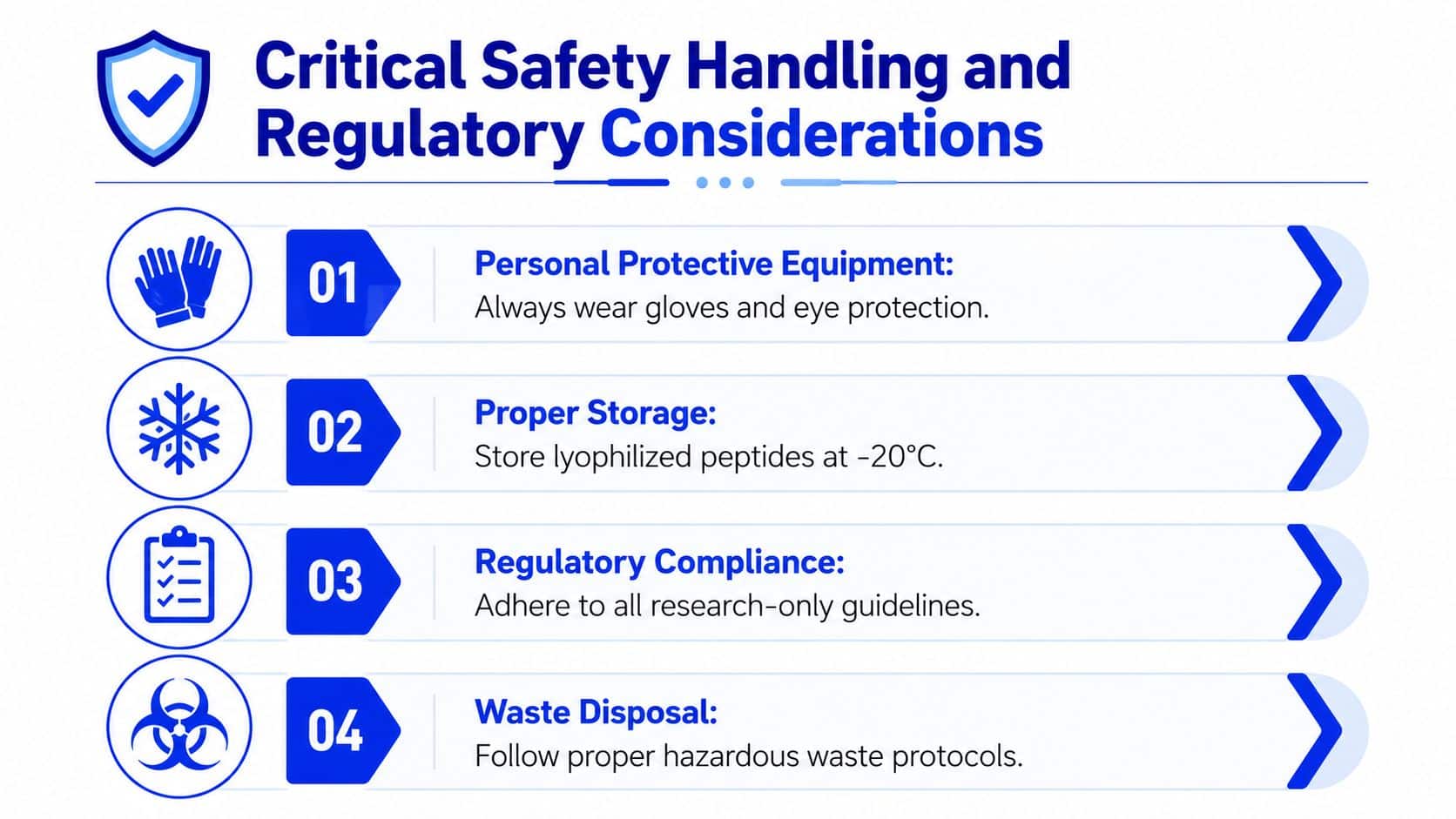
Lyophilized peptides are sensitive materials. Labs should handle them with the same procedural care used for other analytical or preclinical compounds. That means controlled storage, careful reconstitution practices, contamination awareness, and lot-level traceability.
A Certificate of Analysis (COA) matters because it anchors the identity and purity question. Without that document, reproducibility suffers quickly. If one lot differs materially from another, your assay variability may reflect procurement problems rather than biology.
A practical quality checklist looks like this:
Research integrity rule: If the material isn't well documented, the data it generates won't be either.
Regulatory status is not a minor footnote here. It directly shapes how these compounds should be discussed and used.
According to this review covering CJC-1295 regulatory concerns and evidence gaps, the No DAC form remains “uncharacterised” in peer-reviewed human studies. The same source notes that FDA advisory documents from December 2024 reported nonclinical findings of pituitary DNA damage and necrosis for CJC-1295, and that the FDA placed it on the Bulk Drug Substances List (Category 2) due to tachycardia and vasodilatatory reactions.
That doesn't tell you every real-world risk profile detail. It does tell you caution is warranted.
Separate human data on the DAC form of CJC-1295, reported in the published clinical trial record for CJC-1295, showed that a single injection produced 2- to 10-fold increases in mean plasma GH for 6 days or more and 1.5- to 3-fold increases in mean plasma IGF-I for 9–11 days. The estimated half-life was 5.8–8.1 days, and at 30 or 60 microg/kg no serious adverse reactions were reported in that short-term setting. Reported adverse effects included injection site reactions, transient flushing, mild peripheral edema, and occasional headache. That same body of evidence does not resolve long-term safety questions, especially around sustained IGF-1 elevation.
Those details reinforce an uncomfortable but important conclusion. The blend is often discussed casually, while the regulatory and safety context is anything but casual.
The CJC 1295 Ipamorelin blend is compelling for one reason above all others. It combines two distinct signaling concepts into a single research question. One peptide engages the GHRH side. The other engages a ghrelin-related pathway. That makes the blend mechanistically interesting and worth studying carefully.
What it does not do is bypass the need for evidence. The direct human clinical literature for the combination is still absent, and that means many common claims remain unverified. For informed readers, that isn't a reason to dismiss the blend outright. It's a reason to approach it with tighter standards.
A responsible approach rests on a few principles:
Peptide research moves forward when people stop filling evidence gaps with confident marketing language. Better sourcing, cleaner study design, and more disciplined interpretation will do more for this field than hype ever will. If you're comparing compounds, reviewing peptide stacks, or assessing the benefits of peptides in a lab setting, the most useful next step is to learn more, explore options carefully, and stay anchored to what the data supports.
For researchers who need documented, research-use-only materials, Peptide Warehouse USA offers a catalog of high-purity compounds supported by third-party documentation, including COAs and related batch testing records. If you're sourcing for laboratory, analytical, or preclinical work, explore options through a supplier that emphasizes traceability, clear labeling, and responsible research standards.