No products in the cart.


Are you looking at a peptide because the science is strong, or because the label sounds persuasive?
That question sits at the center of the phrase Mindful Research Peptides. Many readers encounter it in product listings or vendor copy and assume it refers to a real scientific category. It doesn't. In the lab, the meaningful distinction isn't between “mindful” and “non-mindful” peptides. It's between careful research and careless research.
A good researcher learns to separate language from evidence. In peptide work, that means checking whether a term appears in scientific literature, whether a compound has defensible analytical documentation, and whether the claims attached to it stay within the limits of the data. That's where reliable work begins.
The useful meaning of mindful peptide research has very little to do with a special class of compounds. It has everything to do with how you work. A mindful researcher documents assumptions, verifies identity, respects safety boundaries, and treats every batch as a potential variable.
That matters because the phrase itself doesn't have a formal scientific basis. The term “mindful research peptides” does not correspond to any recognized category in scientific literature. What the literature does show is something very different. A 2017 review in BMC Complementary Medicine and Therapies examined 13 studies with 1,110 participants and found that mindfulness-based interventions can modulate neuropeptide expression. In other words, the practice influenced biology. The review did not establish a category of administered “mindfulness peptides.”
That distinction clears up a common confusion. If someone reads “mindful peptides” and assumes there are compounds recognized for inducing mindfulness, the evidence doesn't support that interpretation. If someone reads the same phrase and understands it as a call for deliberate, ethical, controlled peptide research, that interpretation is far more useful.
In practice, “mindful” means slowing down where others rush:
Practical rule: If you can't explain where a peptide came from, how it was verified, and how it was handled, you can't defend the result.
New researchers often focus on the compound first. Experienced researchers focus on the system around the compound. That system decides whether your work is reproducible or just plausible.
The confusion usually starts with language that blends wellness vocabulary with preclinical materials. Terms like “focus,” “clarity,” or “mindful support” can sound polished while saying very little about analytical quality. That's why the best starting point isn't the claim. It's the documentation.
For anyone evaluating benefits of peptides in a research setting, this is the baseline. Ask what the peptide is, what evidence supports the intended model, and what quality controls stand behind the vial in your hand.
The phrase Mindful Research Peptides sounds credible because it borrows the tone of both neuroscience and wellness. That's exactly why it deserves scrutiny. In scientific work, familiar-sounding language can create false confidence.

The peptide field is growing quickly, and commercial language often grows with it. According to peptide market and pipeline data summarized by RedPep, the global peptide therapeutics market reached approximately $49.3 billion in 2025 and is projected to grow to $93.5 billion by 2030, with over 140 peptides currently in active clinical trials worldwide. Yet despite that scale, no major regulatory body has approved a peptide for “mindfulness,” and the term appears in non-academic vendor marketing rather than peer-reviewed science.
That tells you something important. A phrase can be commercially useful without being scientifically meaningful. The market may be real. The terminology may still be loose.
Many buyers often get tripped up. They see a modern label attached to compounds such as Selank, Semax, BPC-157, GHK-Cu, PT-141, or TB-500 and assume the category itself has formal standing. It doesn't. Each compound has to be evaluated on its own evidence base, analytical characterization, and appropriate research context.
A polished label is not a mechanism, not a regulatory category, and not a substitute for a defensible protocol.
If we want the phrase to mean something useful, we need to redefine it operationally. In a real lab, mindful research peptides should mean peptides studied under a disciplined framework with four pillars:
| Pillar | What it means in practice |
|---|---|
| Ethical sourcing | You know who supplied the material, how they present it, and whether they respect research-only boundaries. |
| Data integrity | You rely on batch-specific documentation, not vague claims or recycled PDFs. |
| Lab safety | You treat storage, reconstitution, labeling, and PPE as part of the science. |
| Reproducibility | You document enough detail that another researcher could repeat the work faithfully. |
That definition strips away the marketing fog and replaces it with actions you can audit.
A lab director doesn't ask, “Is this a mindful peptide?” The better question is, “Did we source, verify, handle, and document this material in a way that makes the data worth trusting?” That question leads somewhere concrete.
The first uncontrolled variable in peptide research often appears before the experiment begins. It's the supplier. If your source is weak, every downstream step inherits that weakness.
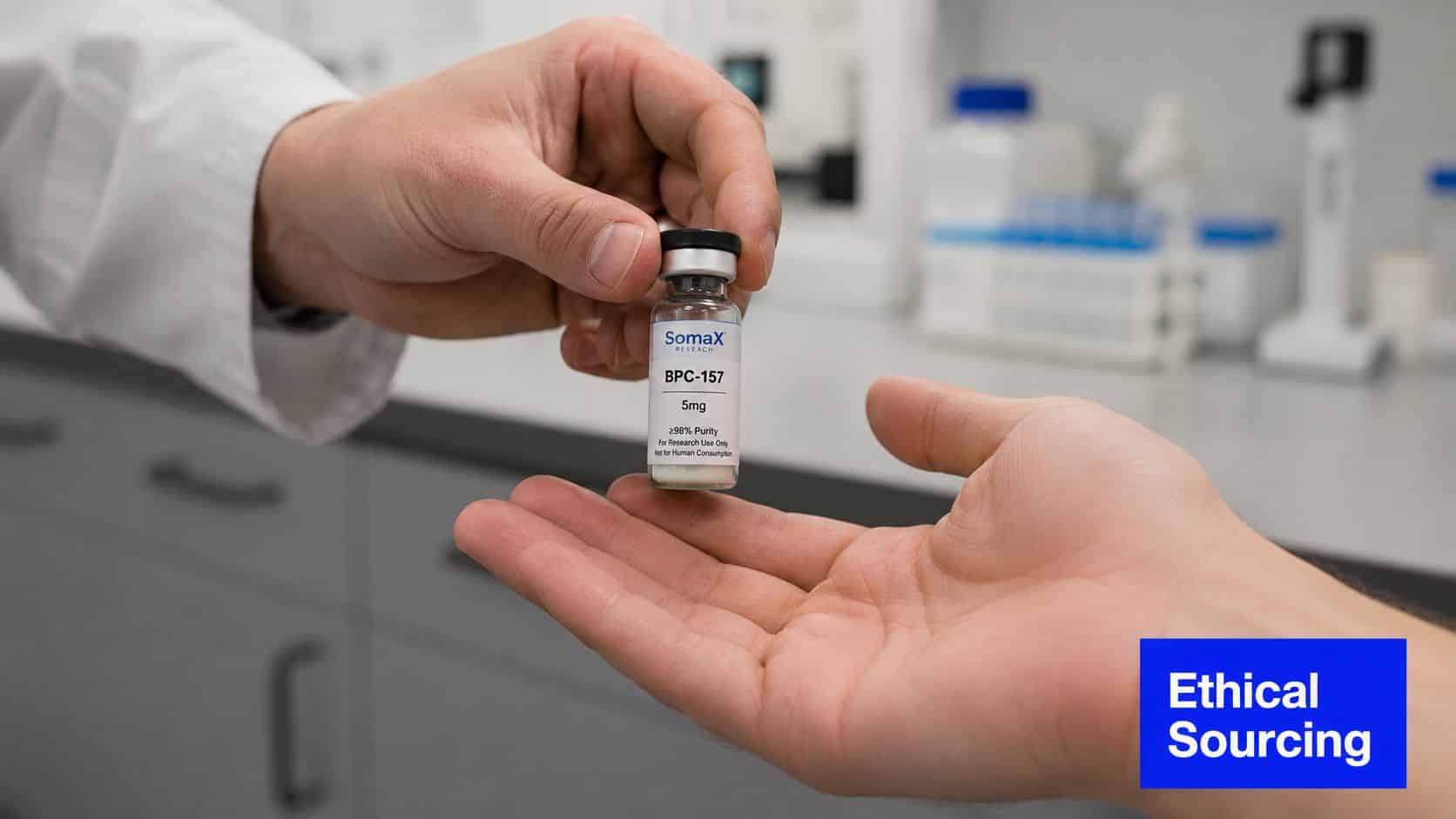
A responsible supplier doesn't hide behind hype. It gives you enough information to evaluate the material as a research input.
Look for signs of operational seriousness:
Many new researchers make the mistake of judging vendors by design quality or aggressive product copy. That's backwards. Start with traceability and compliance. Attractive branding is easy. Reliable procurement is harder.
Use a short due-diligence workflow. It doesn't need to be complicated, but it does need to be consistent.
Read the product page carefully
Check whether the supplier names the peptide clearly, identifies the format, and avoids casual human-use language.
Review documentation expectations
Ask whether the vendor provides batch-specific COAs and supporting analytical records, not just generic examples.
Inspect policy language
Responsible sellers write policies that reinforce legitimate research use. Sloppy policy pages usually signal sloppy controls elsewhere.
Check conduct standards
Broader supplier ethics matter too. If you want a useful reference point for procurement culture, review these Cryonos GmbH insights on supplier code-of-conduct expectations.
Procurement is part of the experiment. A poor buying decision can contaminate a good protocol before the first pipetting step.
For readers who prefer a visual walkthrough before comparing vendors, this overview is useful:
You don't need to interrogate every vendor like an auditor, but you should ask enough to expose weak practices.
Consider questions such as:
Notice what isn't on that list. Price alone. Fast shipping alone. Buzzwords alone.
Those factors may affect convenience, but they don't establish research value. If you're studying compounds used in areas such as healing and repair, muscle growth, antiaging, fat loss, or other preclinical use cases, vendor discipline is still the first filter. The application doesn't lower the quality standard.
A Certificate of Analysis is the document that turns a product claim into something testable. Without it, you're working from trust alone. In serious peptide research, that's not enough.
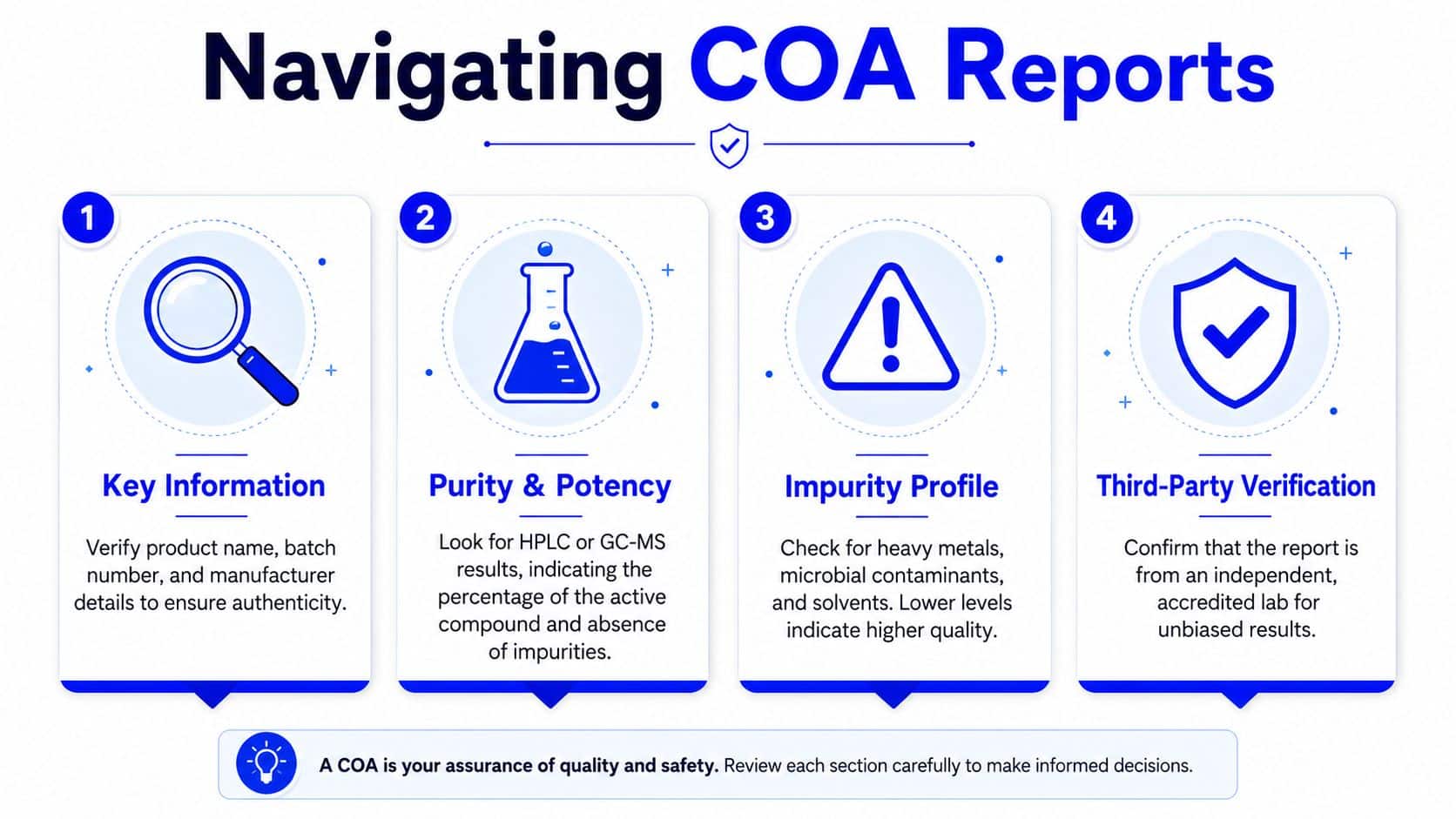
At minimum, a useful COA should help you answer three questions: Is this the correct material? How pure is it? Can I tie this document to the batch I received?
Start with the identifiers. Product name, batch number, and manufacturer or testing lab details must line up with the label and invoice. If the paperwork looks generic, undated, or disconnected from the physical vial, stop there.
Then read the analytical sections. For peptides, the essential pair is:
Those two methods do different jobs. HPLC tells you how much of the UV-absorbing material corresponds to the expected target peak. Mass spectrometry tells you whether the molecular identity matches what you ordered.
The benchmark matters. The research-grade peptide purity guidance summarized here states that the industry-standard benchmark is ≥98% purity as measured by HPLC, while purity below 95% is considered insufficient for reliable research because contaminant levels can alter biological function and confound results.
That's more than a purchasing preference. It's an experimental control issue.
If a peptide comes in below that threshold, several problems appear at once:
| COA element | Why it matters |
|---|---|
| Purity value | Lower purity increases uncertainty about what is driving the observed effect. |
| Peak profile | Unexpected peaks may indicate related impurities, truncations, or synthesis byproducts. |
| Identity confirmation | A correct mass helps verify that the intended peptide sequence is present. |
A new researcher might say, “If it's close enough, I'll still get a signal.” Sometimes that's true. The problem is attribution. You may get a signal from the target peptide, from impurities, or from a mixture. Once that ambiguity enters the experiment, interpretation gets weak fast.
Bench advice: A result is only as clean as the material and records behind it.
First-party testing isn't useless. A manufacturer should know its own material. But independent verification carries more weight because it reduces the chance that the seller is grading its own homework.
That principle sits inside a broader culture of record quality. If you're building better habits around documentation, audit trails, and report review, this guide to laboratory data integrity is a practical companion read.
When comparing vendors or peptide stacks for research planning, ask for batch-linked evidence. Not just “we test everything,” but actual reports tied to what ships. That habit protects more than procurement. It protects your notebook, your conclusions, and the credibility of anyone who has to build on your data later.
A well-characterized peptide can still produce bad data if you handle it poorly. Storage, reconstitution, and labeling are not clerical chores. They are part of the experiment.
The first task is simple. Inspect the shipment and compare the vial, label, and paperwork before anything enters your workflow. If a vial arrives without clear identification, unclear storage instructions, or visible packaging issues, quarantine it until the discrepancy is resolved.
Then decide how the material will be stored in your lab system. Lyophilized powder and reconstituted solutions don't behave the same way. What matters most is consistency. Use controlled storage, minimize unnecessary exposure to heat and light, and document when the material was opened and by whom.
For characterization, the analytical baseline remains clear. The EMA draft guideline on synthetic peptides notes that thorough characterization requires HPLC for purity and mass spectrometry for identity, and it describes how higher-order structure may require additional techniques depending on the peptide and application.
Most handling errors show up during reconstitution. A researcher assumes every peptide will dissolve easily, adds the wrong solvent too quickly, and creates a cloudy mixture or precipitation event that changes the working concentration.
The same EMA guidance describes a practical escalation pathway for insoluble peptides. Start with acidified water, then move gradually toward stronger solvents if needed.
Use a controlled sequence such as:
A common point of confusion arises: a peptide can look dissolved in the stock vial and still precipitate after dilution into the final buffer. That isn't a minor inconvenience. It changes exposure conditions and undermines reproducibility.
If a peptide precipitates after dilution, your nominal concentration and your effective concentration may no longer match.
Lab safety with peptides isn't dramatic. It's disciplined. Wear appropriate PPE. Label everything. Separate research materials from anything that could be mistaken for personal-use products. Maintain the “for research use only” boundary without exception.
That boundary matters even more when compounds are discussed online in contexts like focus, recovery, body composition, or appearance. Research chemicals are not consumer wellness products. A legitimate lab treats them as controlled experimental materials, not lifestyle accessories.
Good handling also means good records:
You don't need a giant compliance apparatus to do this well. You need a repeatable habit. That's what keeps small errors from becoming unusable data.
A checklist won't replace judgment, but it will catch preventable mistakes. That's why strong labs use them. They remove guesswork from routine decisions and free your attention for the actual science.
This discipline also helps keep claims in proportion to evidence. Harvard Medical School notes that health claims for peptides sold online are often “divorced from data” because they haven't been vetted by the FDA, and substantial evidence of benefits in humans is largely absent despite promising test tube and animal findings. For researchers, that means procurement and handling standards matter even more. You can't lean on marketing to fill evidence gaps.
| Phase | Check Point | Verification Action |
|---|---|---|
| Procurement | Supplier states research-only use | Read policy and product language before purchase |
| Procurement | Product identity is clearly named | Match product title, label, and invoice |
| Procurement | Batch-specific COA is available | Confirm the report corresponds to the shipped lot |
| Procurement | Analytical methods are disclosed | Look for HPLC purity data and MS identity confirmation |
| Procurement | Support is reachable | Ask one technical question before ordering and assess the response |
| Procurement | Shipping and return policies are transparent | Review them before checkout |
| Lab use | Receipt inspection completed | Check vial condition, identifiers, and paperwork on arrival |
| Lab use | Storage conditions logged | Record where and how the vial is stored |
| Lab use | Reconstitution protocol documented | Note solvent, concentration, date, and operator |
| Lab use | Solubility observed | Record whether the solution stayed clear after dilution |
| Lab use | Labeling completed | Include peptide name, concentration, date, and initials |
| Lab use | Notebook entry finalized | Capture deviations, observations, and batch linkage |
Print it. Put it near receiving, not just at the bench. Most procurement errors happen when a lab is busy and someone assumes the paperwork can be reviewed later.
It also helps to pair the checklist with a clean visual SOP library. If your team creates internal diagrams for storage, receiving, or reconstitution workflows, tools that simplify scientific figure creation can help. This overview of Natomy's guide to Biorender alternatives is useful when you're choosing a practical design workflow for lab-facing documents.
A checklist is most effective when it becomes a habit across compounds, not just for one peptide or one project. That's what makes reframing Mindful Research Peptides as a method instead of a product category valuable. The phrase becomes useful only when it points to careful sourcing, credible analytical review, safe handling, and honest interpretation.
If you keep those standards in place, you won't just buy better materials. You'll build research that other people can trust.
If you're looking for a supplier that aligns with those standards, Peptide Warehouse USA is built for research-focused buyers who value batch testing, transparent documentation, and clear research-use boundaries. Learn more, explore options, and review the catalog with the same discipline you'd bring to the bench.