No products in the cart.



Why is a Russian-developed peptide attracting so much attention in modern cognition and neuroprotection research when many Western researchers still treat it as a niche compound?
That question exposes a real gap. A lot of Semax coverage sits at one of two extremes: oversimplified marketing copy or dense academic fragments with little practical help for study design. Researchers usually need something in between. They need a clear explanation of what Semax nasal spray is, how its chemistry shapes its behavior, why intranasal delivery matters, and how to evaluate a product for serious laboratory work.
Semax is best understood as a synthetic peptide nootropic with neuroprotective research interest. It has a long clinical history in Russia, but outside those markets it remains investigational, which makes careful interpretation essential. If you're comparing peptide classes more broadly, it also helps to explore different types of nootropics so Semax is viewed in the right context rather than as a standalone curiosity.
This guide takes a research-first approach. It focuses on mechanism, delivery, published findings, handling, regulatory context, and experimental planning. The emphasis stays on what the literature supports, where the evidence is strong, and where caution is still warranted.
Why does Semax keep appearing in research discussions when many peptide compounds never move beyond speculation?
A research-focused view starts with context. Semax has a documented clinical history in Russia, where it was developed and used as an intranasal prescription product, but that history does not translate into broad regulatory acceptance elsewhere. For a researcher, that split matters. It means Semax sits in an unusual category: more grounded than a purely theoretical peptide, yet still incomplete from the standpoint of global validation and replication.
That middle position is easy to misunderstand. Some readers treat any prior clinical use as proof. Others dismiss the compound because it lacks approval in the United States and much of Europe. Neither approach is careful enough for lab work.
A better starting point is to ask practical questions. What exactly has been studied? In what formulation? Under which regulatory system? And how well do the available documents describe identity, concentration, purity, and intended route of administration?
Several features keep Semax relevant in modern research:
This is also why Semax often appears in discussions that explore different types of nootropics. Its research profile overlaps with that category, but reducing Semax to a generic “nootropic” label misses the details that matter in a lab. The more useful frame is narrower and more technical: Semax is a peptide research compound with a specific delivery tradition, a defined formulation history, and uneven international acceptance.
Research mindset: A research-focused perspective frames Semax as a compound with a real clinical history in one regulatory environment and incomplete validation in another.
That framing helps with study design. If you are evaluating Semax for preclinical or translational work, the first job is not to assume efficacy. The first job is to verify what material you have, how the nasal preparation was made, whether the vendor documentation is adequate, and which claims are supported by published research.
In that sense, Semax is less like a broad wellness ingredient and more like a lab tool that requires careful setup. The peptide itself matters, but so do the concentration, vehicle, storage conditions, and dosing method. Researchers who ignore those details can end up comparing studies that are not comparable.
That is what makes Semax a useful subject for modern research. It connects chemistry, formulation, route of administration, and experimental design in one compound, which is exactly where careful laboratory work can add clarity.
What changes when an ACTH-derived peptide is modified to survive real-world handling and nasal delivery long enough to become a usable research tool?
Semax is a synthetic heptapeptide with the amino acid sequence Met-Glu-His-Phe-Pro-Gly-Pro (MEHFPGP). It is derived from the ACTH(4-10) fragment and includes a C-terminal Pro-Gly-Pro extension, a modification described in the Semax entry describing its peptide structure and modification.
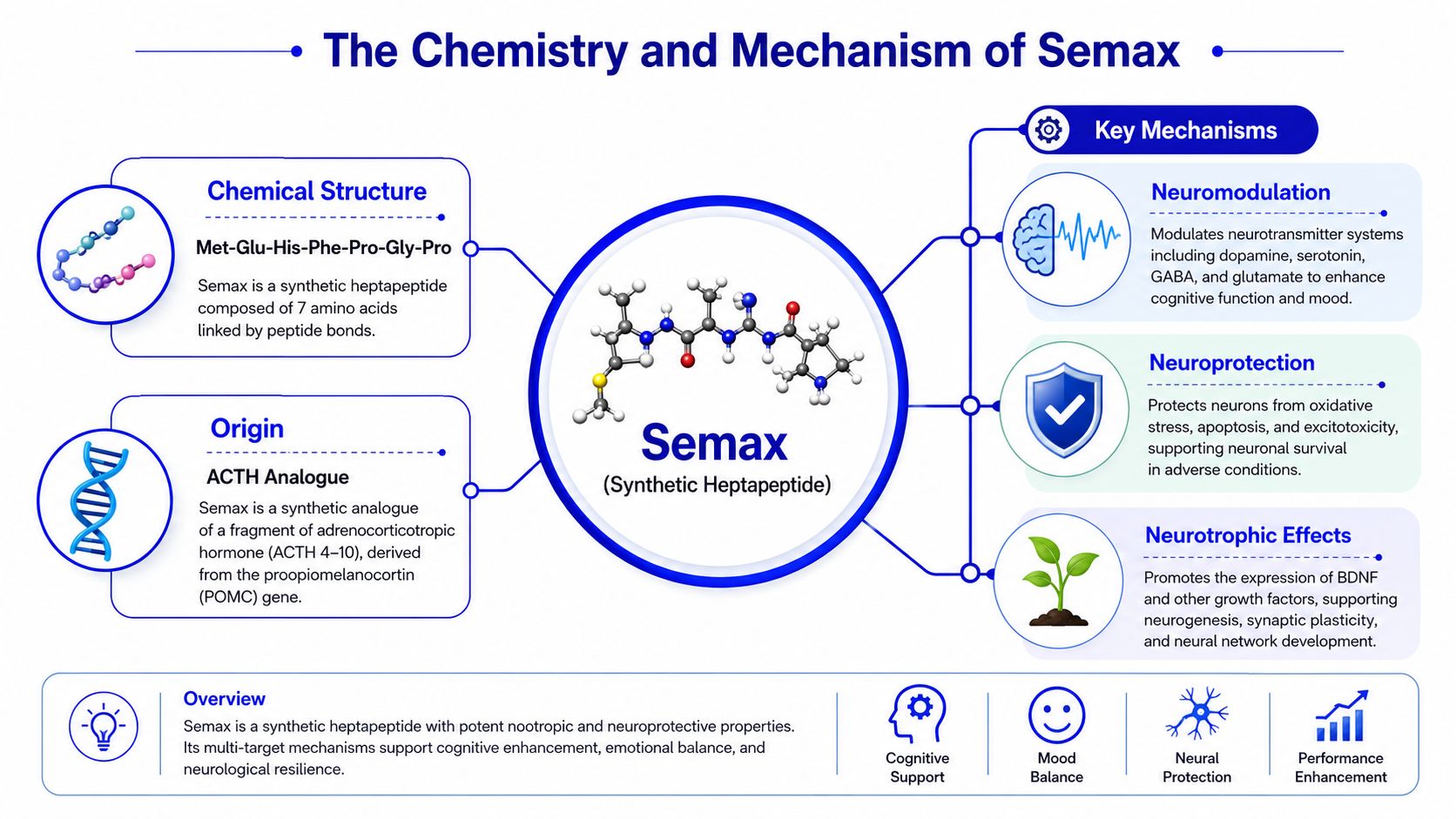
For peptide research, sequence is only the starting point. The more practical question is whether the molecule can remain intact long enough for an experiment to mean anything.
The Pro-Gly-Pro extension matters because short peptides are often vulnerable to enzymatic breakdown. Semax keeps the signaling-relevant ACTH-derived core while adding a structural feature associated with improved resistance to degradation. In lab terms, that changes the compound from an interesting sequence on paper into a more plausible candidate for formulation and repeat-dose study.
A useful comparison is mechanical rather than metaphorical. The parent fragment resembles a prototype component that performs the intended function but fails under stress. Semax represents the same component after reinforcement. The biological target profile may remain related, but the handling characteristics improve, which is exactly the kind of change researchers look for when evaluating whether a peptide can survive preparation, storage, and administration conditions.
That distinction matters for intranasal work. Nasal tissues contain enzymes, mucus dynamics vary, and formulation choices can change how much intact peptide is available for absorption. If a vendor claims Semax activity but provides little detail on concentration, pH, excipients, or stability testing, the chemistry should prompt skepticism before any biological interpretation begins.
Mechanistic discussion around Semax usually centers on neurotrophic signaling, monoaminergic modulation, and broader effects on gene expression. Published and secondary research summaries frequently mention BDNF and NGF, along with possible effects on dopamine- and serotonin-related pathways. Those proposals are best treated as working hypotheses supported to different degrees across preclinical and region-specific literature, not as settled conclusions for all settings.
That framing helps avoid a common mistake. Semax is often described in broad cognitive terms, but broad labels are weak guides for experimental design. A better approach is to define the mechanism at the level of measurable systems: trophic factor expression, stress-response markers, neurotransmitter-associated behavior, or transcriptional changes in selected tissues.
Three research implications follow:
Also consider the indication breadth inside its home market. That history can generate useful hypotheses, but it does not replace direct validation under your own study conditions, material specifications, and analytical methods.
For a lab team, the practical lesson is clear. Semax is interesting because its chemistry appears tuned for survivability and because its proposed mechanisms can be tested with concrete endpoints. That is also why vendor documentation matters so much. Sequence confirmation, purity data, formulation details, and storage guidance determine whether the compound in your vial matches the mechanism you plan to study.
Researchers working with intranasal models should also account for airway status and dosing consistency, since breathing pattern can influence deposition behavior. Background reading on understanding breathing for better health is not a substitute for formulation science, but it helps illustrate why nasal administration is a route with real physical variables, not just a dosing label.
For research purposes, the most defensible working model is narrow and testable: Semax is a stabilized ACTH-derived heptapeptide designed to remain intact longer than the parent fragment, with proposed CNS-relevant effects that should be evaluated through formulation-aware, endpoint-specific experiments.
The delivery route is not an afterthought with Semax. It is one of the main reasons researchers care about the compound in the first place.
Intranasal Semax is described as bypassing the blood-brain barrier by using the olfactory and trigeminal nerve pathways, which supports higher central nervous system bioavailability than systemic circulation alone. A research-focused delivery review also states that this route allows peak brain concentrations within 30 minutes, with detectable levels persisting in hippocampal and cortical tissue for over 24 hours in the referenced work on intranasal delivery mechanics, available in this Semax nasal spray mechanism and delivery overview.
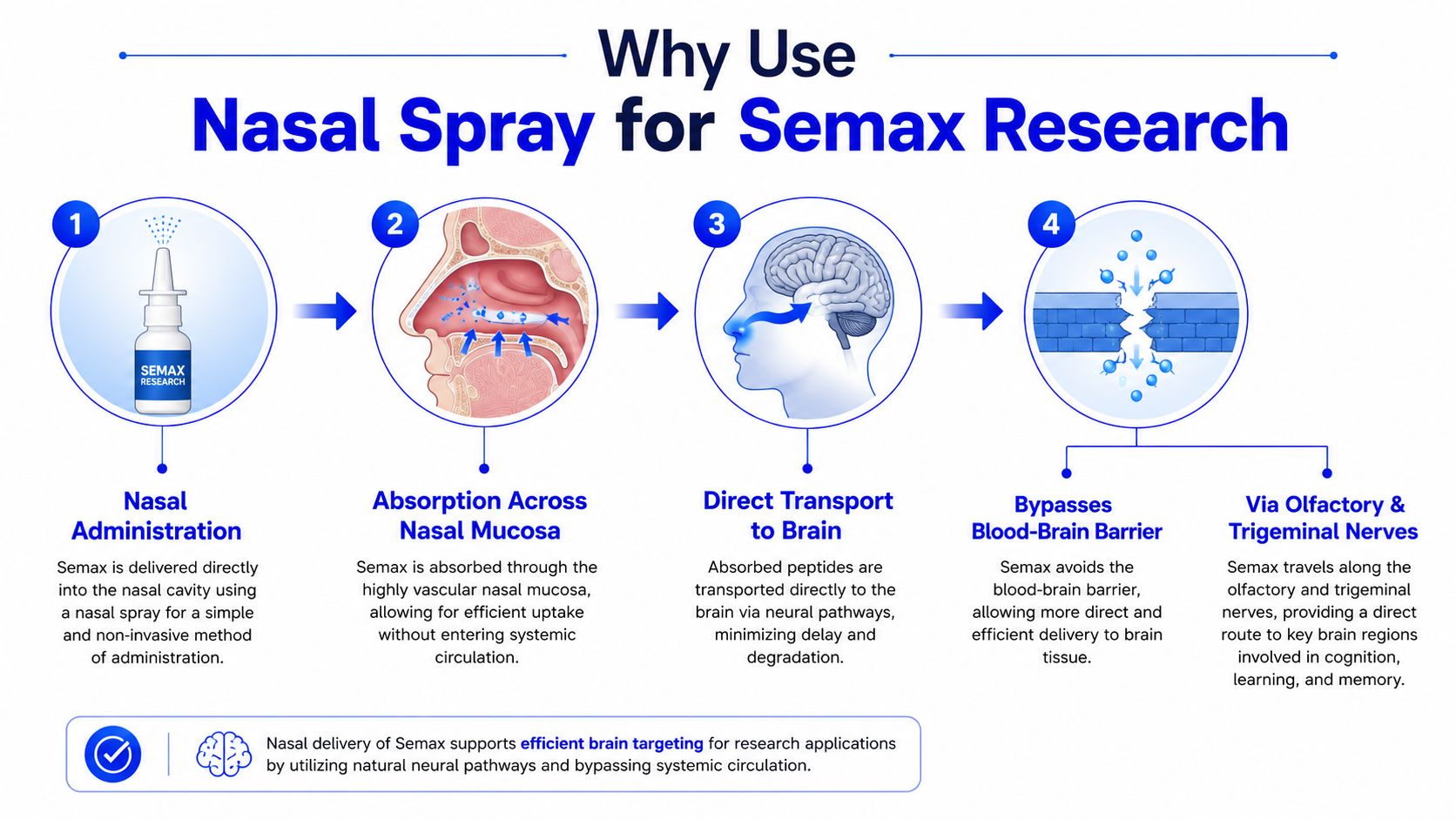
For peptides, the route often decides whether the experiment is meaningful.
Oral administration is a poor fit because peptide compounds generally face digestive breakdown and low oral bioavailability. Semax is routinely discussed as requiring non-oral delivery for that reason. Intranasal delivery changes the problem by offering a local access point with potential transport into the central nervous system.
Many readers often become confused. They assume a nasal spray is a convenient substitute for injection. In Semax research, that's too simplistic. The intranasal route is being used because it may create a more direct path toward brain tissue than a standard systemic route.
A side-by-side view makes the logic clearer.
| Route | Main issue for Semax research | Why researchers often prefer or avoid it |
|---|---|---|
| Oral | Peptide degradation and poor bioavailability | Usually a weak option for CNS-focused peptide studies |
| Systemic injection | Broader circulation and blood-brain barrier limitations | Useful for some designs, but not automatically superior for brain targeting |
| Intranasal spray | Formulation and mucosal delivery variables must be controlled | Attractive for CNS-directed studies because it uses olfactory and trigeminal access pathways |
One nuance deserves attention. A discussion of route efficacy notes that existing content often fails to explain that animal data suggest intranasal delivery can be more potent than injection for cognitive outcomes in some models, and that users frequently misunderstand this point. That specific concern is described in this discussion of Semax bioavailability questions and route comparisons.
Practical rule: If your research question is CNS-target engagement, don't treat “non-invasive” as the main reason to choose nasal spray. Treat pathway access as the main reason.
Formulation quality also matters more than many people assume. Delivery volume, pH, and mucosal contact time can affect intranasal consistency. Even outside Semax-specific work, anyone studying nasal administration benefits from a better grasp of airway mechanics and nasal function. A good general primer is understanding breathing for better health, especially if you're thinking carefully about mucosal exposure and airflow-related variability.
For research purposes, the takeaway is simple. A Semax nasal spray isn't just a packaging choice. It's a delivery strategy tightly connected to the compound's scientific rationale.
What does the Semax literature support once you separate historical use, mechanistic hypotheses, and outcome data?
That question matters because Semax is often discussed in two unhelpful ways. One version treats long clinical use in Russia as if it automatically answers efficacy questions. The other stays so abstract that it never helps a researcher decide what kind of study Semax is suited for. A better approach is to sort the evidence into research domains and ask a practical lab question in each one: what has been observed, what mechanism is proposed, and what still needs replication under tighter modern study design?
One point should stay fixed in the background. Semax has a documented clinical history in Russia, including use in neurologic settings, while in the United States it remains a research compound rather than an approved therapeutic. For a researcher, that means the literature is best read as a source of signals and hypotheses, not as a finished validation package.
The Russian and Eastern European record is useful because it gives Semax more than a purely theoretical profile. Researchers have looked at it in cognitive, neuroprotective, and adaptive-stress contexts, which helps frame experimental questions. It does not remove the usual concerns about sample size, replication, blinding, or cross-system generalizability.
The recurring research themes are fairly consistent:
A useful way to read this pattern is to compare it to a map with different layers. One layer shows where Semax has been used clinically. Another shows which molecular pathways are plausibly involved. A third shows whether a given experiment measured behavior, tissue protection, gene expression, or recovery. Confusion usually starts when those layers are collapsed into a single claim.
A careful reading of the literature supports continued study of Semax as a neuroactive research peptide with multiple testable mechanisms. It does not support treating every reported benefit as equally established.
| Research Area | What research has examined | Why it matters for study design |
|---|---|---|
| Cognitive research | Attention, memory, learning, mental performance, and fatigue-related outcomes | Endpoints must be defined narrowly because “cognitive effect” can mean several different constructs |
| Neuroprotection | Ischemia-related injury, oxidative stress, neuronal survival, and recovery-associated models | Model choice matters because protective effects in injury settings may not predict effects in healthy subjects |
| Stress resilience | Adaptation, emotional regulation, and stress-response patterns | Behavioral assays need careful control because stress outcomes are sensitive to environment and timing |
| Trophic signaling | BDNF, NGF, and related neuroplasticity pathways | Useful for mechanism-focused studies, but biomarker movement alone does not establish functional benefit |
| Intranasal CNS research | Brain-directed delivery hypotheses and central exposure questions | Best suited to experiments that distinguish route effects from peptide effects |
That last row deserves more attention than it usually gets. Many summaries focus on what Semax might do biologically, but for researchers the route of administration is part of the hypothesis. If a study uses intranasal Semax, the design should ask whether any observed effect reflects the peptide itself, the delivery route, the formulation, or the interaction between all three. That lab-centered question is often more informative than broad discussions of “nootropic potential.”
Several evidence-reading habits help keep interpretation disciplined.
First, separate clinical history from current validation standards. Use in one healthcare system can justify interest and guide protocol questions, but it does not replace larger replicated trials under contemporary controls.
Second, separate mechanism from outcome. A study may report changes in neurotrophic signaling or monoaminergic systems, yet functional effects can still vary with species, dose, timing, formulation, and endpoint selection.
Third, define the research question with more precision than the label nootropic allows. In Semax work, that single word may refer to attention, memory consolidation, fatigue resistance, stress adaptation, post-injury recovery, or a mix of these. Good experimental design treats those as separate domains.
For a researcher evaluating Semax, the strongest conclusion is modest and useful. The literature provides enough signal to justify well-controlled modern studies, especially studies that connect formulation, route, mechanism, and endpoint in the same design.
What turns a Semax nasal spray experiment into usable data rather than an expensive pilot with unresolved variables? In many cases, the answer is not the hypothesis alone. It is the quality of the material, the clarity of the vendor documentation, and the discipline of the handling workflow.
A peptide study can fail before the first dose if the lot identity is unclear, the stated concentration does not match the protocol, or the spray vehicle is poorly described. Semax is a good example because intranasal research depends on more than the peptide sequence itself. The formulation acts like part of the delivery system. If that part is vague, the study question becomes vague too.

Earlier sections noted that Semax has an established intranasal research and clinical history. For a laboratory team, that background is useful mainly as a reference point. It tells you that concentration, dosing format, and route are not minor product details. They are part of the experimental system.
Read vendor documents the way you would read a methods section. A label that says only "Semax nasal spray" is not enough for serious work. You need enough information to determine whether the product can answer your specific research question.
Key items to check include:
The practical point is simple. Researchers are not only buying a peptide. They are selecting a defined chemical and physical preparation for a route-sensitive experiment.
Semax nasal spray should be treated as a stability-sensitive research material. Even if the product arrives ready to use, the formulation can still change through poor storage, repeated contamination risk during opening, or inconsistent handling between personnel.
A careful workflow usually includes three layers of control.
Receiving review
Inspect the package on arrival. Confirm container integrity, label readability, lot identifiers, and the presence of supporting documents before the item enters inventory.
Storage control
Follow the supplier's stated storage conditions exactly if they are provided. More generally, peptide formulations are commonly protected from unnecessary heat exposure, prolonged light exposure, and repeated open-close cycles that can introduce variability.
Use documentation
Record the first-open date, handler identity, storage location, and any visible change in clarity, color, or spray behavior. Those observations often explain inconsistent results more effectively than retrospective guesswork.
A Certificate of Analysis only helps if it matches the exact lot in hand and describes the same formulation being used in the study.
One source of confusion deserves attention. A COA can confirm certain analytical properties of a batch, but it does not automatically answer route-specific questions. For intranasal work, researchers still need to know whether the formulation is appropriate for nasal delivery, whether the concentration supports the intended dosing scheme, and whether the container can deliver reproducible volumes.
Poor handling creates a hidden variable. Once a preparation drifts from its documented condition, the experiment is no longer testing a well-defined Semax nasal formulation. It is testing an uncertain mixture with an uncertain dose, and that weakens every downstream interpretation.
Semax has one of those profiles that can mislead people in both directions. Some assume that because it has a long history of use in Russia, the safety question is settled everywhere. Others assume that because it isn't FDA-approved in the United States, the literature has no value. Neither view is careful enough.
Short-term reports described in one summary state that human and animal studies found statistically significant improvements in cognition with high tolerability and no adverse reactions in short-term clinical trials, while reported side effects were described as minimal, mainly mild nasal irritation. The same source notes that Semax is included on the Russian List of Vital & Essential Drugs and remains unapproved by the FDA in the United States, as outlined in this overview of Semax safety and Russian drug status.
The available short-term picture is relatively encouraging, but it has limits.
Researchers can reasonably say the literature often describes Semax as well tolerated in short-duration settings. Researchers should not turn that into a blanket safety claim for all populations, all formulations, or all durations. The evidence base is not broad enough for that kind of confidence.
Regulatory context isn't just legal fine print. It shapes how the compound should be discussed, purchased, labeled, and studied.
For U.S.-based labs, the essential compliance point is straightforward:
That distinction protects study integrity as much as compliance. Once a research compound gets described like an approved consumer therapy, people stop asking the disciplined questions about source quality, endpoint validity, and translational limits.
A useful Semax study starts with a narrow question. “Does it work?” is too broad. “Does intranasal Semax alter BDNF-linked signaling in a defined neuronal model under a fixed exposure condition?” is much better.

Russian clinical protocols provide one practical anchor for dose framing. A research summary notes that intranasal doses typically range from 250 to 1,000 mcg/kg, and that effective therapeutic courses often last 10 days at daily doses of about 6,000 mcg (6 mg) using 0.1% to 1% solution concentrations, according to this Semax peptide research guide on dosing and delivery considerations.
Different models answer different questions.
A common planning mistake is choosing too many endpoints at once. If you measure behavior, inflammatory markers, neurotrophic markers, and transcriptomic shifts in a single small study, interpretation becomes muddy fast.
Researchers usually get better signal by controlling a few key variables tightly:
If you're preparing a manuscript from this kind of work, it helps to think about paper structure early rather than after the data are collected. A useful reference on that process is planning and organizing your research paper, especially if your study includes mechanism plus behavioral endpoints.
Later in the workflow, this video can help researchers think visually about compound context and experimental interpretation.
Semax is best suited to disciplined, question-driven research. The more precisely you define the model, route, formulation, and endpoint, the more useful your results will be.
Researchers seeking a dependable source of research-grade peptides can learn more at Peptide Warehouse USA. Their catalog is built for laboratory, analytical, and preclinical use, with transparent batch documentation that helps teams evaluate identity, purity, and traceability before a study begins. If you're comparing supply options for Semax nasal spray and related compounds, it's worth taking time to explore options carefully and match the documentation to your experimental needs.