No products in the cart.


Clinical evidence has pushed peptides out of the hype category and into the “worth studying carefully” category. In a 2026 systematic review covering 1,341 participants across 19 randomized controlled trials, peptides improved skin hydration and brightness and reduced wrinkle depth, with oral polypeptides driving much of the benefit (Frontiers in Medicine systematic review). That finding matters because it resets expectations. Peptides aren't magic, but they are credible tools with measurable effects when the molecule, formulation, and protocol line up.
For researchers, formulators, and technically curious readers, the key question isn't whether peptides matter. It's which peptides do what, how they signal inside skin, and why some elegant peptide concepts fail once they leave the lab bench and hit a cream jar. The most useful discussion of peptide benefits for skin has to connect biology, formulation, and handling, not just ingredient lists.
Across 19 randomized controlled trials, peptide interventions produced measurable, statistically significant skin changes, but the size of those changes remained modest, as noted earlier. That is a useful starting point for serious skin research because repeatable small effects are often more informative than dramatic marketing claims that fail under controlled testing.
For researchers, the central question is not whether peptides are interesting. It is whether a given peptide can reach the right layer, remain intact long enough to signal, and do so in a formulation that does not hide a good molecule behind poor delivery. In practice, this is the gap that explains much of the confusion around peptide benefits for skin.
A peptide can look promising on paper and underperform in a topical study for the same reason a clear message fails when the signal is weak. The sequence may be appropriate, yet the vehicle, concentration, stability profile, or skin penetration conditions may prevent enough of that message from reaching its target. This is one reason oral polypeptides and topical peptides are often discussed together but should not be judged as interchangeable research formats.
Practical rule: Treat peptides as functional signals that depend on sequence quality, batch purity, formulation design, and assay setup. A high-purity peptide from a batch-tested supplier can still produce weak results if the delivery system is poorly chosen.
A useful guide must connect peptide definition, mechanism, candidate selection, formulation logic, and research-use protocol. That includes sourcing standards, because peptide work becomes hard to interpret when identity, purity, and batch consistency are uncertain. For labs designing exploratory or translational studies, the goal is straightforward. Reduce avoidable noise so any observed skin effect reflects the peptide itself rather than instability, contamination, or formulation failure.
Peptides are short chains of amino acids. In skin research, the simplest way to think about them is as highly specific messages. They're closer to a text message than a construction crew. They don't build skin directly. They tell cells what kind of work to start, slow down, or protect.
That “text message” analogy helps clear up a common confusion. Many readers assume a peptide cream adds collagen to skin the way pouring concrete fills a crack. It doesn't. A peptide typically acts more like a signal that reaches fibroblasts or related pathways and says, “increase repair activity,” “preserve matrix,” or “adjust tension-related signaling.”
Different peptide classes send different kinds of messages:
That classification matters because “peptides” isn't one ingredient category with one outcome. It's a family of molecules with distinct jobs.
Researchers often choose peptides over full-length proteins because peptides are easier to define, compare, and formulate in controlled systems. Sequence matters. Purity matters. Small changes in amino acid order can change receptor interaction, stability, or skin compatibility.
That's also why high-purity research-grade material matters in preclinical work. If you're trying to understand whether a sequence affects barrier function, collagen signaling, or irritation potential, you need confidence that the molecule in the vial matches the intended design.
A clean peptide workflow usually starts with questions like these:
Skin peptide research gets messy when teams skip the identity question and jump straight to marketing language.
A useful way to study peptide action is to trace the chain from sequence to skin response. The visible endpoint might be smoother texture or better firmness, but the underlying biology usually involves fibroblast signaling, extracellular matrix turnover, inflammatory activity, and barrier repair. Peptides act more like short instruction notes than bulk building material. Their job is to trigger, modulate, or dampen specific cellular behaviors.
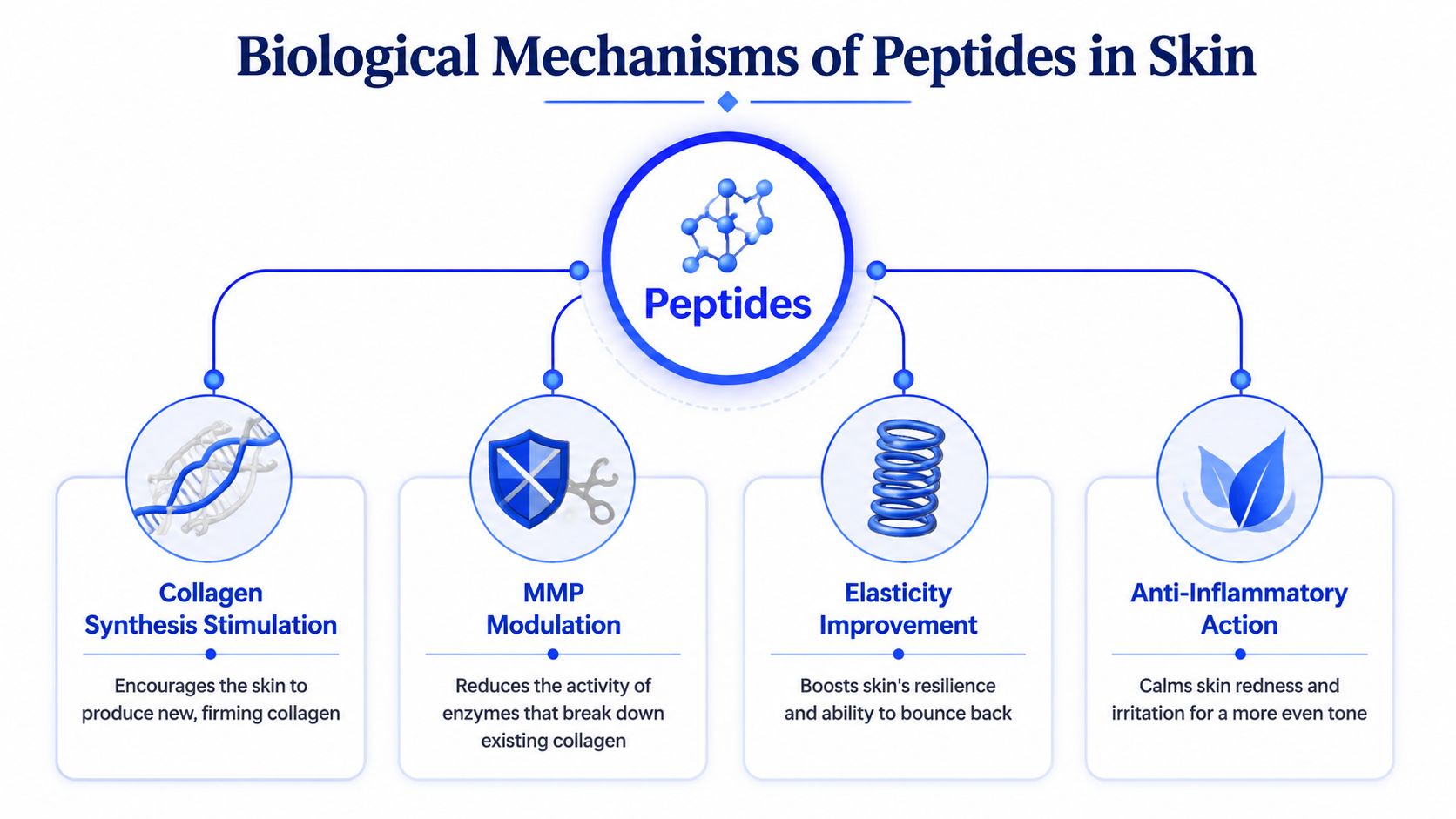
Collagen-related peptide research often starts with fibroblasts because these cells help maintain the dermal matrix. Certain signal peptides appear to act like fragments the skin would normally encounter during repair, which can prompt fibroblasts to shift toward matrix production. That makes them relevant in models focused on fine lines, tensile properties, and dermal support.
A clinical review of cosmetic peptide efficacy found that signal peptides such as Matrixyl 3000 and GHK-Cu showed the strongest evidence for wrinkle depth reduction, while enzyme inhibitor peptides were associated with firmness effects and neurotransmitter inhibitor peptides with elasticity-related outcomes across randomized controlled trials (clinical review of cosmetic peptide efficacy). For lab teams, the practical lesson is simple. A peptide tied to collagen signaling should not be treated as interchangeable with one aimed at muscle-contraction pathways or protease control.
That distinction matters in assay design. If a sequence is meant to influence fibroblast behavior, readouts such as procollagen expression, matrix protein deposition, or fibroblast morphology make more sense than relying only on surface appearance data.
Matrix preservation is a separate mechanism. Skin aging and photoaging involve reduced matrix renewal, but they also involve increased breakdown. Matrix metalloproteinases, or MMPs, function like demolition enzymes in connective tissue remodeling. In a balanced system they help with normal turnover. In stressed tissue, their activity can outpace repair.
Enzyme inhibitor peptides are studied because they may reduce the conditions that favor excess matrix loss. That creates a different research profile from peptides that mainly push synthesis. One protocol asks, “Can this peptide help cells build?” The other asks, “Can this peptide help tissue hold on to what it already has?” Good skin studies often separate those questions instead of blending them into a single anti-aging label.
Elasticity can also confuse new research teams because it is not a single pathway outcome. It reflects matrix organization, hydration, elastin-related changes, cellular tension, and the condition of the barrier. A peptide linked to expression-line softening may improve the appearance of movement-related wrinkles without doing much for dermal remodeling. Another peptide may influence resilience indirectly by reducing stress signaling or supporting recovery after irritation.
That is why irritation and inflammatory tone belong in mechanism work, not just in safety screening.
Skin held in a chronic low-grade inflammatory state behaves like a lab culture under constant noise. Signals become harder to interpret. Repair slows. Barrier measurements drift. For topical peptide research, this is also where the delivery gap becomes impossible to ignore. A strong peptide sequence on paper does little if the formulation leaves most of the material on the surface, degrades it before penetration, or confuses the result through aggressive penetration aids. In practice, sequence selection and delivery system design have to be tested together, especially when teams want clean mechanistic data from topical or ex vivo models.
For readers comparing other biologically active materials used in aesthetic settings, polynucleotides Southsea offers a useful point of contrast with peptide-focused protocols. High-purity peptides from batch-tested suppliers are still the better fit when the goal is controlled mechanism research, because identity, impurity profile, and formulation compatibility directly affect whether the observed skin response can be tied to the peptide itself.
When labs compare skin peptides, they usually aren't choosing the “best” peptide in the abstract. They're choosing the best candidate for a specific endpoint. One peptide may fit wrinkle-focused work. Another may make more sense in wound-repair models or barrier studies.
The table below keeps the comparison grounded in research use rather than hype.
| Peptide | Primary Mechanism | Evidence Strength | Research Use |
|---|---|---|---|
| GHK-Cu | Signal peptide activity associated with collagen-related and repair signaling | Strong clinical interest for wrinkle-focused skin work | Anti-aging models, recovery-focused skin studies, fibroblast signaling |
| Palmitoyl oligopeptides such as Matrixyl 3000 | Signal peptide support for matrix renewal pathways | Strong clinical support among topical cosmetic peptides | Fine line studies, firmness work, formulation comparisons |
| BPC-157 | Commonly studied in repair-oriented experimental settings | More often discussed in healing and repair contexts than classic cosmetic RCTs | Tissue repair models, recovery pathways, barrier stress experiments |
| TB-500 | Commonly investigated in migration and repair-oriented research contexts | Primarily relevant to repair-focused preclinical exploration | Wound-repair models, tissue recovery studies, combination protocols |
GHK-Cu stands out because it sits at the intersection of skin appearance research and repair-focused signaling. In practical lab settings, it often enters screening panels when investigators want to study fibroblast response, collagen-associated signaling, or post-stress recovery in skin models. If the study question is “can this peptide influence visible aging markers through matrix-related pathways,” GHK-Cu is usually on the shortlist.
Palmitoyl oligopeptides, including formulations marketed around Matrixyl-type systems, are especially relevant to topical anti-aging work. They fit well when researchers want to test consumer-relevant vehicles such as serums, emulsions, or gel systems.
One reason they've remained central in formulation work is that some topical peptide systems have produced measurable surface-level improvements. In one clinical report, specific topical peptide formulations increased elasticity by 11.8%, brightness by 110%, and hydration by 10.2% after 30 days, with 70% of participants reporting better skin appearance compared with 42% in controls (PMC review on peptide skin studies). Those numbers don't prove every peptide serum works. They do show that a well-constructed formulation can produce visible changes.
The useful lesson isn't “copy the label.” It's “study the full system.” Sequence, concentration, vehicle, and endpoint selection all shape the result.
BPC-157 and TB-500 are different from the classic cosmetic peptide set. They come up more often in healing and repair discussions than in wrinkle-serum marketing. For skin researchers, they may be more relevant in models involving tissue recovery, barrier disruption, or post-procedure support than in purely cosmetic brightness studies.
That distinction helps prevent category errors. A peptide chosen for regeneration-oriented research shouldn't be judged solely by the same criteria used for an anti-wrinkle topical. Match the candidate to the biological question.
A sensible prioritization framework looks like this:
A peptide can be chemically elegant and still perform poorly on skin. That disconnect explains a large share of the confusion around peptide benefits for skin. Researchers may test a promising sequence, see weak visible results, and blame the peptide when penetration is the problem.
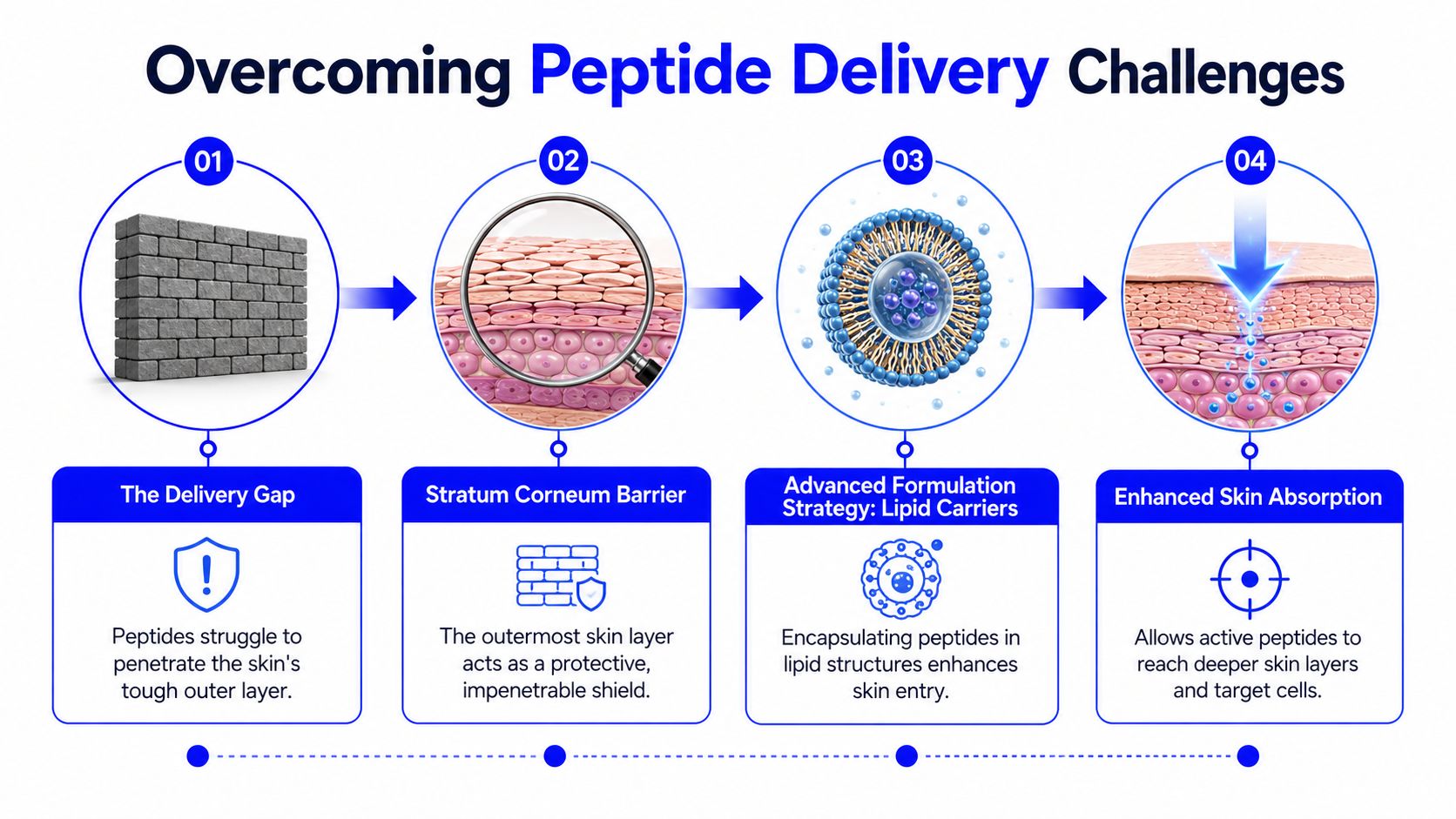
The skin's outer barrier is selective by design. The stratum corneum exists to keep things out. That means many topically applied peptides face a practical bottleneck before they ever reach viable target layers.
A review focused on this issue notes that most topical peptides lack delivery systems needed to penetrate the stratum corneum effectively, leaving 60–70% of applied peptides inactive on the skin surface without encapsulation or lipid carriers (PMC review on topical peptide delivery limits). That's the delivery gap in one sentence. The peptide identity matters, but the vehicle often decides whether the peptide gets a fair test.
Research note: If a formulation doesn't solve barrier entry, the study may end up measuring formulation failure rather than peptide failure.
This becomes especially relevant in post-procedure skin work, scar-focused protocols, or barrier-disrupted models, where delivery assumptions can change quickly. For readers comparing procedural skin improvement pathways with topical support strategies, Face Studio's Cincinnati scar solutions offer a useful example of how skin remodeling is often approached from multiple angles rather than through one topical alone.
Good labs try to separate biological inactivity from delivery failure early. That usually means testing penetration and stability before making broad claims about efficacy.
Common lab-scale approaches include:
The big takeaway is simple. If you want meaningful peptide data, don't test the sequence alone. Test the sequence plus the delivery architecture.
Peptides sit in an area where scientific interest can outpace compliance habits. That's risky. Labs need clear boundaries on sourcing, labeling, handling, and intended use, especially when materials are sold strictly for research, laboratory, or analytical work.
A responsible sourcing checklist starts with documentation, not branding. Buyers should look for:
For research organizations that prioritize consistency, stated purity levels up to 99.5% and third-party documentation can make a practical difference in comparing one batch with the next. That doesn't guarantee performance in a skin model, but it does reduce uncertainty about what entered the study.
Storage and handling often decide whether a peptide remains the same molecule you thought you ordered. Teams should use temperature control, light protection where appropriate, low-contamination reconstitution practices, and written records for opening dates, solvent choice, aliquoting, and freeze-thaw exposure.
Just as important, labs should avoid drifting into implied human-use language when products are sold only for research use. Age-gates, FDA disclaimers, restricted-use labeling, and institutional review standards aren't cosmetic details. They protect the supplier, the lab, and the study.
A strong peptide program usually includes:
That paperwork may feel tedious, but it prevents avoidable ambiguity when results matter.
Getting meaningful results from peptides starts with routine discipline. Researchers don't need a flashy workflow. They need a repeatable one.
Start by checking the lot paperwork before opening anything. Confirm identity, purity statement, storage conditions, and the testing documents that came with the batch. Then plan reconstitution based on the intended assay, not convenience.
A practical lab routine usually includes:
When teams evaluate topical performance, assay design should reflect real application behavior. One study of synthetic peptides applied twice daily for 30 days reported an 11.8% increase in elasticity, a 6.3% decrease in sagging, and a 110% boost in brightness (SCIRP study on synthetic peptide skin effects). Those outcomes are useful because they tie protocol consistency to measurable endpoints.
The most useful pilot studies don't try to prove everything at once. They choose a small set of endpoints that match the peptide's presumed mechanism.
Examples include:
Before any team scales up, it helps to watch a practical lab overview of peptide handling and workflow considerations:
Documentation should be boring and detailed. Record concentration, solvent, batch, exposure schedule, storage conditions, vehicle composition, and endpoint timing. That's what makes a peptide result reproducible instead of anecdotal.
The best evidence on peptide benefits for skin supports a balanced conclusion. Peptides can improve skin-related outcomes, but their effects depend on mechanism, formulation, and study design. Signal peptides, enzyme inhibitor peptides, and related candidates don't all behave the same way, so the smart move is to match the molecule to the endpoint rather than treating all peptides as interchangeable.
The biggest practical lesson is the delivery gap. A promising sequence can fail in a weak topical vehicle, while a well-designed system can reveal real biological value. For researchers, that means reviewing COAs, choosing delivery systems carefully, protecting peptide integrity during handling, and building studies around endpoints that fit the peptide's actual role.
Learn more and explore options with carefully documented research materials that support reproducible peptide workflows.
If you're planning your next skin-focused study, Peptide Warehouse USA offers high-purity research peptides and related compounds with batch testing, COAs, microbial and endotoxin reports, and stated purity levels up to 99.5% for laboratory, analytical, and preclinical use only. Learn more, explore options, and review the catalog to find materials that fit your research protocol.