No products in the cart.


You weigh out a peptide, add water, vortex carefully, and still see powder clinging to the glass. That moment is familiar in peptide research. The sequence looked straightforward, the concentration seemed reasonable, and yet the vial stays cloudy.
A good Peptide Solubility Calculator helps remove that guesswork before reconstitution starts. Instead of treating solvent choice like trial and error, you can use sequence-driven logic to estimate whether a peptide is likely to prefer water, a buffered solution, or an organic solvent first. That matters for day-to-day lab work because failed reconstitution wastes material, delays assays, and makes results harder to compare across runs.
The part many researchers miss is that calculator output only becomes useful when you understand the chemistry behind it. The critical decision usually sits at the intersection of net charge, isoelectric point, hydrophobicity, and solvent choice. If you're building cleaner workflows around peptide handling, practical resources like these free ai tools can also help document and standardize SOP-style lab steps across teams.
A peptide solubility calculator is most useful when the experiment is already under pressure. You may be preparing a reference standard, setting up an analytical run, or reconstituting a research peptide for a stability study. In each case, the same question comes up fast. What should go into the vial first?
At its best, the calculator acts like a fast screening tool. It gives you a starting solvent strategy based on the sequence itself, not just habit. That can mean choosing water for a very short peptide, a pH-adjusted buffer for a charged sequence, or an organic solvent when the peptide is neutral or highly hydrophobic.
Researchers often expect a single answer from these tools, but the stronger use case is narrower and more practical. A calculator helps you estimate what is most likely to work first, so you don't burn through sample while testing random conditions.
Practical rule: Treat the calculator as a decision aid for reconstitution, not a guarantee of final behavior in every buffer system.
The biggest gain comes from knowing what the output means in the lab. If a peptide sits near its isoelectric point, it may precipitate even when the sequence doesn't look extreme. If hydrophobic residues dominate, water may give you a suspension instead of a true solution. Those are the details that turn a basic prediction into a reliable workflow.
Most peptide solubility calculators rely on one of two approaches. Some use simple physicochemical heuristics. Others use sequence-based prediction models.
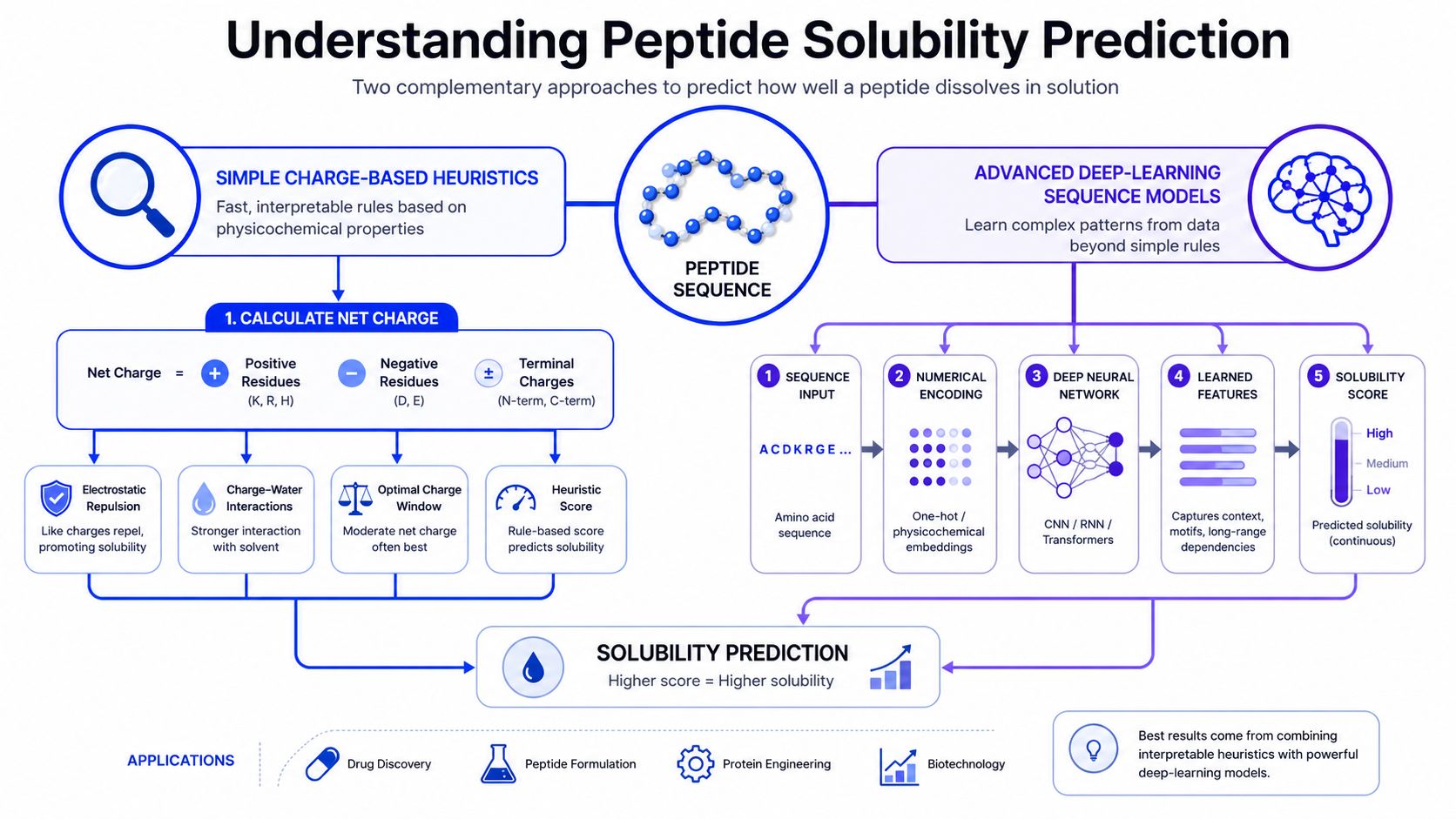
The classic logic is charge-driven. According to the PepCalc peptide solubility calculator reference, peptide solubility is predicted by net charge, where positively charged residues such as arginine and lysine, plus the unmodified N-terminus, support better water solubility at neutral pH, while acidic residues such as aspartic acid and glutamic acid, plus the unmodified C-terminus, push the peptide toward different pH needs.
That matters because isoelectric point, or pI, is where many peptides become least comfortable in solution. Near the pI, the peptide often sits in a zwitterionic state that can favor precipitation. Move the pH away from that point, and solubility often improves because the sequence carries a clearer net charge.
For a bench scientist, this is the easiest mental shortcut:
Newer tools go beyond charge counting. According to the NovoProLabs solubility prediction tool, modern peptide solubility calculators have evolved from simple charge-based estimations to deep learning sequence-based prediction models that achieve excellent performance for short peptides under 50 residues, with reasonable predictions up to 200 residues.
That shift is useful because two peptides can carry similar net charge but behave differently in solution. Sequence order, residue composition, and aggregation tendency all matter. Deep-learning models try to capture those patterns, especially for short research peptides that show up often in screening, analytical, and preclinical workflows.
Still, the output isn't magic. A model can estimate risk, but it can't see every lab variable. Modified residues, unusual counterions, and aggregation during reconstitution can all change the outcome in the tube.
A calculator gives you a smart first move. Your eyes, your pipette, and your validation step decide whether the prediction held up.
A calculator is only as useful as the information you enter. If the sequence is incomplete or the concentration target is fuzzy, the output won't help much.
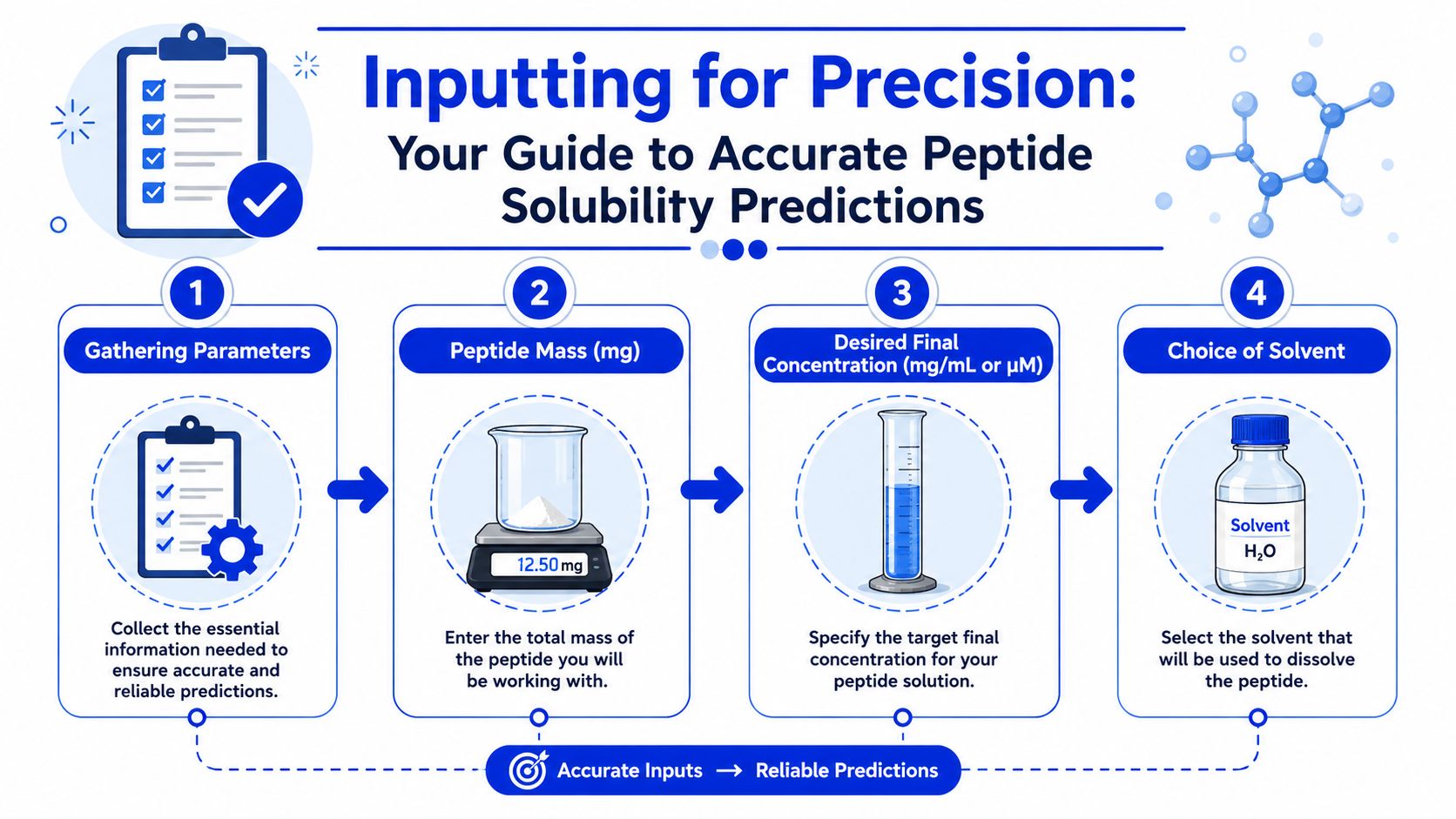
Your first input is the full peptide sequence. Enter it exactly as supplied for research use, including any known modifications if the tool allows them. If the tool only accepts the core amino acid sequence, note separately that the prediction may be less reliable for modified peptides.
Next, define the specific concentration you need for the assay. Researchers often enter a convenient number without checking whether that concentration is realistic for the sequence. It helps to decide up front whether you're aiming for a stock solution or a direct working solution.
According to the GenScript peptide solubility guidelines, sequence length itself matters because peptides with fewer than 6 amino acids generally dissolve in pure water, while longer sequences require strategies based on charge and hydrophobicity.
Use a simple prep checklist before entering data:
Solubility calculators are strongest when you think in terms of starting solvent, not just final buffer. Many peptides don't go directly from dry powder into their final assay matrix cleanly. They need an intermediate step.
A practical input set usually includes:
Counterion context also matters in real workflows. Even if the calculator doesn't ask for acetate or trifluoroacetate explicitly, your vial label and supplier documentation can affect how the peptide behaves during reconstitution. That's one reason two labs can handle the same nominal sequence and report different first-pass solubility outcomes.
Bench note: If your final assay requires an aqueous buffer, that doesn't mean water should be your first reconstitution solvent.
Calculator outputs usually look deceptively simple. You may see a predicted pI, a qualitative solubility note, and a suggested solvent type. The challenge is translating that output into steps that work at the bench.
Start with a peptide whose sequence contains more acidic character than basic character. In practice, a calculator may flag it as requiring a higher pH environment rather than plain water. That recommendation follows the same charge logic covered earlier. If the peptide tends negative overall, moving pH upward can help pull it away from its isoelectric region and improve dissolution behavior.
In the lab, that means you wouldn't just add water and hope. You'd prepare an appropriate aqueous environment, add the solvent in a controlled volume, mix gently, and inspect for clarity. If the peptide dissolves but turns cloudy after transfer into another buffer, the issue may be the final matrix rather than the initial reconstitution step.
A good habit is to read each output in operational terms:
Neutral peptides are where many researchers get frustrated. They may not look strongly acidic or basic, so water feels like the safest choice. Often it isn't.
According to the Sigma-Aldrich solubility guidelines, a critical pitfall is the misclassification of neutral peptides with low charge density, specifically less than 10% of total residues, because calculators often flag them as soluble in water despite experimental data showing they may require organic solvents like DMSO.
That one rule changes how you read a calculator output. If a neutral peptide gets a mild or optimistic water-soluble label, but the charge density is very low, you should treat the result cautiously. Cloudiness can mean you made a suspension, not a true solution.
A practical interpretation workflow looks like this:
If the vial looks hazy after mixing, don't assume the peptide is dissolved just because the calculator suggested water.
The key is to connect output fields to action. A calculator doesn't pipette for you. You still have to choose order of addition, mixing style, and the moment when you stop forcing an aqueous condition that the sequence doesn't support.
The best real-world reconstitution decisions come from combining the calculator output with a few simple lab rules. Here, pI, hydrophobicity, and solvent choice work together.
A common mistake is to focus only on whether the peptide is acidic or basic. That helps, but it doesn't go far enough. You also need to ask whether your chosen solvent environment places the peptide too close to its pI.
If the calculator gives you a pI estimate, use it as a warning zone. A peptide can behave badly not because your solvent is wrong in general, but because your final pH leaves the sequence too close to the point where net charge is minimized. In practice, many stubborn peptides improve when you shift the pH away from that region in measured steps and reassess clarity after each adjustment.
That approach is especially useful for peptides that initially dissolve and then fall out of solution later. The failure may not be dissolution itself. It may be loss of solubility after dilution into the working buffer.
Hydrophobicity often overrides wishful thinking. According to the Biosynth peptide solubilization guide, peptides containing more than 50% hydrophobic amino acids are generally predicted to be insoluble in aqueous solutions at neutral pH, necessitating organic solvents like DMSO or acetonitrile for initial solubilization.
That doesn't mean every hydrophobic peptide needs the same treatment. It means water shouldn't be your automatic starting point. When hydrophobicity is high, an organic-first strategy often makes more sense, followed by controlled dilution into a compatible aqueous system if the downstream assay requires it.
Here is a useful quick-reference table built from the threshold guidance discussed in the literature.
| Charge Density (%) | Buffer or Solvent | Recommended pH |
|---|---|---|
| Less than 10% | Organic solvents such as DMSO, acetonitrile, DMF, methanol | Not primarily pH-driven. Start with organic solubilization |
| 10% to 25% basic character | 25% acetic acid | Acidic conditions |
| Greater than 25% acidic character | Ammonium bicarbonate | Around pH 7 |
You can also improve outcomes with small process choices:
Lab habit: Write down the exact order of solvent addition when a peptide finally dissolves. Sequence chemistry matters, but so does process consistency.
The broader lesson is simple. The calculator tells you what the sequence suggests. Solubility improves fastest when you pair that suggestion with solvent selection that respects both charge density and hydrophobicity.
Even a strong peptide solubility calculator has blind spots. Most failures happen when people trust the prediction more than the sample in front of them.
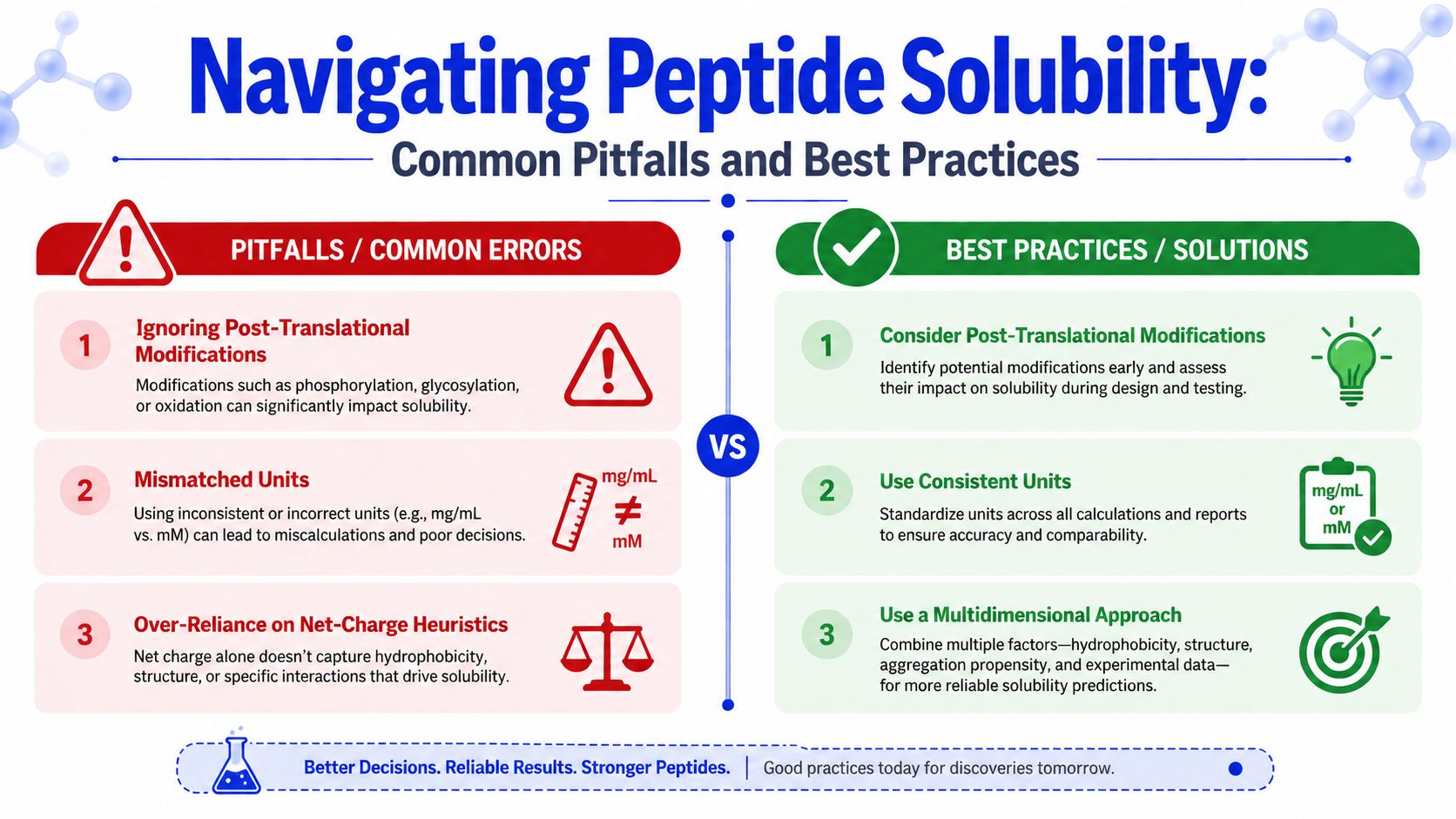
One problem is model transparency. According to the Trumeter discussion of peptide solubility calculator limitations, the lack of algorithm transparency in existing solubility calculators leaves users unable to verify the underlying physicochemical model, leading to mistrust for complex or modified peptides.
That matters most when you're working with:
When troubleshooting, start with the boring checks first. Confirm the sequence entered, review units, compare the starting solvent with the peptide's charge and hydrophobicity profile, and inspect whether the sample is completely dissolved rather than suspended.
Peptide handling also sits inside a compliance framework. Research suppliers typically position these materials for laboratory, analytical, or preclinical use only, not for human consumption. That's an important distinction for labeling, SOPs, and procurement records.
Documentation helps more than commonly realized. Record the sequence, lot details, solvent order, approximate pH environment, and the visual outcome after reconstitution. If a peptide behaves unpredictably, those notes are what let you repeat success or identify where the prediction and the experiment separated.
A calculator is useful. Empirical validation is still required.
A peptide solubility calculator works best when you use it as a chemistry-based starting point, not a final answer. The most reliable reconstitution decisions come from reading the sequence through three lenses at once: pI, hydrophobicity, and solvent choice. That combination is what helps you move from cloudy vials and wasted material to cleaner, more repeatable prep.
For research teams sourcing peptides and related materials, it's worth pairing good prediction habits with consistent documentation and high-quality inputs. Learn more, explore options, and choose suppliers that support traceability, batch consistency, and clear research-use guidance.
If you're ready to source COA-backed research peptides and related compounds for laboratory workflows, Peptide Warehouse USA offers high-purity research products, transparent documentation, and responsive support. Learn more, explore options, and review their catalog for peptides, liquids, aminos, and other research-use materials.