No products in the cart.


You're probably here because you found BPC-157 online, saw wildly different claims about legality, and now you're trying to answer a simple question that turns out not to be simple at all: can you buy BPC 157?
A common version of this starts with a researcher, clinic buyer, or careful consumer opening five browser tabs at once. One vendor says “research use only.” Another hints at wellness use. A third talks about compounding. Then anti-doping warnings, FDA language, and customs issues start showing up, and the whole thing gets muddy fast.
That confusion is understandable. BPC-157 sits in a narrow space between research access and regulatory restriction. If you're also trying to understand the broader conversation around peptide therapy for optimizing health, it helps to separate approved clinical care from compounds that remain outside the approved drug pipeline. That distinction matters a lot here.
The short answer is yes, but only in a limited sense.
In the United States, people can find BPC-157 for sale as a research chemical, usually labeled for laboratory use and not for human consumption. That's where many buyers get tripped up. “Available to purchase” and “approved to use as a human drug” are not the same thing.
An industrial solvent offers a useful comparison. A lab may legally buy it for bench work, testing, or analytical processes, but that doesn't make it a consumer health product. BPC-157 sits in a similar compliance category. The hard part isn't finding listings. The hard part is figuring out whether the vendor, labeling, paperwork, and shipping practices line up with the law.
Practical rule: If a seller talks like a pharmacy, wellness clinic, or supplement brand while hiding behind research-use language, treat that as a compliance warning.
Researchers usually care about three things at once:
Those last two points matter more in 2026 than many guides admit.
The cleanest way to answer can you buy BPC 157 is to separate anti-doping rules, drug approval status, and research-use access. Those are different systems, and people often mash them together.
If you've ever looked into niche regulated products before, a good parallel is understanding spore syringe regulations. The product itself, the intended use, and the seller's claims all affect what's lawful. BPC-157 works the same way. Context drives the compliance outcome.
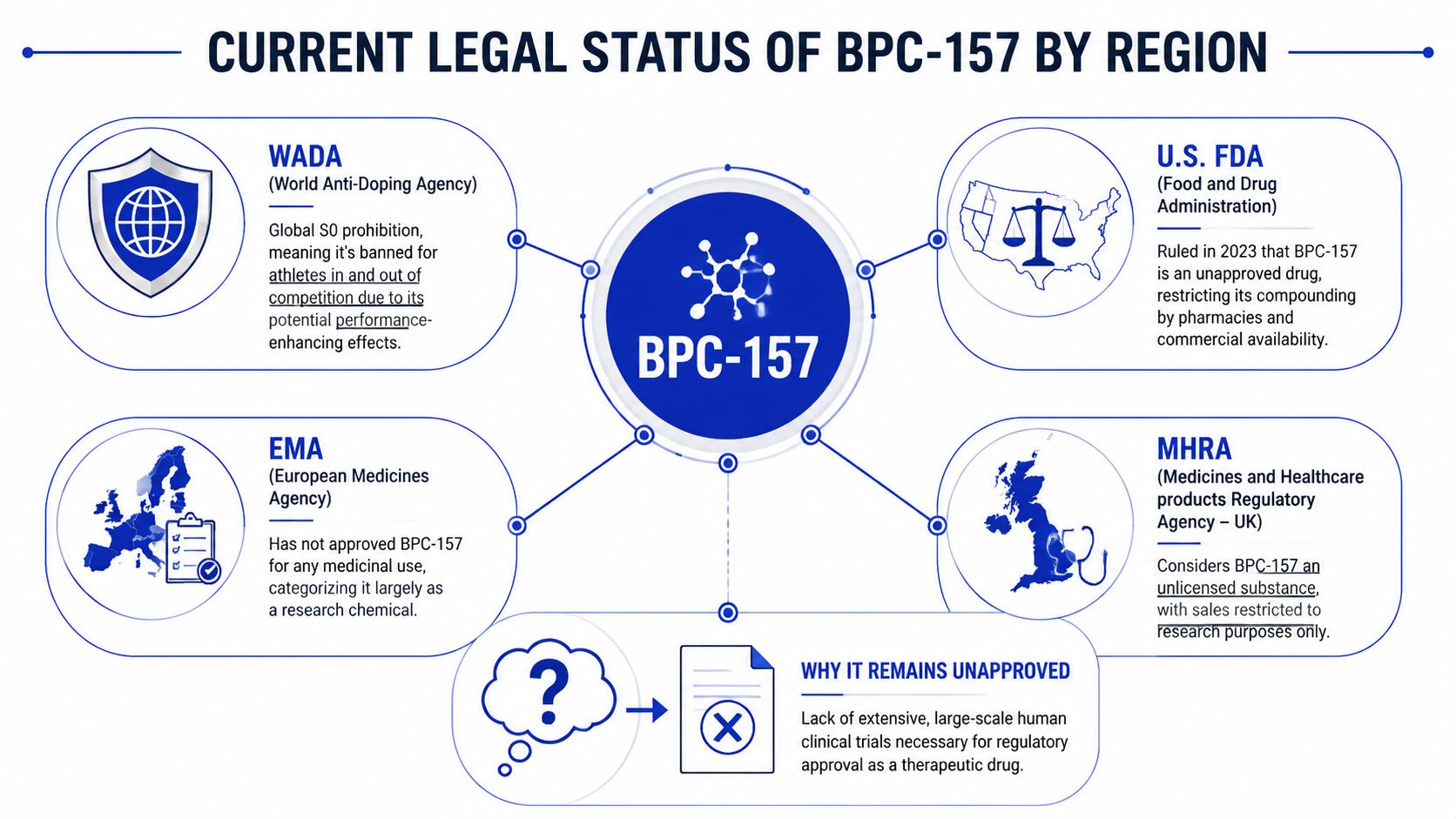
BPC-157 has never received approval as a human drug by major global authorities, and WADA lists it in category S0 (Unapproved Substances), confirmed by USADA as a prohibited compound for athletes according to USADA's guidance on BPC-157.
That matters far beyond professional sports. If you're subject to anti-doping policy, this isn't just a gray-area purchase issue. It can become an eligibility or disciplinary issue. The verified data also confirms that military personnel may face similar concerns under strict anti-doping or prohibited-substance rules.
In the U.S., BPC-157 is not scheduled under the Controlled Substances Act. That means it doesn't carry a federal Schedule I to V classification. Personal possession, by itself, isn't treated the way possession of a scheduled controlled substance would be.
But that doesn't make it an approved medicine. The verified data states there is no approved New Drug Application or Biologics License Application for BPC-157, and the FDA confirmed there is no legal basis for selling it as a drug, food, or dietary supplement. That's why the lawful sales lane is generally limited to research-use labeling rather than consumer therapeutic marketing.
The verified data also states that BPC-157 has never been approved as a human drug by major global authorities, including the European Medicines Agency (EMA) and the UK Medicines and Healthcare products Regulatory Agency (MHRA). In practical terms, that means there is no mainstream medicinal approval pathway you can point to in those regions.
For buyers, the takeaway is simple. “Not scheduled” is not the same as “approved.” “Available online” is not the same as “legal for human therapeutic sale.”
| Region or authority | Practical status |
|---|---|
| WADA | Prohibited under S0 for athletes and other covered groups |
| U.S. FDA | Not approved as a drug, food, or dietary supplement |
| EMA | Not approved for human medicinal use |
| MHRA | Not approved for human therapeutic use |
BPC-157 may be purchasable in some settings, but there is no major jurisdiction that authorizes it as an approved human therapeutic drug.
This is the section most readers need. A vial can be sold under Research Use Only, often shortened to RUO, and still be off-limits for human use.
RUO labeling means the seller is positioning the product for laboratory, analytical, or preclinical work. It does not mean the product has passed through the drug approval system. It also does not mean a pharmacy can dispense it to a patient, or that a supplement brand can lawfully put it into capsules and market benefits of peptides to consumers.
A simple analogy helps. A calibration standard can be perfectly legitimate in a lab, but you wouldn't put it on a pharmacy shelf. BPC-157 follows that same split.
Approved use would involve an authorized drug pathway with the documentation, review, and legal marketing status that come with a cleared pharmaceutical product. BPC-157 does not have that status.
As of 2026, BPC-157 remains on the FDA's Category 2 bulk drug substance list, blocking compounding pharmacies from producing it while allowing research chemical vendors to sell it under an RUO framework according to this 2026 legal status guide.
That explains the contradiction people notice online:
Compliance mindset: Ask one question first. Is the seller supplying a research material, or are they implying human therapeutic use? That answer changes the risk profile immediately.
A legitimate research supplier usually emphasizes documentation, batch traceability, and intended laboratory use. A risky seller often leads with body-composition, recovery, anti-aging, or injury-repair promises while hiding the legal disclaimers in small print.
Once you understand the legal lane, sourcing becomes a document review exercise, not a hype exercise.
A serious buyer doesn't start by asking, “What claims does the product page make?” The better starting point is, “What can this vendor prove?”
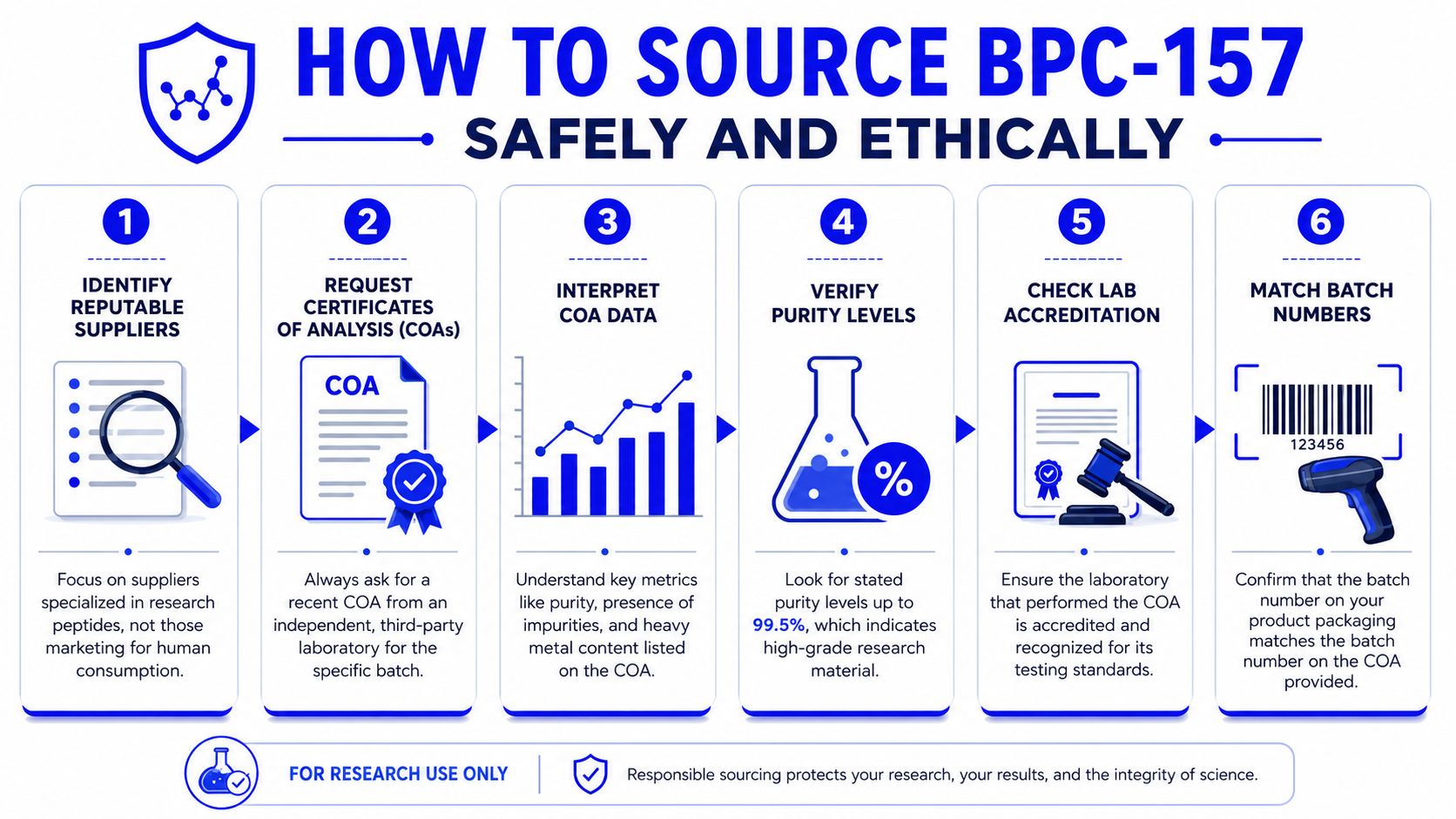
For BPC-157 research sourcing, ask for:
The publisher information for this article notes that some U.S. suppliers provide third-party documentation, including COAs, microbial and endotoxin reports, and stated purity levels up to 99.5%. That's the right kind of sourcing standard to look for. Don't treat any single number as proof by itself. Treat it as one line item within a full documentation package.
A helpful overview of vendor due diligence appears in this video:
A Certificate of Analysis, or COA, is basically the product's lab report card. It should tell you what the material is, identify the batch, and summarize test results.
Use this quick review method:
A polished website is easy to build. Batch traceability is harder to fake.
This is the overlooked angle.
Emerging 2026 regulatory shifts specifically target the supply chain legality of BPC-157, with a PCAC review scheduled for July 23–24, 2026, highlighting the importance of vetting vendor legitimacy now according to this analysis of BPC-157 supply chain legality.
That means sourcing isn't only about current product status. It's also about whether the seller's operating model can survive regulatory scrutiny. A vendor may look fine today and still become unreliable if enforcement tightens around labeling, fulfillment, or compounding-adjacent practices.
For researchers, the practical response is straightforward:
Most ordering problems happen after checkout, not before it.
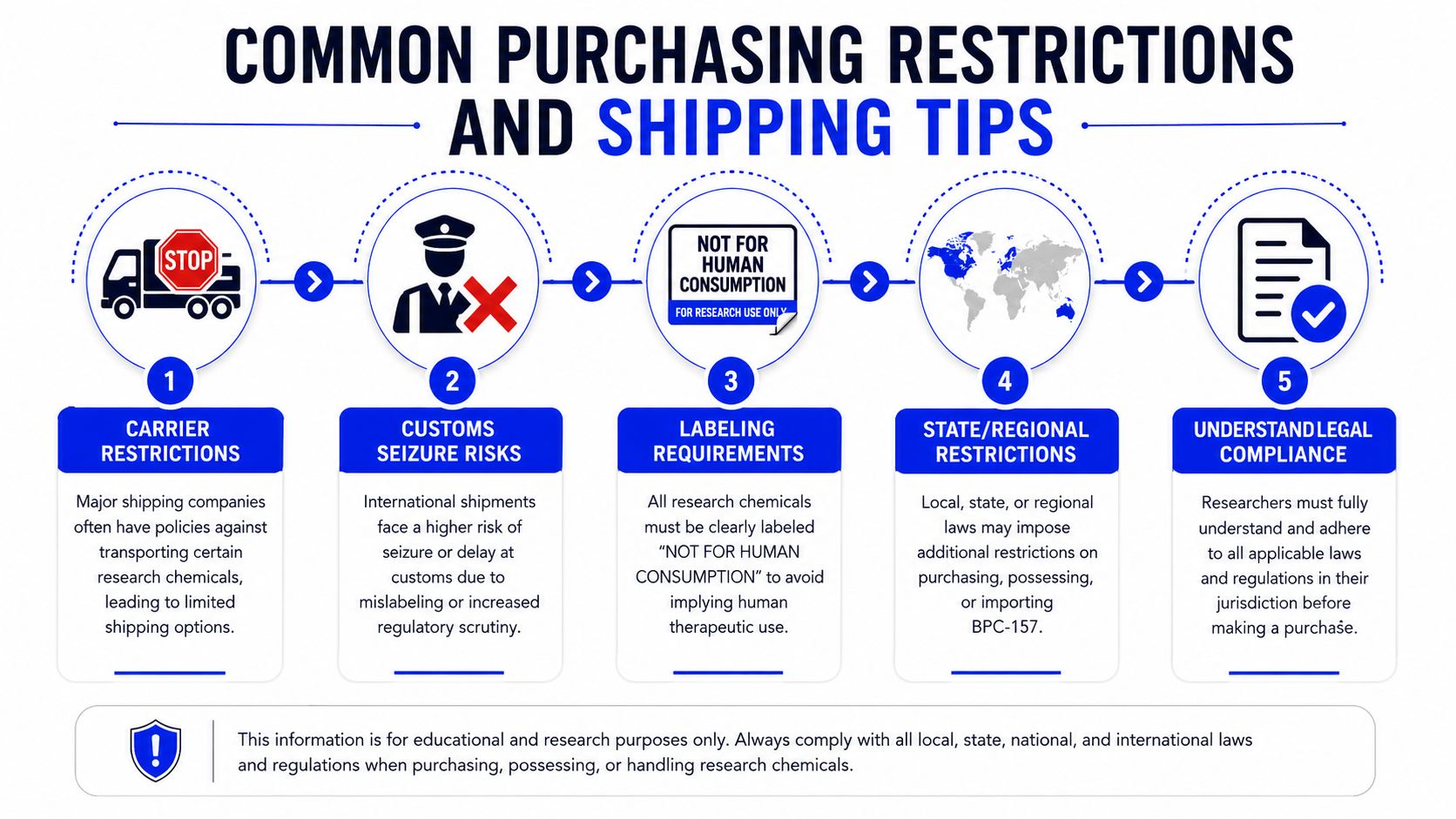
In the U.S., BPC-157 is unscheduled under the CSA but cannot be marketed as a drug or dietary supplement; it must be labeled strictly for research use, and customs may seize misdeclared packages according to this summary of U.S. legal status.
That gives you the main failure points right away. Shipments run into trouble when product descriptions, invoices, declarations, or marketing language suggest human therapeutic use. International orders can face even more friction because customs officers don't care that a product page sounded casual or trendy. They care whether the paperwork aligns with the item and the declared use.
Use a compliance-first checklist instead of guessing.
A good shipping process feels boring. That's a positive sign. If a seller talks more about “beating customs” than about proper declarations and documentation, walk away.
The biggest mistake buyers make is assuming the scam risk is only about fake product. Sometimes the bigger risk is a real product sold through a careless or noncompliant operation.
There is little to no reliable human safety data for BPC-157, and products sold online occupy a regulatory gray zone where customs seizure and lack of quality oversight are common risks according to OPSS guidance on BPC-157.
With that in mind, be cautious when a seller does any of the following:
Ask direct questions and watch how the seller responds.
If support dodges those questions, that tells you more than any homepage banner.
Buy from the vendor that makes compliance easier, not the vendor that makes bold promises easier to believe.
So, can you buy BPC 157? In practical terms, yes for research-use sourcing in limited channels, no as an approved human drug product.
The safest approach is to think like a compliance officer. Separate legal availability from approval status. Review batch documents before you review marketing language. Use vendors that treat labeling, testing, and shipping as core parts of the product, not afterthoughts.
The 2026 supply chain angle matters too. Pending review activity and shifting enforcement priorities can affect vendor stability even when the product category itself hasn't fundamentally changed. That's why the strongest buyers build a paper trail, verify every lot, and keep a backup procurement option ready.
If you're evaluating U.S.-made research peptide suppliers and want a documentation-first purchasing path, learn more about compliant sourcing standards and explore options through a supplier that emphasizes batch testing and laboratory-use transparency.
Sometimes, but international orders carry more risk. Customs can delay or seize misdeclared research materials, and the destination country may apply rules that are stricter than U.S. vendor policies.
Vendor requirements vary. Some sellers serve a broad research market, while others may ask for institutional details or additional verification. The key issue is whether the purchase is framed and documented for research use.
Because BPC-157 does not have approved human drug status, and compounding restrictions have created additional barriers for pharmacies. That's why online research suppliers and pharmacies operate in very different lanes.
Delivery timing depends on stock status, shipping method, weather, and whether a package faces review in transit. A trustworthy seller should give clear fulfillment expectations and order tracking rather than vague assurances.
If you want a U.S.-based source focused on laboratory and analytical use, Peptide Warehouse USA is worth reviewing. The company emphasizes research-only compliance, batch testing, COAs, microbial and endotoxin reporting, and stated purity levels up to 99.5% for supported lots. Learn more, review the documentation standards, and explore options if you need a more reliable peptide procurement process.