No products in the cart.



You're probably in one of two situations right now. Either you're trying to understand why the Selank peptide keeps showing up in discussions about calm focus and stress-related research, or you're trying to source it for lab work and finding a mess of conflicting claims, uneven documentation, and vague “research use” language.
That confusion is reasonable. Selank sits in an unusual category. It has a real development history, a defined mechanism, and documented use in Russia, yet in the United States it still lives inside a research-only marketplace where quality depends less on brand promises and more on paperwork, testing, and batch traceability.
For researchers, that creates a practical problem. A peptide can look identical on a product page while being very different in handling quality, documentation quality, and experimental reliability. The result is what many labs deal with every day: not just “Does Selank work in a model?” but “Can we trust the vial?”
A research team setting up an anxiety-model study often hits the same problem before the first assay begins. The protocol may be clear, the target may be interesting, and the readouts may already be chosen. Yet one basic question can still slow the whole project down. Which Selank sample is trustworthy enough to study?
That question sits at the center of Selank research. Selank, sometimes referred to as TP-7, is a synthetic heptapeptide derived from the naturally occurring immune peptide tuftsin, with a Pro-Gly-Pro extension added to its structure. Researchers pay attention to it for a practical reason as much as a theoretical one. It is a defined molecule with a specific sequence, so it can be studied as a real experimental material rather than a vague “nootropic” label.
The easier way to understand Selank is to compare it to a blueprint instead of a finished building. On paper, the design can look elegant. In the lab, the result only holds value if the material in the vial matches that blueprint closely, lot after lot.
That is where the purity paradox becomes hard to ignore.
Selank is not FDA-approved in the United States as a drug, and that fact can confuse newer buyers. Some assume imported material must be closer to the original research tradition and therefore more reliable. In practice, the opposite can happen. A US research-grade supplier that provides lot-specific certificates of analysis, identity testing, purity data, and endotoxin screening may give a research team a clearer view of what they are handling than an unregulated import with sparse paperwork.
Practical rule: With peptides, documentation is part of the material. A vial without strong testing records creates uncertainty before the experiment even starts.
This is significant because peptide studies often break down at ordinary points of failure. The compound may degrade, vary between lots, or carry contaminants that blur the signal researchers are trying to measure. Selank draws interest partly because it sits at the overlap of neurobiology, immune signaling, and sourcing discipline. For investigators, that makes it more than a peptide with a compelling backstory. It becomes a test of whether the science and the quality controls are aligned from the start.
A researcher opens two Selank papers and gets two different impressions. One describes a fast-clearing peptide. The other discusses effects that outlast its initial presence. The confusion usually starts there.
Selank becomes easier to understand once you separate three layers: what the molecule is made from, which signaling systems it appears to influence, and why a short-lived peptide can still leave a longer biological footprint. That step-by-step view matters because mechanism claims are only useful if the material being studied is the peptide named on the label. This is part of the purity paradox introduced earlier. In US research settings, a well-documented vial with a lot-specific COA and endotoxin data can support more reliable mechanism work than an imported product with thin paperwork, even though Selank itself is not FDA-approved as a drug.
Selank is a synthetic heptapeptide derived from tuftsin, an endogenous immunomodulatory tetrapeptide, with a Pro-Gly-Pro extension added to improve stability against enzymatic breakdown. That design choice matters because peptides often disappear quickly in biological systems. Selank was developed to resist that problem better than tuftsin alone.
Researchers sometimes assume rapid clearance means weak or trivial activity. Peptide signaling does not always work that way. A brief interaction can set off downstream changes that continue after the peptide level falls, much like pressing a doorbell lasts a second while the chime continues after your finger moves away.
To make the receptor story easier to picture, this visual helps:
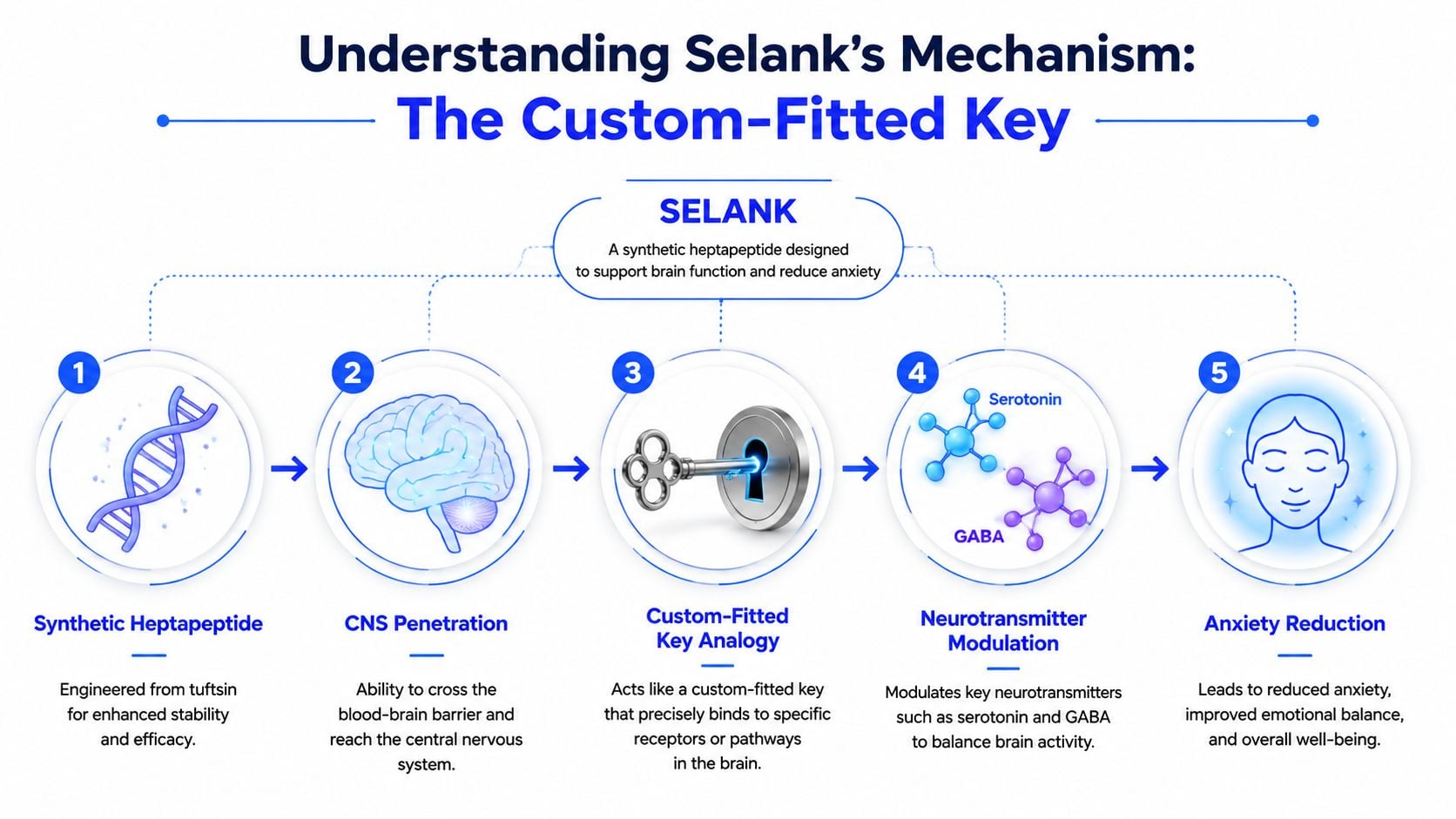
Selank is often discussed in relation to the GABA-A receptor and the benzodiazepine binding site, where it has been described as a positive allosteric modulator rather than a direct receptor activator, as summarized in this Selank mechanism guide. That distinction matters.
A direct activator pushes a system hard in one direction. An allosteric modulator changes how efficiently the system responds to its own native signal. In plain terms, Selank is being studied as a compound that may adjust the sensitivity of inhibitory signaling instead of forcing the entire pathway open. That helps explain why researchers often discuss it separately from classical benzodiazepines even when the same receptor family enters the conversation.
The comparison works best at the systems level. A benzodiazepine is commonly framed as producing a broader calming push with well-known concerns around sedation and motor effects. Selank research points toward a narrower tuning effect on inhibitory tone, with additional pathways that may shape the overall profile.
Its secondary mechanisms are part of that picture:
Selank is better understood not by asking whether it is "like a benzo," but by asking which signaling systems it nudges, how strongly it nudges them, and whether the test material is pure enough to trust the result.
That last point deserves emphasis. Mechanism-of-action research is highly sensitive to quality drift. If one vial contains the intended peptide at high purity and another contains degradation products, residual contaminants, or inflammatory endotoxin burden, the observed receptor and behavioral effects can blur together. For Selank, that means purity is not just a sourcing issue. It directly shapes how convincing the mechanism data looks in the lab.
Researchers keep returning to Selank for that reason. It sits at an unusual intersection of GABA-related signaling, neuroimmune biology, and peptide design. The mechanism is not fully reduced to one simple switch, but the working model is clear enough to guide study design and selective enough to justify continued interest.
Selank research becomes easier to evaluate when you separate three buckets: animal behavior work, cognitive restoration models, and human anxiety studies. That avoids a common mistake where readers blend everything together and end up either overstating or dismissing the evidence.
Preclinical work gives Selank much of its practical research interest. In WAG/Rij rats and other models, specific dosage ranges were linked to anxiolytic and antidepressant-like effects. High doses of 1000 to 2000 µg/kg counteracted depression symptoms after repeated injection, while lower doses of 100 to 300 µg/kg reduced immobility duration in BALB/c mice after a single injection according to this PubMed-indexed study.
One result gets cited often because it is unusually concrete. Administration of 300 µg/kg improved sensory attention by factors of 2 to 3 with p < 0.01 and facilitated learning by 1.5× with p < 0.01 in rats subjected to antenatal hypoxia, based on published findings on Selank's effects.
That doesn't mean every model or protocol will produce the same effect. It does mean the peptide has produced measurable, model-specific signal rather than only anecdotal interest.
Human-facing data is narrower, but it matters. Russian clinical work has reported therapeutic effects comparable to medazepam for generalized anxiety disorder symptoms, with discussion of a cleaner side-effect profile. That's one reason Selank remains relevant in comparisons against standard anxiolytic approaches.
A useful nuance appears in a review discussing underserved angles in the literature. Russian clinical trials involving about 192 patients reported efficacy comparable to benzodiazepines while noting no clinically significant sedation, cognitive impairment, or physical dependence, according to this article in PMC.
Research takeaway: The strongest argument for Selank isn't that it replaces every conventional anxiolytic. It's that it may occupy a different safety and mechanism niche.
Some reports also describe immunomodulatory effects, including cytokine shifts under stress conditions. That broadens Selank's interest for researchers studying stress physiology rather than mood alone.
| Study Type | Model/Subjects | Dosage | Key Findings |
|---|---|---|---|
| Preclinical | Rats subjected to antenatal hypoxia | 300 µg/kg | Improved sensory attention by 2 to 3 and facilitated learning by 1.5×, both with p < 0.01 |
| Preclinical | WAG/Rij rats | 1000 to 2000 µg/kg | Counteracted depression symptoms after repeated injection |
| Preclinical | BALB/c mice | 100 to 300 µg/kg | Reduced immobility duration after single injection |
| Clinical | Patients with anxiety disorders in Russian studies | Not specified here | Therapeutic effects comparable to medazepam for generalized anxiety symptoms |
| Clinical review context | About 192 patients | Not specified here | Comparable efficacy to benzodiazepines with no clinically significant sedation, cognitive impairment, or physical dependence reported |
A careful reading leads to a balanced conclusion. Selank has more than theoretical interest, but the evidence base is still much smaller than what researchers would expect for mainstream Western drug approval.
A lab can lose a clean result long before any data analysis begins. One vial sits on the bench too long. A powder is hit with solvent too forcefully. Two reconstituted samples share similar labels, and one is pulled into the wrong protocol. With peptides, small handling mistakes can act like static in an audio recording. The signal is still there, but it gets harder to trust.
That is why Selank handling should be treated as a reproducibility exercise, not just a storage task. The goal is to keep the material itself from becoming a hidden variable.
Start at intake, not at reconstitution. Before a vial enters active inventory, confirm that the product label, lot number, and accompanying documents match the purchase record. If the paperwork and the physical vial do not line up, stop there and resolve it before the batch is used.
Selank is a synthetic heptapeptide. Earlier sections covered its sequence and research background. For bench work, the practical point is simpler. It is still a peptide, so heat, moisture, light, and repeated handling can all introduce avoidable variability.
This handling visual is useful for standardizing bench practice:
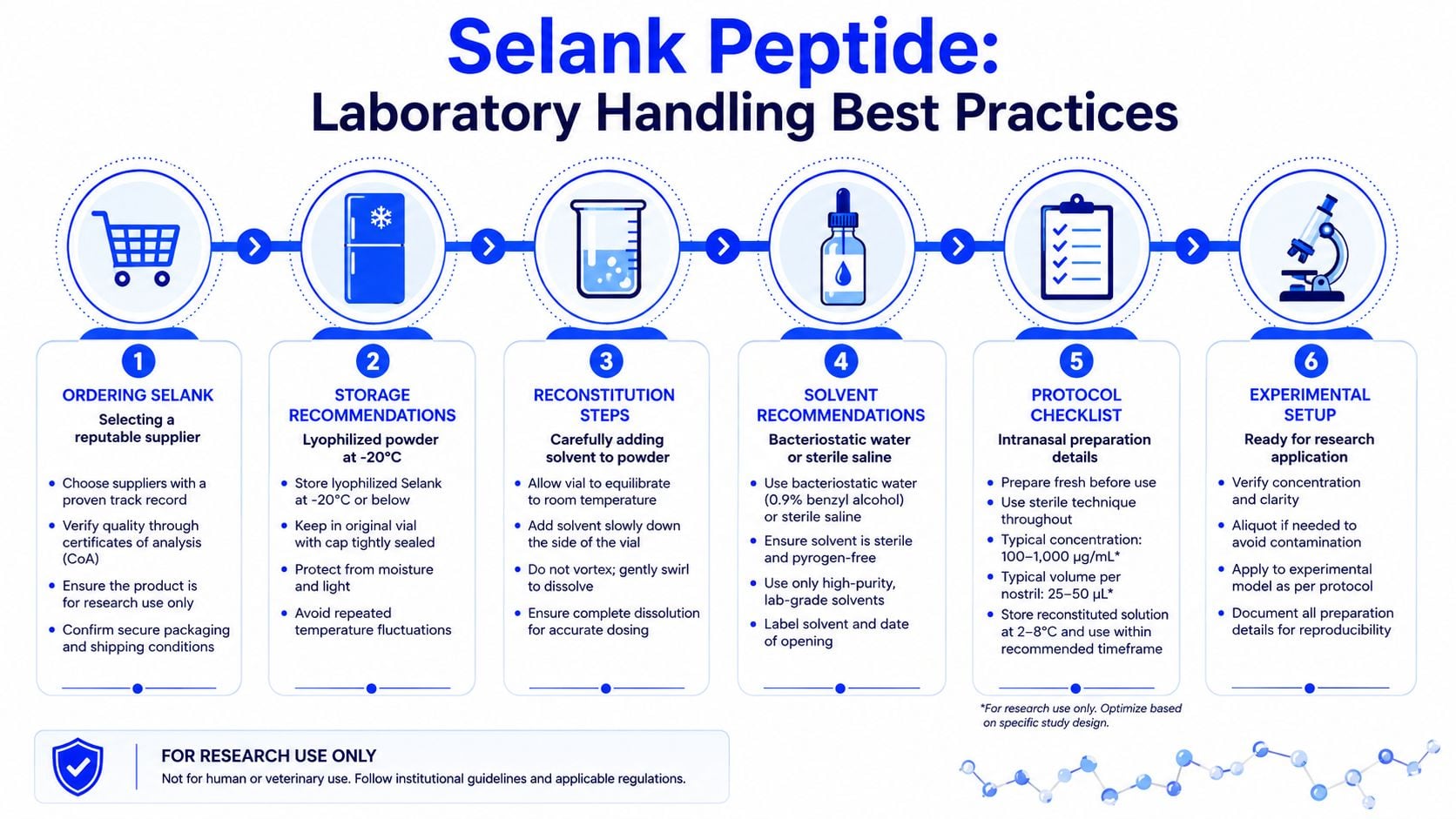
Store lyophilized material cold, dry, and protected from light. Stable storage matters more than frequent repositioning to slightly different shelves or temperatures. A peptide lot that moves in and out of storage without logging can create the same kind of uncertainty as using an unlabeled reagent bottle. You may still have material, but you lose confidence in its history.
For research teams sourcing Selank in the US, handling starts before the box is opened. A well-documented research batch with a clear COA, endotoxin data, and lot traceability is often easier to manage consistently than imported material with thin documentation. That purity paradox matters at the bench. If the identity and contamination profile are unclear at receipt, perfect reconstitution technique cannot fix that uncertainty later.
Reconstitution should be gentle and boring. That is usually a good sign.
A simple way to think about the process is to treat the lyophilized cake like a dry film rather than a hard pellet. Direct pressure from a fast solvent stream can make the material harder to dissolve evenly or create avoidable foaming. Letting solvent run down the vial wall usually gives the peptide time to hydrate more uniformly.
A practical workflow looks like this:
One sentence matters here. Write the final concentration clearly enough that another researcher could use the vial correctly without asking for clarification. Ambiguous labeling causes more preventable error than many labs like to admit.
Later in a protocol planning meeting, many teams also find it helpful to review a visual walk-through:
The larger lesson is straightforward. Selank research depends on two layers of control. The first is batch quality at the time of purchase. The second is bench discipline after the vial arrives. If either layer is weak, interpretation gets harder. If both are strong, the study is in a better position to test the peptide rather than the handling errors around it.
The hardest part of Selank procurement isn't finding a product page. It's deciding whether the documentation behind the vial is good enough for your study.
The purity paradox matters here. Selank may lack FDA approval in the United States, but that doesn't automatically mean every US research-grade batch is low quality. In practice, some research suppliers compensate for the regulatory gap with strong batch-level documentation, while some imported material arrives with little more than a printed label.
Despite Selank's 2009 Russian approval and over-the-counter availability there beginning in 2017, US suppliers often distinguish research-grade material through rigorous COAs, microbial reports, and endotoxin reports, which helps address a key procurement challenge around unregulated imports, as discussed in this article on generalized anxiety disorder research and peptide sourcing.
That's the paradox in plain language. A non-FDA-approved research peptide can still come with stronger lot documentation than a loosely sourced import that sounds more “pharmaceutical” in marketing copy.
This checklist captures the main QA checkpoints:
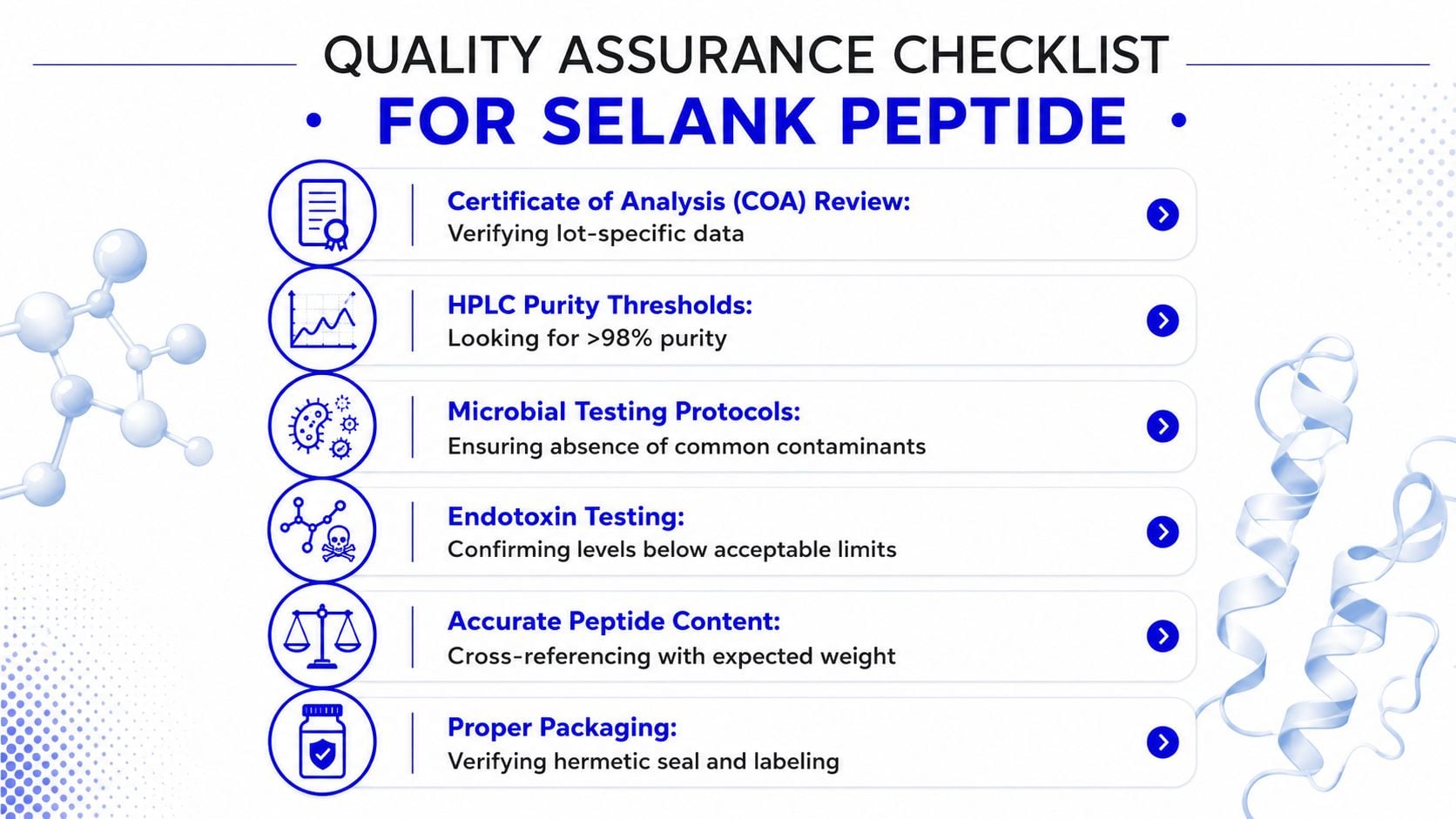
A useful QA review should include more than one page.
Look for:
A peptide without traceable documents is closer to an assumption than a reagent.
Not every problem is dramatic. Some warning signs are subtle:
Researchers often focus on the top-line purity number first. That's understandable, but incomplete. A clean-looking purity claim without identity, contamination, and traceability context can still leave a lab exposed to bad inputs.
A lab can hold two Selank vials that look nearly identical on the bench. One arrives with lot records, endotoxin data, and a clear research-use label from a US supplier. The other comes through an import channel with a bold purity claim and little else. Neither is FDA-approved as a medicine in the United States, but they do not carry the same practical level of risk.
That difference is the purity paradox. Regulatory approval and batch reliability are related, but they are not the same thing. For Selank research in the US, the immediate question is often less about market authorization and more about whether the material is documented well enough for a research team to identify what it received.
Selank has a different regulatory history in Russia than it does in the United States or the European Union. As noted earlier, it was developed in Russia and reached formal use there, while in the US and EU it is generally treated as a research-use compound rather than an approved drug.
That distinction matters because approval status answers one question, while research quality controls answer another. Approval asks whether a regulator has cleared a product for medical use in a given system. A COA, identity testing, and endotoxin reporting ask whether a specific batch is traceable and suitable for controlled lab work. Researchers sometimes blend those ideas together and miss the operational point.
The FDA has also raised concerns around compounded peptide products and route-specific safety issues in some contexts. For Selank, that means teams should be precise about how material is labeled, how intended use is described, and how route-related risk is interpreted. A nasal research protocol and an injectable formulation do not raise the same handling questions.
For healthcare organizations considering how emerging compounds, documentation, and system workflows intersect, EHR integration partners can be a useful operational reference point when planning compliant data flows around research and clinical software environments.
Regulatory ambiguity should lead to tighter process controls.
A useful comparison is customs screening at an airport. A passport tells you something about legal status. It does not tell you what is inside a suitcase. In peptide sourcing, lack of FDA approval does not automatically tell a lab whether a given Selank vial is clean, contaminated, mislabeled, or well documented. Batch records and contamination testing answer that part.
This is why US research-grade Selank can sometimes be the more dependable choice than an unregulated import, even though neither product is an FDA-approved prescription drug. Domestic suppliers that provide lot-specific COAs, microbial screening, and endotoxin results give a lab more visibility into what it is buying. An imported product with weaker documentation may look similar on a storefront page but leave larger blind spots once it reaches the freezer.
Teams handling Selank research can lower avoidable risk by keeping a few habits in place:
Precision helps here. The goal is not to make Selank appear more established than it is, or more uncertain than it is. The goal is to treat it like any other sensitive research reagent. Verify the batch, label it correctly, and keep the paper trail intact.
When ordering Selank for research, the best buying decision usually comes from a short verification routine, not from the most persuasive product description.
Start with fit for purpose. Make sure the product form matches the protocol. Some labs want lyophilized peptide for custom reconstitution control. Others may prefer formats that streamline a specific preparation workflow. Either way, the choice should come from the study design, not convenience alone.
Then verify the documentation package. A strong order page should make it easy to confirm whether lot-based COAs, microbial reports, and endotoxin reports are available. That is especially important with Selank because sourcing quality can vary more than casual buyers expect.
A practical pre-order checklist:
Good peptide procurement feels boring. The listing is clear, the paperwork is available, and nobody has to guess what arrived.
The receiving step deserves just as much attention as the ordering step.
When the package lands, confirm:
Researchers sometimes lose rigor after checkout, as if the hard part is over. It isn't. A clean procurement chain includes ordering, receipt verification, cold-chain logic when needed, and internal logging.
The right supplier reduces friction by making those steps straightforward. Transparent documentation, responsive support, and US-based shipping all help labs spend less time chasing paperwork and more time running controlled experiments.
The Selank peptide stands out because it brings several research priorities into one compound. Its design from tuftsin helps explain its stability and CNS relevance. Its mechanism helps explain why it is studied differently from classical sedatives. Its evidence base gives researchers a real starting point, not just hype. Its handling and QA requirements remind labs that peptide performance begins long before dosing.
The biggest lesson is practical. With Selank, quality assurance isn't a side issue. It is part of the science. A well-documented, traceable batch gives researchers a cleaner foundation for interpreting results, especially in a market where the regulatory label alone doesn't tell you enough.
If you're evaluating options, review the documentation first, not last. Learn more about batch testing, compare sourcing standards carefully, and choose materials that support repeatable research rather than unnecessary uncertainty.
Learn more about research-ready Selank options at Peptide Warehouse USA, review available batch documentation, and explore options that can help streamline your next peptide study.