No products in the cart.



You're in a lab, the assay has been validated, and the next question is simple on paper but hard in practice. Can peptides in pill form replace a syringe without losing the chemistry that makes the peptide work in the first place? This is the central challenge in oral peptide delivery, and it's why the topic is much more technical than most consumer articles make it sound.
For a clear, practical overview of peptide therapy basics, ProMD Health Columbia's peptide guide is a useful starting point. But if you're trying to understand why some oral peptide medicines work while most still struggle, you have to go deeper than convenience and look at stability, absorption, and formulation design.
The appeal of a pill is obvious. In a busy lab, anything that reduces handling time, simplifies dosing, or improves consistency looks attractive, especially when the molecule involved is fragile and the workflow already has enough moving parts. That's why peptides in pill form keep drawing interest from researchers, clinicians, and buyers who want something more convenient than injections.
The catch is that peptides are not small, stubborn little tablets waiting to be swallowed. They're chains of amino acids that have to survive stomach acid, enzymes, and intestinal barriers before they can do any meaningful work. Once you understand that, oral peptide delivery stops looking like a simple packaging change and starts looking like a formulation problem.
A good way to think about it is this. The pill is not the medicine by itself, it's the delivery system around the medicine. That distinction matters, because a tablet can be elegant on the outside and still fail if the peptide inside gets dismantled too early.
For readers who also want a broader clinical overview, Harvard Health's discussion of peptides and safety concerns is a helpful companion read. It reminds you that the difference between approved peptide medicines and online supplement-style products is enormous, and that distinction becomes even more important when the product is meant to be taken by mouth.
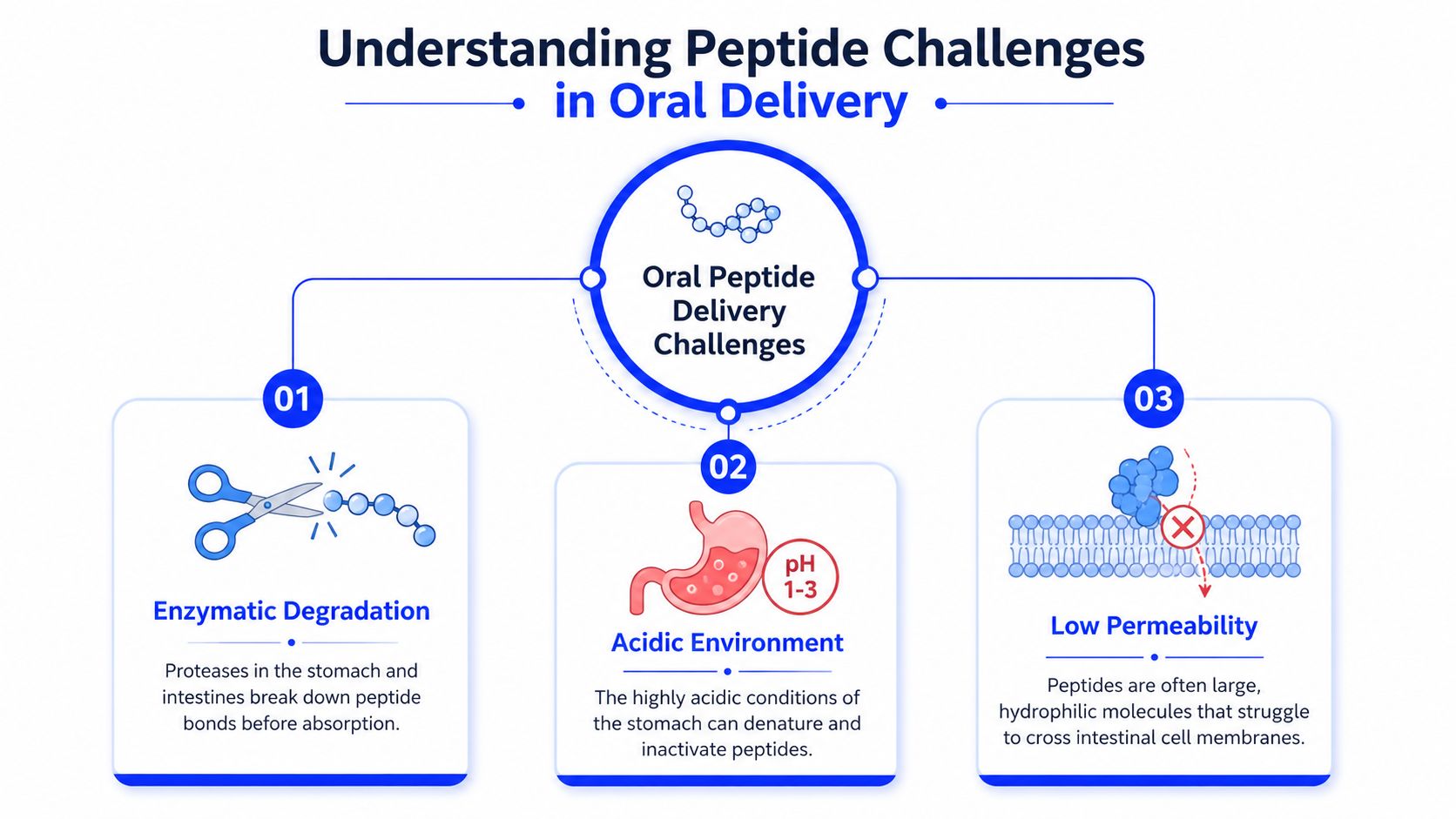
A peptide pill has to make it through a digestive system that is designed to dismantle proteins and peptides. That is helpful for food, but it creates a hard path for a therapeutic molecule that needs to stay whole long enough to be absorbed. Proteases, acidic stomach conditions, and intestinal handling all reduce how much active peptide survives the trip.
A simple way to understand the problem is to follow the molecule step by step. First, it may face acid in the stomach. Then enzymes can clip it into smaller fragments. Even if some of it survives both stages, it still has to cross the intestinal wall, which is a selective barrier rather than an open door. The result is that unmodified oral peptides often show very poor absorption, and bioavailability can be extremely low.
Practical rule: if the peptide cannot survive the journey through the gut, the pill is only carrying a molecule that never reaches its target.
For a long time, oral delivery of peptides looked out of reach. One review notes that, aside from desmopressin, no orally formulated peptide had been FDA-approved at the time it was published, which helps explain why the idea of peptides in pill form was often treated as unrealistic review. That history matters because it shows the barrier was never only about swallowing a tablet, it was about protecting a fragile molecule long enough for it to do useful work.
The picture changed when formulation science improved. Researchers learned that tablets and capsule systems could be built to shield peptides from degradation and shape where release happens in the gut. In the same line of work, later reviews described oral peptide development as technically plausible once those formulation barriers started to be addressed review.
The broader pipeline also grew as the chemistry matured. Recent reviews describe dozens of peptide drugs reaching FDA approval in the newer era, along with many more in clinical and preclinical development Frontiers review. That does not mean oral delivery is easy. It means the field moved from a basic feasibility question to a more precise engineering question about how to keep the drug intact and how to help it cross the gut wall.
A common misconception is that a peptide capsule works like a regular supplement capsule with powder inside. That mental model misses the primary challenge. The capsule shell is only the outer packaging. The harder problem is whether the formulation can protect the peptide, release it at the right point, and preserve enough activity for absorption.
That is why oral peptide delivery is a chemistry and materials problem before it is a packaging problem. The pill format may look simple from the outside, but the inside has to resist acid, resist enzymes, and still release a molecule that can pass through the intestinal barrier. For readers who want a practical reference point, the FDA's interpreting inactive ingredients database can help show how much of a pill is often doing support work rather than acting as the active drug itself.
A person sees a peptide tablet on a pharmacy shelf and may assume the hard part is already solved. The tablet looks ordinary, but the chemistry inside has to survive a hostile trip through the digestive tract before it can do any work. That is the hidden challenge behind peptides in pill form.
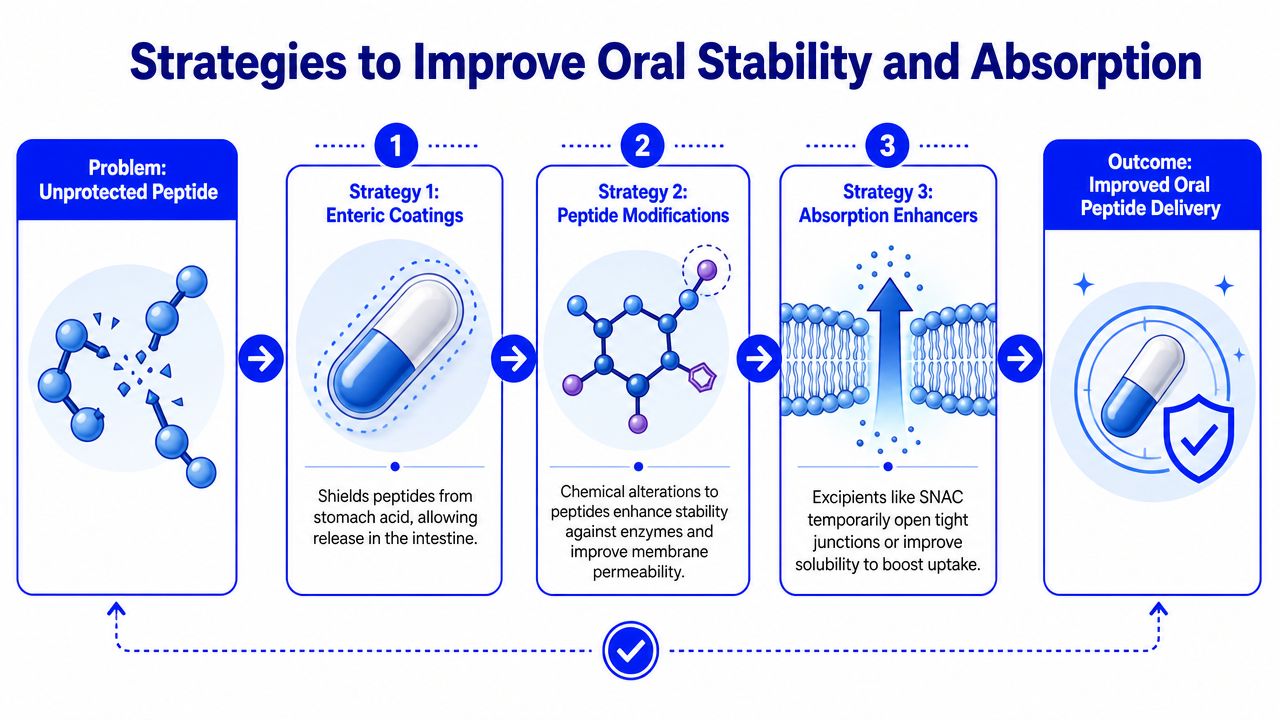
Oral peptide formulation starts with a simple sequence of problems. First, protect the peptide from acid and enzymes. Then, help it reach the intestinal surface in a form that still has activity. If either part fails, the dose can lose too much potency before absorption ever has a chance.
Enteric coatings are one of the clearest examples. They act like a protective shell on a package, keeping the peptide away from stomach acid until the tablet reaches a more favorable part of the GI tract. That does not solve every barrier, but it can reduce exposure to the most aggressive conditions early in the journey.
Another route is to change the peptide itself. Cyclization, D-amino acid substitution, and related structural changes can make the molecule harder for enzymes to break apart, which is why modified peptides often survive better than unmodified sequences review.
A peptide does not need to be indestructible. It only needs to remain intact long enough for the formulation to carry it through the most dangerous part of the process.
Some oral systems use absorption enhancers, such as SNAC, to improve uptake conditions in the gut. Oral semaglutide brought that approach into wider view and showed that a peptide drug could be reformulated into a tablet with a carefully designed delivery system video source. That example matters because it made clear that oral peptide delivery depends on formulation, not just on the active ingredient itself.
Other systems use protease inhibitors to slow enzymatic breakdown, or carrier approaches such as chitosan-based conjugates to support intestinal transport review. These methods do not make the gut gentle. They work around the gut's normal defenses for a short period, just long enough to give the peptide a better chance of crossing the barrier.
For readers comparing formulation components, the interpreting inactive ingredients database helps show how much of an oral product may be doing support work rather than acting as the active drug itself. That distinction is easy to miss if you only look at the label name and not the delivery chemistry.
The point is not that one method always wins. Oral delivery usually depends on layers of protection and support, because the peptide has to survive, release, and absorb in sequence. That is why advanced oral peptide tablets are less like a simple capsule and more like a coordinated system with several parts working together.
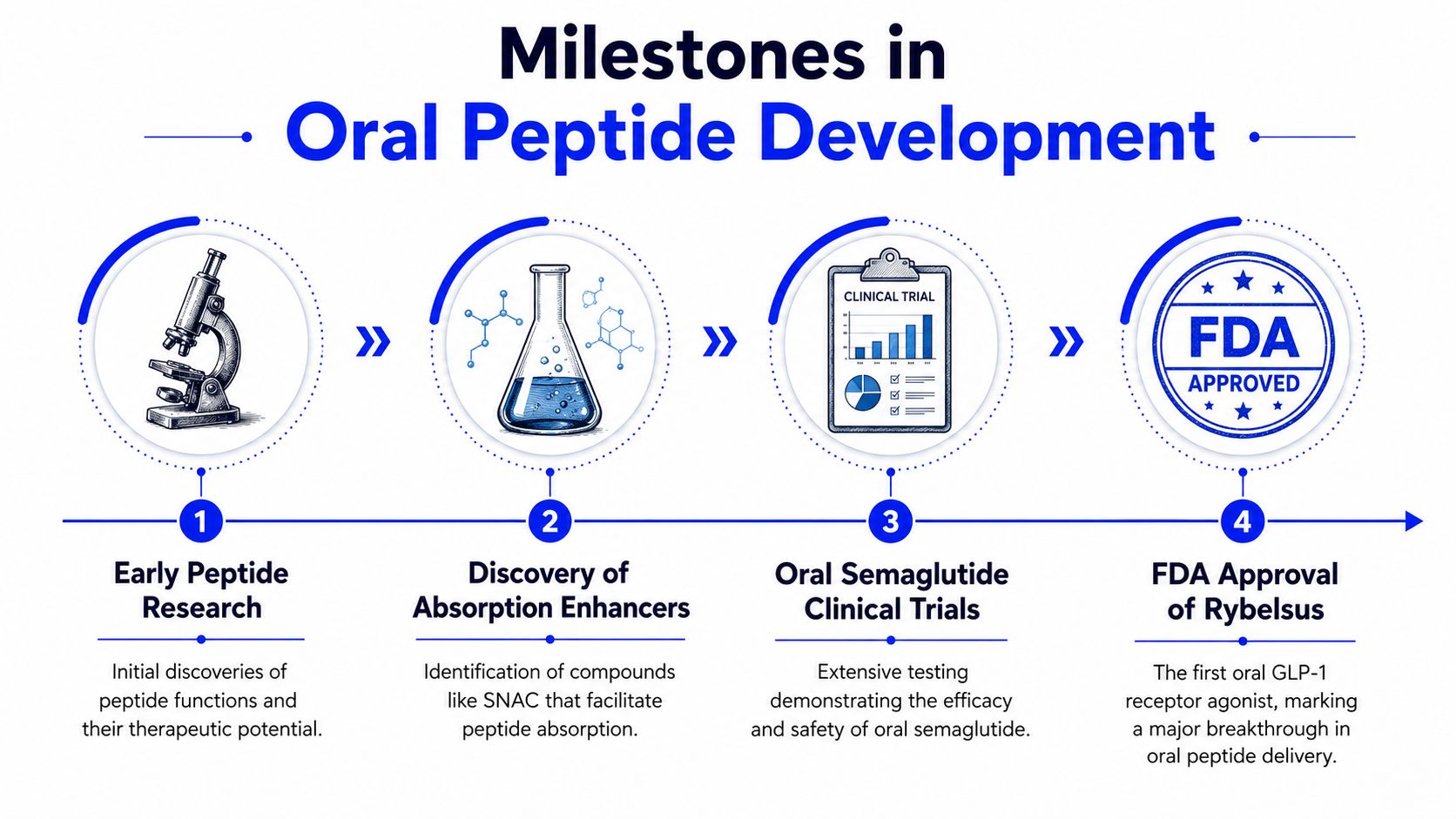
A patient who is used to injections may look at an oral peptide tablet and assume the hard part is “making it a pill.” The chemistry is far more demanding than that. Oral semaglutide, sold as Rybelsus, became the example that made many researchers take oral peptide platforms seriously because it showed that a peptide drug could be paired with the absorption enhancer SNAC and turned into a workable tablet format video source. Before that, oral peptide delivery often looked like a promising idea with limited proof in real use.
That matters because semaglutide did not become notable only because it was swallowed instead of injected. It mattered because the formulation was strong enough to translate a fragile peptide into a usable tablet. The delivery system became part of the product itself, not just a shell around it.
Oral peptide platforms are now being studied well beyond metabolic therapy. Review literature points to gastrointestinal disorders, autoimmune disease, and inflammatory bowel disease as active areas of interest, which fits the practical appeal of a non-injectable option for chronic treatment patterns review. The broader pipeline also keeps expanding, as earlier reviews of peptide development show how many approved and in-development peptides are now on researchers' radar.
Formulation science can be easily underestimated. A peptide that looks straightforward on paper can still fail in the gut if the coating, timing, and absorption support do not work together.
Early animal studies also helped show what is possible. In one report, researchers said a newer peptide pill survived intact through the stomach and intestines in mice, even though only small amounts reached the bloodstream coverage. That kind of result matters because survival in the gut is the first barrier every oral peptide has to clear.
For readers following treatment conversations, Georgia Plastic & Reconstructive Surgery's page on Semaglutide options for losing weight gives a consumer-facing example of why oral formats draw attention. It does not explain the chemistry, but it helps show why easier dosing can attract so much interest.
They do not show that every peptide belongs in a pill. They do show that oral delivery is no longer just a theoretical goal. The cases that work depend on specialized chemistry, and the failures still remind researchers how narrow the margin can be.
The lesson is simple. Oral peptide medicines are real, but they are still unusual products built on careful formulation work.
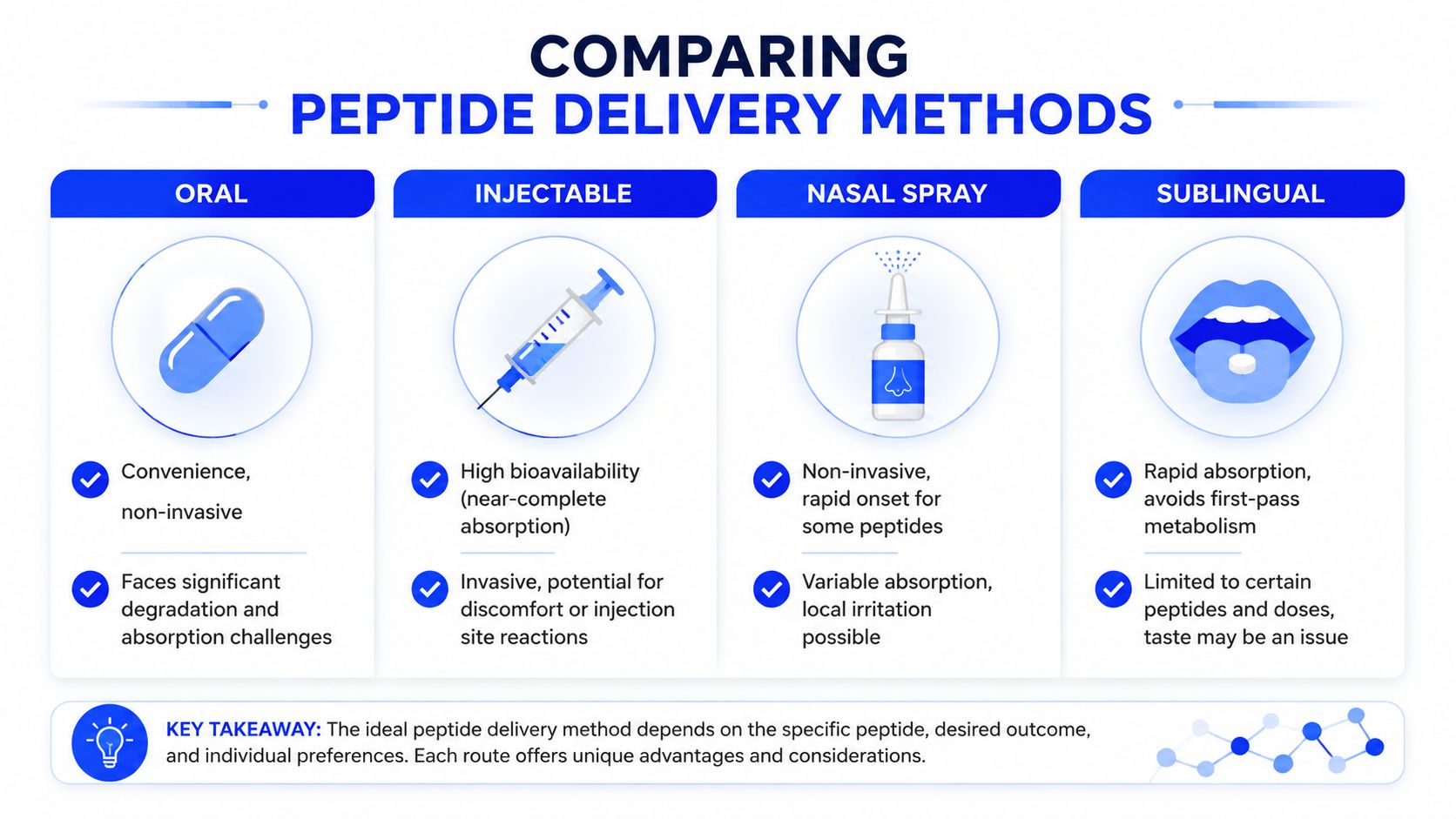
A peptide that looks simple on a chart can behave very differently once it meets the body. Some molecules are fragile enough that the stomach breaks them down before they can do much work, while others can be adapted for a non-needle route if the dose, size, and chemistry line up. The best delivery method depends on how much of the molecule must survive the journey and how tightly the formulation can control that journey.
The comparison below keeps the choice practical.
| Delivery method | What it offers | Main limitation |
|---|---|---|
| Oral | Convenient, non-invasive | Significant degradation and absorption challenges |
| Injectable | Near-complete bioavailability bioavailability review | More invasive, requires more handling |
| Nasal spray | Non-invasive, fast for some peptides | Variable absorption and local irritation |
| Sublingual | Avoids first-pass metabolism | Dose and peptide size limits |
Injectables remain the most reliable option for many peptide programs because they bypass the digestive tract almost entirely. A peptide delivered by injection does not have to survive stomach acid, digestive enzymes, or the intestinal wall before entering circulation. That is why reviews of peptide bioavailability often describe injections as producing exposure close to the administered dose, while oral delivery can lose most of the compound before it is absorbed bioavailability review.
The route does not solve every formulation problem, but it removes the biggest obstacle. Oral peptides must clear a series of barriers in order, like a package that has to pass through several security checkpoints before it reaches the final room. Each checkpoint takes its share, and the remaining amount can be very small by the end.
Nasal and sublingual routes sit between those two extremes. They attract interest because they are less invasive than injections, yet they still depend on how well the molecule fits the route and how consistent the dose can be. For some projects, that balance is workable. For others, the variability is too high to accept.
If a peptide's effect depends on predictable systemic exposure, the delivery route matters as much as the sequence itself.
Researchers usually sort the choice by asking three practical questions. Can the molecule survive the route. Can the dose be delivered consistently. Does the project value convenience more than absolute reliability. Those questions matter more than trying to rank one route as universally best.
Oral delivery wins on ease. Injectable delivery wins on exposure. Nasal and sublingual systems serve narrower use cases where the molecule and dose fit the route well enough. The right answer depends on the compound, not on the label on the package.
The biggest regulatory mistake people make is treating all peptide products as if they're the same. They're not. FDA-approved peptide medicines have gone through clinical testing and review, while supplement-style peptide pills may be sold without the same level of scrutiny.
Harvard Health is blunt about this gap. It warns that many peptides marketed online or through wellness clinics are not FDA regulated, that evidence for benefits in people is largely absent for several popular compounds, and that safety concerns include immune reactions, contamination, and uncertain long-term effects Harvard Health. That warning matters even more when a product is being marketed as a pill, because the convenience factor can make weak quality control easier to miss.
For research use, the practical standard is simple. Check the documentation, verify the source, and store the material correctly. A Certificate of Analysis should be treated as a baseline document, not a bonus, because it's one of the few ways to confirm identity and purity before anything goes into a preclinical workflow.
A few habits reduce avoidable problems:
The most important takeaway is that oral format doesn't soften the need for documentation. If anything, it raises the bar, because formulation complexity adds another layer where quality problems can hide.
Peptides in pill form are real, but they're not simple. The science works only when chemistry, formulation, and route of delivery are designed together, and the reason becomes clear once you look at how aggressively the gut tries to break peptides down. For researchers and buyers, the best decisions come from matching the molecule to the delivery system, then checking the documentation behind every batch.
If you're evaluating research-grade options, review COAs carefully and compare the delivery format to your actual use case, not just the convenience of a tablet. For a closer look at available research materials and sourcing support, explore Peptide Warehouse USA and learn more about how to choose peptide products with confidence.
A CTA for Peptide Warehouse USA.