No products in the cart.


GHK-Cu altered expression in about 31.2% of human genes at a 50% cutoff in Broad Institute work, which is a much broader molecular footprint than is commonly expected from a small peptide. That single result changes how peptide GHK Cu gets read in the lab, because it points to a signaling molecule that behaves like a systems-level regulator, not just a cosmetic additive GHK-Cu research guide
Researchers who treat GHK-Cu as only a skin ingredient miss the complete story. Its structure, copper binding, formulation sensitivity, and quality-control requirements all affect whether a lot performs like a credible research material or a noisy variable in an assay. The practical questions are simple, but they matter, what is the peptide doing, how stable is it, and can the supplier prove what's in the vial?
From a research standpoint, GHK-Cu sits at the intersection of regenerative biology, dermatology, and analytical sourcing. The sections below connect its molecular behavior to the handling decisions that determine whether a study stays reproducible, safe, and useful.
A peptide first isolated from human plasma can still shape current lab practice. GHK-Cu fits that category. It was first isolated from human plasma in 1973 by Loren Pickart and Melvin Thaler, which places it among endogenous human signals that researchers can examine as part of normal biology rather than as a purely synthetic construct GHK-Cu research guide.
That origin matters for interpretation. The strongest work still centers on topical skin repair, extracellular-matrix support, and controlled laboratory modeling, while broader systemic claims remain much less supported. For that reason, the main research questions are practical ones, what formulation was used, whether the complex remained stable, and whether the material supplied to the lab matched the intended Cu:peptide stoichiometry GHK-Cu guide.
Practical rule: if a peptide's mechanism depends on copper binding, sourcing and QC are part of the mechanism, not an afterthought.
The literature is easier to interpret if it is read in three layers. Structure explains why GHK-Cu can influence signaling. Evidence shows where human support is strongest, especially for topical use. Handling determines whether the same signal can be reproduced in the next batch, the next week, or the next assay. That sequence also matches how a research team should set up protocols, because a broad gene-expression footprint only becomes useful when identity, purity, and copper coordination are checked before analysis begins.
The practical implication is narrow but important. If the goal is research-grade sourcing, the peptide should be evaluated with the same care used for other coordination complexes, with attention to identity confirmation, lot consistency, and storage conditions that preserve the intended chemistry. That approach reduces ambiguity before the first experiment starts and gives the resulting data a clearer technical basis.
GHK-Cu is a 1:1 copper(II)-chelated tripeptide built from glycine, histidine, and lysine. That composition is simple on paper, but biologically it behaves like a compact signaling complex, not a passive ingredient. The copper coordination state matters because the literature ties activity to the complex itself, not just to free peptide or free copper.
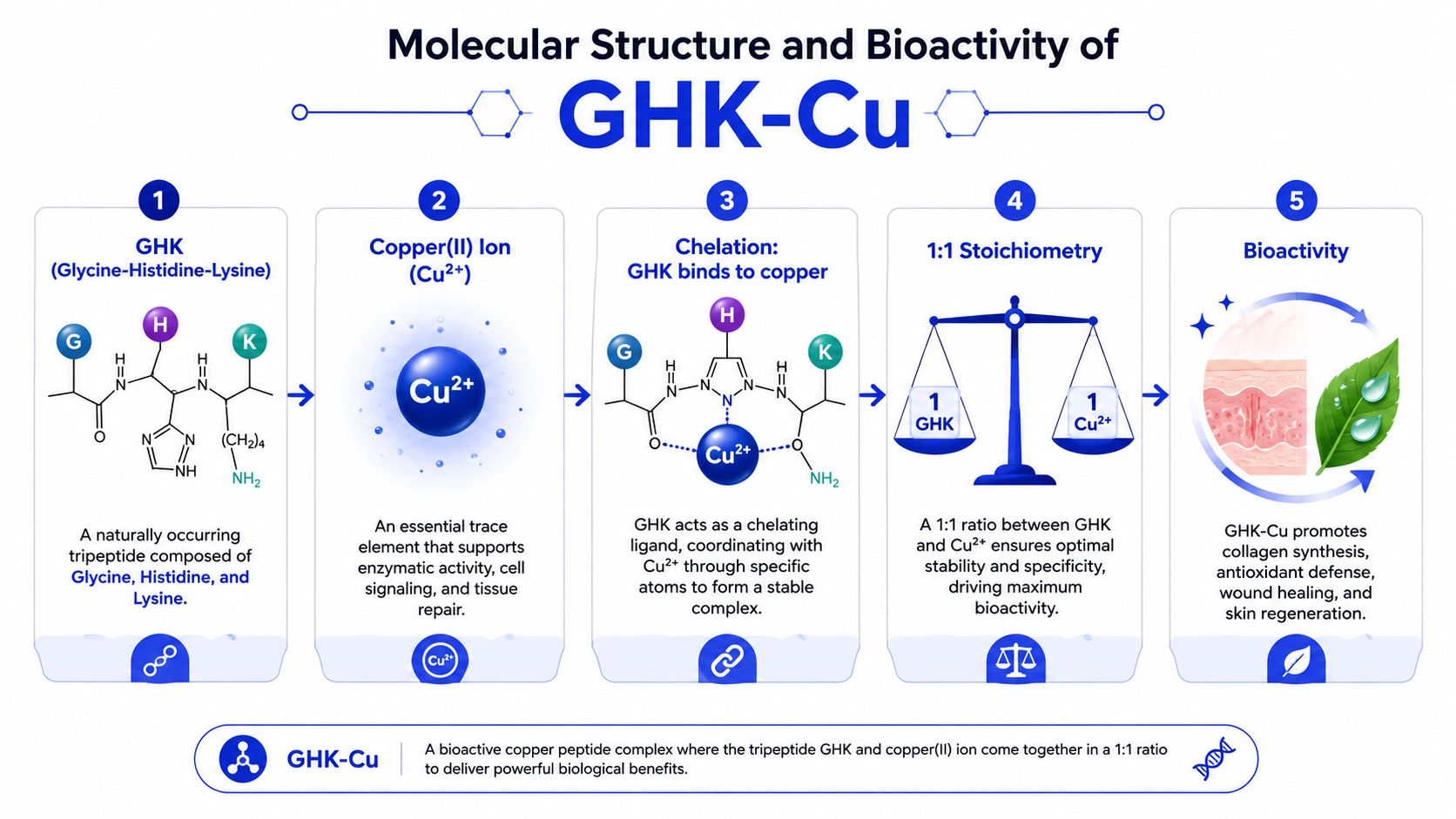
The core distinction is the Cu:peptide ratio. When the complex is intact, suppliers typically verify identity and purity by HPLC and mass spectrometry, and high-purity lots may include endotoxin limits below 0.05 EU/mL in batch QC. That level of specification matters because copper peptides are formulation-sensitive, and small shifts in stoichiometry can change the biological readout.
GHK-Cu is also described as a naturally occurring human tripeptide found in human plasma, saliva, and urine, with the plasma origin first documented in 1973 peptide overview. That endogenous context helps explain why the compound has remained relevant in regenerative biology. Researchers are not trying to force a foreign molecule into tissue, they are examining a human signaling motif that seems to participate in repair.
The most striking systems-level finding is the Broad Institute result showing that GHK altered expression in about 31.2% of human genes at a cutoff of 50% or more, with 59% upregulated and 41% downregulated. That does not mean every one of those genes translates into a visible effect, but it does show why the peptide is treated as a broad regulator of repair biology.
The downstream phenotype aligns with that view. Technical literature links GHK-Cu to collagen, elastin, and glycosaminoglycan synthesis, plus antioxidant and anti-inflammatory actions technical dossier. Independent biomedical review also describes stimulation of dermal fibroblast matrix production PMC review. The practical point is narrower than the broad transcriptomic footprint suggests. A peptide with this kind of gene-expression reach only gives interpretable results when identity, purity, and copper coordination are controlled before the assay begins.
A useful interpretation follows from that pattern. GHK-Cu is less about bulk nutrient replacement and more about low-dose signaling. In practice, that makes it relevant to research questions involving extracellular-matrix repair, controlled inflammation, and tissue remodeling, but only if the formulation remains chemically coherent enough to deliver the intended signal.
The molecule's value lies in the message it carries, so the lab has to protect the message from the moment it leaves the vial.
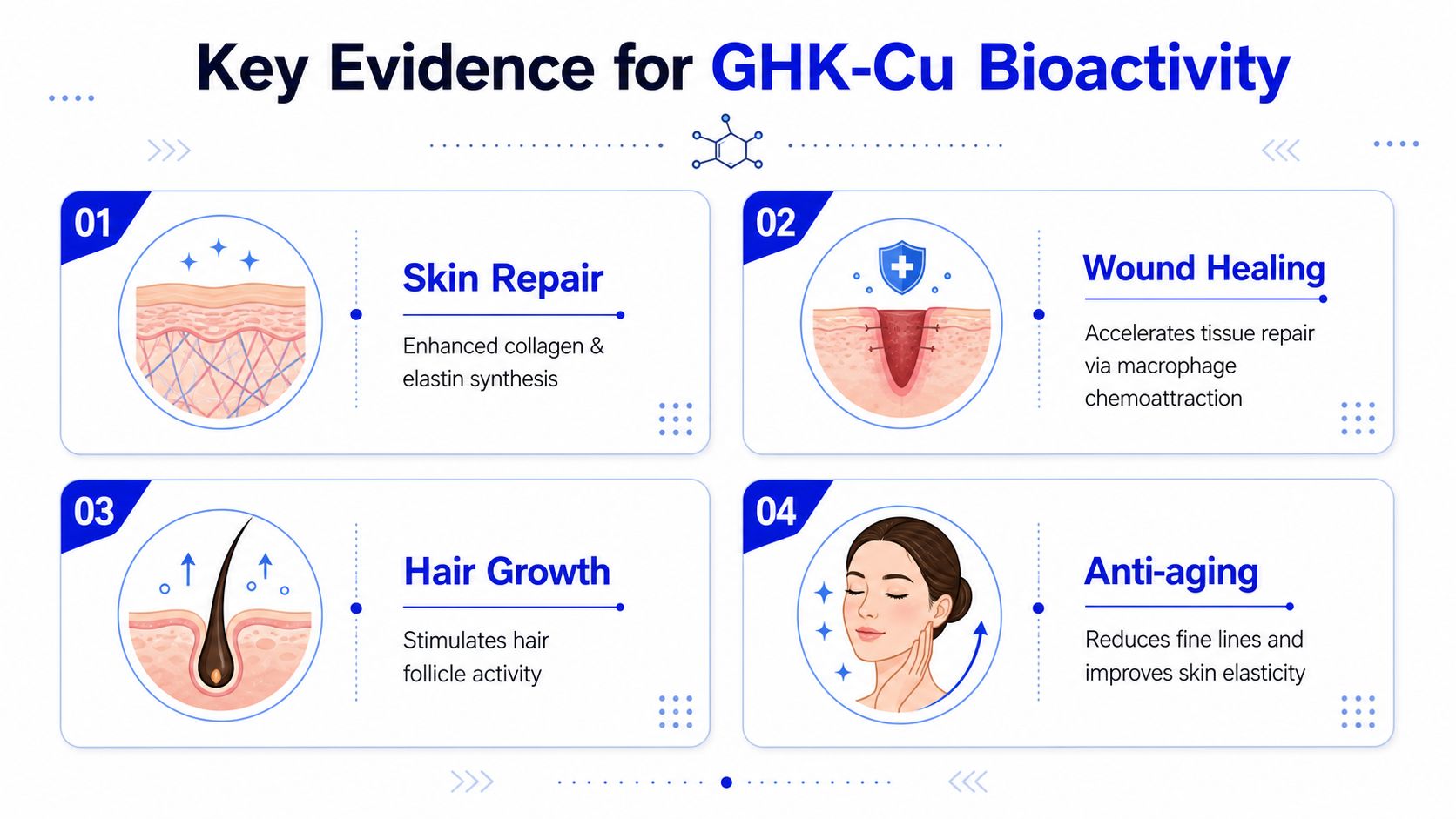
A broad gene-expression footprint does not automatically make a peptide clinically useful, but it does change how researchers should read the evidence. For peptide GHK Cu, the strongest support comes from settings where tissue response is measurable, especially topical skin repair and wound-related remodeling. That fits the way the literature describes it, as a copper-binding peptide associated with collagen synthesis, matrix remodeling, and wound-healing signaling GHK-Cu guide.
The human safety profile is more reassuring for topical use than for speculative systemic use. A 2023 safety review covering 12 studies and 512 participants found that topical GHK-Cu at 0.1% to 1% caused only occasional mild skin irritation and no serious adverse effects. That finding supports tolerability for skin-focused research, but it does not establish efficacy by itself GHK-Cu guide.
The most defensible mechanistic reading is that GHK-Cu participates in tissue-repair signaling. Peer-reviewed review material reports stimulation of collagen, elastin, and glycosaminoglycan synthesis in dermal fibroblasts, which are core structural components of skin repair and remodeling PMC review. That helps explain why the peptide appears so often in skin-repair and cosmetic formulations.
Research summaries also describe GHK-Cu as supporting wound healing across major phases of repair and as a chemoattractant for macrophages wound-healing summary. That matters because macrophage recruitment sits upstream of cleanup, signaling, and remodeling. The practical implication is that the peptide is not only relevant to collagen accumulation after the fact, it may also help shape the repair environment earlier in the process.
For lab work, the assay has to match the claim. A dermal fibroblast model is appropriate if the endpoint is matrix synthesis. If the endpoint is repair signaling, models that track inflammatory resolution and remodeling are more informative than a simple viability readout.
The route changes the evidentiary standard. Most controlled human work described in recent reviews is topical, usually in the 0.1% to 1% range, applied once or twice daily GHK-Cu guide. Independent summaries also note that there are no completed randomized controlled trials of systemic injectable GHK-Cu in humans route evidence gap.
That gap matters for interpretation. A cream that performs reasonably on skin does not validate injection-based use, because biodistribution, tissue exposure, and regulatory expectations differ. The same caution applies to chronic wound applications, where a 2024 clinical guidance summary says topical GHK-Cu peptides are not recommended for diabetic foot ulcers or other chronic wounds because major guidelines do not endorse them and human randomized evidence is lacking clinical guidance.
Decision rule: topical tolerability can support cosmetic research, but it does not justify systemic assumptions.
The evidence base therefore splits into two tiers. Topical studies give researchers a credible starting point for skin-focused work. Systemic claims remain too thin to support strong translational conclusions, so sourcing, identity checks, and formulation control matter more than marketing language when the goal is research-grade QA.
GHK-Cu behaves like a formulation-sensitive signaling complex, so handling is part of the experimental design. If copper coordination changes, or if the vehicle destabilizes the peptide, the biological readout can reflect chemistry problems rather than tissue biology. That matters more here because GHK-Cu is often discussed for its broad gene-expression effects, which makes clean input material and disciplined preparation the difference between a useful signal and an ambiguous result.
For lyophilized powder, the first step is reconstituting it in a sterile aqueous vehicle that matches the assay design, then confirming that the solution stays clear and consistent before use. In practice, that may involve water, saline, buffered aqueous media, gels, or liposomal systems, depending on whether the endpoint is compatibility, penetration, or release behavior.
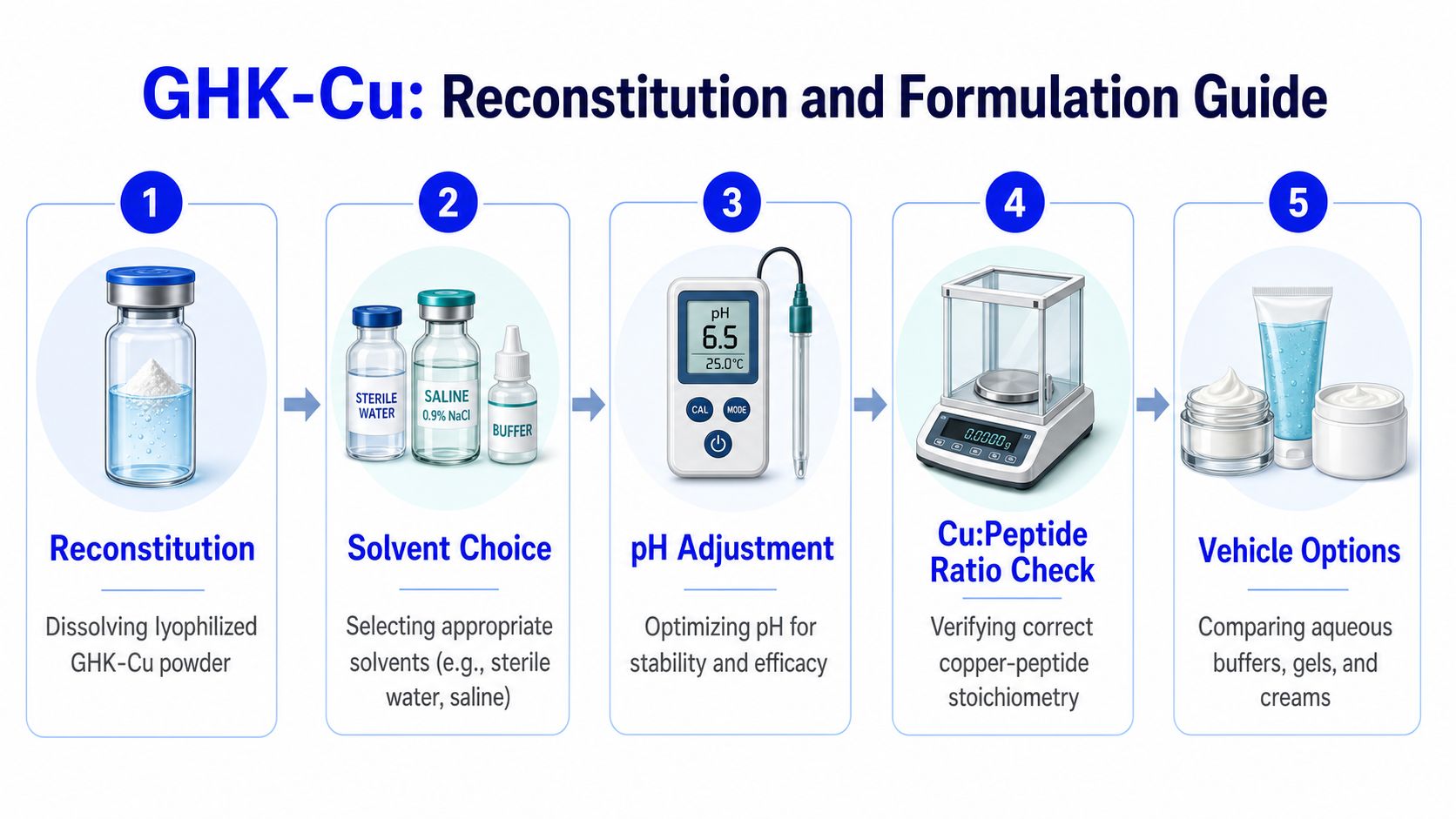
The formulation choice should match the question, not the trend. A simple aqueous buffer is easier to control analytically, while gels and liposomal systems may be better when the study is trying to approximate topical delivery. Preservative compatibility also matters, because some excipients can alter peptide behavior or complicate stability interpretation. For research groups comparing lot performance across preparations, that means the vehicle cannot be treated as a neutral background variable.
A useful QC workflow starts with identity confirmation. The supplier documentation should show HPLC and mass spectrometry verification, and the lot should carry batch-specific contaminant reporting that includes endotoxin data product QC. If those records are missing, the lot is harder to defend in a publication, even if the peptide name on the label looks correct.
Use a short internal checklist:
Researchers who buy research peptides from a supplier with transparent lot documentation, such as Peptide Warehouse USA, should still treat the COA as data, not marketing. The point is traceability, because a reproducible peptide study begins with a reproducible input. That becomes especially important when the experiment is meant to connect molecular activity with formulation behavior, since weak documentation can make a gene-expression claim impossible to interpret with confidence.
If a formulation can't be characterized, it shouldn't be trusted as the basis for a mechanistic claim.
GHK-Cu should be handled as a peptide whose activity depends on preserving both the peptide backbone and the copper complex. That means storage choices have to protect against moisture, light, repeated warming, and unnecessary agitation.
For lyophilized material, refrigerated storage is the safest default in most lab workflows, and the vial should stay protected from direct light in an amber container or equivalent dark packaging. Desiccant use helps reduce moisture uptake, which is a quiet but common source of degradation for hygroscopic compounds.
The practical reason is simple. Moisture and light can create the kind of slow instability that doesn't show up until an assay starts drifting. Once that happens, the study loses time and the lot becomes harder to interpret.
Once GHK-Cu is in solution, handling discipline matters more. Minimize freeze-thaw cycles, prepare small aliquots for near-term use, and inspect each aliquot visually before loading it into an assay. If a solution changes color, develops haze, or shows precipitation, it needs review before any downstream use.
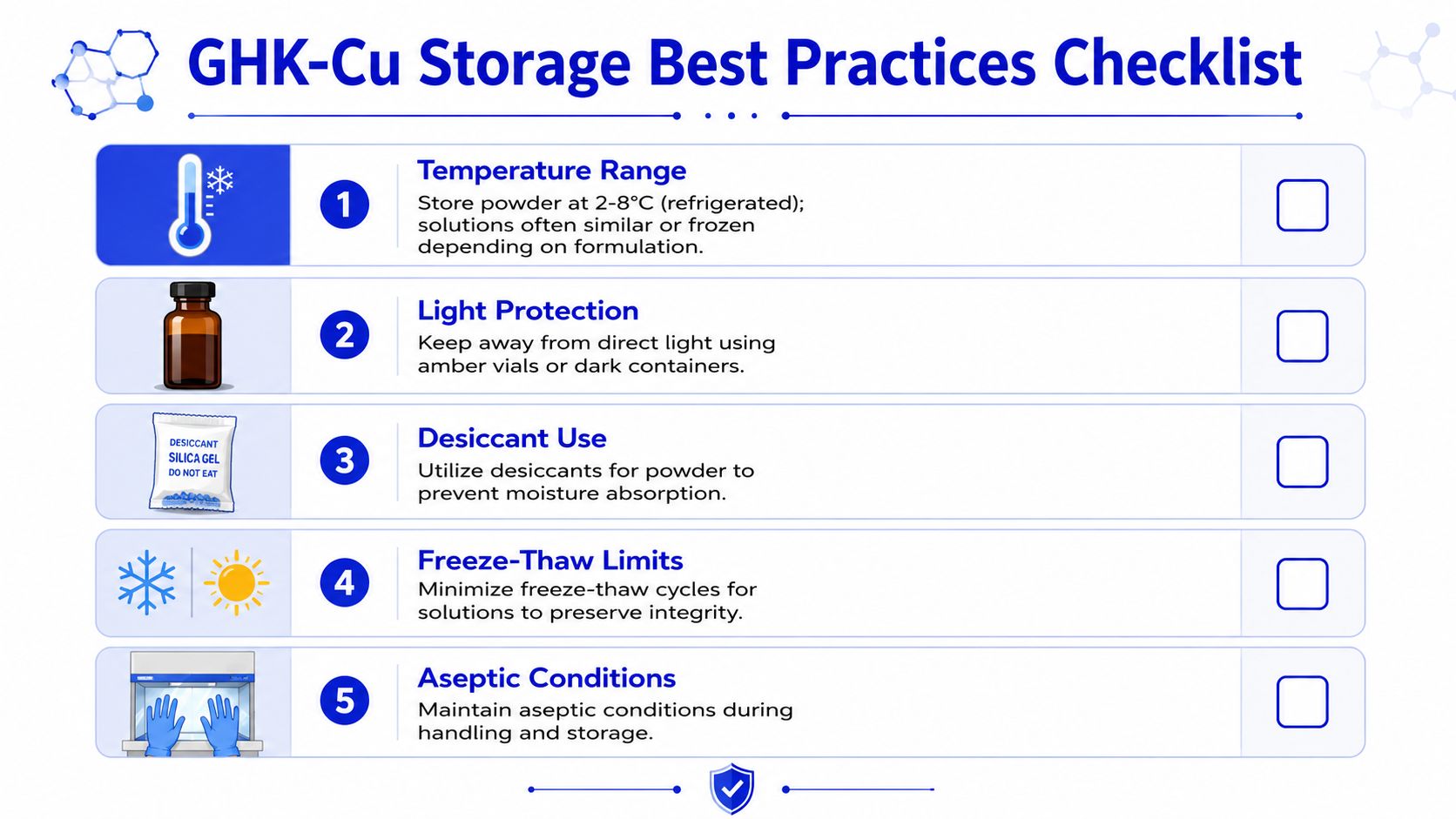
A sensible monitoring routine includes:
The point isn't to turn peptide storage into bureaucracy. It's to make sure the compound that enters the assay still resembles the compound that left the supplier.
GHK-Cu sits in a mixed category from a compliance perspective. Topical cosmetic interest is established, but systemic or injectable use belongs to a different evidentiary and regulatory category. That distinction matters because material sold for research use only is not the same as a product supported for human administration.
The human safety data that are easiest to defend are topical. A safety review covering 12 studies and 512 participants reported only occasional mild irritation and no serious adverse effects with topical use in the 0.1% to 1% range. That pattern supports a low-risk profile for cosmetic research, but it does not resolve the question of invasive use.
The route gap is the larger regulatory problem. As noted earlier, there are systemic evidence gap no completed randomized controlled trials of systemic injectable GHK-Cu in humans. Extrapolating topical findings into injectable protocols is therefore a weak research argument, especially if the study design depends on assumptions about absorption, distribution, or tolerability that have not been shown in human systemic work.
Documentation protects both the experiment and the institution. Labels should match the COA, the study file should record lot numbers and storage conditions, and any in vivo or ex vivo work should pass the relevant institutional review steps before it begins. That matters even more when a protocol moves beyond skin-surface work into models that could be read as translational or therapeutic.
A simple risk frame helps keep the work defensible:
The practical conclusion is conservative. GHK-Cu has support as a topical research ingredient, but the boundary between research use and human application remains clear, and QA practice should reflect that boundary at the bench, in the file, and in the supplier record.
Sourcing errors show up quickly in the biology. GHK-Cu is straightforward to obtain, but poorly documented material can undermine a study before the first assay runs, especially if the sample's copper binding, identity, or impurity profile is uncertain.
A defensible supplier record has to survive review, not just a sales conversation. At minimum, that means a certificate of analysis, stated purity, and batch-specific microbial and endotoxin reports. The supplier should also identify how the peptide was verified, with HPLC and mass spectrometry listed in the documentation rather than implied.
A simple intake check reduces later ambiguity:
A lot with a full analytical package can enter the data trail with fewer questions attached to it. A lot without that package leaves avoidable uncertainty in any study that depends on reproducibility, especially when the work ties molecular behavior to handling conditions and batch history.
Buying rule: choose the lot that can be defended on paper before you ever defend it in a poster or paper.
For research teams comparing vendors, the most useful metric is not marketing language. It is whether the supplier can document a consistent chain from synthesis to QC to delivery, with the peptide's copper stoichiometry intact when it arrives and the record set complete enough to support later review.
GHK-Cu makes sense only when the reader keeps three things in view at once, structure, evidence, and handling. The molecule is a naturally occurring copper-binding tripeptide with a broad gene-expression footprint, the strongest human support sits in topical skin research, and the lab process has to preserve the complex if the result is going to mean anything.
The biggest gap is still systemic evidence. Without completed randomized human trials for injectable use, the right posture is disciplined skepticism, especially outside skin-focused applications. That's why sourcing, COAs, and storage are not side topics, they're the foundation of a defensible research program.
If you're planning a new assay or building a procurement list, start with the documentation trail first. Review the lot data, compare vehicles, and choose a supplier that can show the identity and purity records your lab needs. Explore the GHK-Cu catalog at Peptide Warehouse USA, request the COAs that match your workflow, and contact support if you need to align a bulk order with a specific research protocol.
A CTA for Peptide Warehouse USA.