No products in the cart.

You're halfway through a study, the peptide order is moving faster than expected, and the lab manager has just asked why the next round is going to cost more than the first. That's the moment when it becomes evident that buy peptides in bulk is not just a pricing decision, it's a documentation decision, a traceability decision, and a reproducibility decision.
The mistake is treating bulk buying like a larger version of retail ordering. In practice, the move changes how you vet suppliers, what paperwork you demand, how you validate the lot, and how you store and receive the shipment. Done well, it keeps a multi-month project moving without constant reordering. Done badly, it creates a stack of cheap vials you can't confidently use.
A preclinical team often starts with one or two vials, then the protocol expands, the timeline stretches, and the next invoice lands at exactly the wrong time. At that point, procurement stops being a convenience task and turns into a budget control problem. One pricing source notes that larger research orders can save about 15 to 40 percent per unit, with 5-vial orders typically reducing prices by 15 to 20 percent, 10-vial orders by 25 to 30 percent, and 25-plus vial orders by 35 to 40 percent (Real Peptides bulk discount analysis).
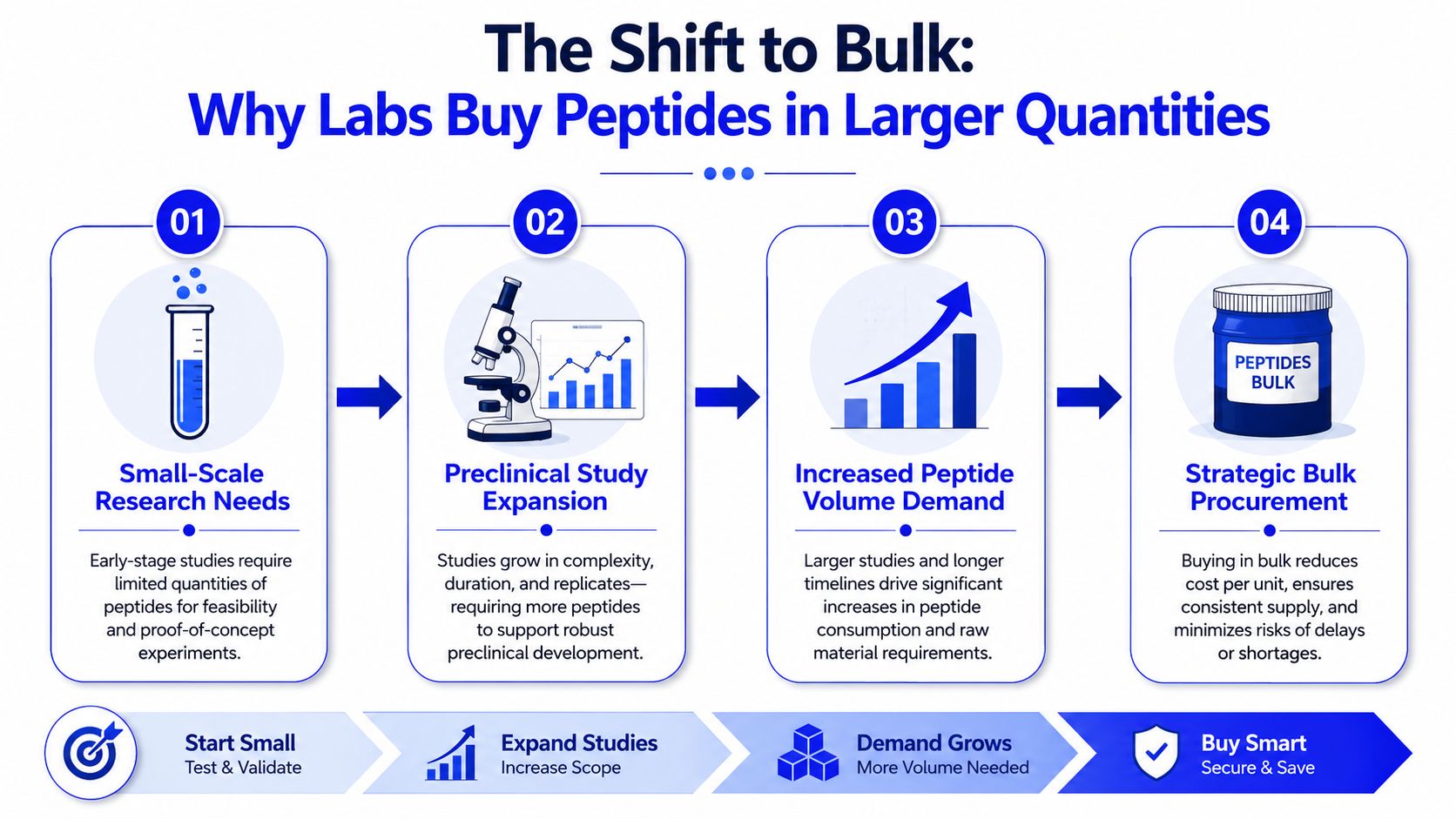
The main reason labs consolidate peptide orders is continuity. One source describes how a facility spending $12,000 per year at standard pricing could reduce annual spend to roughly $8,000 to $8,500 through structured volume purchasing, which shows why bulk buying has become a procurement strategy rather than a one-off bargain hunt. The same source also notes that many suppliers set 5-vial minimum order quantities before bulk pricing starts, so the market already runs on tiered thresholds.
That changes the buyer's job. You are no longer comparing a single product page, you are comparing batch consistency, reorder friction, and the hidden cost of repeated receiving, testing, and sign-off. For institutional labs, those frictions matter as much as the label price.
Practical rule: if the study timeline is longer than a single purchase cycle, treat the order like a supply program, not a shopping cart.
The strongest bulk buyers do not start with price. They start with the paperwork stack, then validate the lot, then decide whether the economics still work. That is the thread running through the rest of this guide, from compliance checks to pilot orders to chain-of-custody records.
If you are trying to buy peptides in bulk for a lab, the main question is not whether the unit price drops. It is whether the supplier can prove that every vial in the batch is traceable, testable, and consistent enough to support repeat work.
Research peptide buying lives or dies on category discipline. A careful buyer needs to separate research-use supply from human-use categories, compounding pharmacy workflows, and anything that looks like a therapeutic product presented without the right controls. The fastest way to disqualify a vendor is to check whether the product page, label, and checkout flow all say the same thing about intended use.
A legitimate research supplier should make the intended use obvious. Look for language that clearly limits products to research, laboratory, or analytical use only, and check whether the site uses age-gating and an FDA disclaimer that keeps the category boundaries clear. If the supplier's language drifts into treatment claims, dosing guidance, or human-use positioning, that's a procurement problem, not a sales advantage.
You also want to see whether the supplier restricts shipping in a way that matches the product category and customer type. Institutional procurement teams should keep a simple internal file with the intended-use statement, product label, and any site policy that confirms the research-only boundary.
Use a short compliance screen before any commercial conversation. A clean supplier record usually includes:
That screening step matters because it keeps non-research suppliers out of the pipeline early. It also protects the lab if purchasing records are ever reviewed internally. If a vendor can't document the category cleanly, the rest of the transaction is already shaky.
A well-run procurement file should show that the buyer checked the compliance boundary before touching price. That habit saves time later, especially when purchasing goes through a university, a CRO, or a regulated internal review process.
A marketing page can say almost anything. A lot-specific document package has to prove something. That is why the core evaluation stack for bulk peptides starts with a Certificate of Analysis, then moves to HPLC chromatogram, mass spectrometry data, and, when relevant, endotoxin or microbial reports.
The strongest buying guidance is direct about the gap between a claim and evidence. A standalone “98% purity” label does not tell you much unless the vendor also shows the method details, including HPLC conditions, retention times, and peak-area data. The number matters less than the path used to generate it.
A usable lot package should include batch number, retention time, peak shape, chromatograms from the exact lot being shipped, and mass confirmation tied to the same batch. For many buyers, the common technical benchmark is ≥98% purity by reverse-phase HPLC, MS confirmation within ±0.5 Da, and endotoxin below 1 EU/mg for cell-based work. Those are not marketing phrases. They are procurement filters, and they help separate a real lot from a polished sales sheet.
The failure patterns are easy to spot once you know where to look. Generic template COAs, delayed post-synthesis paperwork, and documents that are not tied to the actual shipped lot are all warning signs. So are claims that rely on supplier reputation alone without raw chromatograms or batch-specific analytics.
A COA that arrives after the shipment, or without the raw data behind it, does not really verify the lot. It only documents that someone was willing to write one.
Independent third-party testing is a stronger signal than internal claims by itself. One wholesale supplier states that each lot is independently tested by Horizon Analytical using HPLC/MS and that a per-lot CoA is available, while another U.S.-based supplier reports per-lot identity, purity, and quantitation documentation with lot values such as 99.4% purity for a BPC-157 vial. The buyer's job is to ask for that same level of lot specificity, not to accept a vague summary sheet or a recycled spec page. The practical checklist in the Alibaba buying guide on bulk peptides and the related Alibaba buying guide on peptide research bulk both point in the same direction, document the lot, then verify the lot.
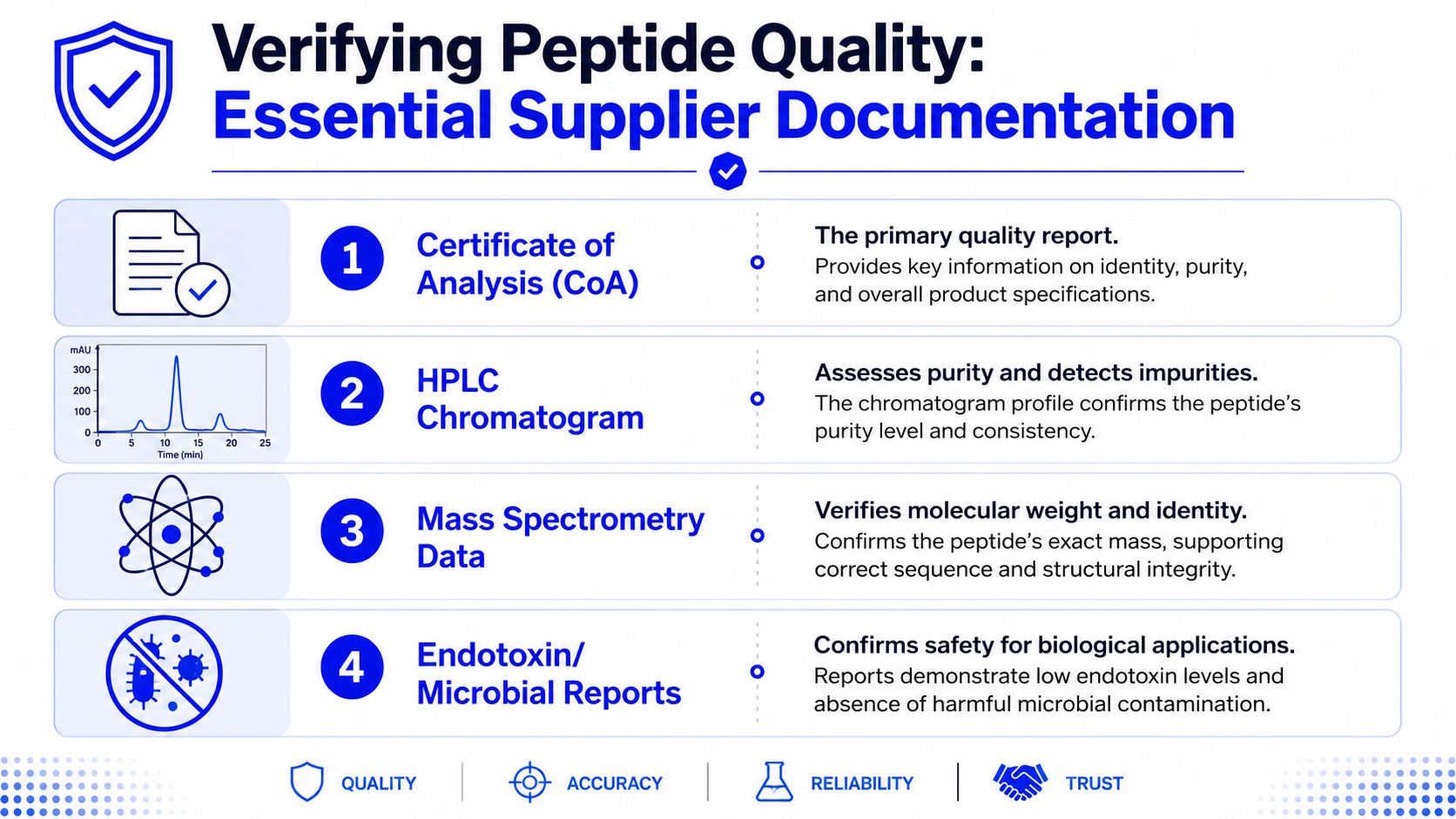
A practical document request should be short and direct. Ask for the exact lot COA, the raw HPLC trace, the MS printout, and any endotoxin or microbial report tied to the shipped batch. If the vendor cannot produce those cleanly, do not move forward.
A supplier can still fail inside your lab if the lot behaves badly in your workflow. That is why the first purchase should be a pilot order, not a bulk commitment. A buying guide recommends a small validation order of about 5 to 10 mg, then analytical review and short-term stability checks before any larger scale-up.
A formal RFI should ask for more than a quote. It should specify the sequence, purity target, packaging, required analytics, and whether endotoxin testing is needed. That gives the vendor a clear target and gives procurement a paper trail showing that quality was defined before price entered the discussion.
The best vendors respond with lot-specific paperwork, not a recycled spec sheet. If the supplier cannot provide raw HPLC and MS data tied to the lot, the order should stay at pilot scale. If the work is cell-based or otherwise sensitive, ask for endotoxin testing as part of the evaluation package.
The minimum QA stack is broader than many buyers expect. Experts recommend at least four orthogonal checks, HPLC-UV, mass spectrometry, amino-acid analysis or sequencing, and LAL endotoxin testing, because purity summaries alone do not prove identity or suitability.
A simple pilot workflow looks like this:
That sequence protects downstream assays and keeps the lab from locking into a vendor before the lot has earned trust. It also creates an internal QA record that can be reused the next time the same peptide is purchased.
One option in that evaluation phase is Peptide Warehouse USA, which provides research-use peptides with third-party documentation, including COAs, microbial reports, and endotoxin reports. Use that kind of supplier only as part of the same documented workflow, not as a shortcut around it.
Bulk pricing only makes sense when the paperwork, lead time, and receiving plan are clear enough to support the order. Procurement teams that treat bulk buying as a documentation problem first tend to avoid the expensive mistake of chasing a lower unit price on a lot they cannot verify or receive on time. The discount structure described in Real Peptides bulk discount analysis shows why order size changes the economics, while vendor quote timing from Royal Peptides wholesale information reminds buyers that availability and responsiveness can vary with the order.
The gap between a small wholesale order and a larger consolidated buy is not just price per vial. It also changes how much procurement effort gets spread across the study, how many receiving events the lab has to manage, and how often the team has to recheck lot paperwork. As noted earlier, 5-vial orders often sit in a lower discount band, 10-vial orders move into a better one, and 25-plus vial orders usually sit at the deepest discount tier.
That curve matters because it changes the buying decision. A larger order can reduce reorder risk, cut down on receiving cycles, and keep a project supplied through a longer experimental window. For labs running repeated work, that continuity can be worth more than the first quoted discount.
Ask for tiered pricing in plain language and make the vendor define the terms. A serious wholesale supplier should be able to state the MOQ threshold, confirm whether the peptides are in stock or made to order, and explain how that choice affects quote turnaround and shipping speed. If the supplier cannot answer those questions clearly, the apparent savings may disappear into delays, substitutions, or extra follow-up.
Buying note: a lower unit price only helps if the lot can be documented, shipped on time, and validated before use.
The hidden cost is administrative. Smaller orders create more invoices, more receiving events, more lot checks, and more storage decisions. Bigger orders reduce those touchpoints only if the document trail stays intact and the receiving team can support the volume without losing traceability.
For teams building a more formal operating system, the guide to SME supply chain solutions is useful background.
A clean COA doesn't save a bad shipment. If the vial arrives compromised, the lab inherits the problem whether the supplier wrote a perfect document set or not. That's why shipping and storage need to be treated as part of quality control, not a separate operations issue.
For bulk peptide orders, chain-of-custody should answer four questions immediately. Who received the package, when did it arrive, what condition was it in, and where was it stored next? Those notes are the difference between a traceable handling issue and a vague reproducibility complaint later.
Lyophilized peptides should be protected from light and moisture, and the receiving log should note whether the shipment was sent under ambient or temperature-controlled conditions. If a vial arrives damaged, quarantined, or mismatched to the paperwork, document it before anyone opens the container.
Institutions should align returns and damaged-shipment procedures with internal procurement policy before the first order lands. If a package is compromised, the lab needs a clear path for photos, quarantine, supplier contact, and replacement review. That avoids ad hoc decisions under time pressure.
For teams building a more formal operating system, the guide to SME supply chain solutions is useful background on keeping receiving, tracking, and vendor communication organized. The same discipline applies here. You don't need a complex platform to manage peptide logistics, but you do need a closed loop from ordering to storage.
Bulk buying only works when the physical handling matches the analytical scrutiny. If the shipment process is sloppy, the downstream data will eventually show it.
The cleanest bulk workflow is simple enough to hand to a new lab member. First, verify the supplier's research-only labeling and compliance language. Then request the lot COA, raw HPLC chromatogram, MS data, and any endotoxin or microbial report tied to the exact batch.
After that, place a 5 to 10 mg pilot order, run your own analytical review, and document a short stability check before you scale. If the vendor can't meet the paperwork standard, can't explain MOQ and lead time clearly, or ships without traceable receiving details, stop there.
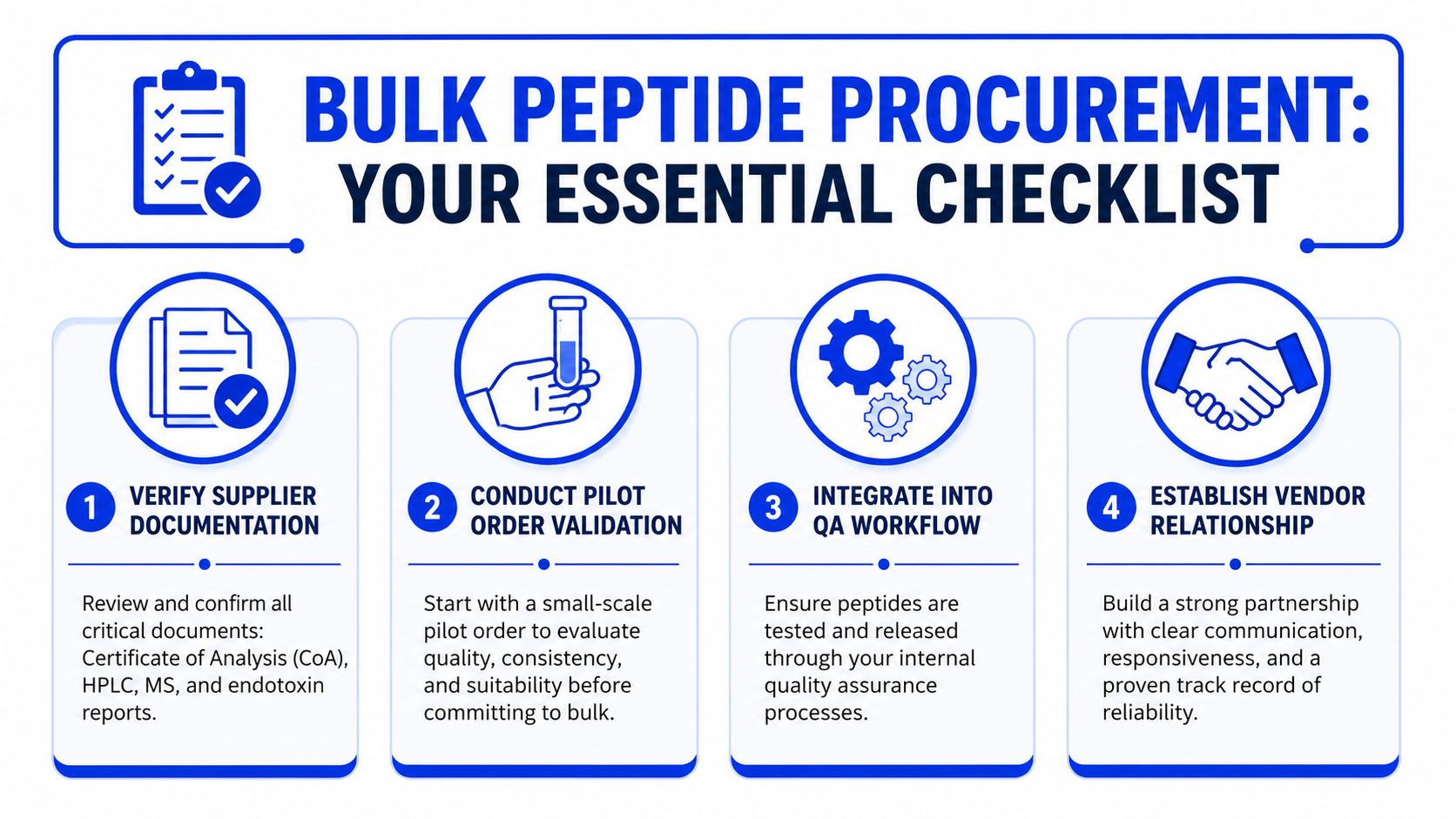
Use the checklist below as the final gate:
If you're ready to compare transparent, COA-verified research options, visit Peptide Warehouse USA and review the product documentation with the same checklist in hand. The right supplier should make traceability easier, not harder.