No products in the cart.


Most advice on pt-141 nasal spray UK starts in the wrong place. It talks about convenience, timing, or “results,” and skips the part that determines whether a purchase even belongs in a compliant lab workflow. In the UK, PT-141 is not approved as a pharmaceutical medicine, so the key question isn't whether it's easy to find, it's whether a supplier is treating it correctly as a research chemical and documenting it that way UK research guide.
That distinction changes everything for procurement, storage, and interpretation. A product page can look polished and still be unsuitable if it implies therapeutic use, blurs clinical framing, or fails to show the documentation a lab needs. The practical buyer's job is to separate marketing from material reality, then judge the spray form on stability, dosing format, and fit for research use.
The most common mistake is assuming PT-141 nasal spray UK sits somewhere between a pharmacy product and a wellness supplement. It doesn't. In the UK, bremelanotide/PT-141 is not approved as a pharmaceutical medication and is instead handled as a research chemical when sold by legitimate research suppliers UK research guide.
That UK position matters because the United States has a different regulatory outcome. PT-141 reached a major milestone in 2019 when the FDA approved it as Vyleesi for acquired, generalized HSDD in premenopausal women, with a prescribed 1.75 mg subcutaneous injection at least 45 minutes before anticipated sexual activity and a maximum of 8 doses per month US dosing reference. The UK does not mirror that pathway, so a listing for nasal spray in Britain is not the same thing as a prescription medicine.
Practical rule: if a UK page reads like a consumer sexual-health advert, treat that as a red flag, not a convenience.
Legitimate UK-facing research listings tend to stay in the research lane. The market examples in the brief show 10 mg nasal spray products, one stating ≥98% purity and another emphasizing 10 mg per unit UK research supplier reference. That pattern signals research distribution, not routine clinical dispensing.
“Research use only” is not a decorative disclaimer. It means the supplier is framing the material for laboratory work, not for human treatment or pharmacy-style dispensing. For a lab buyer, that should trigger a simple question, can the supplier prove identity, purity, and intended use without drifting into clinical claims?
The safest procurement posture is narrow and boring. Ask whether the product is clearly labeled, whether the documentation matches the batch, and whether the seller avoids language that implies diagnosis, treatment, or patient benefit. If a supplier can't keep that boundary clean, the problem is usually bigger than the peptide.
PT-141, also called bremelanotide, is a centrally acting melanocortin receptor agonist. In practical terms, it acts through central signaling rather than the peripheral blood-flow pathway people usually associate with erectile-function products melanocortin mechanism.
The intranasal route is used to trade convenience for speed and dose efficiency. Research-focused and review sources describe nasal onset as typically 20 to 60 minutes, with some reports placing peak effects around 30 minutes and duration at roughly 2 to 6 hours. Injected PT-141 is often described as lasting 6 to 12 hours, so the form factor clearly changes the exposure window nasal pharmacokinetics.
The same source also cites about 30% bioavailability for nasal administration. That is the practical reason nasal systems often need more material per delivered session than injection does, even when the user experience is simpler.
PT-141 nasal spray is popular for one reason that matters in the lab, it removes needles without removing systemic exposure.
In UK research supply, PT-141 nasal spray is often presented as a 10 mg unit with metered delivery. One supplier reference describes a 10 mL bottle containing 10 mg total peptide, with 100 micrograms per spray, which implies 100 evenly metered sprays at full fill volume metered-dose reference. That matters because intranasal work lives or dies on uniform spray performance, deposition, and consistency from one unit to the next.
For experimental design, the big advantage is operational simplicity. The spray can be handled as a repeatable delivery system, while still keeping the peptide in a format that is easier to deploy than needles in some research settings. The limitation is just as important, because nasal absorption can vary with technique, congestion, and device quality.
The mechanism also explains why PT-141 gets discussed alongside sildenafil in research conversations. An independent study found that co-administration with sildenafil produced a significantly greater erectile response than sildenafil alone, without an increase in adverse events versus monotherapy. That does not turn the spray into a clinical shortcut, but it does show why researchers keep looking at central arousal signaling.
The spray-versus-injection decision is not about which format sounds easier. It comes down to what the protocol needs most, convenience, potency, or consistency. In the UK research setting, that choice carries extra weight because PT-141 is still a research chemical, not an approved domestic medicine for routine prescribing. Format selection therefore becomes a procurement and study-design decision, not a brand preference.
| Characteristic | Nasal Spray | Subcutaneous Injection |
|---|---|---|
| Absorption | Through nasal mucosa, more variable | Direct systemic delivery, more consistent |
| Onset | Often within 20 to 60 minutes nasal pharmacokinetics | Often within 15 to 30 minutes, with peak around 30 to 60 minutes in research protocols research guide |
| Duration | Roughly 2 to 6 hours | Often 6 to 12 hours |
| Dosing feel | Needle-free, easier to deploy | More precise and generally more potent |
| Use case | Situational, lower-friction workflows | Studies needing reliable exposure |
The practical split is straightforward. Nasal spray is easier to handle, but it also gives up some control over absorption. Injection demands more handling discipline, yet it usually gives a cleaner and more reproducible exposure profile.
Independent summaries of the clinical literature note nausea, flushing, headache, sweating, and taste disturbance as observed effects, and they also note that adverse reactions were generally more severe with subcutaneous injection than with nasal spray in studied settings tolerability summary. That distinction matters if the protocol values participant comfort, repeat administration, or fewer interruptions during observation.
Injection still keeps the stronger case on exposure control. Analysts reviewing the literature describe injections as more potent and consistent. So the nasal spray can be the better operational choice without being the stronger pharmacologic one.
If the study needs repeatable exposure and the cleanest read on response, injection usually wins. If the study needs easier handling and potentially gentler tolerability, nasal spray earns its place.
The right format depends on the question being asked. If the project is measuring user acceptability, the spray form often makes sense. If the goal is to reduce variability in a controlled experiment, injection usually gives the more dependable signal.
A polished product page does not prove a compliant supply chain. For PT-141 nasal spray UK procurement, the supplier needs to show what the material is, where it came from, and how it was handled before it reached your bench.
The request list is simple, and it should be available without back-and-forth. Ask for a Certificate of Analysis, identity and purity documentation, and evidence that the batch matches the label. A clear research-grade baseline is ≥98% purity, but that figure only matters if the seller can support it with proper documentation rather than a sales claim UK research supplier reference.
A supplier file that deserves attention usually includes:
The point is consistency across the paperwork. If the label, batch data, and supporting documents do not line up, the lab takes on avoidable risk.
Therapeutic language is the first warning sign. If the page reads like it is selling sexual performance, libido treatment, or clinical outcomes, the supplier may be presenting a research chemical as if it were an approved medicine. That matters in the UK because buyer questions often turn on legality, import expectations, and whether a product page is implying clinical use where none exists UK FAQ gap reference.
Vagueness around testing is another problem. A seller may mention purity but avoid saying how it was verified, which leaves you with a headline and no audit trail. That is weak enough for a lab and weaker still for institutional procurement.
A serious supplier usually looks plain on paper. The documentation is a little dull, and that is exactly what you want.
PT-141 handling starts with a simple assumption. It is a research chemical, not a clinic-ready medicine, so storage, traceability, and batch consistency matter more than convenience.
Unreconstituted PT-141 is typically stored at 2 to 8°C, protected from light and moisture storage guidance. In practice, that means keeping the material cold, dry, and sealed until it is needed. Once reconstituted, it should still be held under cold conditions, and repeated freeze-thaw cycling should be kept to a minimum because each cycle can affect stability.
If your lab is using a nasal system, the delivery device deserves the same attention as the peptide. The brief's metered example, 100 micrograms per spray in a 10 mL bottle containing 10 mg total peptide, is useful because it forces attention to spray uniformity rather than assuming every actuation is identical metered-dose reference.
A workable protocol does not need theatrics. It needs consistency.
Lab rule: if the delivery device isn't consistent, the data won't be either.
For research integrity, the safest approach is to treat the spray as a metered analytical tool. That means handling it cleanly, keeping storage disciplined, and recording anything that could affect deposition or comparability between units. For broader transport and packaging context, a general shipping company in the UK guide can help labs think through carrier choice and handling expectations, even though it is not peptide-specific.
A good procurement plan starts before the order is placed. If you're sourcing inside the UK, shipping is mostly a supplier-management issue. If you're importing, it becomes a documentation and timing issue too.
Domestic procurement usually moves with less friction because the package isn't crossing a border. International orders are different, customs can ask questions, and any gap between product description and research-only paperwork can slow delivery or trigger manual review. That's why buyer files should be assembled before the parcel ships, not after it stalls.
A practical example is simple. A lab coordinator orders from a domestic supplier, keeps the CoA and invoice on file, and the shipment arrives with the batch details intact. Another coordinator imports the same kind of product from overseas but doesn't keep the intended-use paperwork ready, so the parcel gets questioned and the timeline slips.
For logistics context, a general shipping company in the UK guide can help teams think more clearly about carrier selection, transit planning, and handling standards when time-sensitive materials are involved. It's not peptide-specific, but it's useful when you're building a broader procurement process.
Keep the paperwork simple and the shipment description accurate. Border questions get harder when the seller's story changes from page to page.
The safest habit is to plan ahead for a delay even when nothing seems likely to go wrong. That means setting realistic timelines, keeping documentation ready, and avoiding any supplier whose shipping language sounds casual about regulated research materials.
A compliant purchase starts with a narrow question, is this research-only PT-141 nasal spray UK material, backed by documentation that a lab can defend? If the answer is fuzzy, the purchase isn't ready.
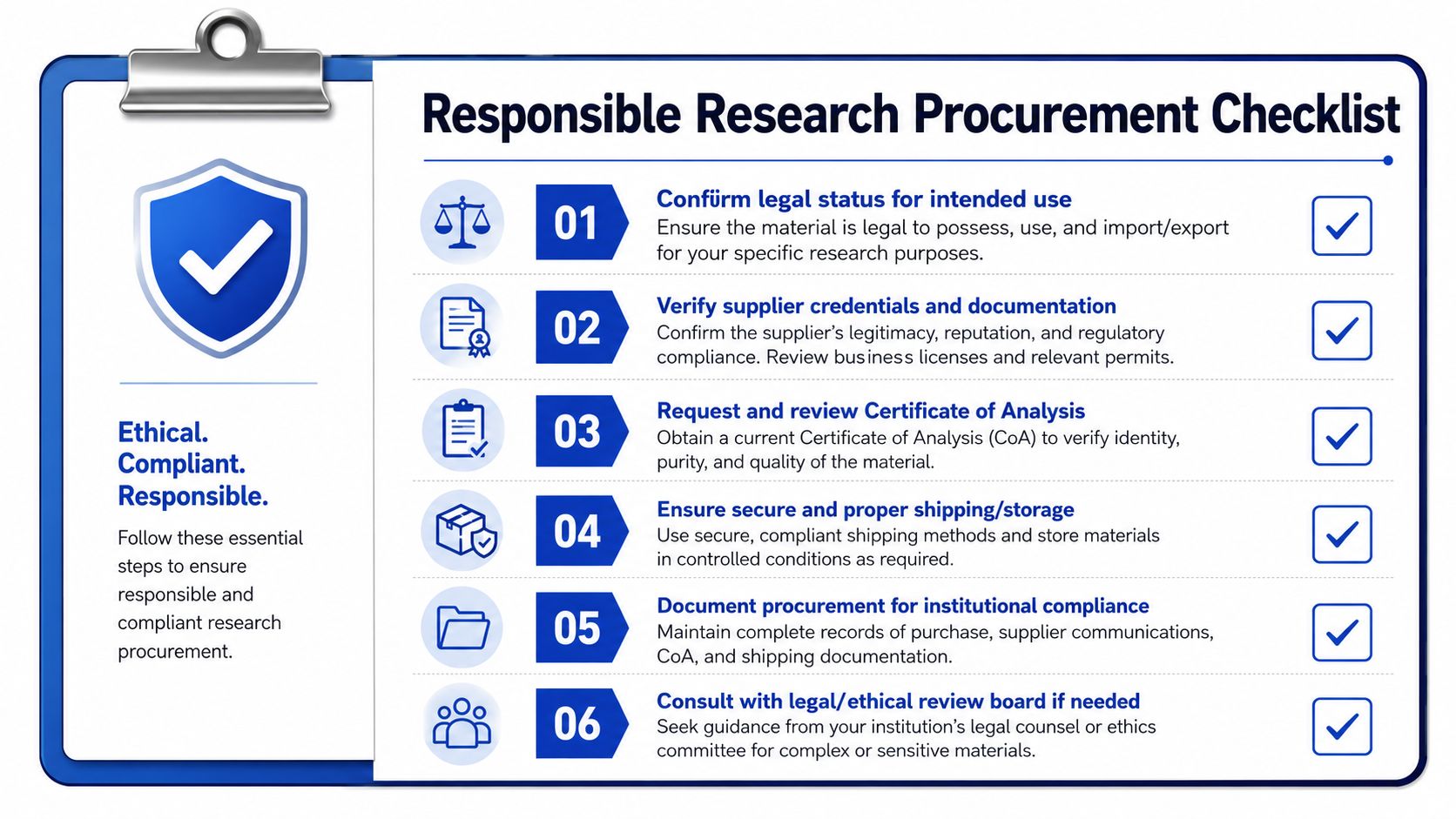
The best suppliers don't just sell a product, they make it easy to verify what you received. That matters more than a flashy landing page or a broad promise about performance.
For anyone building a serious peptide workflow, the right move is to source from a vendor that treats quality, documentation, and traceability as part of the product itself. If you need a reliable research-only supply chain with clear documentation, review the options at Peptide Warehouse USA and compare how they present PT-141 and other research peptides for lab procurement.