No products in the cart.


You've got a vial on the bench, a syringe in hand, and two protocol sheets that don't quite agree. One says 10 mg for 10 days, another points to 5 mg for 20 days, and the math only gets messy after you add reconstitution into the mix. An Epitalon dosage calculator exists for exactly this moment, because the problem isn't just converting milligrams into syringe units, it's deciding which protocol assumptions are being used before anyone draws a line on the barrel.
A bench top with a lyophilized vial, bacteriostatic water, and a U-100 insulin syringe is where most dosing mistakes begin. The issue usually isn't the final injection volume. It's the gap between the protocol someone meant to follow and the concentration they created in the vial.
A proper Epitalon dosage calculator prevents that drift by forcing the core variables into view before a dose is drawn. Those variables are the vial size, the reconstitution volume, the target daily dose, and the cycle length. Leave one out, and every later conversion can look neat while still being wrong for the protocol you thought you were using.
Practical rule: never convert units until you've written down the protocol framework first.
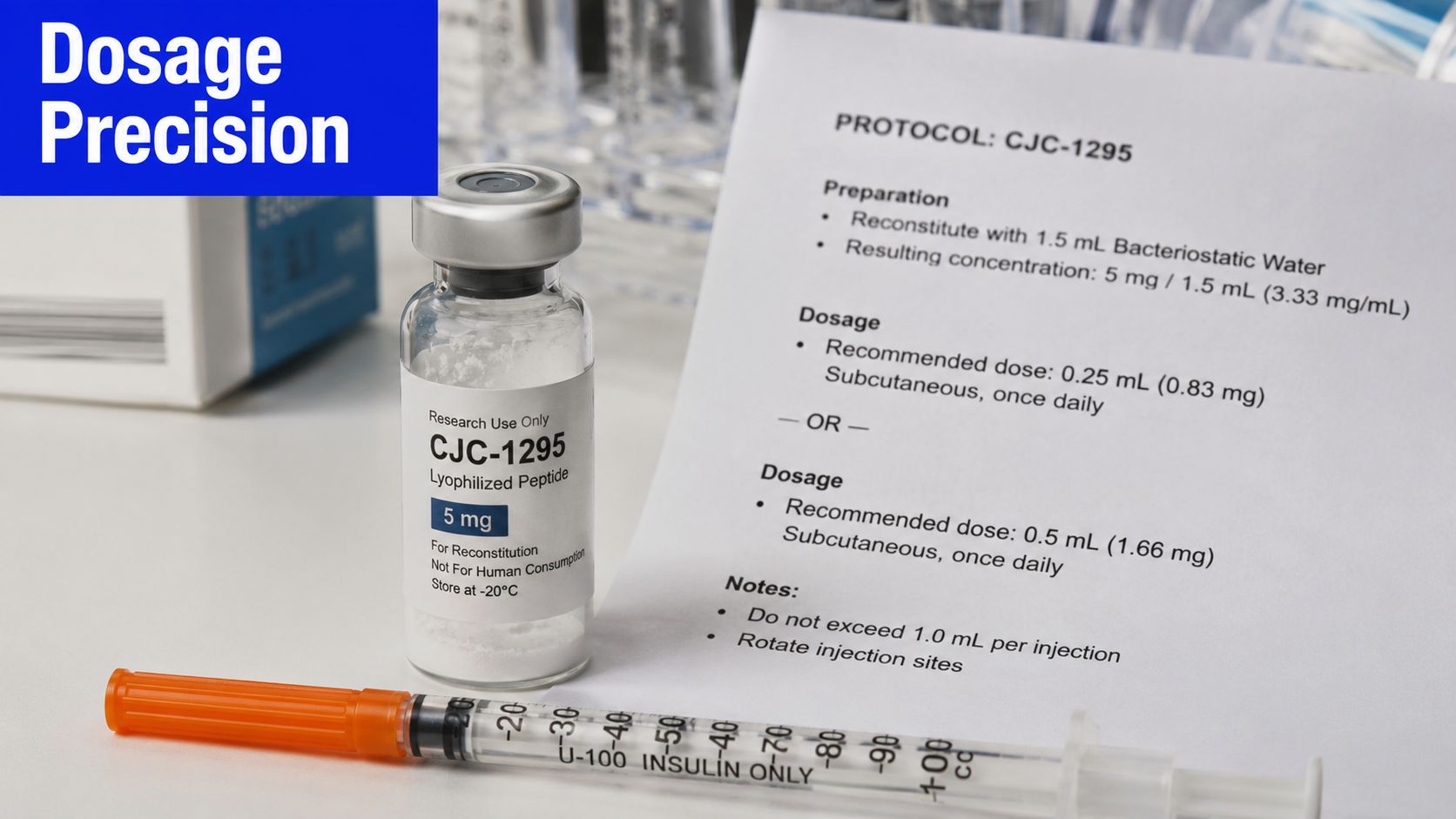
That matters because the math is only as good as the assumptions behind it. In research settings, people often inherit a dose note from a forum, a shared spreadsheet, or an old lab document, then skip the step where the vial concentration is confirmed. The calculator is the checkpoint that turns a rough plan into a reproducible workflow.
For Epitalon, that workflow is narrow compared with many other peptides. The commonly used calculator rule around a 10 mg vial mixed with 2 mL of bacteriostatic water yields 5.00 mg/mL, and a 1 mg dose at that strength equals 0.200 mL or 20 units on a U-100 syringe, according to the referenced dosing calculator guidance for Epitalon (source). That is exactly why dose math has to happen before administration, not after.
When a calculator is doing its job, it doesn't just output a number. It helps the user confirm whether they're planning a short course, a repeat cycle, or a single daily draw, and that prevents small conversion errors from compounding across an entire run.
A dosage calculator has to know which Epitalon protocol it is converting, because the field does not agree on a single schedule. The difference is not academic. A 5 mg daily plan, a 10 mg daily plan, a 10-day pulse, and a 20-day course all lead to different totals even before the syringe math starts.
Some summaries cluster around 5 to 10 mg subcutaneously once daily for 10 to 20 days, repeated 2 to 3 times per year, while others describe shorter or more intermittent schedules (source). Another protocol summary states a 10 mg daily schedule for 10 days, which totals 100 mg per course, while a different guide describes a 50 mg course divided across days 1, 5, 9, 13, and 17 (source). A separate protocol overview notes that some guidance even places Epitalon in the 1 mg to 5 mg once-daily range for typical subcutaneous use.
Epitalon is a good example of why a calculator should compare protocols, not hide them.
| Common Epitalon Research Protocols Compared | Daily Dose | Cycle Length | Total per Cycle | Repeat Frequency |
|---|---|---|---|---|
| Short-course daily use | 5 to 10 mg | 10 to 20 consecutive days | Varies by schedule | 1 to 2 times per year |
| Ten-day pulse | 10 mg | 10 days | 100 mg | Roughly every 4 to 6 months |
| Twenty-day daily course | 5 mg | 20 days | 100 mg | Roughly every 4 to 6 months |
| Intermittent cycle | Split across selected days | 17 days | 50 mg | Cycle-based repeat use |
Protocol drift is the primary problem. One person thinks they are following a 10-day course, another assumes a 20-day course, and both can end up with very different totals even if the daily draw looks similar on paper. A calculator that does not flag the protocol framework can make those differences disappear until the vial is already in use.
That is why the protocol choice has to come first. A 10 mg daily plan and a 5 mg daily plan may both sound familiar in forum notes, but they do not produce the same reconstitution target, the same syringe mark, or the same total amount consumed from the vial. If the calculator does not force that assumption into the open, the user is converting the wrong target with confidence. The problem is not the arithmetic, it is the unspoken protocol behind it.
The practical fix is simple. Select the schedule first, then convert the dose, then record the total cycle amount in the lab notes. That keeps the math tied to the experiment instead of to whichever version of the protocol was copied last.
A reconstituted vial only works if the concentration is fixed and recorded. For the common bench example, a 10 mg vial mixed with 2 mL of bacteriostatic water gives 5.00 mg/mL. That matters because the daily target may be written as 10 mg in one protocol note, 5 mg in another, or split across a different cycle length, and the calculator has to know which assumption is being used before it converts anything into syringe units.
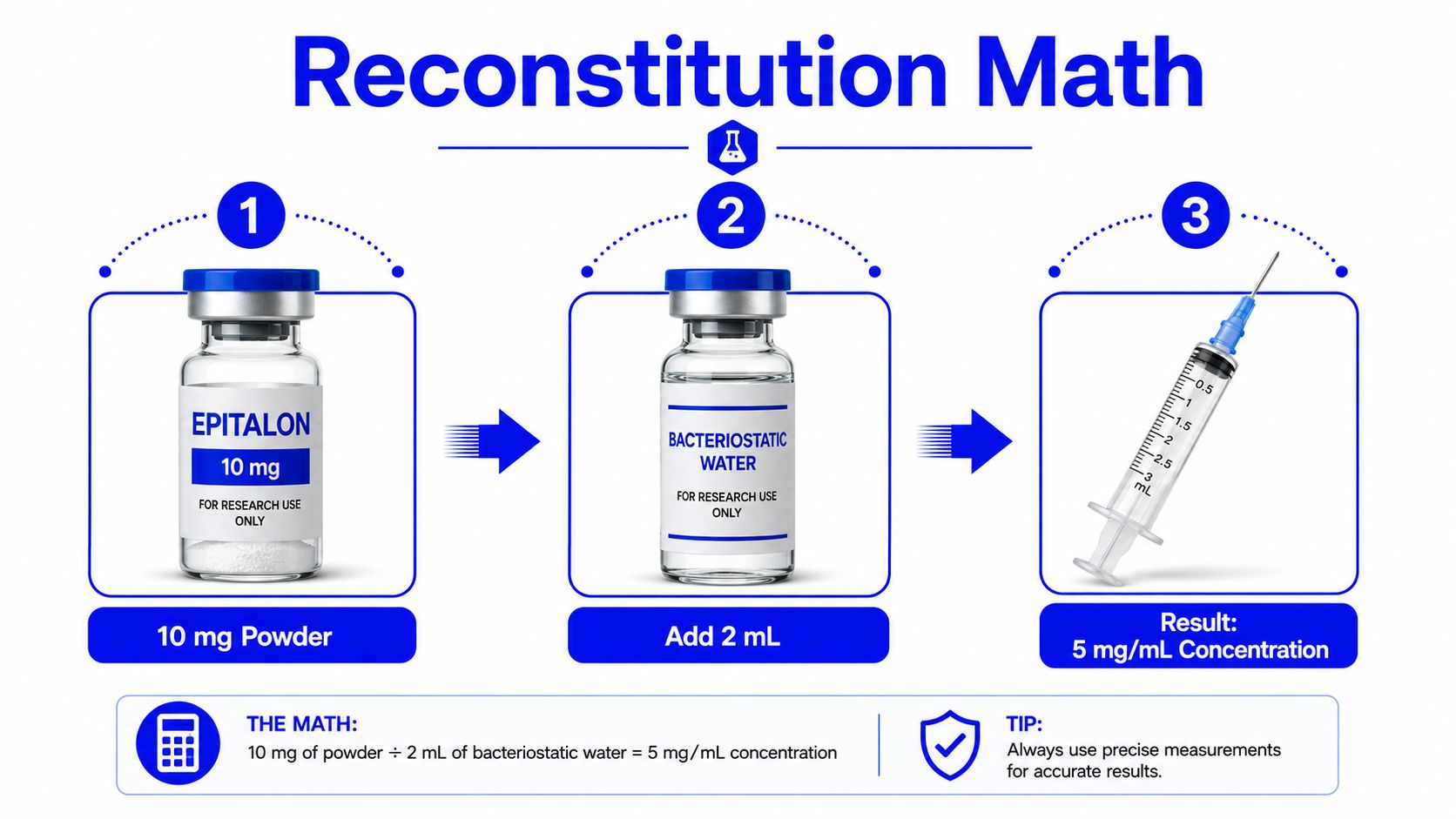
The math is simple once the inputs are fixed.
Concentration = total milligrams in the vial ÷ milliliters of diluent
For the standard example:
That single number sets every later draw. Change the reconstitution volume, and the concentration changes with it. Change the concentration, and the syringe mark for the same milligram target changes too.
The vial and the label matter as much as the arithmetic. Once the powder is dissolved, handle the solution gently, because aggressive shaking is a poor habit for peptide prep. The practical step is to label the vial right away with the concentration and the date, so nobody has to reconstruct the math later from memory or from a half-finished note.
The reconstitution step also gives a checkpoint for inventory planning. If a protocol calls for repeated daily draws, the person preparing the vial can compare the full cycle amount against what is on hand before the first dose day arrives. That helps prevent a protocol that starts cleanly on paper but runs short before the schedule is complete.
Once the concentration is fixed, the remaining step is a volume conversion. At 5.00 mg/mL, a 1 mg target equals 0.200 mL, which reads as 20 units on a U-100 insulin syringe. The practical issue is that Epitalon protocols are often written in milligrams, while the syringe only shows volume, so the calculator has to bridge those two units before anyone draws solution.
At the standard concentration:
These examples matter because they reveal a frequent protocol error. A researcher may hold the dose in mind as a milligram target and still misread the syringe, since the barrel is measuring liquid volume, not peptide mass. The syringe does not know whether the vial came from a 5 mg daily plan, a 10 mg daily plan, a 10-day cycle, or a 20-day cycle. It only shows how much liquid is being withdrawn, so the calculator needs to force that assumption into the open before the draw is made.
Use this:
Target dose in mL = target dose in mg ÷ concentration in mg/mL
Then convert mL to U-100 units by multiplying by 100.
A shorter way to handle the same check is to confirm the vial concentration first, then convert the target dose into syringe units from that value. If the reconstitution volume changes, the unit mark changes immediately, even when the milligram target stays the same. That is the point where dosing assumptions drift, especially when different community protocols disagree on daily amount and cycle length.
Read the syringe in volume, not in intention.
A calculator should treat the concentration as a required input, not a background detail. If that number is wrong or guessed, the unit conversion is wrong with it. The math stays straightforward only after the vial has been prepared and labeled correctly.
A useful calculator starts with the protocol, not the syringe. That matters with Epitalon because the community still splits on the basic assumptions, a 10-day or 20-day cycle, a 5 mg daily target or a 10 mg daily target. If those choices are not fixed first, the milligram math may look neat while the actual draw volume is wrong.
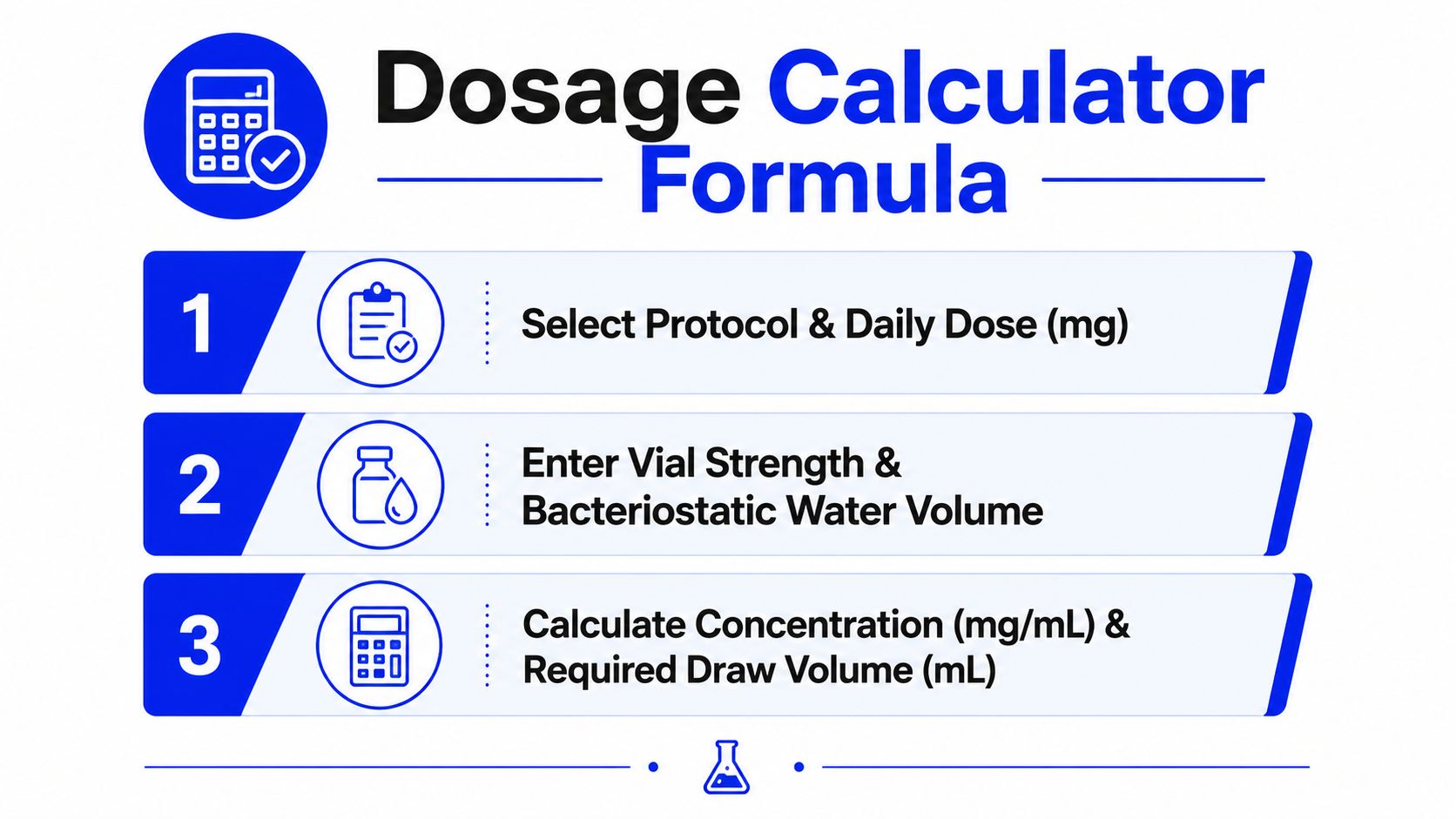
Use this order:
That sequence keeps the assumptions visible. A calculator should force the researcher to name the daily target, the vial strength, and the reconstitution volume before a single unit is drawn. Otherwise, the syringe reading becomes a guess wrapped in arithmetic.
Take a 10 mg vial reconstituted with 2 mL of bacteriostatic water. The concentration becomes 5.00 mg/mL. A 10 mg daily protocol would therefore require 2.0 mL per dose, or 200 units on a U-100 syringe.
If the same vial is instead used for a 5 mg daily plan, the draw volume changes immediately. The milligram target stays the same kind of input, but the unit mark on the barrel does not. That is why a calculator has to flag the protocol assumption before it converts anything.
A good tool should show more than the draw for one dose. It should present the daily dose, the draw volume, and the total milligrams per cycle together, so the full run can be checked before reconstitution begins. That keeps the calculation tied to the actual protocol rather than to a single syringe fill.
That cycle total is where protocol differences matter most. A 10-day schedule and a longer cycle do not ask for the same total peptide, even if the daily target is identical. The calculator should make that difference obvious instead of hiding it in a per-dose number.
A clean calculator also helps with procurement planning. If the protocol is cycle-based, the user should know whether one vial covers the run or whether multiple vials are needed before any reconstitution begins. That keeps the workflow repeatable, especially when a lab is running the same protocol on a schedule. It also matches the same kind of discipline used when you learn calorie tracking with a food log, only here the concern is traceability of dose and draw volume rather than meal totals.
The most common mistake isn't bad math. It's protocol drift, where someone starts with one schedule and gradually shifts to another mid-cycle. That can happen when a note says 10 days, another note says 20 days, and the drawer label doesn't say which framework was chosen. A calculator prevents that by locking in the assumptions before the first unit is drawn.
Incorrect syringe reading is the next failure point. U-100 markings are easy to misread when the person drawing the dose is thinking in milligrams instead of units, and that's why the concentration needs to be written on the vial itself. Storage errors also matter, especially when a vial is left unlabeled or handled without a clear reconstitution date.
A useful comparison point comes from other routine self-tracking tasks. If you've ever used learn calorie tracking with to keep food logs consistent, the same logic applies here, only the unit system is different and the stakes around traceability are higher.
Research note: keep the protocol, the concentration, and the draw volume in the same record.
For any Epitalon work, the product should be treated as research, laboratory, and analytical use only, not for human consumption. Good practice also includes checking the Certificate of Analysis, keeping batch records, and avoiding assumptions about purity or sterility that aren't documented.
If you're building out an Epitalon research run and want a supplier that keeps documentation clear, visit Peptide Warehouse USA. Their research-focused catalog supports lab and analytical workflows with documented sourcing, and it's a practical place to explore options for your next peptide project.