No products in the cart.



What does a tesamorelin ipamorelin CJC 1295 blend add, once you strip away the marketing language and look at the data? That's the right question for anyone comparing peptides for fat-loss research, body-composition work, or recovery-focused protocols, because the answer changes depending on whether you're looking at human trial evidence or a mechanistic hypothesis.
The short version is simple. Tesamorelin has the strongest human record in this space, including FDA-backed efficacy for a specific indication, while the fixed three-peptide blend does not have a published human randomized trial proving additive outcomes. That gap matters, because it separates a studied single agent from a combination built mostly on pathway logic.
This guide walks through the blend the way a careful lab investigator would. You'll see what each peptide does, why the combination looks plausible on paper, where the data are firm, and which parts are still extrapolation. The focus stays on research use only, with no medical claims and no shortcutting around evidence.
Researchers and buyers usually find the tesamorelin ipamorelin CJC 1295 blend while looking for one of three things, fat-loss research, body-composition support, or growth-hormone-pathway modulation. That search pattern makes sense, because these peptides are all discussed in the same orbit of GH and IGF-1 signaling, even though they are not interchangeable in how well they've been studied.
The interest isn't random. Tesamorelin is the benchmark because it has large human efficacy data and FDA approval for a specific indication, while the broader blend is still a conceptual stack rather than a validated clinical protocol. In pooled Phase 3 randomized trials with 806 participants, 26 weeks of tesamorelin 2 mg/day subcutaneously reduced visceral adipose tissue by 15.4% versus placebo and increased IGF-1 by 108 ng/mL (source). A separate Phase 3 study with 404 participants reported a 10.9% reduction in visceral adipose tissue at 6 months, with benefits persisting to 52 weeks in continuers (source).
That's why so many readers want to know whether the blend really does more than tesamorelin alone. The answer, at least from published human data, is not yet proven. The blend's appeal comes from biological plausibility and practical convenience, not from a controlled trial showing superiority.
Practical rule: if you're comparing this blend against tesamorelin alone, treat tesamorelin as the evidence anchor and the blend as the hypothesis.
The rest of the article stays on that line. It's written for informed consumers, lab staff, and researchers who want a plain-language explanation without medical hype or outcome claims that the literature hasn't earned.
Tesamorelin is the easiest peptide in this group to define because its role is the most established. It acts as a growth hormone-releasing hormone, or GHRH, analog, so it works at the GHRH receptor and nudges the pituitary to release more endogenous growth hormone. In the human literature, that matters because the body-composition outcome is real, measurable, and tied to controlled studies rather than inference.
That's also why tesamorelin keeps showing up as the comparison point whenever people talk about a tesamorelin ipamorelin CJC 1295 blend. The blend inherits its credibility from tesamorelin, but only indirectly. The blend itself hasn't been validated as a fixed product in a published human RCT, so the confident part of the conversation belongs to tesamorelin alone (source).
CJC-1295 is also discussed as a GHRH analog, which means it enters through the same general pathway as tesamorelin. Ipamorelin is different, because it works as a ghrelin-receptor, or GHSR-1a, agonist. In plain language, that gives the blend two doors into the same room, one through the GHRH receptor family and one through the ghrelin receptor.
That dual-pathway framing is the blend's scientific appeal. If two receptor systems both push toward GH release, the stack looks mechanically elegant, and that's why it keeps appearing in research catalogs and buyer conversations. Still, the combination logic is just that, logic. Human endpoint evidence for synergy is missing, so the better wording is mechanistic plausibility, not proof of additive benefit (source).
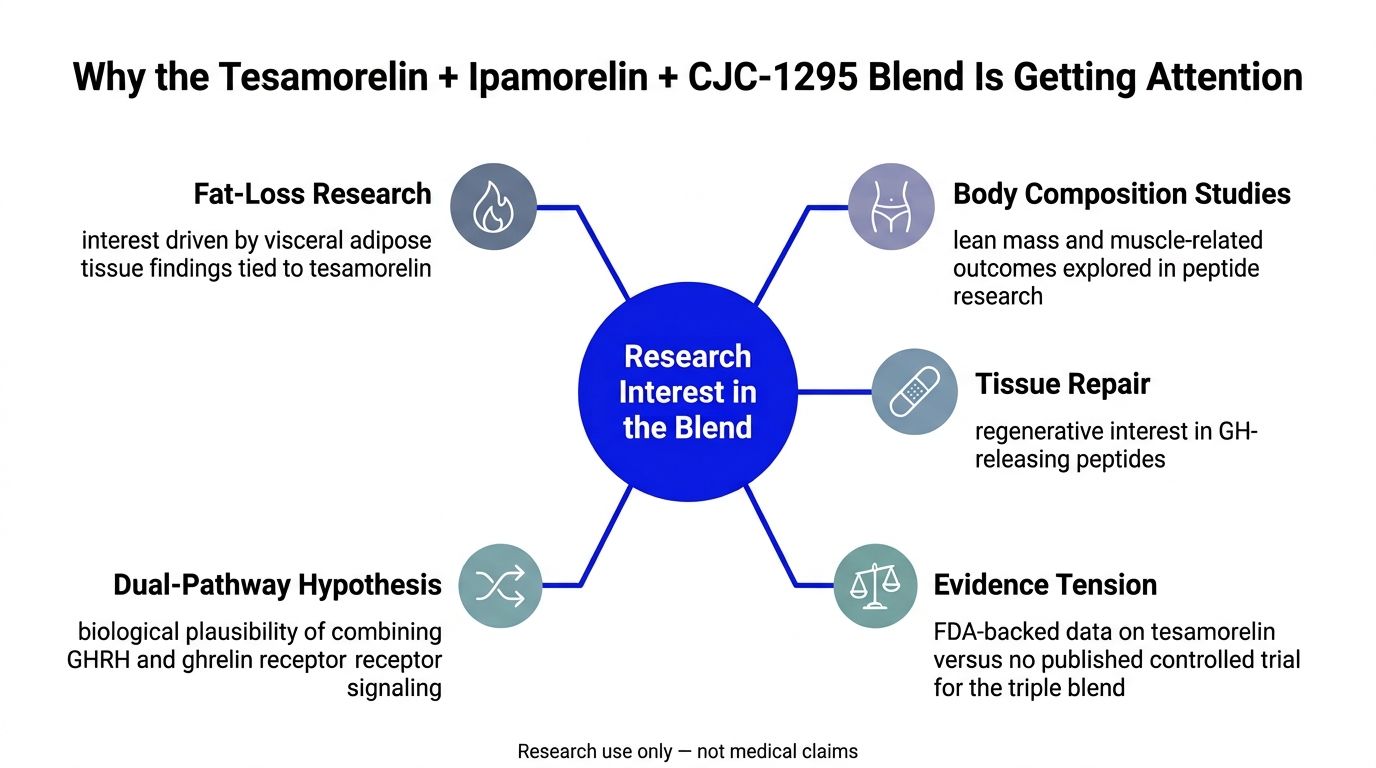
One way to think about the trio is this:
The blend looks interesting because it combines pathway diversity, not because it has proven combination outcomes.
The strongest human endpoint evidence in this group still belongs to tesamorelin. In a randomized, placebo-controlled Phase III trial in HIV-associated lipodystrophy, 2 mg/day for 26 weeks reduced visceral adipose tissue by 15.2% versus a 5.0% reduction with placebo, while increasing IGF-1 by about 35% and not causing clinically significant fasting-glucose changes at the trial endpoint (source). Another evidence summary reported a mean lean-body-mass gain of 1.42 kg in pooled analyses (source).
That evidence matters because it gives tesamorelin a clinical footing that the rest of the blend does not yet have. A peptide can look plausible on paper and still lack human endpoint data. Tesamorelin is the comparator that changes that conversation, since its effects have been observed in people rather than inferred from receptor logic alone.
The combination question is still answered mostly by inference. There is no published human clinical trial showing that tesamorelin plus ipamorelin, or tesamorelin plus ipamorelin plus CJC-1295, works as a single combined product (source). What exists instead is a chain of indirect support, which is useful for hypothesis building but not enough to validate a fixed protocol.
One review of peptide stacks notes that CJC-1295 with DAC has been associated with sustained GH and IGF-1 elevation for about 6 to 8 days after injection (source). Another review discusses ipamorelin in the context of growth hormone secretagogue logic, while also showing how much of the discussion still comes from secondary summaries rather than direct outcome trials (source). That is why the triple blend is better described as a mechanistic hypothesis than as a validated combination product.
| Evidence tier | What exists |
|---|---|
| Strongest human data | Tesamorelin Phase 3 body-composition outcomes |
| Indirect support | CJC-1295 pharmacokinetics, ghrelin-pathway reasoning |
| Missing piece | Published human RCT for the fixed triple blend |
The clean reading is straightforward. Tesamorelin has human outcome data, the other components add pathway logic, and the fixed three-peptide combination still lacks a published randomized trial showing that the stack itself produces a distinct clinical result. That gap is exactly where researchers should be careful, because mechanistic compatibility does not automatically become combination efficacy.
Tesamorelin is commonly described as having a short half-life of about 26 to 38 minutes (source). That short window matters because it reminds you that peptide behavior isn't just about what receptor a molecule hits, it's also about how long the signal stays in circulation.
For researchers, that creates a practical question. Are you comparing a short-acting GHRH analog against a longer-acting variant, or against a short-acting one? If you don't specify the exact CJC-1295 form, the comparison becomes muddy fast.
CJC-1295 with DAC is the version linked in one summary to sustained GH and IGF-1 elevation for about 6 to 8 days (source). Another summary of research protocols describes a different CJC-1295 variant with a shorter profile, around 30 minutes (source). That discrepancy is exactly why “CJC-1295” by itself is not precise enough in a lab context.
A clean way to handle it is to verify the variant before anything else:
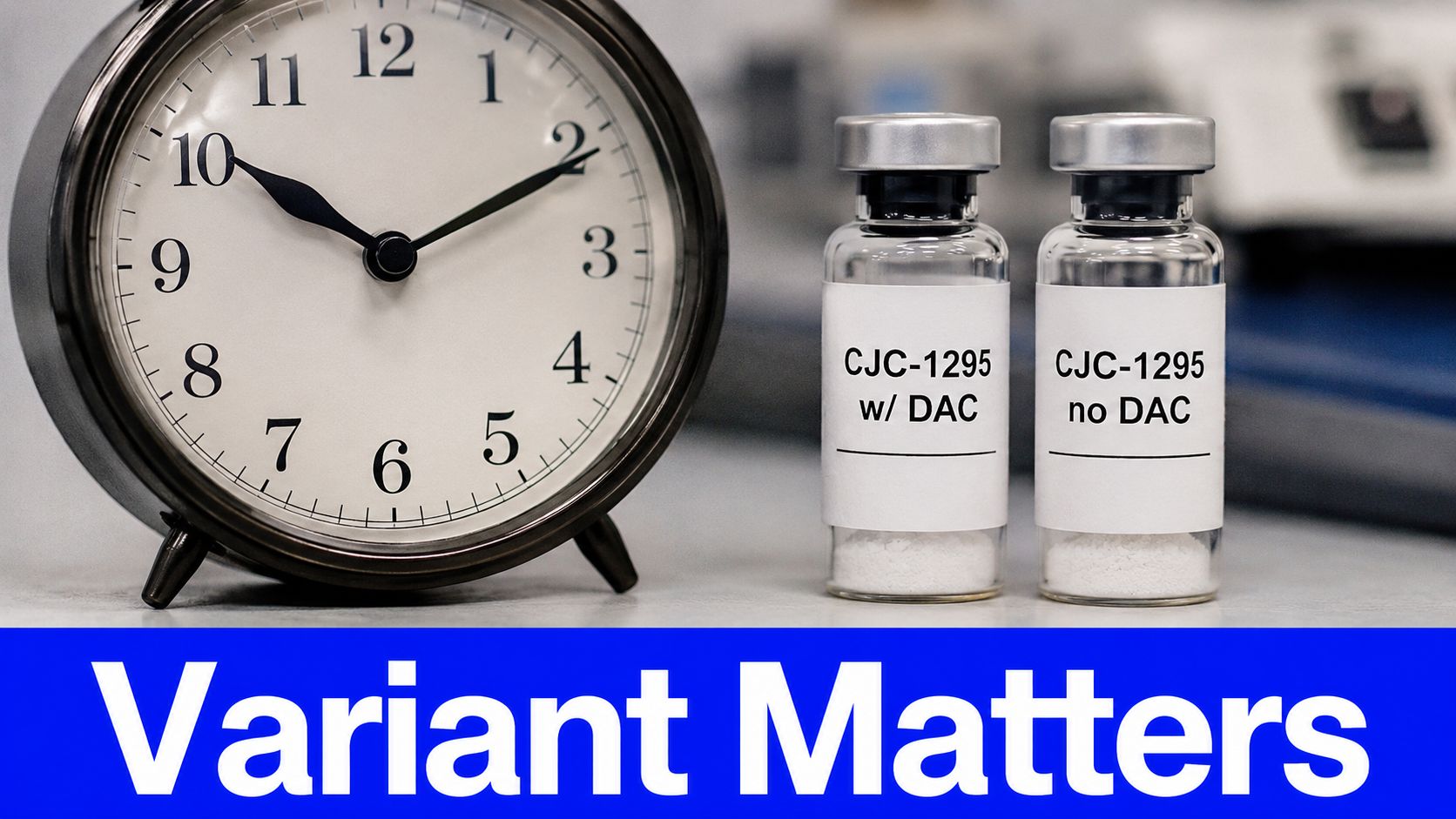
Working assumption: if the variant isn't specified, the dosing logic isn't ready yet.
A fixed blend ratio tells you how a supplier chose to fill the vial, not whether the combination has been validated as a better biological system. One cited example lists a 3 mL maximum vial with either 10 mg tesamorelin + 3 mg ipamorelin or 5 mg tesamorelin + 5 mg ipamorelin (source). Another source describes a 12 mg formulation as 6 mg tesamorelin, 3 mg CJC-1295, and 3 mg ipamorelin (source).
Those numbers are useful for interpretation, because they show the formulation logic behind the product. They do not show that one ratio is more effective than another in a controlled setting. In lab planning, the ratio belongs in the formulation notes, while any claim about superiority belongs in the evidence review, and for the fixed triple blend that evidence gap still matters.
Once a vial is in hand, the first job is recordkeeping. Researchers usually note peptide mass per milliliter, the vial size, and the exact label wording so the batch can be traced later. That matters because a multi-peptide vial only stays interpretable if the composition is recorded clearly from the start.
A practical checklist looks like this:
The handling logic follows the composition, not the product name. A vial built around tesamorelin and ipamorelin is not the same as a blend that also includes CJC-1295, and a fixed ratio does not remove the need to check what is present before any reconstitution step.
The appeal of stacking is obvious. If one GH-pathway peptide is interesting, then two or three must be better. That logic feels intuitive, but it's also where a lot of peptide buying decisions go wrong.
The safe way to think about the tesamorelin ipamorelin CJC 1295 blend is as a research hypothesis, not as an interchangeable substitute for a studied single agent. Tesamorelin already has controlled human body-composition data, while the fixed triple blend does not have a controlled-trial record (source). Those are not small differences.
Class-level concerns are easy to name and harder to ignore. IGF-1 elevation, changes in glucose metabolism, edema, headache, and injection-site reactions are all plausible monitoring points for GH secretagogue work. Neutral sources also emphasize that ipamorelin and related secretagogues have limited long-term and large-population safety data, which is exactly why a fixed combination shouldn't be treated casually (source).
Practical rule: if you can't state the endpoint you're monitoring, you're not running a study yet, you're guessing.
A careful research plan usually separates three questions:
That separation matters commercially too. A stack can be popular because it sounds complete, while still being scientifically incomplete. Those aren't the same thing.
If you're sourcing a tesamorelin ipamorelin CJC 1295 blend for research, the first question isn't what result it claims. It's whether the batch documentation is complete. The minimum package should include a Certificate of Analysis, third-party testing for identity and purity, and microbial and endotoxin reports, along with a stated purity level.
Manufacturing location and lot traceability matter too. For laboratory use, U.S. manufacturing, transparent batch testing, and clear lot records should be the baseline, not a premium add-on. If a supplier can't document the lot, the batch is hard to defend in any serious research file.
Storage and handling should be boring, because boring is good here. Keep the material cool, dry, and dark, then move to single-use aliquots after reconstitution so the vial isn't repeatedly opened and handled. That approach supports consistency and makes downstream recordkeeping simpler.
A usable procurement checklist includes:
One practical option in this category is Peptide Warehouse USA, which supplies research peptides with lot documentation and batch testing for laboratory use. For teams comparing the blend against other peptide formats, that kind of sourcing consistency is part of the workflow, not an afterthought.
The evidence picture is clear in one respect. Tesamorelin is the only component with large human efficacy data and FDA approval for a specific indication, while the fixed tesamorelin ipamorelin CJC 1295 blend has no published human randomized trial proving combination efficacy (source, source). The dual-pathway rationale is biologically plausible, but it's still a hypothesis.
The most useful gaps for future research are easy to name:
For buyers and researchers, the right mindset is simple. Treat tesamorelin as the benchmark, treat the blend as an unvalidated formulation, and ask for evidence before assuming the stack adds value.
If you're comparing peptide options for laboratory or analytical work, Peptide Warehouse USA offers research-grade peptides with batch testing, COAs, and U.S.-based sourcing built around traceability. If this topic is on your desk, visit Peptide Warehouse USA to review research-use-only catalog options and source documentation that fits a careful peptide workflow.