No products in the cart.



Popular advice treats Ovagen like a settled answer for liver support. The data doesn't support that level of confidence. Ovagen peptide benefits are real enough to warrant attention in a lab setting, but the evidence base is narrow, heavily Russian, and still missing the kind of independent Western validation researchers usually want before calling a compound established.
That gap matters because Ovagen sits at the intersection of organ-specific peptide theory, liver biomarker research, and anti-aging claims. A careful read shows a peptide that looks more interesting than most casual summaries admit, yet far less proven than its most enthusiastic advocates suggest. The question isn't whether the molecule is interesting. The question is what the current data supports, and where the story still depends on speculation.
Ovagen draws attention because the evidentiary base is narrow. It is presented as a liver-focused tripeptide bioregulator, yet review-level summaries describe a record without independently replicated randomized controlled trials in major English-language journals, and one account says there are no English-language studies at all (Ovagen peptide evidence review). For researchers, that combination matters. A peptide can have a clear mechanistic story and still remain weakly validated if the work sits inside a single research tradition.
Ovagen's visibility comes largely from the Khavinson bioregulator line of work, where it has been discussed for years in connection with liver support and regeneration claims (Khavinson bioregulator overview). Familiarity within that literature does not resolve the core question of reproducibility. It only shows that the compound has remained part of a stable internal narrative.
The more cautious interpretation is straightforward. Ovagen is not just wellness branding, because the available summaries do point to liver-linked biomarker and tissue-response claims. At the same time, it is not a broadly validated intervention, because the public record does not yet show the level of independent confirmation Western translational researchers usually look for.
Practical rule: if a peptide's main claims trace back to one research ecosystem, treat those claims as provisional rather than established.
The reason Ovagen continues to attract interest is the recurring emphasis on ALT and AST improvement. Those markers are widely used to assess hepatocellular injury, so even modest shifts can be relevant in liver-focused research. The evidence review literature treats that signal as one of the main reasons the peptide remains on the radar.
That still does not establish clinical efficacy. It does explain why the compound keeps appearing in discussions about liver aging, toxic stress, and organ-specific repair. For a lab audience, the correct reading is disciplined curiosity, with the burden of proof still resting on replication and better-controlled studies.
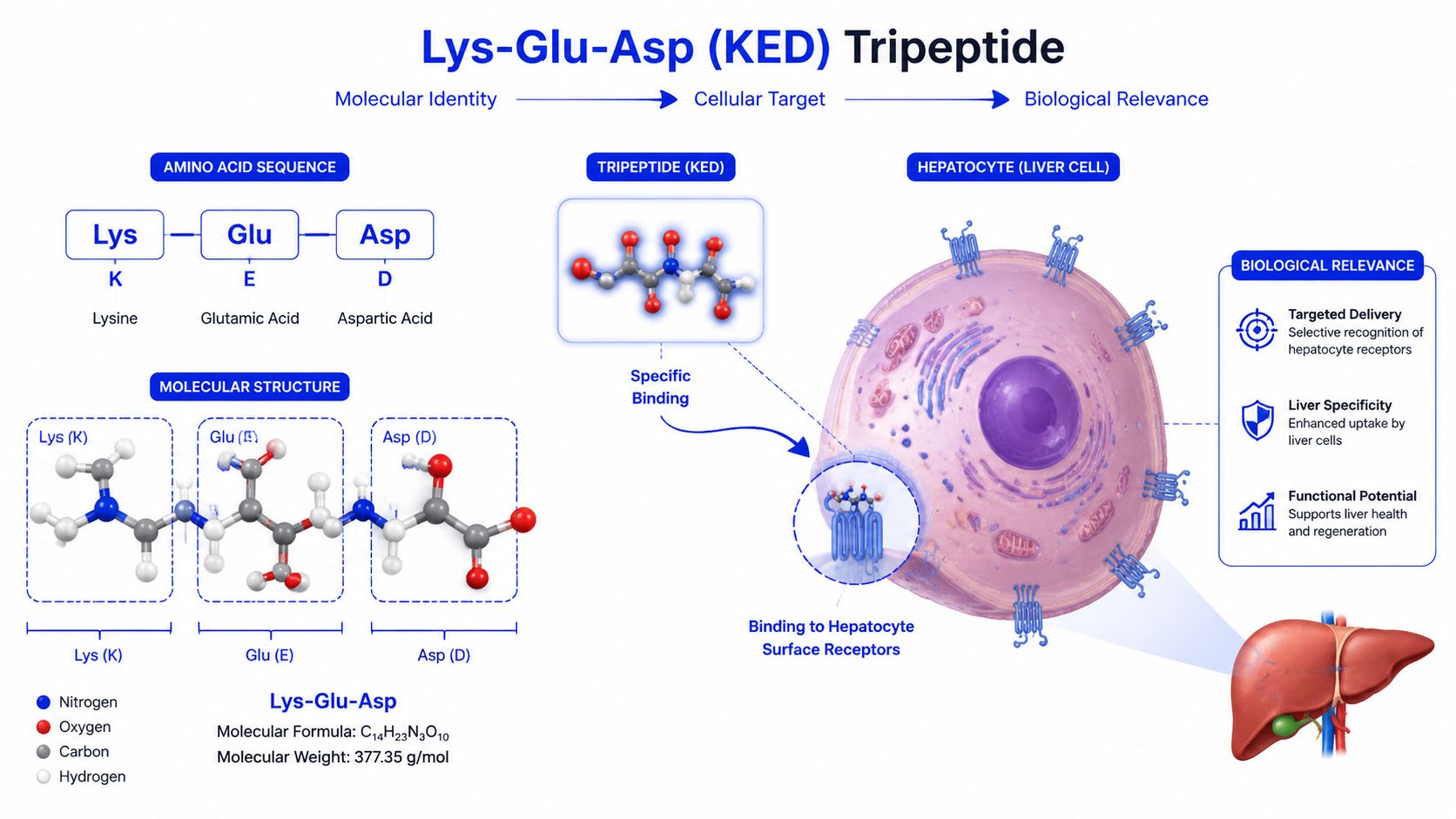
Ovagen is described in independent peptide references as a liver-focused tripeptide bioregulator from the Khavinson research tradition, and one source identifies it specifically as Lys-Glu-Asp (Ovagen peptide reference). That identity matters because it gives the compound a defined sequence rather than a vague wellness label. The available descriptions frame Ovagen as a hepatocyte-targeted bioregulator, which is a narrower claim than the broader language often used in peptide marketing.
A tripeptide is a short chain of three amino acids. In the bioregulator model, that short length is part of the proposed advantage, since short sequences are thought to interact with target tissues in a more selective way instead of producing diffuse activity across the body. For Ovagen, the proposed target is the liver cell, or hepatocyte.
The molecular logic is simple enough to state without overstretching it. A shorter sequence may have fewer off-target interactions than a larger peptide, but that is a hypothesis about tissue selectivity, not proof of mechanism. The main value of the structure is that it gives researchers something concrete to test, rather than a purely descriptive product name.
Independent write-ups also describe Ovagen as relevant to both the liver and the gastrointestinal tract, with a proposed role in supporting the GI mucosal layer under stress from antibiotics, environmental toxins, and chemotherapy (GI-focused Ovagen summary). That dual-tissue framing is important because it places Ovagen at the intersection of hepatic and digestive biology, where barrier function and detoxification stress often overlap.
The mechanistic claim remains provisional by Western translational standards. Within the bioregulator model, the idea is internally consistent. Liver cells and gut tissue both face constant metabolic and environmental exposure, so a peptide described as organ-specific has a plausible rationale on paper. What the public record does not yet provide is the level of independent validation that would move that rationale from plausible to established.
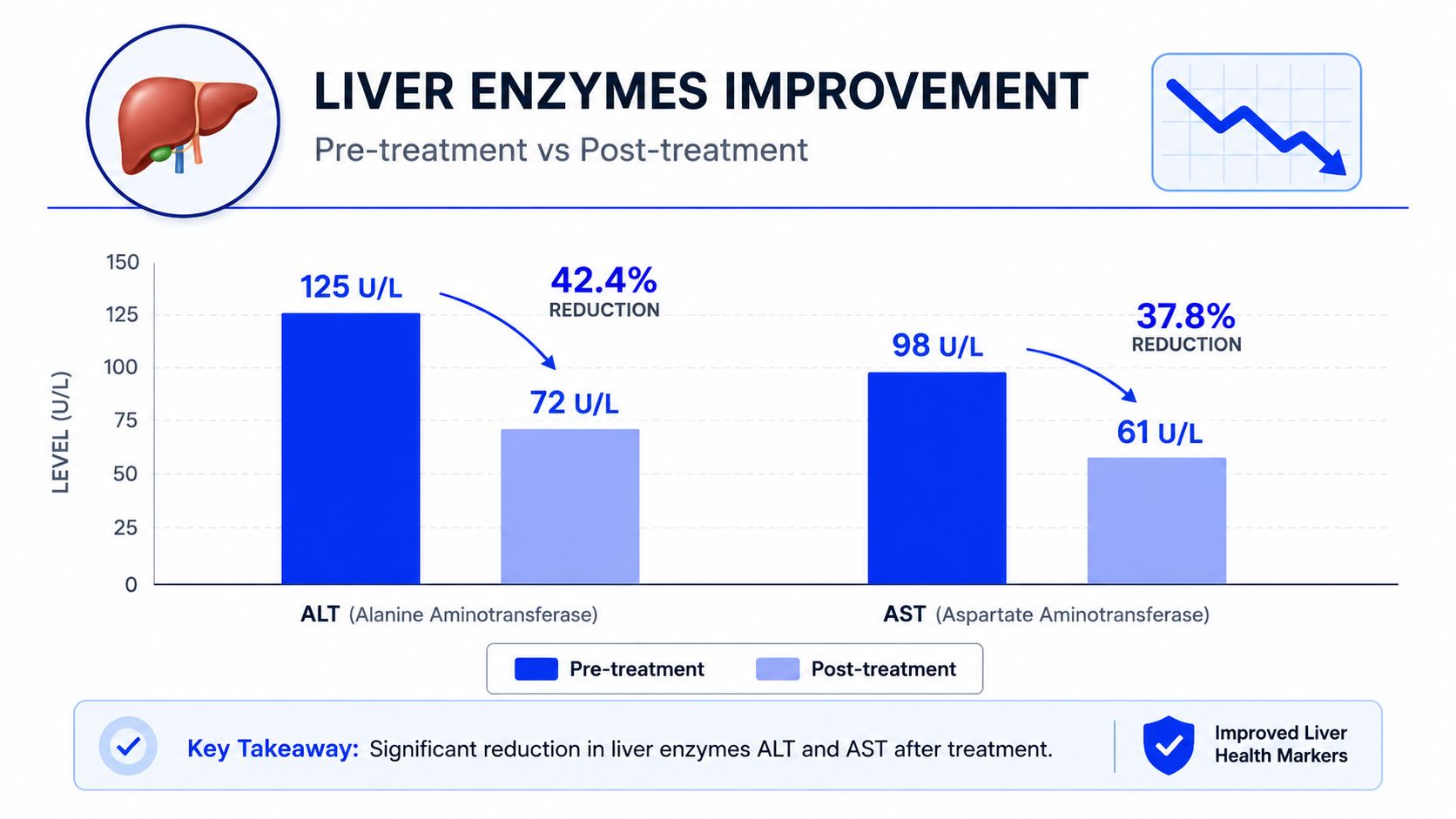
The clearest Ovagen signal in the public record is liver enzyme improvement, but the evidence behind that signal is uneven. Secondary summaries of Russian clinical material describe 15-25% reductions in ALT and AST after a standard 10-20 day Ovagen cycle in people who started with elevated values. Another summary reports roughly 26% ALT reduction in a clinical setting involving chronic hepatitis or chemotherapy-associated liver dysfunction (Ovagen peptide evidence review).
Those changes are relevant because ALT and AST are routine hepatology markers. If they decline from an increased baseline, that can indicate reduced hepatocellular stress. What matters for interpretation, however, is the evidentiary chain behind the result.
Here the chain is thin. The reported reductions come from secondary write-ups of Russian clinical data, not from a large, independently replicated body of English-language trials. For researchers, that places the finding in a narrow category, interesting enough to study further, but not strong enough to treat as established clinical proof.
Researcher's rule: a biomarker shift only carries the weight of the design behind it. Without replication, it is a signal, not a conclusion.
The regeneration data are more striking, and also more difficult to verify in a Western evidence framework. One source reports an 18-fold increase in Ki-67, a proliferation marker, and a 6-fold decrease in p53, an apoptosis marker, in aged liver tissue (Khavinson bioregulator overview). Another Ovagen summary reports an 18-fold increase in liver cell regeneration markers, with the effect described as more pronounced in older adults (Ovagen regeneration summary). In partial hepatectomy models, Ovagen-related administration has been associated with improved hepatocyte proliferation at 24 and 48 hours and better liver mass restoration by days 7 and 14.
Those findings are the strongest part of the Ovagen discussion. They still do not establish clinical certainty. At most, they support the view that Ovagen has biologic activity in preclinical or early clinical contexts and may influence regenerative pathways in liver tissue. What remains unproven is whether those effects translate cleanly across independent human cohorts, different disease states, or modern Western trial standards.
Ovagen's GI profile is easy to miss if you focus only on the liver data. Independent references describe it as active in both the liver and gastrointestinal tract, with possible protection of the GI mucosal layer against injury from antibiotics, environmental toxins, and chemotherapy. That framing shifts the research question from isolated liver support to broader tissue barrier support.
The liver and gut are tied together by continuous metabolic exchange. Nutrients, xenobiotics, and microbial byproducts move across that axis, so a peptide discussed in relation to one tissue can reasonably be examined in the other. Ovagen's dual-tissue framing is therefore more coherent than a superficial reading suggests.
For researchers, the GI angle also widens the experimental use case. A lab studying mucosal resilience, antibiotic-related barrier injury, or digestive tissue recovery does not need to treat Ovagen as a liver-only compound. The available summaries make it a candidate for models where epithelial integrity and organ-specific repair both matter.
The key word here is “suggest.” The literature supports a GI-protective framing, but it does not support broad clinical claims. A peptide can show tissue-protective behavior in a review article, or even in animal and small human contexts, without enough evidence to become a standard intervention.
That distinction matters because the gut-support narrative can be overstated. Ovagen is not established as a digestive cure-all. It is better understood as a compound that has been discussed in relation to mucosal support, especially in stress models where the gut lining is vulnerable.
The cleanest conclusion is that Ovagen's profile is wider than many summaries admit. Its research identity is hepatic first, but not hepatic only.
Ovagen's evidence gap is the central issue, not a side note. The available discussion points to no independently replicated randomized controlled trials in major English-language journals, and one summary says there are no English-language studies. That leaves the compound anchored to a narrow research tradition rather than a broadly checked body of work.
The broader Khavinson bioregulator tradition has circulated for years, and one overview reports that tripeptide bioregulators in this line can increase target-tissue protein synthesis within 2-4 weeks in aged cell cultures and animal models. The same source also claims that multi-bioregulator rodent protocols were associated with roughly 20-40% lifespan extension.
Those figures are attention-grabbing, but the setting matters more than the headline. They come from a research stream that has produced recurring preclinical signals, yet still has not cleared the level of independent confirmation that would make clinical translation credible by Western standards. For researchers who also care about the mechanics of evidence collection, the gap is similar to the difference between web scraping for AI agents that gathers candidate signals and a validated pipeline that can defend each output under audit.
A preclinical signal can justify follow-up work. It cannot substitute for validation. That is the practical limit with Ovagen. The compound looks biologically active, and the biomarker and tissue-regeneration claims are specific enough to justify tracking, but the evidence remains preliminary and the repeated problem across sources is the absence of Western-standard trial confirmation.
Bottom line: Ovagen is best treated as a research hypothesis with a visible signal, not as a settled translational tool.
For a lab audience, the better questions are specific ones. Which models produced the effect, which endpoints moved, what controls were used, and whether another group can reproduce the same result. Until those answers are stronger, Ovagen belongs in the promising-but-unverified category.
Researchers evaluating Ovagen should begin with documentation, not promotional language. A supplier worth considering should provide a Certificate of Analysis, purity data, third-party testing, and batch traceability. In practical terms, sourcing is not just about obtaining peptide powder, it is about knowing what the material is, how it was tested, and whether the lot can be matched to a specific production record.
A serious procurement checklist usually includes:
A simple internal checklist can prevent avoidable mistakes. Teams that review supplier documents at intake, rather than after the material is already in use, are better positioned to catch mismatches between marketing language and the underlying test record.
Peptides are only as useful as their identity and consistency. A polished product page does not show whether the batch is clean, correctly sequenced, or stable in storage. Good documentation does.
For research teams that handle vendor records and structured datasets, the same discipline used in web scraping for AI agents applies here, because traceable inputs make later analysis easier to defend. In peptide sourcing, that means putting verified evidence ahead of presentation.
Ovagen is a compound where supplier quality matters because the literature is still incomplete. If the source is weak, the research becomes harder to interpret, and any downstream conclusion carries more uncertainty.
Ovagen's appeal comes from a real signal, not from marketing language alone. The peptide is described as a liver-focused tripeptide bioregulator, with additional GI-protective framing, and the reported effects most often center on ALT and AST improvement, Ki-67 elevation, and p53 reduction.
The evidence gap is the key issue. The current record does not include independently replicated randomized controlled trials in major English-language journals, and it does not provide an English-language study base that would support broad confidence. That leaves Ovagen in a research category, not a clinically established one.
For lab teams, the most defensible position is straightforward. Ovagen looks like a biologically interesting, hepatocyte-targeted hypothesis with enough preclinical and secondary clinical signal to justify further study, but not enough independent confirmation to support certainty. Researchers who choose to examine it should prioritize documentation, reproducibility, and clean experimental design, because those are the factors most likely to separate a true signal from a supplier-driven claim.
If the goal is a practical research conclusion, Ovagen currently supports further investigation more than it supports firm therapeutic interpretation. That distinction matters, especially in a field where Russian bioregulator claims have moved faster than Western validation.