No products in the cart.



Typing peptide therapy online into a search bar can feel like opening three different websites at once. One tab shows telehealth clinics, another shows med spas, and a third shows products labeled for research use only. If you're trying to understand what's legitimate, what's clinical, and what's just a storefront, the first step is separating those channels before you compare anything else.
The phrase peptide therapy online now covers two very different buying experiences. In one path, a licensed clinician reviews your history, looks at labs, and, if appropriate, sends a prescription to a pharmacy. In the other, you're buying a material labeled for laboratory or analytical use only, with no human-use claim attached.
That split matters because people often assume they're comparing the same thing when they're not. A telehealth site may feel convenient, but it is still a medical workflow. A research catalog may look faster, but it is not a treatment pathway.
The clinical channel is built around care delivery. The process starts with intake, continues through clinician review, and ends with dispensing through a licensed pharmacy when appropriate. The research channel is built around product procurement, documentation, and handling for non-human work.
That distinction is the backbone of this guide. If your goal is human-use care, you need a proper clinical pathway. If your goal is lab work, analytical use, or preclinical research, you need documentation that matches that purpose.
Practical rule: if the site can't tell you whether it's prescribing care or supplying research material, treat that ambiguity as a warning sign.
The online market has become crowded enough that this distinction is no longer academic. A careful reader should sort the market before making any decision, because the same peptide name can appear in very different settings, from telehealth prescribing to research-grade procurement. If your question is about human-use care, that also means checking whether the service aligns with age-related hormone changes treatment from a licensed medical provider such as Promd Bel Air.
A peptide is a messenger molecule. It works by binding to a specific receptor on a cell and prompting that cell to respond in a particular way. That simple picture helps explain why peptides draw attention in wellness, aesthetics, and research settings.
They are not one uniform category. Some peptides are discussed in metabolic use, some in recovery and repair conversations, and some in skincare and hair care. The online market tends to mirror those themes because readers usually search by the outcome they want, not by the chemistry alone.
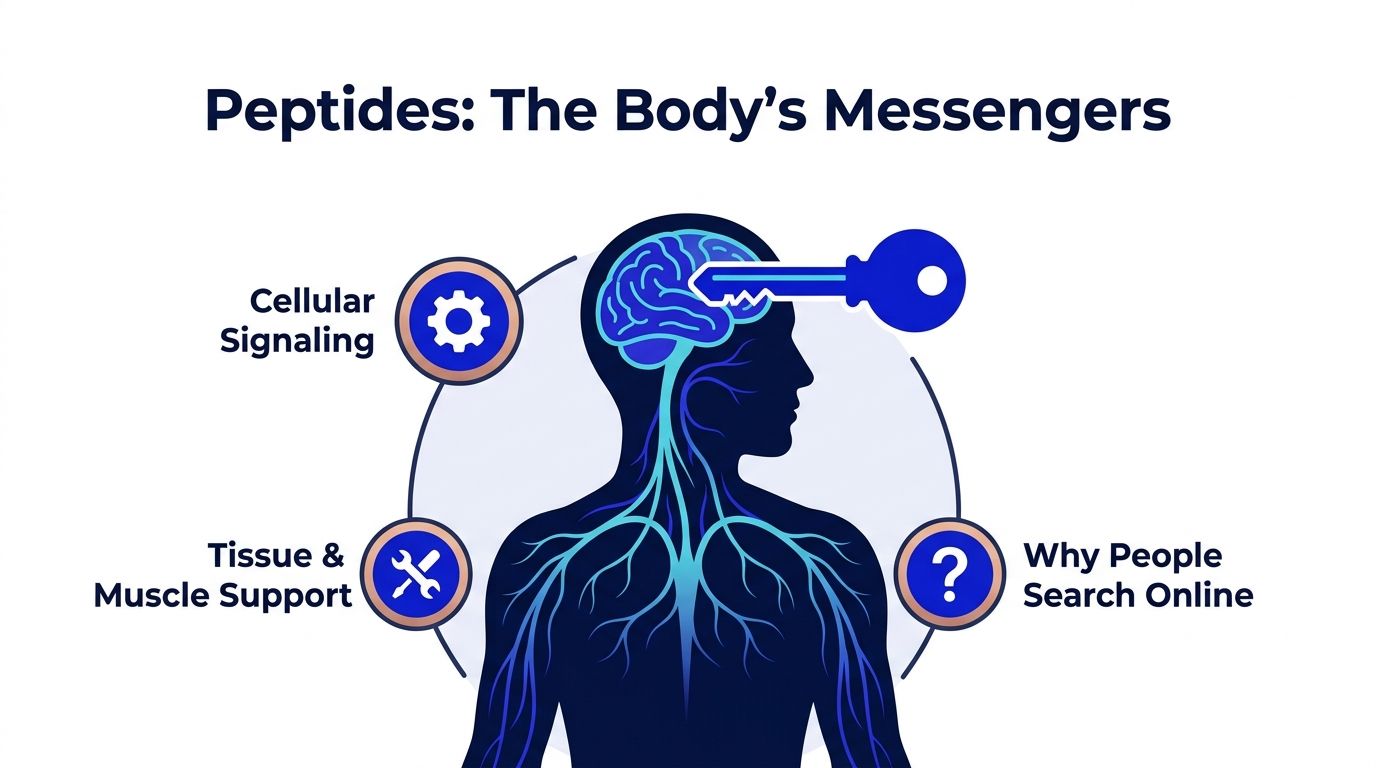
Peptides are short chains of amino acids that help cells communicate. That is why they are usually discussed in terms of signaling rather than simple supplementation. In plain language, they can tell the body to start, stop, repair, or adjust.
That distinction gives readers a practical way to sort what they see online. If a compound is discussed around metabolism, it belongs in a different bucket than one discussed around skin tone or tissue support. That mental model helps prevent the mistake of treating every peptide as if it serves the same purpose.
The search market reflects that pattern. Analysts in the 2026 peptide trend analysis found that tirzepatide was the single most searched peptide at roughly 1 million monthly searches, GHK-Cu showed the fastest year-over-year growth at +1,016%, and about 60% of peptide search traffic was tied to weight-loss peptides such as semaglutide and tirzepatide. The picture is clear, interest is concentrated around a few high-profile compounds rather than peptide chemistry in general.
People looking for peptide therapy online usually begin with a problem, not a molecule name. They search for weight management, recovery, skin support, or general wellness. Online content has to translate chemistry into use-case language without blurring the line between evidence and hype.
A simple way to group unfamiliar peptides is this:
That framework also helps explain why peptide-related demand is so concentrated. Search traffic tends to follow the use case first, then the use case shapes the product conversation. Readers comparing hormone-focused care may also run into broader wellness questions, so a related reference such as age-related hormone changes treatment can help place peptide questions beside other care decisions.
A legitimate online peptide program does not work like ordering a protein powder. It begins with a structured intake, then a clinician reviews the information, often with recent labs, before any prescription is considered. That is the part many buyers never see when they only skim a website.
The goal is closed-loop care, not a checkout cart. Good systems ask about medical history, current symptoms, and relevant biomarkers before choosing a protocol. That matters because dosing decisions and follow-up timing depend on context, not just product name.
| Stage | Telehealth Prescribing | Research-Grade Procurement |
|---|---|---|
| First step | Online intake and medical history | Browse a product catalog |
| Review | Licensed clinician evaluates symptoms and labs | Buyer reviews documentation and product details |
| Delivery | Prescription may be sent to a licensed pharmacy | Material ships as a research product |
| Purpose | Human-use care pathway | Laboratory, analytical, or preclinical use |
| Follow-up | Reassessment and monitoring schedule | Buyer manages research handling and storage |
Telehealth prescribing in the U.S. typically includes intake, video or phone consultation, remote lab review, and, if appropriate, a prescription sent to a licensed compounding pharmacy (telehealth peptide prescribing laws). A safer online workflow also emphasizes reviewing recent pathology, often from the prior few months, before deciding whether a protocol fits (safer online peptide therapy workflow).
A real clinical workflow has checkpoints. If a site skips intake, labs, and reassessment, it is not behaving like a medical program.
The research channel works differently. The supplier's role is to provide documented material, clear labeling, and handling information for non-human use. That is why the quality of the paperwork matters as much as the vial or powder itself.
For readers comparing sourcing language, the distinction becomes clearer when you look at secure healthcare warehouse planning, because controlled handling and documentation are part of the same chain of custody mindset. A separate discussion of how buyers compare catalogs can also help, since research-grade descriptions often group products by concentration, purity language, and supplier notes rather than by treatment goal.
The legal distinction is simple in concept, even if the market tries to blur it. FDA-approved peptide drugs are one category. Compounded preparations dispensed by licensed pharmacies under a valid prescription are another. Products labeled research use only are not approved for human use.
That line exists for a reason. It protects human-use pathways from being confused with laboratory supply. It also helps buyers see why a polished website doesn't automatically mean a lawful clinical offer.
The FDA-focused guidance in the search results draws a sharp boundary between legitimate treatment and research-only products. It says that peptides labeled “research use only” are not approved for human administration, and that lawful human access generally requires either an FDA-approved drug or a compounded product dispensed by a licensed pharmacy under a valid prescription (FDA peptide regulations 2026).
Compounding pharmacies also face hard limits. They can't freely make any peptide from bulk ingredients, and the substance generally has to fit recognized compounding categories such as appearing in an FDA-approved drug, having a USP monograph, or being included on an FDA-recognized list (compounding pharmacy peptide guidance). Some peptides are not legally compounded for human use because the FDA considers them insufficiently supported for compounding.
That's why a buyer has to read labels carefully. If a page says a product is for research, it's not a prescription product. If a page says it can be used for humans without explaining the legal pathway, that's a problem.
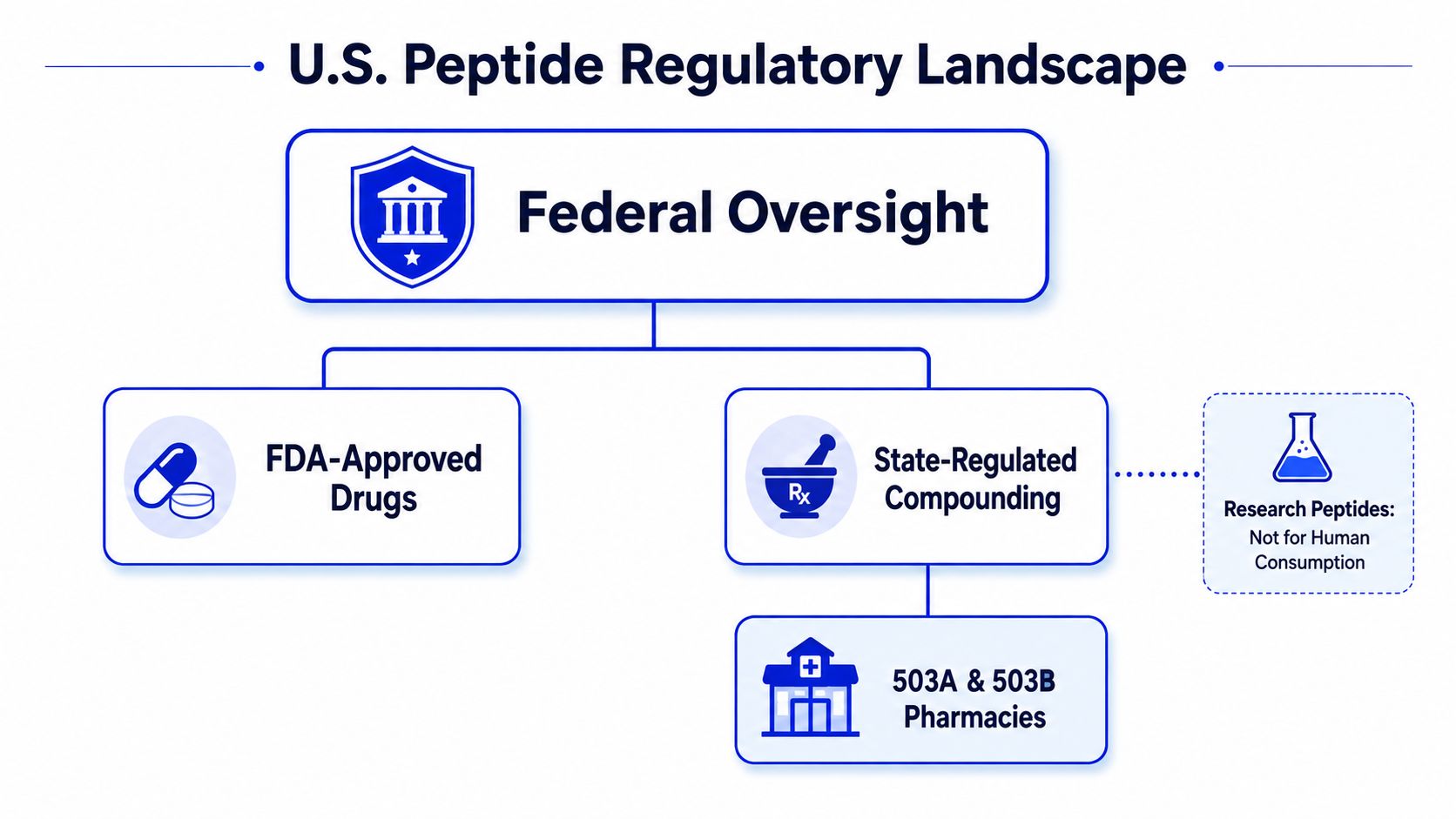
The market structure itself reflects these boundaries. A 2026 index found 4,728 active clinics across all 50 states, with semaglutide offered by 2,285 clinics (48.3%) and tirzepatide by 1,745 clinics (36.9%) (clinic index data). That density shows how large the clinical ecosystem has become, even as a parallel research market continues to grow.
For the warehouse and distribution side of controlled pharmaceutical handling, secure healthcare warehouse planning is a useful reference point for understanding why chain-of-custody and controlled storage matter in this category.
The fastest way to judge a peptide supplier is to stop asking whether the site looks modern and start asking whether the paperwork makes sense. Research-oriented buyers should look for a clean trail from the product page to the batch documents, and from the batch documents to the stated testing methods.
That trail tells you more than marketing text ever will. If a seller can't show where the material came from, how it was tested, and how it should be handled, the product may be convenient but not well verified.
Use this checklist before you buy:
A COA should function like a receipt for the chemistry. It tells you what was tested, which batch was tested, and what the results were. If those details are missing or hard to verify, the document isn't doing its job.
Strong suppliers don't hide behind generic product photos or one-line descriptions. They usually explain whether the material is intended for laboratory, analytical, or preclinical use, and they make the documentation easy to find. That transparency matters more than a flashy storefront.
A useful test is to ask yourself whether the site would still make sense if stripped of marketing language. If the answer is no, the documentation is probably carrying too much of the burden.
Read the paperwork before the price. In research procurement, documentation quality is often the real safety variable.
For a practical video walkthrough of provider evaluation, this overview can help anchor the documentation mindset:
The research market also tends to be divided by how openly sellers explain sourcing and testing. A discussion of peptide concentrate options and suppliers can be useful when you're comparing how much detail a vendor gives you.
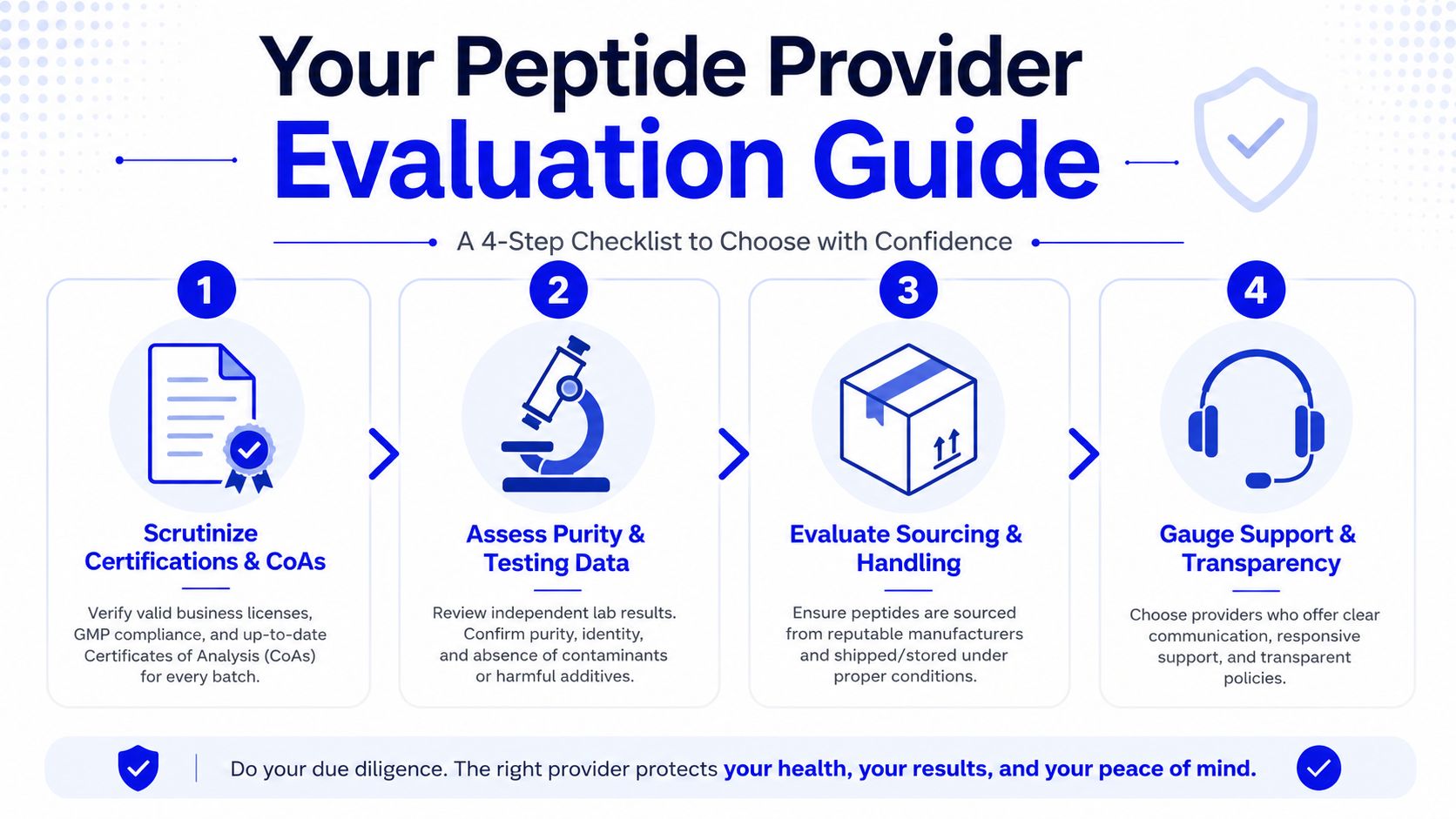
The biggest mistake buyers make is focusing on convenience first and documentation second. In this market, convenience can hide sloppy sourcing, and low price can hide poor verification. For research use, the question isn't which store feels easiest, it's which one can prove what it sold you.
That's why red flags should be treated like quality-control defects, not scare tactics. A good buyer doesn't need drama. A good buyer needs a reason to trust the batch.
The same applies to product language. If a site claims clinical use but also uses the language of casual e-commerce, the buyer should pause. If a site has contradictory disclaimers, that's another sign the operator hasn't cleanly separated human-use and research-use categories.
The physician-facing barometer in the brief also shows why this matters in practice. Doctors reported patients disclosing non-FDA-approved peptides in the prior 12 months, often obtained through medspas, online "research" products, or compounding pharmacies (physician barometer on peptide use). That mix of channels makes documentation even more important, because the buyer may be walking into a market that already blends multiple access points.
If the seller can't explain batch identity and testing, don't assume the material is trustworthy just because the storefront looks polished.
The safest habit is to leave any cart that can't answer three questions clearly, what is it, how was it tested, and what is it for. If those answers aren't obvious, the supplier hasn't earned the order.
Peptide Warehouse USA sits squarely in the research procurement channel, not the clinical one. It's an American supplier of high-purity research peptides and related compounds for laboratory, analytical, and preclinical applications. The catalog includes peptides, liquids, aminos, and nasal sprays, with examples such as PT-141, BPC-157, GHK-Cu, TB-500, Selank, and Semax.
The research model is built around batch controls and documentation. Each lot is supported by Certificates of Analysis, microbial and endotoxin reports, and stated purity levels up to 99.5%, with manufacturing in the USA and batch testing protocols designed to support consistency and traceability. The site also uses an age gate and an FDA disclaimer, and it positions products for research, laboratory, or analytical use only.
That makes the channel clear. It isn't a compounding pharmacy or outsourcing facility, and it isn't presenting itself as a human-use prescribing platform. For readers comparing suppliers, that clarity is part of the evaluation.
Start with intent. If you want clinician-supervised care, look for intake, labs, a licensed clinician, and a pharmacy in the chain. If you want research material, look for COAs, batch traceability, testing reports, and clear non-human-use language.
Then verify the paperwork before you buy. If the documents don't match the claims, walk away. If the site can't cleanly explain its channel, it's probably not the right fit.
For readers who need research-grade materials with documented sourcing, Peptide Warehouse USA offers a catalog built around laboratory, analytical, and preclinical use. Visit the site to review the available options, compare documentation, and decide whether its research-only model matches your needs.