No products in the cart.

You're six tabs deep, your inbox is full of “99%+ purity” quotes, and the purchase order for your first bulk peptide order is still sitting in draft. Every vendor sounds the same at first glance, U.S.-made, third-party tested, research use only, fast shipping, but the problem is that those phrases don't tell you what you need to know before you release spend.
A defensible wholesale peptides USA buying decision starts with documentation, not marketing. In practice, that means learning how to read a COA like an auditor, how to separate purity from contamination risk, and how to tell whether a supplier is built for real procurement or just for search traffic.
The first time a lab manager gets handed peptide sourcing, the job looks simple on paper. Find a U.S. supplier, verify purity, place the order, move on. Then the vendor pages start to blur together, because every one of them claims the same three things, high purity, U.S. origin, and third-party testing.
That's where procurement teams get stuck. A headline purity number says very little if the supplier can't show the lot-level evidence behind it, and a nice-looking website doesn't tell you whether the vial you receive will match the batch data you reviewed. In wholesale peptides USA procurement, the signal is in the documentation depth, not in the slogan.
A procurement manager should think like a buyer in a regulated category, even when the material is sold for research. The key question isn't “Does this supplier say 99%?” It's “Can this supplier prove what was tested, by whom, on which lot, and under what method?”
Practical rule: If a vendor can't tie the COA to the exact vial or lot, the purity claim is weaker than it looks.
That distinction matters because research workflows fail in boring ways. The wrong lot gets ordered. The COA is generic. The batch that arrived doesn't match the one that was discussed. Those are procurement failures, not lab failures, and they're avoidable when the buyer asks for documentation before price.
A good supplier review shouldn't end with “they look legitimate.” It should answer whether the material is traceable, whether the testing is meaningful, and whether the legal positioning matches a research-only supply chain. That's the framework that separates a defensible purchase from a blind one.
The rest of this guide is built for the person who has to sign off on the order, not the marketer trying to win a keyword. If that sounds like your seat, the questions below are the ones that move risk.
A wholesale research peptide order is a procurement decision about evidence, format, and intended use. These are synthetic peptide materials sold for laboratory and analytical use, not drug products, and the seller should state plainly that the material is not for human or veterinary use. In the U.S., that RUO labeling keeps the product in a chemical-supply framework instead of a drug-dispensing one.
The first question is often the wrong one. Buyers ask about purity before they ask how the peptide is packaged, yet format changes how the material behaves in storage, transit, and verification.
Lyophilized powder is the most common presentation because it ships better and is easier to hold under controlled conditions. Pre-reconstituted liquids are more convenient at the bench, but they usually shorten shelf-life expectations and make handling more sensitive. Finished presentations, including nasal sprays, belong in a separate review because the packaging, stability, and chain-of-custody questions change once the peptide is no longer a dry solid.
That format choice should shape vendor comparison. A liquid may be easier to use, but it can also change how a buyer thinks about storage requirements, assay behavior, and whether the COA matches the material in hand. A dry vial is not automatically better. It is often easier to evaluate against a batch COA, and that matters when procurement has to defend the purchase later.
This boundary gets blurred constantly, and it creates avoidable mistakes. A research chemical supplier sells RUO material for non-clinical work. A 503A compounding pharmacy prepares patient-specific medications under pharmacy rules. A 503B outsourcing facility operates in a different regulatory lane and can compound for office use under stricter controls. Those categories do not substitute for one another, and a vendor should state clearly which lane it occupies.
For procurement teams, that distinction is more than a label issue. It affects how you review documentation, what you expect on the COA, and how much confidence you can place in claims about traceability or suitability for a research workflow. A supplier that stays in the research lane is making a narrower promise, and a buyer should evaluate that promise on its own terms rather than treating it like pharmacy-grade distribution.
A good review starts with that boundary and then moves to the paperwork. If the product line is presented as research-only, the documentation should support that position without leaning on vague marketing language or a generic purity claim.
A COA should be read as proof, not decoration. The first things to check are identity, purity, lot traceability, and whether the method is disclosed. A credible peptide COA usually ties HPLC retention time and mass spectrometry to the stated compound, then connects that data to a lot number and, ideally, the exact vial.
The strongest COAs don't just say “tested.” They show the test method, the result, and the lot-specific identifier that matches the vial in hand. Independent wholesale documentation often goes further by pairing purity with quantitation, and supplier disclosures can show lot-level values such as ~99.4% HPLC/MS-verified purity alongside vial-level mass checks (Wholesale Peptide Supply).
That is useful, but it still isn't the whole story. HPLC/MS alone does not detect bacterial endotoxin, viable microbes, or inorganic contaminants, so purity on a chromatogram should never be treated as a clean bill of health.
A procurement-minded review treats contamination controls as their own bucket. The most useful add-ons are endotoxin screening, bioburden testing, heavy-metal screening, and, where relevant, residual solvent or moisture testing. One research-grade supplier protocol, for example, pairs HPLC, LC-MS, amino acid analysis, Karl Fischer moisture testing, endotoxin screening below 0.5 EU/mg, and bioburden testing to reduce false confidence from a clean-looking chromatogram (Peptides Suppliers Tech).
A pretty chromatogram can still hide a bad vial if the supplier never looked for endotoxin or microbial load.
| Test | Why It Matters | What to Look For |
|---|---|---|
| HPLC identity | Confirms the material behaves like the claimed peptide | Method name, retention time, and lot match |
| MS identity | Verifies molecular mass against the target structure | Clear mass signal tied to the same lot |
| Purity percentage | Shows impurity burden under the chosen method | Stated method and acceptance criteria |
| Endotoxin | Matters for contamination control in sensitive workflows | Explicit LAL result, ideally with units |
| Bioburden | Screens for viable microbial contamination | Reported result, not just a marketing claim |
| Heavy metals | Flags inorganic contamination risk | USP or ICH-aligned screening language |
| Lot and vial traceability | Lets the lab match paperwork to product | Same identifiers on COA, vial, and invoice |
The audit question is simple. Can you tell, in under a minute, whether the COA is specific enough to trust for your assay? If the answer is no, the vendor hasn't given you procurement-grade documentation yet.
The supplier itself should be tested the way you'd test any critical vendor, with a sequence and a scorecard. Start with the lab that generated the data, then move to how the supplier publishes and distributes that data, then check whether the shipping and support experience matches the paperwork.
A lot of sites display third-party seals, but that doesn't tell you much unless the actual lab, method, or accreditation is named. Buyer guidance in the market keeps returning to the same point, verify the method details, not just the branding. The most useful question is whether the supplier can show the testing facility, the method, and the specific acceptance criteria, not just a badge on a webpage.
Public batch documentation is stronger than private, on-request paperwork because it lets the buyer review the lot before money changes hands. If a vendor only shares COAs after checkout, you're already taking on avoidable risk. A more advanced buyer will also want batch data that is easy to map to the exact item being ordered, not buried in generic product text.
Domestic manufacturing can reduce chain-of-custody uncertainty, but it doesn't replace documentation. A supplier should be able to tell you where the batch was made, how it was handled, and who answers if the lot doesn't match the paperwork. For additional supplier-screening structure, a useful external reference is Market Edge wholesale sourcing tips, especially if your team is building a repeatable review process.
A lot of the crowded market looks identical on the surface. The suppliers that stand out are the ones that make it easy to verify, easy to compare, and easy to trace.
A clean COA does not clear a regulatory problem. Under the Food, Drug, and Cosmetic Act, a business can cross into regulated territory if it manufactures, repackages, imports, compounds, or markets peptide products with therapeutic or performance-enhancing claims (LumaLex legal guide).
Legitimate research vendors usually frame products as For Research Use Only and Not for human or veterinary use, with age-gating and a visible FDA disclaimer. That positioning fits the research-reagent framework referenced to 21 CFR § 809.10(b)(9) and reflects the current reality that peptide research sales are handled through product positioning and labeling rather than a peptide-specific federal prohibition on research-purchase sales.
That wording is a signal, not a guarantee. If the page reads like a clinical promise, the risk profile changes fast, and procurement should treat that as a warning to slow down and recheck the vendor's claims against the paperwork.
The FDA has already shown how it evaluates these listings. In June 2026, it issued a warning letter to Wholesale Peptide saying that “Prostamax” and “Gonadorelin” were unapproved new drugs under section 505(a) of the FD&C Act and that introducing them into interstate commerce violated sections 301(d) and 505(a) (FDA warning letter). That is a concrete example of what happens when a peptide seller shifts from research supply into drug marketing.
If a peptide page starts promising therapeutic outcomes, procurement risk stops being theoretical.
Compounding policy also changes over time. The FDA has placed peptides on Category 2 lists of bulk drug substances that may present significant safety risks for compounding, and later removed some peptides for additional review (Peptide Library legal overview). For buyers, that means the regulatory status of certain peptides is not fixed. A vendor's positioning has to be checked against current rules, not old assumptions, and the COA should be read alongside the intended use statement, labeling, and sales language.
Bulk peptide pricing usually falls as order size rises, but comparison is not just unit price. It's unit price plus documentation quality, replacement risk, and whether the supplier can keep the lot consistent from sample to bulk.
A practical workflow starts with a small order. The lab checks the sample against the COA, confirms that the peptide behaves as expected in its workflow, and only then scales to a larger lot. If the bulk vial arrives, it should be traceable back to the same documented batch program, not a loosely related product page.
Domestic supply can help here because the chain is shorter and the handling is easier to audit. That said, lower shipping time is not the same thing as lower total risk. A buyer should still ask what happens if the bulk lot is out of spec, who pays for replacement, and whether the supplier will provide lot-level paperwork before shipment.
The smartest procurement teams don't compare price alone. They compare:
One market reality is that the U.S. peptide retail-side market is already large, with Grand View Research estimating USD 103.66 billion in 2024 and a projected USD 336.12 billion by 2033, implying a 12.77% CAGR from 2025 to 2033, while North America held 61.9% of global revenue in 2025 (Grand View Research). That scale explains why the supplier pool is crowded, but it doesn't excuse weak documentation.
The takeaway is straightforward. A bulk order is worth the savings only when the vendor can show you the same lot discipline, shipping reliability, and paper trail that a smaller trial order did.

Even a strong peptide can become a bad result if storage and handling are sloppy. Lyophilized peptides are the most forgiving in transit, but they still need to stay cool, dry, and protected from light. Temperature excursions, especially in summer shipping, can matter more than teams expect.
Liquid peptides are convenient, but they demand more discipline around shelf life and temperature control. Finished presentations such as nasal sprays add another layer of handling complexity because the container and formulation affect stability differently than a dry vial does.
Reconstitution should follow the vendor's documented diluent guidance so the material you prepare behaves the same way the vendor described it. If the reconstitution method is unclear, the COA becomes less useful because the lab may no longer be comparing like with like.
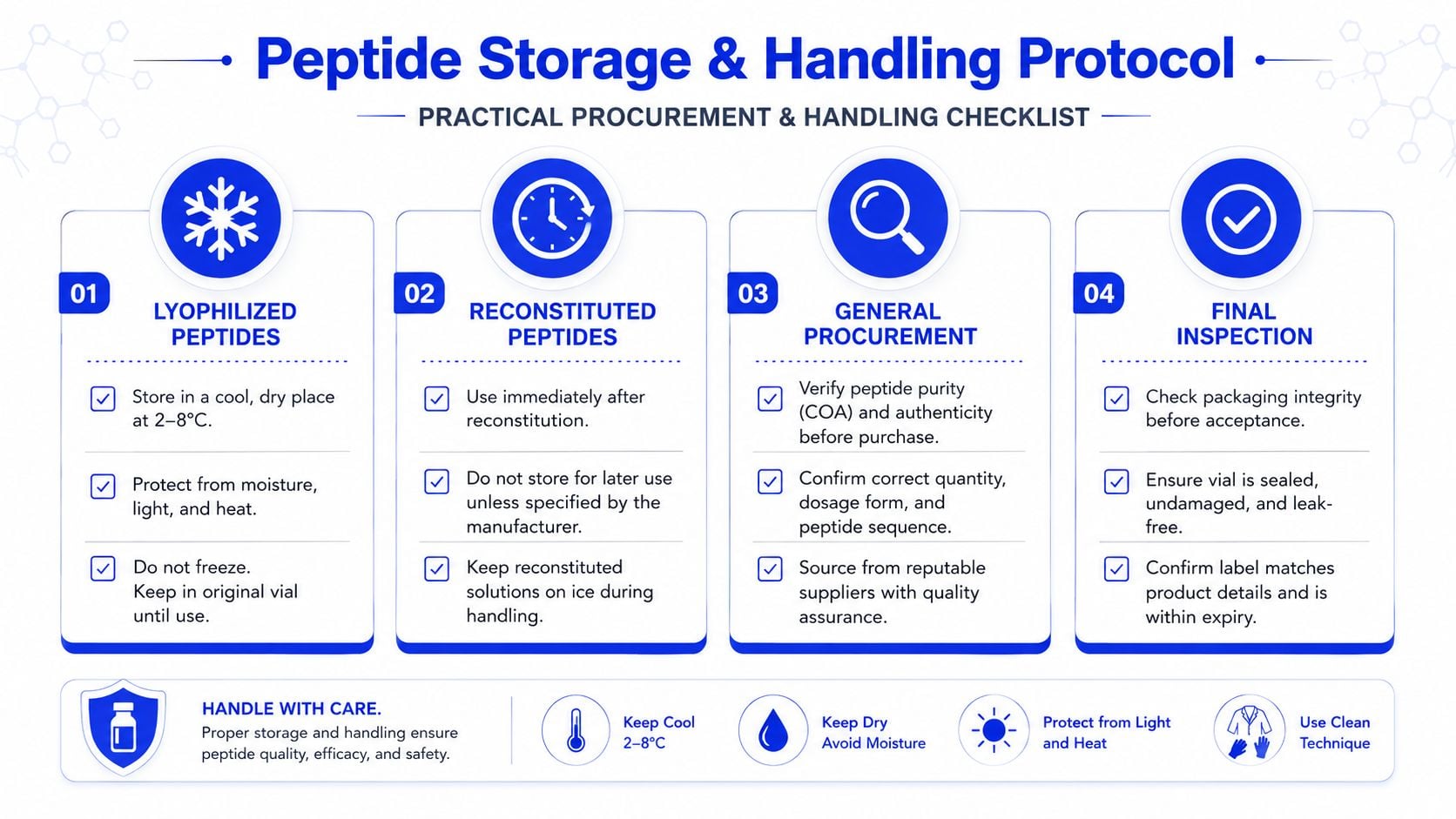
Keep the checklist short enough that your team will actually use it, and strict enough that weak vendors can't pass on presentation alone.
A good procurement process doesn't try to eliminate every risk. It makes the risks visible before the order goes out, which is the difference between deliberate buying and hope.
The final screen is simple. Ask the vendor whether they can show a complete per-lot COA, whether the product pages stay firmly in the RUO lane, and whether the supply chain is domestic enough to preserve traceability from manufacture to bench.
If a team wants a broader vendor governance framework, it can pair those questions with reduce supplier risk with Legitt AI, especially when multiple internal stakeholders need a repeatable review process.
The best vendors answer cleanly, without hedging. The weaker ones lean on slogans and hope the buyer won't ask for the paperwork.
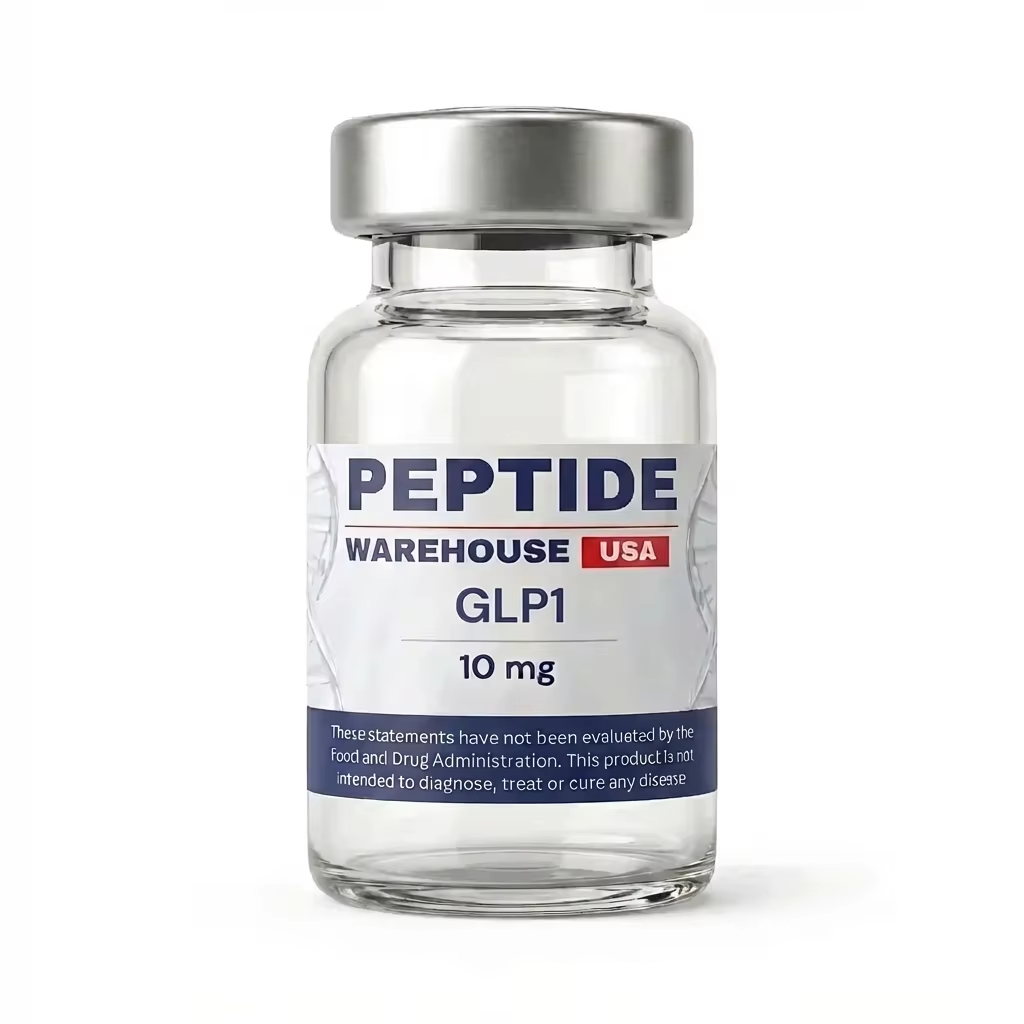
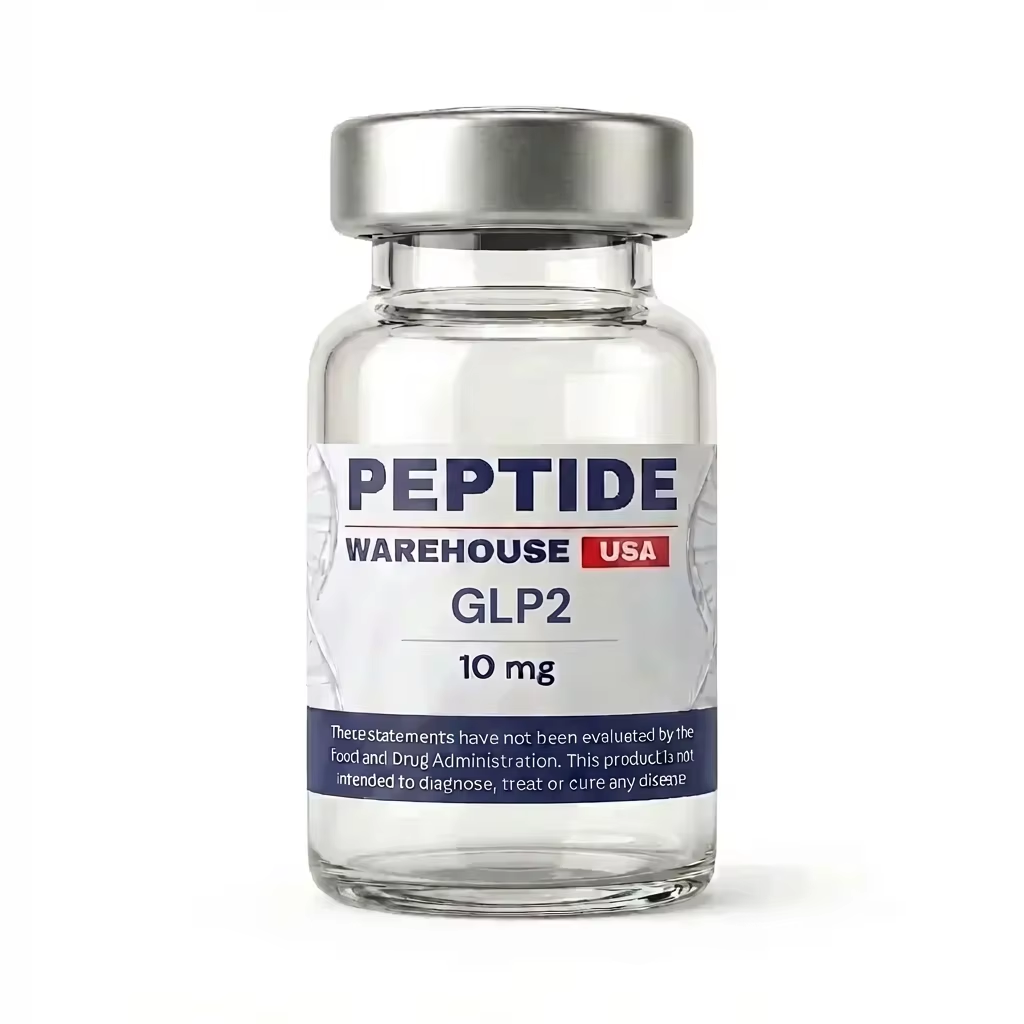
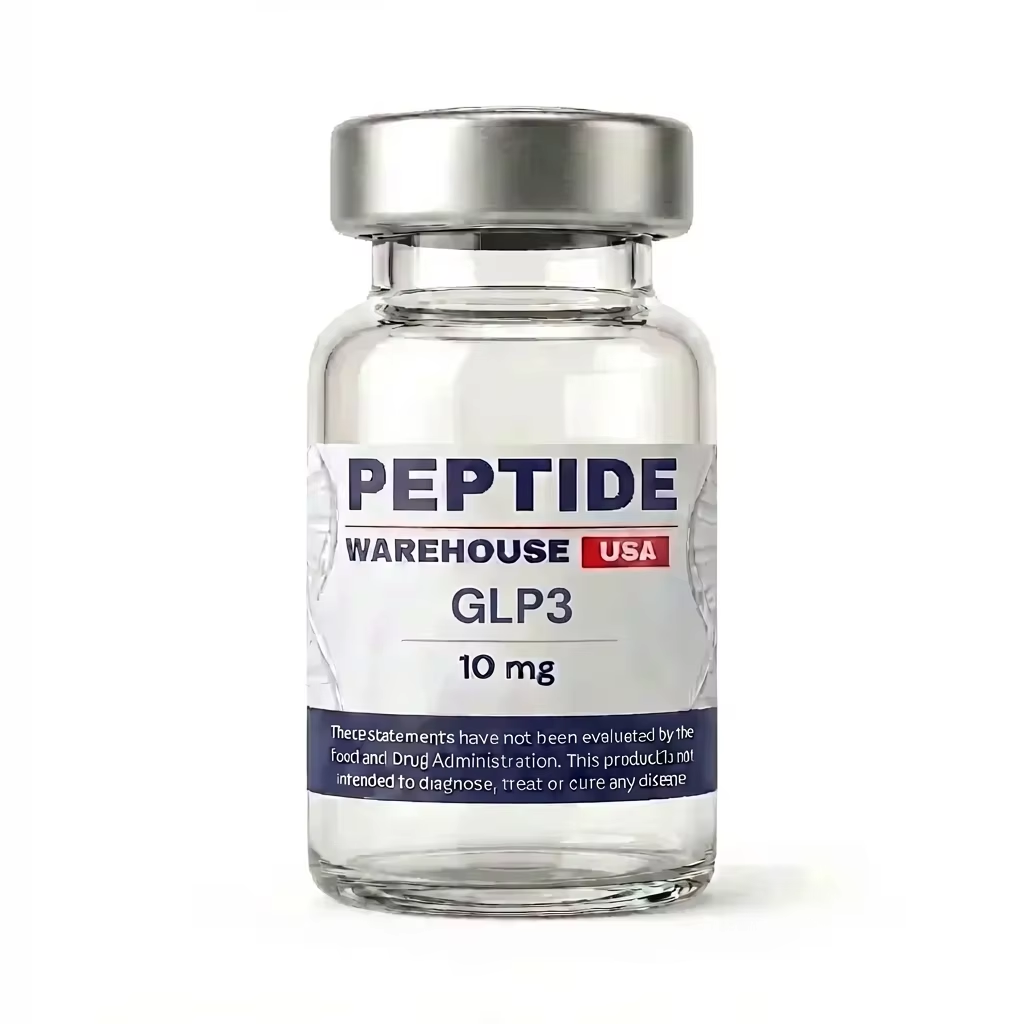
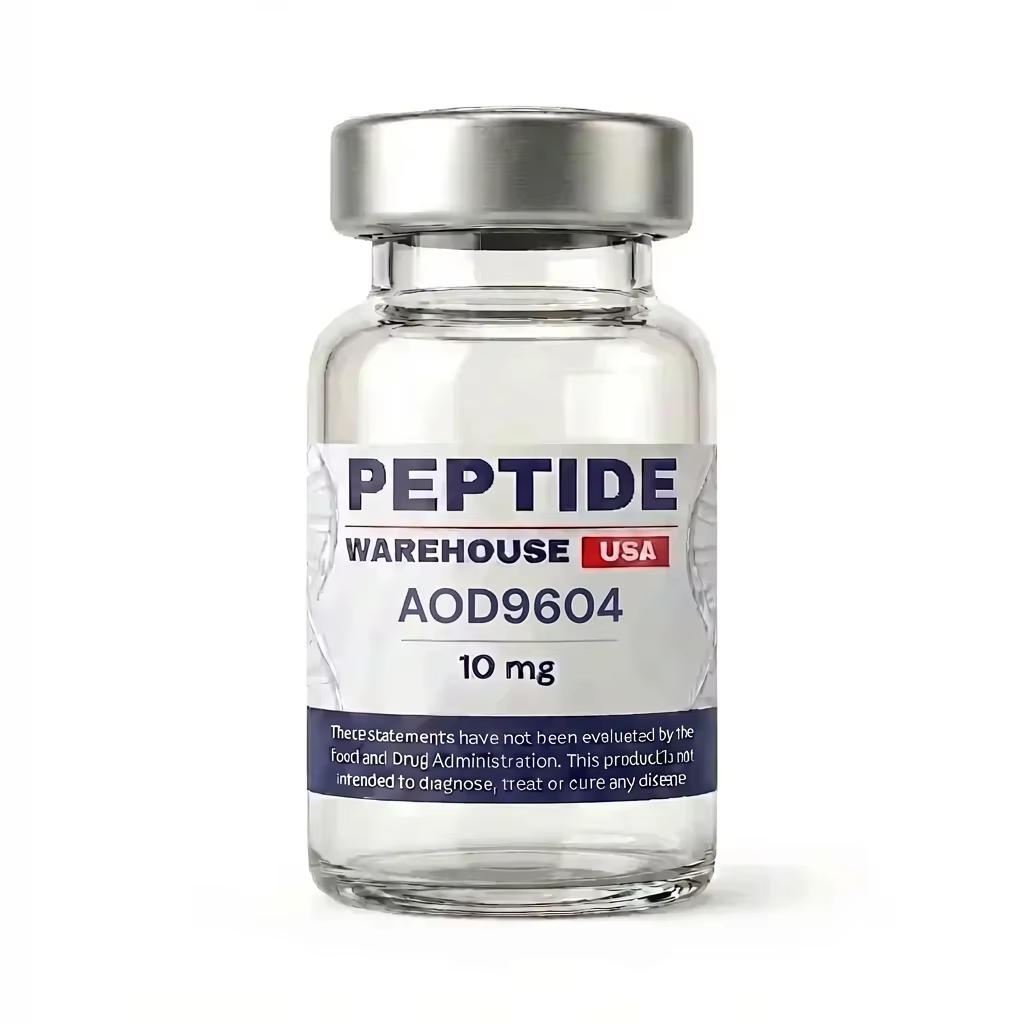
Peptide Warehouse USA is built around U.S.-made research peptides, lot-level documentation, and a research-only purchasing model that fits the procurement standards discussed here. If you're ready to compare COAs, traceability, and shipping discipline against a domestic supplier, visit Peptide Warehouse USA and review the catalog with your own vendor checklist in hand.