No products in the cart.



What makes a GLP-1 peptide for weight loss more than a passing headline, and why do trial results often look better than everyday outcomes? The answer sits at the intersection of hormone biology, obesity research, and the practical realities of long-term use. Readers usually hear the most about appetite suppression, but the fuller story includes how these peptides signal the brain, slow digestion, change glucose handling, and then face a real-world gap once people leave tightly controlled trials.
If you're trying to understand the class from the ground up, this guide walks through the biology first, then the major trial data, then the maintenance and body-composition questions that consumer content often skips. It stays research-focused, so you can separate what's well validated from what's still uncertain in routine use.
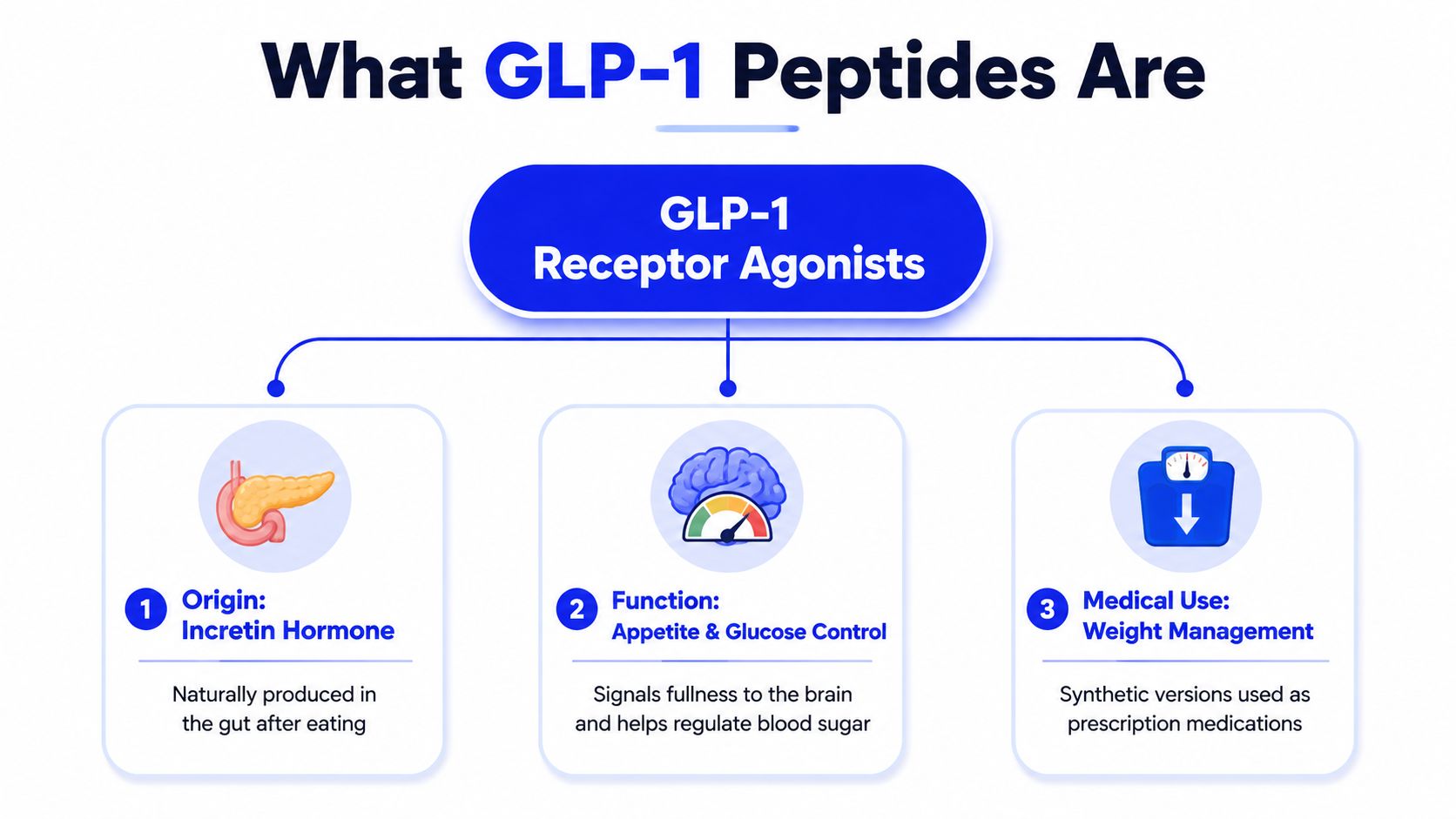
What changes when a hormone signal becomes part of a weight-management strategy? That question sits at the center of the interest in GLP-1 peptides, because the category is broader than one drug name and more specific than a general wellness trend.
GLP-1 stands for glucagon-like peptide-1, a hormone the body naturally releases in the gut after eating. Synthetic GLP-1 receptor agonists are built to mimic that signal, which is why they appear so often in diabetes care and obesity research. A plain way to understand the class is that it amplifies an existing satiety and glucose-control pathway rather than creating a new one. That matters because it explains why GLP-1 peptides influence meal-related signaling instead of acting like a simple appetite blocker.
The shift from glucose management into weight-loss trials followed from that biology. A 2024 review of obesity data reported that semaglutide reached up to 13.9% average weight loss after 68 weeks, tirzepatide reached up to 17.8% after 72 weeks, and retatrutide reached up to 22.1% after 48 weeks in adults with overweight or obesity, with gastrointestinal side effects common across studies PubMed review. Those trial numbers changed the conversation, because they gave the class a measurable role in obesity treatment research rather than leaving it as a theoretical idea.
Practical rule: if a peptide claim cannot be tied to a receptor mechanism or a controlled trial outcome, treat it as marketing until evidence supports it.
People keep searching for GLP-1 peptide for weight loss because the class now sits at the point where biology, trial results, and real-world expectations meet. The first question is whether it works at the receptor level. The second is how large the effects are in controlled studies. The third is what remains unknown outside a trial, where adherence, dosing, and follow-up are less structured.
For readers comparing products and terminology, Gym Snack GLP-1 options offers a useful starting point for organizing the different GLP-1-related questions people ask before they ever compare molecules. That kind of reference helps because the category can look confusing when drug names appear without the biology that sits behind them.
The rest of the article follows that path, from mechanism to comparative data, then to the gap between research settings and everyday use so the numbers stay grounded in context.
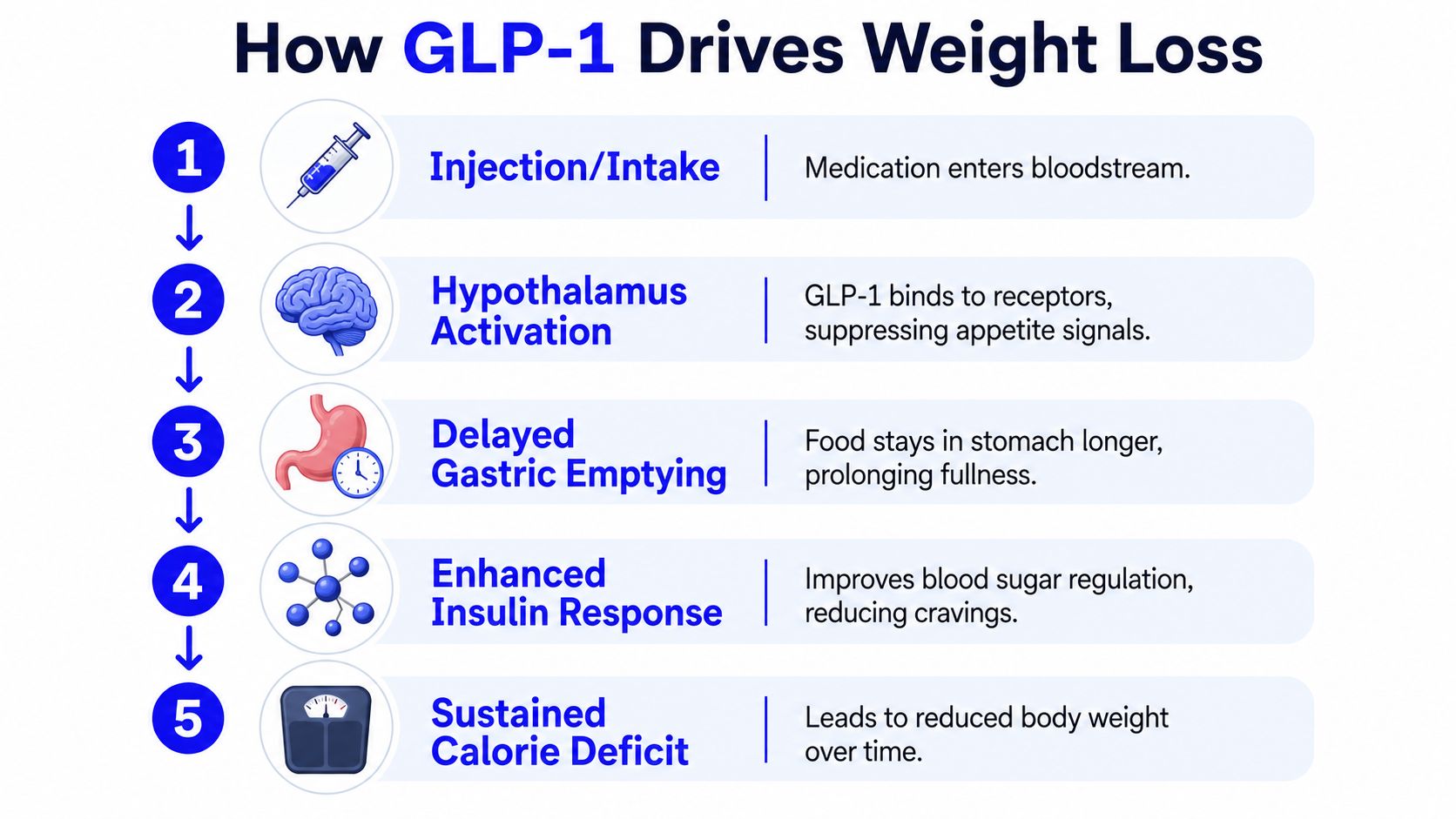
How does one signaling pathway end up changing body weight in a durable way? The answer is that GLP-1 acts across several linked steps, starting with appetite regulation, continuing through digestion, and then shaping glucose and energy handling after meals.
GLP-1 receptor agonists reduce body weight through a dual mechanism, they suppress appetite via central nervous system signaling and they also slow gastric emptying, which prolongs fullness after meals mechanism review. At the brain level, GLP-1 activates hypothalamic satiety pathways, including POMC/CART neurons, while inhibiting NPY/AgRP signaling, which is associated with hunger.
That shift changes how the meal experience is organized. Fullness arrives sooner, lingers longer, and food cues tend to feel less intrusive as eating continues. The same review also notes that long-acting GLP-1 analogs reduce food intake largely through direct brain GLP-1 receptor activity and vagal-brainstem pathways rather than through peripheral insulin effects alone mechanism review.
The next layer is gastric emptying. When food leaves the stomach more slowly, post-meal fullness lasts longer and caloric intake tends to fall because meals feel more satisfying. GLP-1's effect is also glucose-dependent, so it enhances insulin secretion and suppresses glucagon release in ways that improve postprandial glycemic control while lowering caloric intake metabolic review.
The downstream ripple matters too. Reviews describe lower triglycerides and LDL cholesterol, reduced adipose tissue inflammation, and less ectopic fat deposition as associated metabolic changes metabolic review. In preclinical models, GLP-1 receptor agonism can also increase energy expenditure through CNS-linked adrenergic and AMPK signaling that activates brown adipose tissue metabolic review.
The biology is layered, and that is why the trial data often looks more durable than a simple appetite-suppression story would suggest. A compound can reduce intake, prolong satiety, and shift metabolic responses at the same time, which helps explain why controlled studies keep finding meaningful weight loss while treatment continues, and why maintenance becomes the next question once the trial ends. For a related example of how this works beyond single-receptor GLP-1 agents, see the dual-action GLP-1 and GIP mechanism.
How do four peptides in the same broad class end up with different weight-loss profiles? The answer sits in the receptor targets they hit, the trial designs used to measure them, and the fact that trial outcomes do not always translate cleanly into routine use.
| GLP-1 Peptide Weight Loss Comparison | Mechanism | Headline Trial Result | Trial Duration |
|---|---|---|---|
| Semaglutide | GLP-1 receptor agonist | 14.9% body-weight loss in STEP-1, versus 2.4% with placebo STEP-1 and STEP-5 review | 68 weeks |
| Liraglutide | GLP-1 receptor agonist | About 4% to 5% weight reduction across the Cochrane-reviewed trials Cochrane review | Reviewed across 24 to 68 weeks |
| Tirzepatide | Dual GLP-1 and GIP agonist | About 16% weight reduction in the Cochrane review Cochrane review | 12 to 18 months |
| Retatrutide | Triple agonist targeting GLP-1, GIP, and glucagon receptors | Up to 22.1% average weight loss in the 2024 obesity trial data review PubMed review | 48 weeks |
The table is useful because it shows a pattern before the details blur together. Semaglutide and liraglutide are both GLP-1 receptor agonists, but semaglutide produced a much larger effect in the trial data. Tirzepatide adds GIP signaling, and retatrutide extends the idea further by adding glucagon receptor activity.
Semaglutide is still the main reference point because STEP-1 helped define what modern obesity trials were expected to show. The follow-up STEP-5 trial showed that the weight loss could be sustained for 104 weeks, which is one reason semaglutide became a familiar benchmark in the field STEP-1 and STEP-5 review.
Liraglutide sits lower in the effect range, but that does not make it biologically uninteresting. It helped establish that GLP-1 therapy could produce meaningful weight loss rather than only modest metabolic change, and the broader trial summaries still support that conclusion Cochrane review.
Tirzepatide is often compared with semaglutide because it works through two signaling axes instead of one. That dual-action GLP-1 and GIP mechanism changes the receptor profile in a way that helps explain why the trial numbers diverge, and the comparison is easiest to follow when you keep the biology and the outcome data together.
Retatrutide is earlier in the evidence curve, so the numbers should be read as emerging rather than settled. Even so, the review findings are enough to show why researchers pay close attention to it, especially when they compare how much pathway coverage each molecule adds. The broad pattern is straightforward. Greater receptor pathway coverage has generally tracked with larger trial weight loss, although that still does not tell you how any one person will respond outside a study.
Headline trials are controlled environments. Real life is not, and that gap is where a lot of consumer confusion starts.
The class has moved well beyond a specialist corner of endocrinology. The CDC reported that in 2024, 26.5% of adults with diagnosed diabetes used GLP-1 injectables to lower blood sugar or lose weight CDC data brief.
Outside the United States, a 2025 Great Britain survey estimated that 2.9% of adults, about 1.6 million people, had used a GLP-1 or GLP-1/GIP medication in the past year for weight loss, and 1.7%, about 910,000 adults, used one exclusively for weight loss. Those figures show how quickly the therapy class has moved into mainstream use, and they explain why so many people now ask a practical question instead of a theoretical one, whether results last outside a trial setting.
A real-world cohort of over 2,400 patients with type 2 diabetes found that starting a GLP-1 agonist was associated with only about 2% weight loss at 72 weeks without a structured behavioral program, and only one-third reached the commonly used threshold of ≥5% weight loss real-world cohort. That does not mean the therapy “does not work.” It means the protocol, follow-up, adherence, and persistence conditions are very different from a randomized trial.
Real-world use usually reflects the messiness of daily life, meal patterns, missed doses, inconsistent follow-up, and dose changes that are not as smooth as a trial protocol.
Recent reviews also note that semaglutide and tirzepatide produce the strongest real-world losses, but outcomes can approach trial results only among highly adherent patients real-world review. This is the practical gap many want answered, not whether the molecules work in theory, but whether the effect survives routine use.
The search phrase GLP-1 peptide for weight loss often hides this tension. The molecule may be validated, but the outcome still depends on how the person uses it, what support surrounds it, and whether the treatment stays consistent long enough to matter.
The tolerability story is part of the efficacy story. A treatment that changes appetite and digestion also changes the experience of taking it, so side effects and body composition belong in the same discussion.
In the 2024 review of obesity trial data, adverse events were frequent across GLP-1 receptor agonist and co-agonist studies, and the most common issues were nausea, vomiting, diarrhea, and constipation PubMed review. That does not mean every person reacts the same way, but it does show why gastrointestinal tolerability remains one of the defining features of this class.
A separate obesity review raises ongoing concern about lean muscle mass and bone density during substantial weight reduction, especially for older adults body composition review. Consumer content often treats weight loss as a single number on the scale, but researchers look at what the body is made of after that number falls.
The scale measures total weight change but doesn't reveal whether lean tissue or fat drove the loss.
That matters because two people can lose the same amount of weight and end up with very different outcomes. One may preserve more lean tissue. Another may lose more muscle along with fat, which changes how success should be interpreted.
The published averages do not fully answer questions about strength, function, or whether weight reduction changes tissue distribution in ways that affect older adults differently. The same concern applies to bone, because large losses can shift the body's load-bearing environment even when the scale trend looks favorable body composition review.
Research lens: the scale measures total weight change but doesn't reveal whether lean tissue or fat drove the loss. That distinction is central when the goal is evaluating a peptide, not celebrating a number.
For that reason, the most useful reading of GLP-1 weight-loss data includes both efficacy and composition. The molecule can be powerful, and the tradeoffs still deserve close measurement.
Research-grade peptides need more than a product page and a name. They need documentation, traceability, and storage discipline that matches the work being done.
For laboratory, analytical, or preclinical work, procurement teams usually look for Certificates of Analysis, stated purity levels, batch identification, microbial testing, endotoxin testing, and clear shipping and storage instructions. Those documents matter because they tell you whether the material you received matches the material you intended to study.
A strong checklist usually includes:
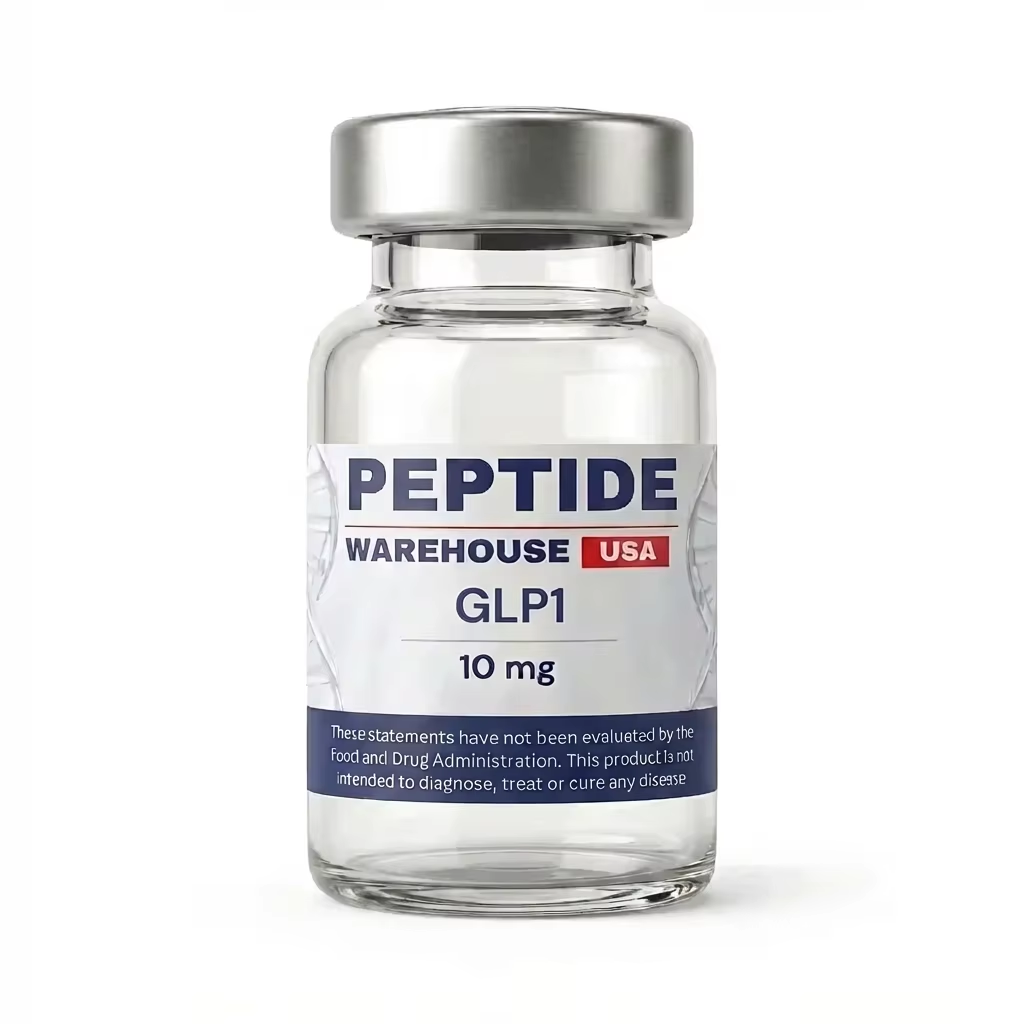
Peptide Warehouse USA operates as a research chemical supplier, not a compounding pharmacy or outsourcing facility, and its products are sold for research use only. That distinction isn't just legal language, it's part of how sourcing aligns with laboratory standards, documentation expectations, and controlled handling.
If you compare suppliers, the useful question isn't which page sounds the most polished. It's which supplier can show consistency across batches, transparent documentation, and support for researchers who need traceability. In practice, that makes the selection process easier to audit later.
When labs are evaluating options, one example in this space is Peptide Warehouse USA, which emphasizes batch documentation and research-only positioning. That kind of sourcing model belongs in the conversation because the quality of the material affects the quality of the data.
What do the trial results tell us, and where do they stop? The clearest answer is that GLP-1 peptides have moved from an experimental idea into a validated obesity-treatment class. In controlled studies, they produce meaningful weight loss, and the biology explains why the effect is so consistent, appetite drops, fullness rises, and eating becomes easier to regulate at the level of the brain and gut PubMed review mechanism review.
The harder question is what happens after the trial setting ends. Long-term maintenance remains the part many consumer summaries skip, and the gap between trial and routine use still needs close attention, especially when follow-up is less structured and support is less consistent real-world review. Body-composition tradeoffs also matter, because large weight reductions can include lean mass changes that deserve careful monitoring in research settings body composition review. For researchers and laboratories, that means the next step is not just asking whether a peptide works in principle, but checking whether the material, documentation, and study design match one another before any analysis begins.
That research-use framing matters. Start with the mechanism, move to the trial data, and then examine sourcing standards and documentation. Those three layers show what the science supports inside a study, and they also make clear what still remains uncertain outside one.
How long does weight loss last after stopping a GLP-1 peptide?
The appetite and fullness effects usually fade after treatment ends, so weight regain can follow. That makes maintenance the part many readers miss, because routine use depends on staying with the regimen and keeping follow-up consistent, not just on the first response.
Is muscle loss unavoidable?
No single trial answer applies to everyone. The concern still deserves attention, because large weight reductions can come with changes in lean mass and, in some research settings, bone density.
Why do real-world results trail trial results?
Trials keep dosing, follow-up, and support tightly organized. Everyday use is less controlled, so results can look different once structure drops away. A real-world cohort of people with type 2 diabetes found about 2% weight loss at 72 weeks without a structured behavioral program real-world cohort. That kind of gap is one reason researchers separate trial efficacy from routine-use outcomes.
What should be checked before sourcing research-grade material?
Look for a COA, stated purity, microbial and endotoxin testing, batch traceability, and research-only labeling. Those documents help researchers confirm that the material matches the study plan before any analysis begins.
Peptide Warehouse USA supplies high-purity research peptides for laboratory, analytical, and preclinical applications, with batch documentation and research-only positioning that fit this topic. If you're comparing peptide options for a study or reviewing supplier documentation for a GLP-1 project, visit Peptide Warehouse USA to explore the catalog and review available support materials.