No products in the cart.


BPC 157 price in 2026 starts around $25 to $80 per 5 to 10 mg research vial, and that usually works out to about $17 to $50 per month at common research doses. Clinic bundles push the same peptide much higher, often into the $200 to $600 per month range once consults, handling, and supervised protocols are bundled in.
That spread is why most pricing advice on BPC 157 is incomplete. A cheap vial can be real value, or it can be a stripped-down listing with weak documentation, while a clinic quote can look inflated until you account for what's included.
Buyers keep seeing mismatched BPC 157 price quotes because sellers are not pricing the same thing. One listing may be a bare research vial, another may be a clinic protocol with supervision built in, and a third may be a capsule or tablet product that looks cheaper until you break it down by usable content. That is why sticker price alone is a weak comparison.
The cheapest public research-market rows in 2026 sit around $23.40 for 10 mg on comparison trackers and around $25 to $55 for 5 mg on buying guides, while clinic cycles can start at $445 for a single-peptide protocol and reach $795 for the BPC-157 plus TB-500 Wolverine Stack on a clinic pricing page. Those figures sit in different lanes. One is a research vial, one is a bundled clinical program, and one can include supervision, handling, prescription steps, or follow-up care. For the clinic side of the comparison, a useful reference point is chamber pricing for clinics, because it shows how professional services often bundle the hardware, access, and oversight instead of pricing only the raw substance.
Ask what you are paying for per usable milligram. That is the number that matters.
Practical rule: if a quote does not state vial size, purity, format, and testing, it is not a real price comparison.
The 2026 market snapshot makes the point clearly. Analysts tracking a thinly traded token tied to BPC-157 and TB-500 have shown extreme price swings on CoinGecko, a reminder that low-liquidity prices can move fast. The same pattern shows up in physical peptide listings, where shipping, testing, storage, and sales channel all change the final number.
The right way to read an offer is simple. Convert the vial into cost per milligram, then convert that into cost per usable dose. After that, cheap-looking listings stop looking cheap.
The cleanest way to read BPC 157 price quotes is by vial size first, then by milligram. In 2026, a pricing guide reports common research vial ranges of $25 to $55 for 5 mg, $35 to $80 for 10 mg, and $75 to $140 for 20 mg. A comparison tracker also shows verified 10 mg listings at $23.40 on the low end and $40.00 or more at the high end, depending on the vendor. At the premium catalog end, a 1 mg ≥99% HPLC reference material is listed at $382, and a 1 mg Sigma-Aldrich trifluoroacetate salt is listed at $225.
Those numbers do not sit in the same lane. Research vial pricing, catalog reference material, and clinic billing all carry different overhead, so the sticker price alone tells you very little. Bigger pack sizes usually lower the unit cost, while small catalog lots carry more cost per milligram because of testing, packaging, and distribution. The right comparison is not cheap versus expensive. It is what each milligram really costs after you normalize the vial.
| Vial Size | Typical Price Range | Cost per mg | Common Use Case |
|---|---|---|---|
| 5 mg | $25 to $55 | $5.00 to $11.00 | Smaller research runs, trial batches |
| 10 mg | $35 to $80 | $3.50 to $8.00 | Standard research procurement |
| 20 mg | $75 to $140 | $3.75 to $7.00 | Higher-volume lab use |
The unit math keeps buyers honest. A 10 mg vial at $40 breaks down to $4 per mg, while a 5 mg vial at $30 works out to $6 per mg. The smaller vial looks cheaper on the shelf, then gets more expensive once you measure it properly.
Clinic pricing can look higher because it is a different product category. In an in-person setting, a single-peptide BPC-157 cycle starts at $445, and that figure reflects a protocol rather than a vial. It sits closer to chamber pricing for clinics, where professional services bundle access, oversight, handling, and setup instead of charging only for raw material.
The blunt takeaway is simple. Sticker price is the wrong starting point. Normalize the vial, then compare the usable cost per milligram, or the cheap quote will mislead you.
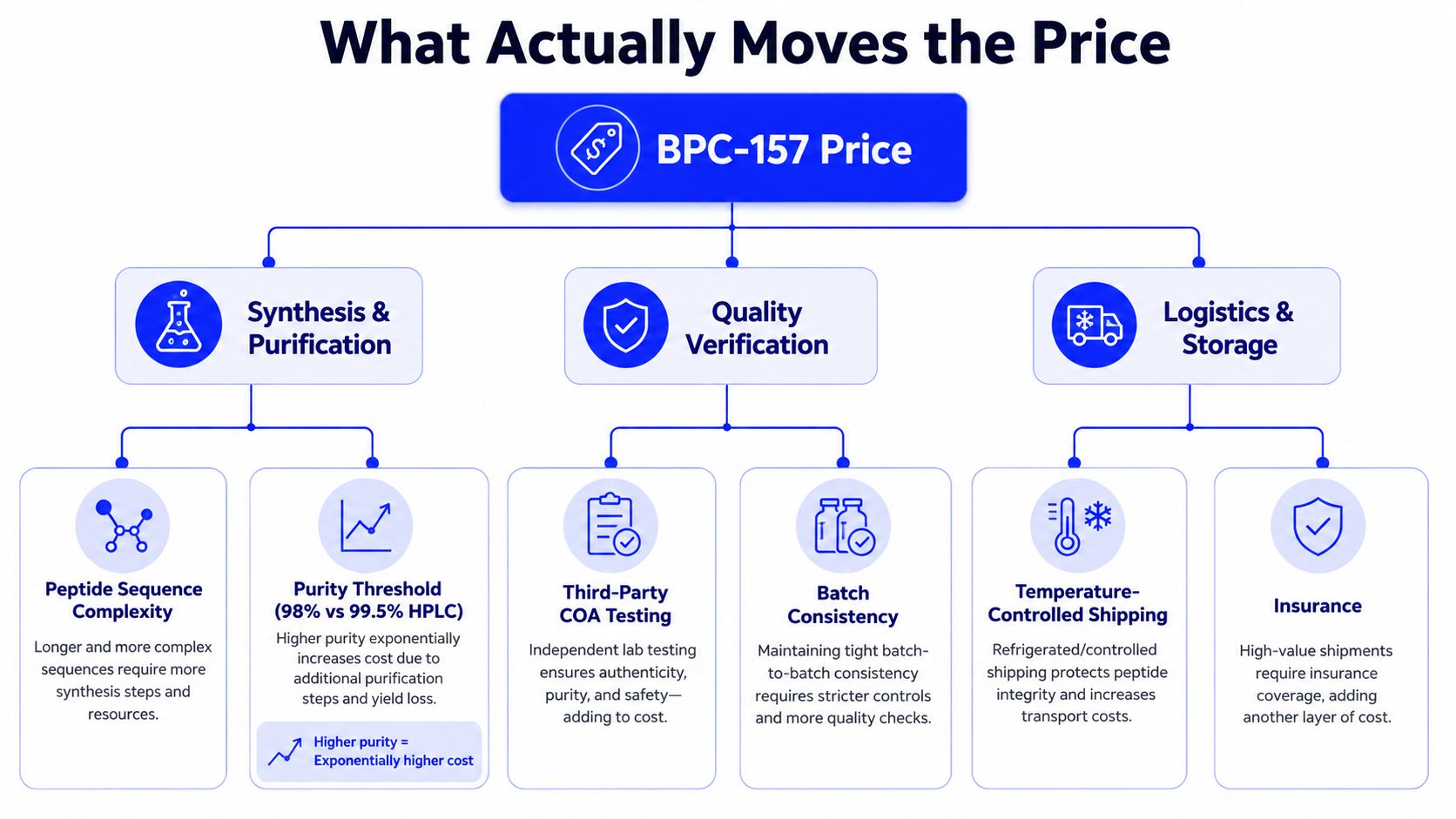
BPC-157 is a 15-amino-acid synthetic pentadecapeptide with a molecular weight of about 1419.5 g/mol and formula C62H98N16O22. Suppliers that sell tighter-spec material report purity thresholds from ≥98% to ≥99.5% HPLC, and that extra control is not free. Higher chromatographic acceptance standards mean more rejected batch material, more analytics, and more overhead per gram.
That is the first place price spreads start. A seller moving basic bulk material and a seller moving reference-grade lab material may both use the same peptide sequence, but they are not delivering the same level of control.
Lyophilized powder and acetate salt formats usually cost more to process than a casual buyer expects. Freeze-drying, packaging, and storage discipline all add cost before the vial even reaches a cart. One source notes about 28 days of stability at 2 to 8 °C in bacteriostatic water and degradation above 25 °C, so cold handling is part of the usable-cost calculation, not an optional extra.
Cheap storage practices show up later as waste. If the material loses integrity in transit or after opening, the price per usable microgram climbs fast.
Bottom line: a cheaper vial can be cheaper because fewer controls were applied, not because the same control was delivered more efficiently.
Third-party COAs, endotoxin panels, residual solvent screens, and related-substance checks all add batch cost. Vendors either absorb those costs or leave them out. Buyers need to treat those omissions as part of the pricing decision, because a lower price without documentation is often just a lower standard.
A useful procurement question is simple. Two identical 10 mg listings can be priced at $30 and $65, but one may include tighter HPLC acceptance, better identity testing, and cleaner logistics while the other offers only a basic label and a hope. The cheap one is not automatically bad, but it is rarely the better buy on a traceability-adjusted basis.
For a broader reminder that headline price and product quality do not always move together, creatine HCl vs Kre-Alkalyn evidence is a useful comparison point.
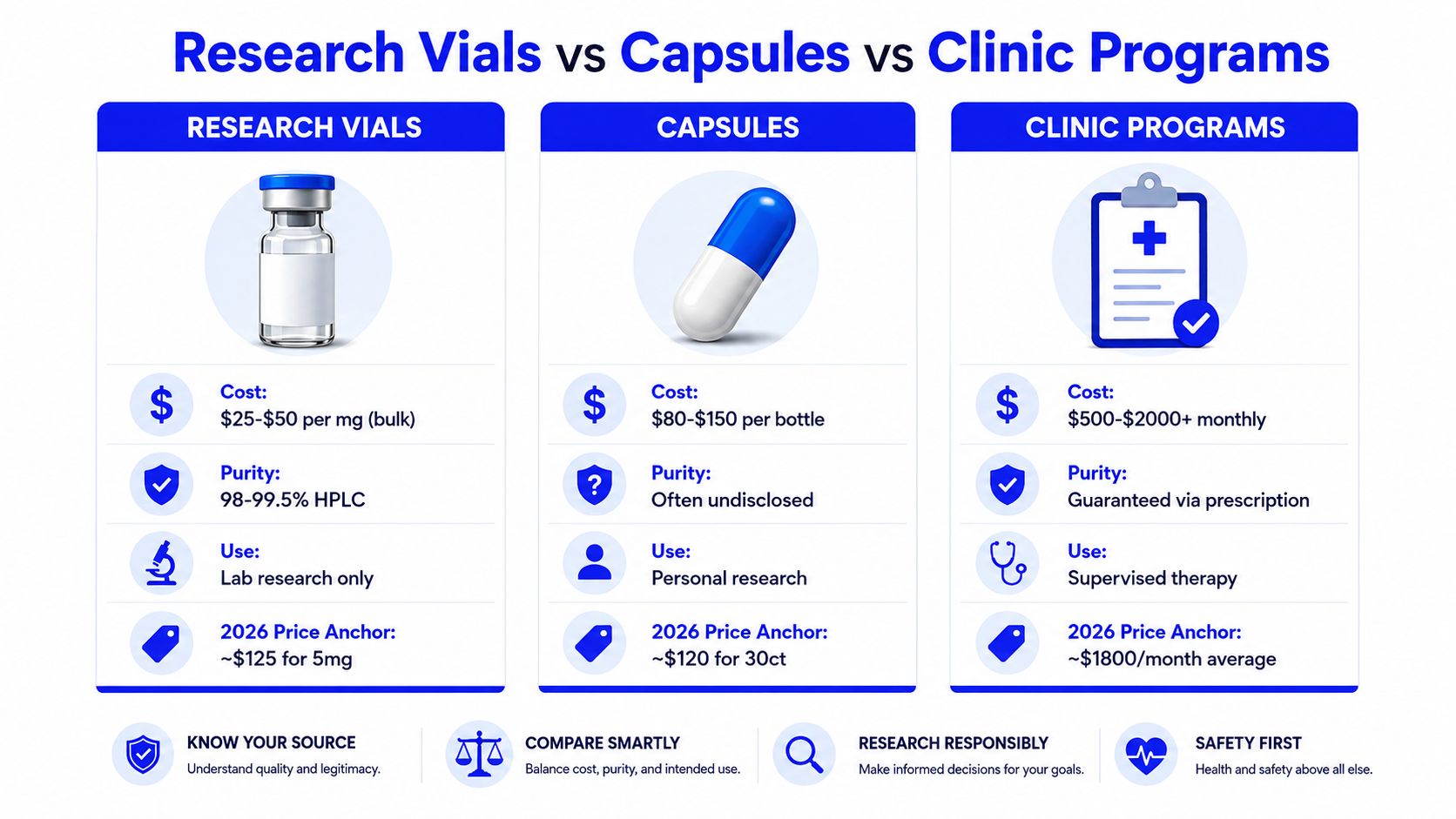
The channel you choose changes the price story fast. A research vial, a capsule bottle, and a clinic program can all carry the same BPC-157 label, but they do not deliver the same usable value.
| Channel | Typical Price Shape | What You're Really Paying For |
|---|---|---|
| Research vials | About $25 to $80 per 5 to 10 mg vial | Raw peptide, testing, shipping, vendor margin |
| Capsules | Listed at $5.25 per cap, with lower per-cap pricing at bulk tiers | Convenience, packaging, and product format |
| Clinic programs | $445 per cycle for single-peptide BPC-157, $795 for Wolverine Stack | Provider oversight, clinical workflow, and bundled service |
Capsules deserve their own column because the math changes with format. A consumer peptide price guide lists BPC-157 500 mcg capsules at $5.25 per cap, then shows lower per-cap pricing at $4.46, $4.20, and $3.94 at larger quantities. The injectable side is a different buy altogether, with BPC-157 2,000 mcg/mL injectable in a 5 mL vial priced at $262.50 down to $170.63 depending on quantity tier.
That is why “same peptide” is a lazy comparison. Capsules, injectables, and clinic cycles do not carry the same sterility burden, concentration profile, reconstitution work, or oversight cost. For another procurement lens, creatine HCl vs Kre-Alkalyn evidence shows how product form and evidence quality often matter as much as the headline price.
A smart buyer compares use case first, format second, and sticker price last.
A rough monthly example makes the difference plain. At a 250 mcg/day research dose, a 5 mg vial can cover about 20 days, so a $25 to $55 vial still lands far below a clinic bundle on a monthly basis. At 500 mcg/day, that same 5 mg vial lasts about 10 days, and the monthly run rate rises quickly. Per-dose math is what tells you whether a listing is affordable.
Clinic pricing also hides in the bundle. A program at $445 may look simple until you compare it with a lower-cost vial plus shipping, supplies, and the time spent verifying documentation. A $795 stack can be justified when it replaces multiple separate purchases and gives you oversight, but it is not the same purchase as a research vial sitting in a cart. The question is not which listing is cheapest. It is which channel gives you the lowest cost per usable microgram after you account for purity, handling, and what you have to buy around the product.
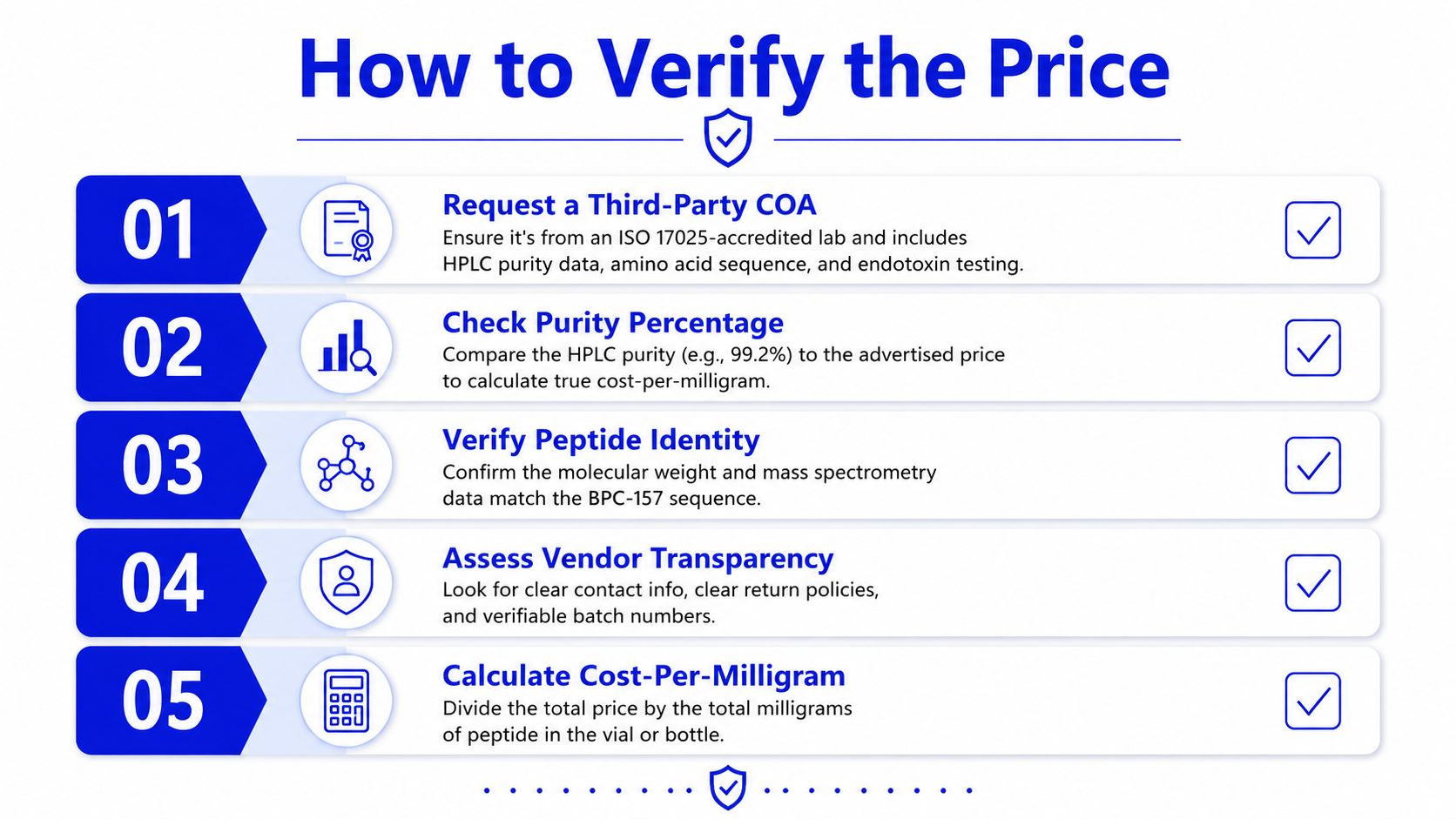
Start with the Certificate of Analysis. A price tag means little if the COA does not show HPLC purity, peptide identity, lot number, and testing methods. If the batch number on the vial does not match the batch number on the COA, stop there.
The last step is where buyers usually fool themselves. A low sticker price with expensive shipping, reconstitution supplies, or a weak documentation trail is not a bargain. It is just underpriced on the front end.
A vendor quoting $40 for a 10 mg vial may include third-party verification that a cheaper listing skips. A vendor at $30 can still cost more if it leaves out testing, traceability, or cold handling. Those gaps matter in a lab or analytical workflow because they change the cost per usable microgram, not just the checkout total.
Here is the standard I would keep open in a browser tab while shopping:
If one of those pieces is missing, the price is not well formed.
Cheap is not efficient. In the 2026 market, a 10 mg listing below $20 or above $140 deserves scrutiny for opposite reasons. A very low quote can hide weak testing or sloppy sourcing. A very high quote can mean you are paying for branding without getting better control.
Storage changes the math too. Lyophilized powder holds up better than a reconstituted solution, but once the product is mixed, the usable window narrows. The same vial can have a different effective cost per dose depending on how quickly you use it and whether you keep it cold.
USADA also states that BPC-157 is a prohibited substance for athletes under the spirit-of-sport framework, so price should never be viewed without compliance risk in the background. For athletes, the monetary cost is only part of the equation, because a cheap buy can create an expensive eligibility problem.
Treat the vendor's documentation as part of the product. If the paperwork is thin, the true price is higher than it looks.
A trustworthy supplier does not just post a number. It documents the lot, the test methods, the storage handling, and the stated purity, then leaves you enough information to verify the offer before money changes hands.
Buy BPC 157 price the right way by tying every offer to cost per milligram, then checking whether you need a research vial, a capsule, or a clinic protocol. That keeps you from paying a premium for packaging, or missing the extra handling and service costs that come with bundled programs. The sticker price is only the starting point.
A cheap listing is not automatically a better deal. Poor documentation, weak purity proof, and sloppy storage can make the usable cost per dose climb fast, while a well-documented offer with tighter control can be the smarter purchase even at a higher upfront number.
USADA treats BPC-157 as a prohibited substance under the spirit-of-sport framework, and legitimate research suppliers sell for laboratory, analytical, and preclinical use only, not human consumption. That compliance reality belongs in the same calculation as the price tag, especially for athletes and anyone buying for regulated settings.
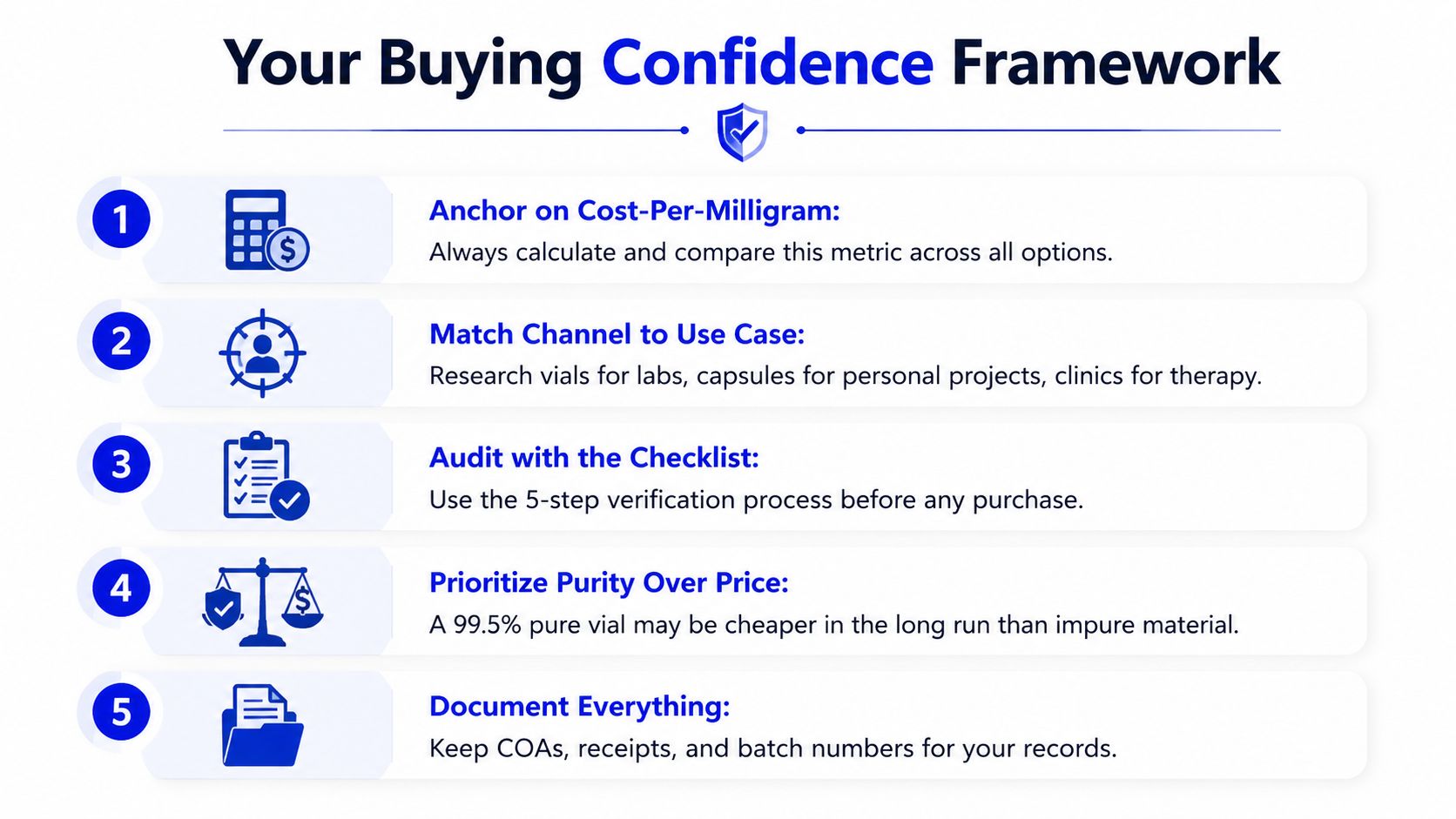
The offer that holds up is the one with verified purity, clear handling records, and a usable cost per dose you can defend. Review the COA, confirm the lot details, check the storage terms, and compare compliant research listings against the quality standard you need before money changes hands.
Peptide Warehouse USA supplies research-use-only BPC-157 and related peptides with batch documentation, stated purity, and U.S.-based fulfillment for laboratory and preclinical buyers. If you want to compare documented research options, visit Peptide Warehouse USA and check the lot-level details against the pricing benchmarks covered here.